
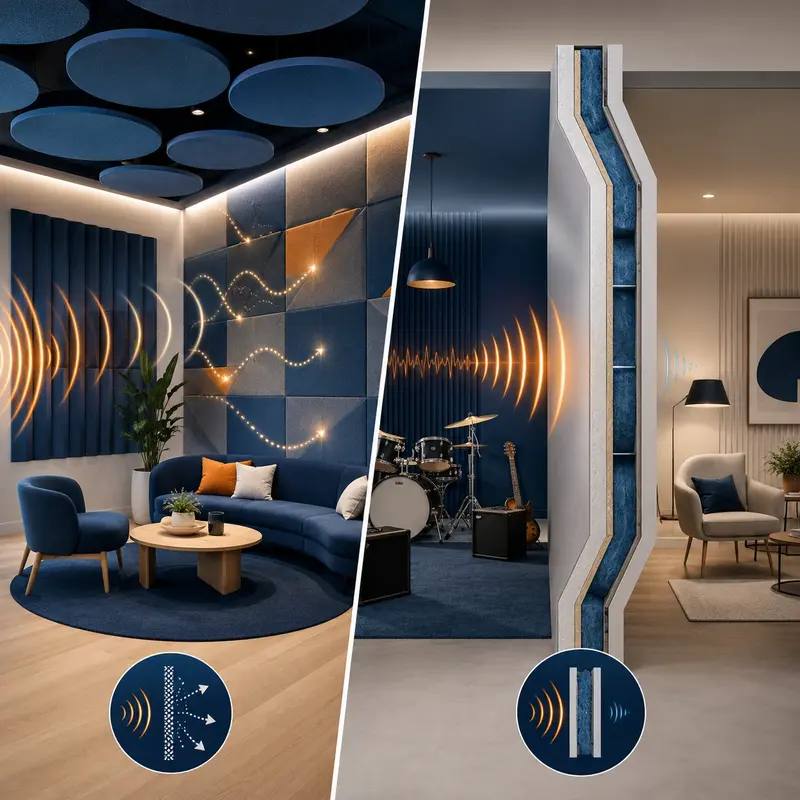
Summary: NRC measures sound absorption inside a room on a 0 to 1.0 scale, while STC measures sound blocking between rooms, typically rated between 25 and 60 or higher. Use NRC-rated acoustic panels to control echo and improve speech clarity, and use STC-rated partitions, doors, and windows to stop noise from travelling between spaces. Most real-world projects, from studios to offices, need both ratings working together for complete acoustic comfort.
What Are NRC and STC Acoustic Ratings?
NRC and STC acoustic ratings measure two different things. NRC, or Noise Reduction Coefficient, is the degree to which a surface absorbs sound, ranging from 0 (total reflection) to 1.0 (total absorption). STC measures how well a material or partition blocks sound transmission between two spaces. In short, NRC deals with sound inside a room, while STC deals with sound moving between rooms.
What Is the Real NRC vs STC Rating Sound Difference?
The NRC vs STC rating sound difference comes down to absorption versus blocking. NRC ratings focus on absorbing sound within a space, while STC ratings concentrate on blocking sound transmission between spaces. A recording studio with soft, high-NRC panels can sound calm inside, yet still let drum beats leak into the next room if its walls carry a low STC rating. Neither rating can substitute for the other.
What Are the Key Differences Between STC and NRC Ratings?
Key differences between STC and NRC ratings to note when specifying panels:
- Purpose: NRC reduces echo and reverberation, while STC blocks noise transfer through walls, doors, and windows.
- Test method: NRC is tested under ASTM C423, while STC is tested under ASTM E90 and classified per ASTM E413.
- Application: Acoustic panels, ceiling tiles, and carpets typically improve NRC, while insulated walls, soundproof doors, and double-glazed windows improve STC.
- Frequency coverage: STC mainly measures mid-range frequencies and does not fully address low-frequency noise such as bass or traffic sound.
- Ideal use case: NRC suits open offices, restaurants, and classrooms, while STC suits shared walls, home theatres, and clinics needing privacy.
Which Rating Should You Prioritise for Your Space?
Choosing between NRC and STC depends on the actual complaint you are solving. If people inside a room struggle to hear each other because of echo, you need high-NRC acoustic panels. If noise from a neighbouring room, street, or office is the real issue, you need higher STC-rated partitions, doors, or windows. Many commercial spaces, such as offices and healthcare facilities, need a balance of both, since focusing on STC alone can leave a room isolated from outside noise yet still suffering from internal echo. At Ecotone, room function is evaluated first before recommending a single rating.
How Are These Ratings Tested and Verified?
Both ratings follow internationally recognised testing standards, which makes them dependable references for architects and specifiers. NRC testing happens in a controlled reverberation chamber under ASTM C423, while STC values come from transmission loss data gathered under ASTM E90 and classified per ASTM E413, as explained by Riverbank Acoustical Laboratories. Always check that a panel’s data sheet references these standards, since unverified ratings can be misleading.
Conclusion
The comparison between NRC and STC is not about which number is better, it is about which one answers your specific noise problem. NRC tells you how much echo a panel removes from inside a room, while STC tells you how much sound it stops from crossing into the next space. A well-designed acoustic plan usually accounts for both, matched to the room’s real-world use.
Frequently Asked Questions:
1. Is a higher NRC or STC rating always better?
Not necessarily, it depends on your goal. A high NRC helps with echo control, while a high STC helps block outside noise.
2. Can one acoustic panel have both a good NRC and STC rating?
Yes, but panels are usually optimised for one function; dense, layered panels offer moderate performance in both.
3. What NRC rating is considered good for office acoustic panels?
An NRC of 0.70 or above is generally considered good for reducing echo in commercial and office spaces.
4. Does STC rating account for bass or low-frequency noise?
No, STC mainly reflects mid-range frequencies, so extra mass or decoupling is needed for low-frequency noise control.
5. Where can I find verified NRC and STC test data for acoustic panels?
Check the manufacturer’s data sheet for test reports referencing ASTM C423 for NRC and ASTM E90 or E413 for STC.
