
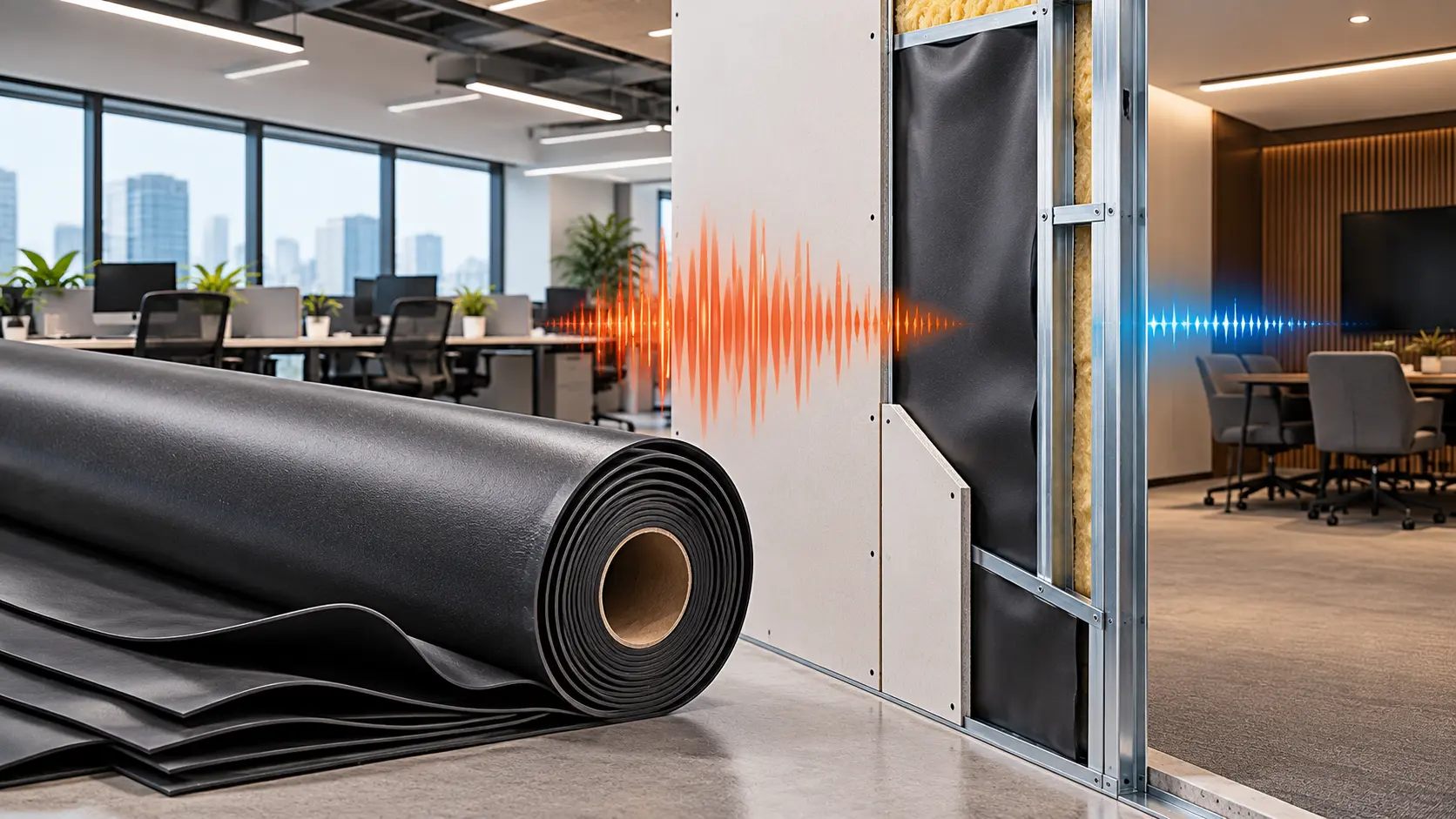
A boardroom where every word can be heard in the next cabin. A hotel room that picks up the lift motor at night. A DG room that hums through the office above it. All of these are the same problem: sound is passing through a wall, floor or ceiling that is too light to stop it. An MLV soundproof sheet is one of the most effective ways to fix this without making walls much thicker.
This guide explains what MLV is, how it works, which thickness suits which space, and how it should be installed in commercial buildings so it actually performs on site.
What is an MLV soundproof sheet?
MLV stands for mass loaded vinyl. It is a thin, heavy and flexible sheet that adds a lot of mass to a wall, floor or ceiling while taking up only a few millimetres. Sound needs to move a surface to pass through it, and a heavy, limp layer is hard to move. The result is less noise reaching the other side.
Our PACKSOUND™ MLV sheet has a density of 2,200 kg/m³ and is tested at STC 42.7. It comes in 2 mm, 3 mm and 5 mm thickness, in sheets of about 5.65 sq m (60 sq ft).
Does mass loaded vinyl really work?
Yes, when it is used for the right job. MLV is made to block sound travelling between spaces. It does not reduce echo inside a room. That is the job of absorbers such as acoustic panels and acoustic foam.
It also only works as well as the weakest point of the room. A wall lined with MLV will still leak if the door is hollow, the ceiling void is open, or gaps around pipes are left unsealed. That is why we always look at the whole room, not just one wall.
Where MLV is used in commercial buildings
- Offices and boardrooms: inside drywall partitions between cabins, meeting rooms and open work areas.
- Hotels: walls between guest rooms and floors above restaurants or banquet halls.
- Hospitals and clinics: consultation rooms where privacy matters.
- Studios and auditoriums: walls and ceilings that must keep sound in and outside noise out.
- Plant rooms and DG rooms: walls, doors and ducts near offices or homes.
- Restaurants and gyms: floors and ceilings above or below other tenants.
Which MLV thickness should you choose?
| Thickness | Weight | Typical Commercial Use |
|---|---|---|
| 2 mm | 4.4 kg/sq m | Office partitions, cabins, ceiling voids, duct wrapping |
| 3 mm | 6.6 kg/sq m | Meeting rooms, hotel walls, hospital rooms |
| 5 mm | 11 kg/sq m | Studios, plant rooms, DG rooms, floors under gyms |
As a rule, the louder the source and the quieter the room next to it needs to be, the heavier the sheet you need. For very loud sources, two layers or a heavier build-up give better results than relying on the sheet alone.
MLV vs acoustic foam: which one do you need?
| Point | MLV Sheet | Acoustic Foam |
|---|---|---|
| Main Job | Blocks sound between rooms | Reduces echo inside a room |
| How It Works | Mass and flexibility | Absorbs sound in open cells |
| Where It Goes | Inside walls, floors, ceilings | On the room surface |
| Visible? | Hidden behind finishes | Visible, can be decorative |
Many projects use both: MLV to stop noise passing through, and absorbers to make speech clear inside the room. If you only have an echo problem, MLV will not fix it.
How to install MLV in a commercial wall
Performance on site depends far more on installation than on the sheet itself. A good drywall build-up looks like this:
- Fix the metal channel frame and fill the cavity with acoustic insulation.
- Fix the first layer of gypsum or calcium silicate board.
- Fix the MLV sheet over the board, overlapping joints by at least 50 mm.
- Seal every joint and the full perimeter with acoustic sealant or tape.
- Fix the second layer of board over the MLV and finish as usual.
For floors, MLV goes between the slab and the finished flooring. For ceilings, it can be laid over the frame together with glass wool. Pipes and ducts can be wrapped with the sheet to cut mechanical noise. For the full range of options, see our guide to soundproof sheets for walls.
Common mistakes that waste MLV
- Leaving joints unsealed or not overlapped
- Stopping the wall at the false ceiling instead of taking it up to the slab
- Installing MLV but keeping a hollow, unsealed door
- Cutting large holes for sockets and services without sealing them
- Using MLV to fix an echo problem it was never meant to solve
Doors are often the weakest point. Pairing the wall with acoustic wooden doors or acoustic steel doors keeps the whole room performing at the same level.
Is MLV safe for commercial buildings?
Commercial projects need materials that meet fire and safety requirements. Ask your supplier for the fire rating, test reports and a data sheet before you approve the material. PACKSOUND™ is a self-extinguishing membrane, and we share its fire test data with every commercial quote. Always check that the full wall or floor build-up, not just one layer, meets your project fire norms.
What affects the price of an MLV soundproof sheet?
The cost of an MLV project in India depends on a few things:
- Thickness and number of layers
- Total area, including walls, floors and ceilings
- Boards, insulation and sealants needed for the full build-up
- Site conditions, height and working hours
- Whether supply only or supply with installation is required
For a meaningful price, share the room size, what the noise source is and how quiet the room next to it needs to be. A quote based on the full build-up is far more useful than a per-sheet price alone.
Alternatives and add-ons to MLV
MLV is not the only way to separate spaces. Where a room needs to be split and opened again, an acoustic sliding folding partition can do the job. Where a private space for calls is needed in an open office, acoustic office pods avoid construction altogether. An acoustic consultant can help you decide which mix suits your budget and noise problem.
Frequently asked questions
Yes. It can be fixed to an existing wall and covered with a new layer of board. This adds very little thickness.
No single material does. MLV works best as part of a sealed build-up with insulation, double boards and a good door.
Yes. Heavier sheets in walls, doors and duct wraps help reduce machine noise reaching nearby spaces.
Installed inside a wall or floor, it is protected from sunlight and wear and lasts as long as the building finish.
Plan your MLV soundproofing with Ecotone
We manufacture PACKSOUND™ MLV and install complete soundproof walls, floors and ceilings for offices, hotels, hospitals, studios and industrial sites across India. See our completed projects, or contact our team with your room size and noise problem for a site visit and quote.
