Micro Perforated Wooden Ceiling Tiles for Sound Absorption

Micro Perforated Wooden Ceiling Tiles are timber ceiling panels with holes smaller than 1mm, invisible from normal viewing distance, that pull sound waves into a fleece backed cavity and convert them to heat through friction. This is not decoration with holes punched in it, it is a tuned acoustic instrument that happens to look like a wood ceiling. 

Reverberation time (RT60) in a room exceeds 0.8 to 1.2 seconds, speech intelligibility is poor in meeting rooms or classrooms, a studio needs mid and high frequency control without going fully black and foam covered, or a project brief demands a Class A fire rated, visually seamless wood ceiling.
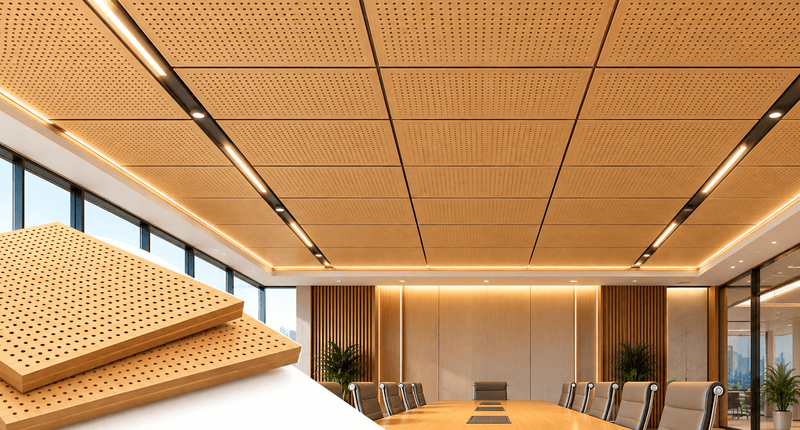
Micro Perforated Wooden Ceiling Tiles, micro perforated wooden slats manufacturer, perforated wooden slats acoustic wall panels manufacturer, perforated wooden slat panels, perforated wooden acoustic panels, wooden acoustic panels

What Is a Micro Perforated Wooden Ceiling Tile?

A Micro Perforated Wooden Ceiling Tile is an MDF or HDF core panel, veneered or laminated in real wood or wood finish, drilled with perforations typically between 0.5mm and 1mm in diameter at a controlled open area ratio, and backed with an acoustic fleece and air cavity. The small hole size is the entire point. Standard perforated acoustic panels use 3mm to 8mm holes that are visible as a grid pattern from across the room. Micro perforation keeps the same physics of sound absorption but shrinks the hole to a size the human eye stops resolving at normal viewing height, so the ceiling reads as a continuous wood surface while still performing as a Class A sound absorber underneath.

Features :-

Our Perforated Wooden Ceiling Panels Have

0.9/NRC Value
  • High sound absorption
  • Backing Material: MDF, Ply, Fire Rated Ply, UPVC Board
  • Non-combustible
  • Environmentally friendly

How Does Sound Absorption Actually Happen Inside the Panel?

♪

Sound enters through the micro perforations, loses energy to friction inside each tiny hole, and the remaining energy is trapped by the fleece and air cavity behind the board.

Step
How Micro Perforated Acoustic Panels Work
01 Sound Entry
Sound waves strike the wood face and pass through perforations smaller than 1mm.
02 Friction & Energy Conversion
Air molecules moving through each narrow perforation experience viscous friction, converting acoustic energy to heat.
03 Acoustic Fleece
The acoustic fleece bonded to the panel back adds resistance and prevents dust ingress into perforations.
04 Air Cavity
The air cavity behind the panel acts as a resonant chamber, reinforcing absorption at specific frequency bands.
05 Cavity Tuning
Cavity depth can be tuned on site to shift peak absorption toward speech or bass frequencies.

Where Are These Panels Actually Used

Application Area
Recommended Acoustic Use
01 Auditoriums & Multipurpose Halls
Reverberation control panels manage flutter echo across large hard-floored volumes.
02 Corporate & Podcast Spaces
Studio acoustic panels for conference rooms and boardrooms, where speech intelligibility drives productivity.
03 Recording & Broadcast Studios
Studio acoustic panels used as a warmer, less clinical alternative to foam wedges.
04 Hospitality Lobbies & Restaurants
Noise control panels provide acoustic treatment where exposed foam or fabric wraps are not on brand.
05 Educational & Healthcare Interiors
Fire rated MDF acoustic panels help satisfy both code and acoustic comfort requirements.

Technical Data Sheet (TDS)

Core Material
MDF / HDF, moisture resistant grade available
Perforation Diameter
0.5mm to 1mm (micro perforation)
Open Area Ratio
1% to 3%, project dependent
Panel Thickness
8mm to 18mm
Standard Panel Size
600 x 600mm, 1200 x 600mm, custom sizes on request
Backing
Factory-applied acoustic fleece + air cavity
NRC Rating
0.65 to 0.85 (frequency dependent)
Fire Rating
Class B-s1,d0 / Class A options available
Surface Finish
Natural wood veneer, laminate, or melamine wood-look finish
Edge Profile
Square edge, tegular, or shadow line

FAQs| Wooden Ceiling Tiles

01 Do perforated wood panels actually reduce echo?
Yes, they absorb mid and high frequency sound through the perforations, measurably lowering reverberation time and echo.
02 What NRC rating is good for a home studio?
Aim for NRC 0.75 or higher on primary wall and ceiling surfaces for effective vocal recording control.
03 Can I install these panels myself?
Small DIY installs are possible with basic carpentry skills, but grid alignment needs care for a seamless finish.
04 Are micro perforated panels better than acoustic foam?
They absorb differently across frequencies and look far more finished; foam is cheaper but less durable and less attractive.
05 How much do wooden acoustic panels cost per square foot?
Pricing varies by thickness, finish and perforation ratio; request a quote based on your exact project specification.
06 Do these panels work without an air gap behind them?
No, absorption drops sharply without a cavity; the air gap is essential to the acoustic performance.
07 What is the difference between MDF and HDF acoustic panels?
HDF is denser and more moisture resistant than MDF, offering slightly better durability in humid environments.
08 Are micro perforated wooden ceiling tiles fire rated?
Fire rated MDF acoustic panel options are available and commonly specified for commercial and institutional projects.
09 Will the perforation holes be visible after installation?
No, holes under 1mm diameter are not visible to the eye from normal room viewing distances.
10 What NRC do I need for a conference room versus an auditorium?
Conference rooms typically need NRC 0.65 to 0.75; larger auditoriums often require 0.75 to 0.85 or higher.
Project Has been Delivered
0 +
Postive Feedback
0 %

[wpforms id=”7352″]

CUSTOMER REVIEWS

I opted for wood ceiling tiles in my office, and I’m thrilled with the outcome. The geometric pattern I chose adds a unique and artistic flair to the space. The wood tiles are incredibly sturdy and resistant to moisture, which is essential in an office setting. The versatility of design options allowed me to customize the ceiling to match my branding. I’m impressed with the quality and highly recommend these tiles.

Diya Gautam

I chose a floating installation with stained wooden ceiling tiles for my spa, and the results are stunning. The linear pattern creates a sense of serenity and tranquility, perfect for a spa environment. The natural finish of the stain enhances the beauty of the wood, and the tiles blend seamlessly with the overall design. The installation process was hassle-free, and the durability of the tiles is impressive. I’m delighted with the ambiance the wooden ceiling tiles have created in my spa.

Aarav kukerti

For a unique and eco-friendly look, I went with reclaimedperforated wooden ceiling panels in my restaurant. The rustic and weathered texture of the tiles adds character and charm to the dining area. The floral and organic patterns I incorporated give a sense of nature and create a visually stunning ceiling. My customers have been raving about the unique ambiance it creates. Reclaimed wood tiles are a fantastic choice for those looking for sustainability and style.

Devender Bhalla
