Call ✆ +91 9809802016 | 9891320678

Features :-
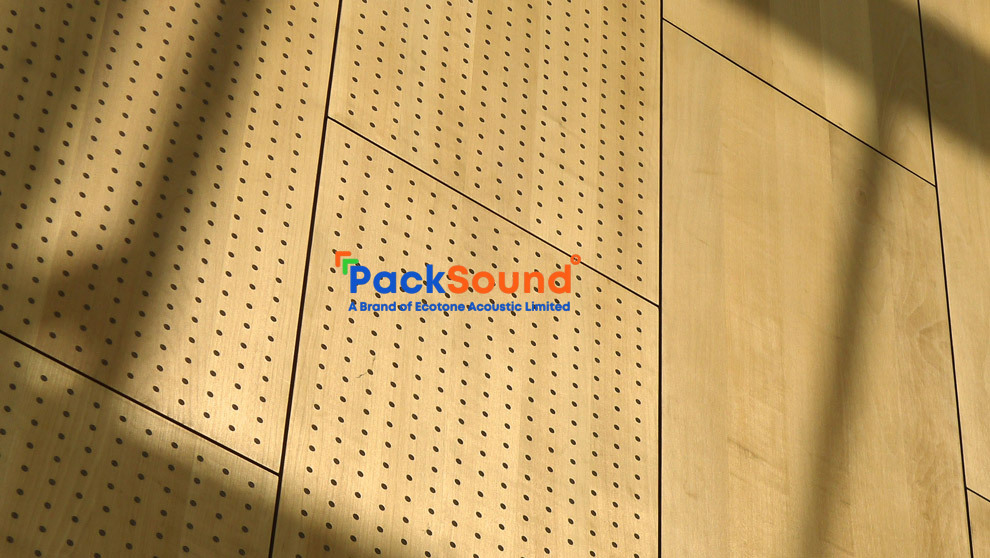
Sound waves travel through the perforations, lose energy as friction inside the porous backing material, and only a small fraction reflects back into the room, which reduces echo and reverberation time.
The mechanism has three layers working together, and missing any one of them is why some installed panels underperform their rated NRC:
Skip the air gap, and even a premium perforated panel behaves closer to a decorative wood panel with a fraction of its rated absorption.
This is the comparison architects ask for most often on site visits, and it rarely gets a straight answer in catalogues.
| Panel Type | Best For | Typical NRC | Visual Look |
|---|---|---|---|
| Perforated wooden slats | Mixed-use rooms, auditoriums, offices | 0.60 to 0.75 | Fine dot or slot pattern, modern |
| Grooved wooden acoustic panels | Corridors, lobbies, low absorption needs | 0.25 to 0.45 | Linear slats, minimal holes |
| Micro perforated panels | Recording studios, high-end home theatres | 0.70 to 0.85 | Almost invisible perforation |
M-type perforation patterns handle low to mid frequency absorption better, while T-type patterns are tuned toward mid to high frequency control, which matters for speech-heavy rooms like auditoriums and classrooms.
In practice, we size this against the room’s dominant noise source, not a generic chart:
| Property | Value |
|---|---|
| Thickness | 10 mm / 12 mm |
| Panel Size | 600 × 600 mm (custom sizes on request) |
| Base Material | High-density pre-laminate MDF, IS-14587:1998 |
| Density | 750 kg/m³ |
| Weight | 11.6 kg/m² |
| Light Reflectance | 74 to 75% |
| Fire Rating | Class 1 |
| Frequency (Hz) | 125 | 250 | 500 | 1000 | 2000 | 4000 |
|---|---|---|---|---|---|---|
| Absorption Coefficient | 0.04 | 0.05 | 0.07 | 0.15 | 0.33 | 0.73 |
| No. | Key Benefit |
|---|---|
| 1 | Cuts echo and reverberation in speech-critical rooms |
| 2 | Class 1 fire rated for commercial compliance |
| 3 | Natural wood finish, no visible acoustic foam look |
| 4 | Customizable perforation pattern and density |
| 5 | Long service life versus fabric-wrapped panels |
| 6 | Improves speech intelligibility in classrooms and halls |
| 7 | Works on both walls and ceilings |
| No. | Applications |
|---|---|
| 1 | Auditoriums and concert halls |
| 2 | Corporate offices and boardrooms |
| 3 | Home theatres and media rooms |
| 4 | Restaurants and hospitality lobbies |
| 5 | Gymnasiums and multipurpose halls |
| 6 | Schools and lecture theatres |
| 7 | Broadcast and recording studios |
| Step | Action |
|---|---|
| 1 | Mark GI ‘Z’ clamp grid layout on wall or ceiling |
| 2 | Fix GI Z-clamps at 25 or 50 mm projection |
| 3 | Install U-channel GI frame across the clamp grid |
| 4 | Fill cavity with polyester fibre or Rockwool infill |
| 5 | Fix acoustic fleece layer to the panel rear |
| 6 | Mount dowel-jointed perforated panels onto the frame |
| 7 | Check joint alignment and finish edges. |
| Myth | Reality |
|---|---|
| More holes always mean better sound | Wrong density can over-absorb and flatten a room. |
| Any wood panel is “acoustic” | Only tested, backed panels with an air gap absorb sound. |
| Perforated panels stop noise fully | They absorb sound inside the room, not block outside noise. |
| Thicker panel means higher NRC | Air gap and infill affect NRC more than thickness. |
| Paint or stain kills acoustic performance | Approved finishes barely change absorption values. |
| Parameter | Specification |
|---|---|
| Product Name | Perforated Wooden Acoustic Slat Panel |
| Core Material | Pre-laminate MDF board (IS-14587:1998 compliant) |
| Perforation Type | M-type / T-type / custom, 10 to 25% open area |
| Backing | Black acoustic fleece + GI Z-clamp with 25/50 mm air gap |
| Infill (Optional) | Polyester fibre or glass wool, density per consultant brief |
| Sound Absorption (NRC) | Up to 0.75 |
| Frame and Fixing | GI 'Z' clamps, dowel-jointed panel edges |
| Fire Performance | Class 1 fire resistant |
| Finish Options | Natural veneer, laminate, custom stain |
| Standard Panel Size | 600 × 600 mm |
They reduce in-room echo and reverberation, not outside noise transmission through walls.
An NRC of 0.60 to 0.75 is generally sufficient for open offices and meeting rooms.
Yes, they work on both walls and ceilings using the same GI clamp grid system.
Yes, quality panels carry a Class 1 fire resistance rating for commercial compliance.
Perforated panels have holes for sound to enter; solid acoustic panels absorb only at the surface.
Yes, glass wool or polyester fibre infill behind the panel significantly boosts absorption performance.
Yes, using approved finishes that do not block the perforations or change absorption values.
10 to 12 mm is standard, paired with proper air gap and infill depth.
They cost more upfront but last longer and look far more finished than foam.
No, that needs mass and sealing (soundproofing), not perforated acoustic panelling.