
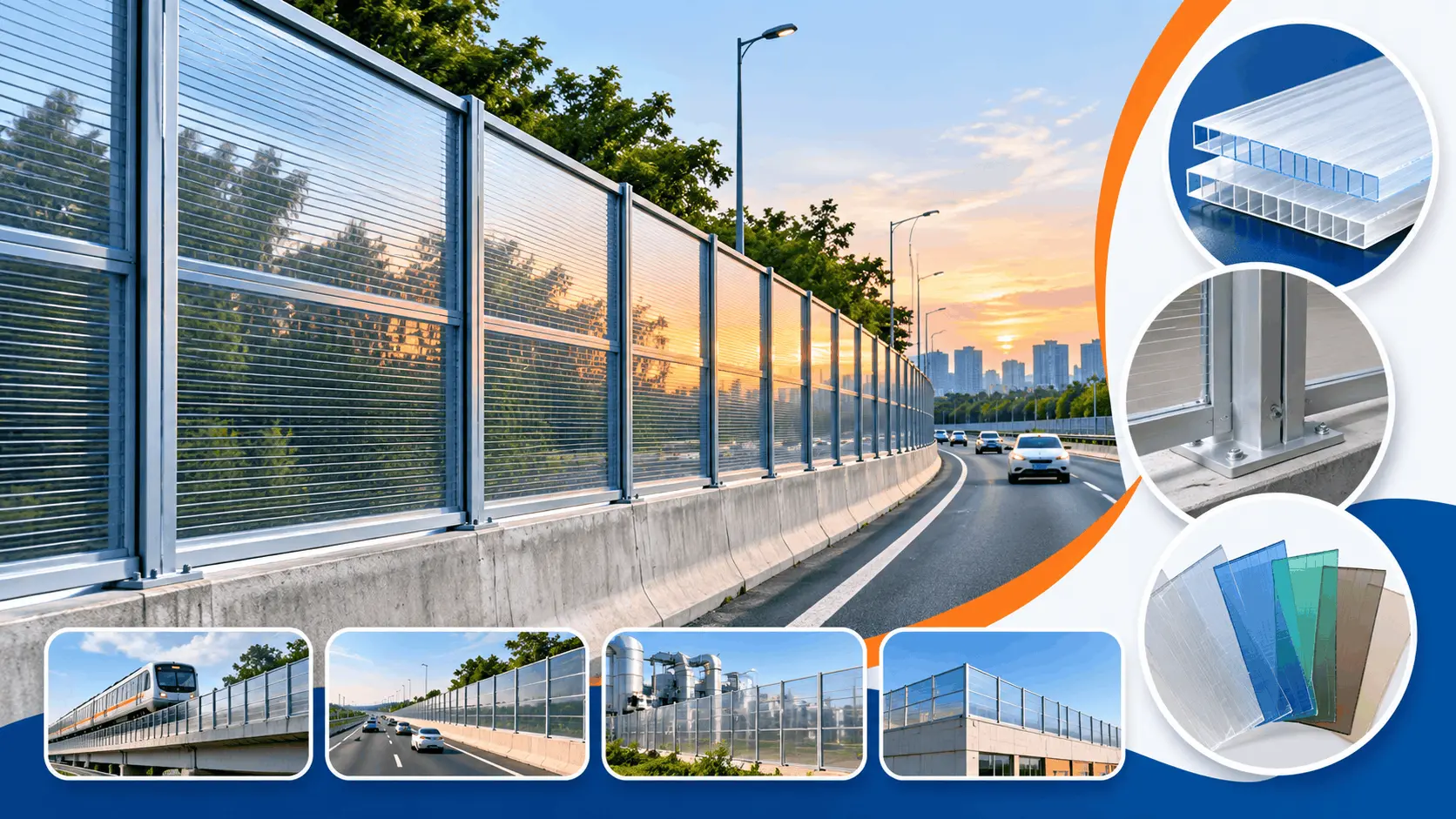
Traffic on expressways, trains on elevated corridors, metro viaducts passing between buildings and machines running at factory boundaries all push noise into offices, hospitals, schools and homes nearby. In growing Indian cities, many of these sources sit only a few metres from the people they affect. A solid wall can stop much of that noise, but it also blocks light, views and the sense of open space.
A polycarbonate noise barrier solves this by combining acoustic shielding with transparency. Clear sheets held in a strong frame block the direct path of sound while letting daylight through and keeping sight lines open for drivers, train operators, residents and CCTV. This guide explains how these barriers work, what to look for in specifications, where they are used and what drives their cost in India.
What Is a Polycarbonate Noise Barrier?
A polycarbonate noise barrier is a transparent or translucent sound barrier made from polycarbonate sheets fixed in a galvanised steel or aluminium frame. It reduces noise by blocking and reflecting sound travelling from a source, such as traffic or trains, towards nearby receivers, while allowing light and visibility.
A typical system has four parts: the polycarbonate sheet, the support posts and frames, the mounting system that fixes posts to a foundation, parapet or bridge deck, and rubber gaskets and seals that close every joint. The gaskets matter as much as the sheet, because small gaps let a surprising amount of sound through.
Polycarbonate differs from other barrier materials in important ways. Acrylic (PMMA) is also clear and often slightly clearer, but it is more brittle under impact. Glass is heavy, can shatter and needs strong supports. Metallic barriers absorb more sound when built with a perforated face and infill, but they are opaque. You can compare them on our metallic noise barriers page.
How Do Polycarbonate Noise Barriers Work?
1. Sound reflection
A polycarbonate panel is a hard, smooth surface. Most of the sound that hits it is reflected back towards the source side. This is why placement matters: a reflective barrier on one side of a road can bounce noise towards buildings on the other side.
2. Sound transmission loss
Some sound passes through the panel itself. Transmission loss describes how much the panel reduces that sound. It depends mainly on the mass and stiffness of the sheet and on how well the joints are sealed. Thicker sheets give higher transmission loss.
3. Sound diffraction over and around the barrier
In practice, most of the noise that reaches a receiver behind a barrier bends over its top edge or around its ends. This is called diffraction. A taller and longer barrier forces sound to travel a longer path and loses more energy, which is why height and length usually matter more than sheet thickness once the panel is heavy enough.
4. Sound absorption in hybrid systems
A conventional solid polycarbonate panel blocks and reflects sound; it does not absorb much. Where absorption is needed, for example between two rows of buildings, designers use hybrid systems with absorptive metal panels on lower rows and polycarbonate above, or specially engineered absorptive constructions.
5. Height, continuity and placement
A barrier works best when it is close to the source or the receiver, tall enough to break the line of sight, long enough to extend well past the area being protected, and continuous without gaps at the base, joints or ends.
Laboratory ratings vs real noise reduction
Laboratory values such as Rw or STC describe how well a panel resists sound passing through it under test conditions. The noise reduction people experience on site is called insertion loss: the difference in noise level at a receiver before and after the barrier is built. Insertion loss depends on geometry, distance and site conditions, so a high panel rating alone does not guarantee a quiet result.
Key Features and Benefits of Polycarbonate Noise Barriers
Types of Polycarbonate Noise Barriers
- Transparent polycarbonate barriers: clear sheets for maximum light and visibility, common on expressways, bridges and near buildings.
- Translucent polycarbonate barriers: tinted or frosted sheets that let light through but reduce glare and privacy concerns.
- Solid polycarbonate panels: monolithic sheets, usually the right choice for acoustic barriers because their mass gives better sound insulation.
- Multiwall polycarbonate systems: light, insulated sheets used in roofing; they are generally less suitable for noise barriers because they have lower mass. Use them only where the acoustic target allows.
- Hybrid metal and polycarbonate barriers: absorptive metallic panels on lower rows with clear sheets above, balancing absorption and openness.
- Railway-specific transparent barriers: designed for train-induced pressure, vibration and maintenance access along tracks and viaducts.
- Highway noise barrier systems: designed for traffic noise, vehicle impact zones, sight distance and long continuous runs.
Polycarbonate Noise Barrier Technical Specifications
The table below separates Ecotone supplier data from typical design values. Always confirm final figures against test reports and project calculations.
| Parameter | Value | Source / Note |
|---|---|---|
| Material grade | Solid UV-protected polycarbonate sheet | Typical design option |
| Panel thickness | 10 mm to 15 mm | Ecotone supplier data |
| Panel dimensions | Made to post spacing and barrier height | Project specific |
| Panel weight | About 12 kg/sq m at 10 mm, 18 kg/sq m at 15 mm | Calculated from typical polycarbonate density (about 1.2 g/cm³) |
| Sound insulation (STC) | STC 32 to 36 | Ecotone supplier data |
| Sound reduction index (Rw) | To be confirmed by test report | Request ISO 10140 / ISO 717-1 report |
| Light transmission | High for clear sheets; lower for tinted sheets | Confirm from sheet manufacturer data |
| UV protection | Co-extruded UV layer | Typical design option |
| Impact resistance | High; far tougher than glass and acrylic | Confirm from sheet data sheet |
| Wind-load resistance | Designed per site wind speed | Calculated to IS 875 Part 3 |
| Frame material | Galvanised steel or aluminium | Ecotone supplier data |
| Mounting hardware | Posts, base plates, anchors, rubber gaskets | Project specific |
| Fire performance | As per sheet grade | Request fire test documentation |
| Expected service life | Depends on UV grade, exposure and maintenance | Confirm with warranty terms |
See the full product details on our polycarbonate noise barrier page.
Applications of Polycarbonate Noise Barriers
Railway Noise Barriers
Trains create rolling noise from wheels and rails, plus noise from braking, horns and aerodynamic effects at speed. On elevated corridors, sound travels far over surrounding areas. Trackside barriers must be placed close to the track, withstand pressure pulses from passing trains, leave clearance for maintenance and keep visibility for staff and signals. Transparent panels are useful where corridors pass close to offices, hospitals and housing.
Highway Noise Barriers
Highway noise comes from tyres, engines and exhausts, and it rises with speed and heavy vehicles. Long barrier runs along expressways and ring roads protect roadside communities. Transparent sections are often used near interchanges, on bridges, or where drivers need to see surroundings and landmarks.
Metro Rail Noise Barriers
Metro viaducts run through dense city areas, often at the height of upper floors. Light polycarbonate panels add little dead load to the viaduct, and their transparency keeps the corridor from feeling like a closed tunnel for passengers and neighbours.
Industrial Noise Barriers
Factories, power plants, compressor stations and loading yards often need to keep boundary noise within legal limits. Polycarbonate sections are useful where security staff need to see across the boundary, while absorptive metal panels may be used nearer to loud machinery.
Flyover and Bridge Noise Barriers
On flyovers and bridges, every kilogram adds to the dead load, and wind loads are higher than at ground level. Polycarbonate is light, but panels and fixings must be designed for wind suction and pressure, with secure retention so no sheet can fall onto traffic below.
Commercial and Residential Applications
Business parks, hospitals, schools and housing next to busy roads use transparent barriers to reduce traffic noise without losing light. For short-term works such as road widening, mobile noise barriers can be used until the permanent barrier is installed.
Polycarbonate vs Metal vs Concrete vs Acrylic Noise Barriers
| Factor | Polycarbonate | Metal | Concrete | Acrylic (PMMA) |
|---|---|---|---|---|
| Sound insulation | Good, depends on thickness | Good with solid back | Very good | Good, depends on thickness |
| Sound absorption | Low | High with perforated face and infill | Low unless absorptive face added | Low |
| Transparency | Yes | No | No | Yes, very clear |
| Weight | Light | Medium | Heavy | Light |
| Impact resistance | Very high | High | Very high | Lower, can crack |
| Weather durability | Good with UV layer | Good with coating | Very good | Good |
| Installation | Easy, light panels | Easy, modular | Heavy lifting, slower | Easy, careful handling |
| Maintenance | Cleaning, gasket checks | Coating checks | Low | Cleaning, crack checks |
| Relative cost | Medium to high | Medium | Medium, high foundation cost | Medium to high |
| Best suited to | Bridges, views, light | Absorption on roads, rail, plants | Ground level, long runs | Where maximum clarity matters |
No single material is best for every site. Many projects combine them, for example metal or concrete at the base with polycarbonate above. A noise barrier manufacturer that works with several systems can recommend the right mix.
How Much Noise Can Polycarbonate Barriers Reduce?
Noise is measured in decibels on a logarithmic scale. A reduction of about 10 dB is usually heard as roughly half as loud. For barriers, the useful number is insertion loss at the receiver, not just the lab rating of the panel.
The real reduction depends on:
- Panel mass and construction: heavier, well sealed panels let less sound through.
- Barrier height and length: the biggest factors in most projects.
- Distance from the source: barriers close to the source or receiver work best.
- Receiver location: upper floors above the barrier line get less benefit.
- Ground conditions: hard and soft ground change how sound travels.
- Openings and joints: gaps can cancel much of the benefit.
- Frequency: low-frequency truck and train noise is harder to block.
- Reflections: nearby buildings or a barrier on the opposite side can reflect sound back.
Because of these factors, no honest supplier should promise a fixed reduction without a site survey and calculation. Our acoustic design consultancy team prepares these predictions before design is finalised.
Polycarbonate Noise Barrier Installation Process
- Noise assessment and site survey: measure existing levels and map sources and receivers.
- Acoustic performance target: agree the level to be achieved at receivers.
- Barrier height and location: model options and choose the best position.
- Structural and wind-load calculations: design posts, fixings and foundations to IS 875 Part 3 and project loads.
- Foundation and post installation: build footings or fix base plates to parapets and decks.
- Panel mounting: fix polycarbonate sheets into frames with the correct clearance for expansion.
- Gasket and joint sealing: seal every joint, including the base and post connections.
- Quality inspection: check alignment, fixings, seals and surface protection.
- Acoustic verification: measure noise at receivers and compare with the target.
- Maintenance planning: set a schedule for cleaning, gasket checks and panel inspection.
Standards and Testing Requirements
The following standards are commonly referred to on barrier projects. Which ones apply depends on the project specification:
- ISO 10140: laboratory measurement of sound insulation of building elements, where applicable to the panel.
- ISO 717-1: single-number rating (Rw) for airborne sound insulation.
- ISO 1793 and ISO 1794 series: test methods and requirements for road traffic noise-reducing devices, where applicable.
- IS 875 Part 3: wind loads for structural design in India.
- IRC:130-2022: check its applicability with the project authority before relying on it.
- Project specifications and environmental noise limits set by the client and local rules.
Do not accept claims of compliance without test reports or certificates that name the actual panel and system being supplied.
Polycarbonate Noise Barrier Price in India
Prices vary widely from project to project, so a per-square-metre figure without context can mislead. The main cost factors are:
- Panel thickness and material grade
- Barrier height and total project area
- Structural framing, posts and foundations
- Acoustic performance required and any hybrid sections
- Installation complexity, such as bridge work, traffic blocks or night working
- Transportation to site
- Customisation such as curves, tints or printed patterns
- Testing, certification and documentation
The most reliable way to compare offers is to ask each supplier to quote against the same drawings, acoustic target and structural design.
How to Choose a Polycarbonate Noise Barrier Manufacturer in India
- Acoustic test reports for the exact panel and thickness offered
- Structural calculations for posts, fixings and wind loads
- Material specifications, including sheet grade and UV protection
- UV and impact-resistance documentation from the sheet producer
- Previous project references of similar scale
- Manufacturing capability for frames, gaskets and custom sizes
- Installation support with trained crews and safety procedures
- Warranty terms in writing
- Maintenance guidance for cleaning and inspection
- A project-specific quotation, not a generic rate
As an Indian manufacturer and acoustic consultant, Ecotone Acoustic Limited designs, makes and installs polycarbonate, metallic and mobile barriers. You can see our projects for the kind of work we handle.
Frequently Asked Questions
1. What is a polycarbonate noise barrier?
It is a transparent or translucent sound barrier made from polycarbonate sheets held in a steel or aluminium frame. It reduces noise from roads, railways and industry by blocking and reflecting sound, while letting light through and keeping views open for people on both sides.
2. How does a polycarbonate noise barrier work?
It blocks the direct path of sound. Most sound is reflected, some passes through the sheet and some bends over the top. Its effect depends mainly on height, length, placement and well sealed joints, not only on sheet thickness.
3. How effective are polycarbonate noise barriers?
They can give a clearly noticeable reduction when designed correctly. The actual result depends on barrier height, distance, receiver position and site conditions, so it should be predicted through a project-specific acoustic calculation rather than assumed.
4. What is the best thickness for a polycarbonate noise barrier?
Solid sheets of 10 to 15 mm are commonly used. Thicker sheets give higher sound insulation and stiffness. The right thickness depends on the acoustic target, panel span and wind loads at the site.
5. Are polycarbonate noise barriers transparent?
Clear sheets are transparent and keep good visibility. Tinted or frosted sheets are translucent and reduce glare. Both let daylight through, unlike metal or concrete barriers.
6. What is the difference between polycarbonate and acrylic noise barriers?
Both are clear plastics. Acrylic is often slightly clearer, but polycarbonate is far more impact resistant and less likely to crack, which is why it is preferred where stones, debris or vandalism are a risk.
7. Can polycarbonate noise barriers be used along railway tracks?
Yes. They are used along tracks and on viaducts, provided the design accounts for train pressure pulses, vibration, clearances and maintenance access.
8. Are polycarbonate barriers suitable for highways?
Yes. They are widely used on highways, especially on bridges, near interchanges and where transparency is needed for driver visibility or nearby buildings.
9. How long do polycarbonate noise barriers last?
Service life depends on UV protection, sheet grade, exposure and maintenance. UV-protected sheets in corrosion-resistant frames, with regular cleaning and gasket checks, last many years. Confirm the expected life in the warranty.
10. What is the price of a polycarbonate noise barrier in India?
Price depends on thickness, height, area, framing, foundations and installation conditions. A reliable price needs drawings and a site survey. Ask suppliers to quote against the same specification for a fair comparison.
11. Can polycarbonate noise barriers withstand high wind loads?
Yes, when posts, frames and fixings are designed for the site wind speed using IS 875 Part 3. Light panels need secure retention so they cannot move or come loose.
12. Are polycarbonate noise barriers better than metal noise barriers?
Neither is better everywhere. Polycarbonate is best where light and views matter. Metal is better where sound absorption is needed. Many projects combine both for the best result.
Conclusion
Polycarbonate noise barriers block traffic, rail and industrial noise while keeping light and views, and their low weight suits bridges, flyovers and metro viaducts. Their main limitation is low absorption, which hybrid designs can address. The right result comes from careful attention to height, length, sealing, structural design and documented test data.
If you are planning a highway, railway, metro or industrial project, contact our team for an acoustic assessment, technical specifications or a project quotation. You can also learn more about our tunnel acoustics work for underground sections of the same corridor.
