Call ✆ +91 9809802016 | 9891320678

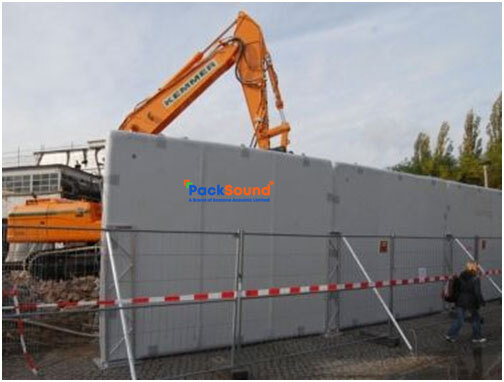
Quick Answer: A Mobile Noise Barrier is a freestanding, wheeled or skid-mounted acoustic panel system that blocks noise at the source without civil foundation work. It is used by construction contractors, DG set operators, event planners, and industrial facilities who need 15 to 30 dB of noise reduction that can be relocated in under an hour. Ecotone’s Packsound mobile barriers are built for Indian site conditions: monsoon exposure, uneven ground, and CPCB compliance deadlines.
A Mobile Noise Barrier is a self-supporting acoustic barrier panel on a movable base, engineered to reduce airborne noise transmission between a source and a receiver without requiring foundation or masonry work. Unlike a fixed acoustic barrier bolted to a boundary wall, a mobile unit can be wheeled, craned, or forklifted to a new position the same day the noise source relocates.
• Easy Installation and Mobility: Packsound‘s mobile noise barriers are designed for quick and hassle-free setup. Their lightweight structure allows for easy transportation and repositioning, ensuring they can be moved to different locations as needed.
• High Noise Reduction Capabilities: Our barriers are crafted using advanced acoustic materials that offer excellent sound absorption and reflection properties. This ensures effective noise reduction even in the most challenging environments.
• Weather-Resistant Design: Built to withstand harsh weather conditions, Packsound‘s mobile noise barriers are made from robust materials that ensure longevity and durability in outdoor settings.
• Customizable Solutions: We understand that every project is unique. Packsound provides customized mobile noise barriers that can be tailored to meet specific noise control requirements and site conditions.
Realistic field performance is 15 to 30 dB(A) reduction at the receiver point, depending on barrier height, distance from source, and panel density (typically 25 to 40 kg/sqm). This is enough to bring most construction-zone readings within CPCB’s residential limit of 55 dB by day and 45 dB by night, and industrial limits of 75 dB day and 70 dB night, as defined under the Noise Pollution (Regulation and Control) Rules.
“Acoustic barrier” is the umbrella term for any structure that blocks sound transmission, fixed or portable. “Mobile sound barrier” and “mobile noise reduction” panel are used interchangeably in the industry for the wheeled, relocatable version. If a supplier quotes a fixed steel or polycarbonate wall with no wheels or base plate, that is a permanent acoustic barrier, not a mobile one, and it cannot be repositioned without dismantling. Also Check for: Polycarbonate Noise Barrier.
| Parameter | Value |
|---|---|
| Product | Mobile Noise Barrier / Portable Sound Reduction Panel |
| Brand | Packsound by Ecotone Acoustics |
| Panel Thickness | 50mm to 100mm |
| Core Density | 25 to 40 kg/sqm |
| STC Rating | 25 to 35 |
| Standard Sizes | 1.2m x 1.8m to 1.2m x 3.6m |
| Frame Material | Galvanised Mild Steel |
| Wheel Load Capacity | Up to 150 kg per panel |
| Warranty | As per project scope, contact for terms. |
| Specification | Detail |
|---|---|
| Panel Height | 1.8m to 3.6m (Customisable) |
| Core Material | Rockwool or Mineral Fibre, 25 to 40 kg/sqm density |
| Facing | Perforated Metal + Solid Steel/Composite Sheet |
| Sound Transmission Class (STC) | 25 to 35 depending on configuration |
| Base Type | Steel Skid with Lockable Castor Wheels |
| Weather Rating | UV, Rain, and Corrosion Resistant Outdoor Grade |
| Fire Rating | Class A / Non-Combustible Core Available |
| Benefit | Why It Matters |
|---|---|
| No civil foundation needed | Deploy same day, no masonry approvals required |
| Reusable across projects | Lower cost per project than fixed walls |
| Modular panel linking | Extend or shorten the barrier run on site |
| Fast CPCB compliance | Bring readings under limit before inspection deadlines |
| Weather-sealed core | Performance holds through monsoon and heat cycles |
| Low labour installation | 2-person crew, no crane in most configurations |
| Custom heights available | Matched to exact source height for best dB drop |
| Application | Typical Use Case |
|---|---|
| Construction Sites | Piling rigs, breakers, and cutting stations near housing |
| DG Set Enclosures | Backup power noise during outages in commercial buildings |
| Roadwork and Highways | Night paving and machinery near residential stretches |
| Outdoor Events | Stage and speaker noise control at festival boundaries |
| Industrial Plants | Compressors and pumps near CPCB monitoring points |
| Metro and Rail Projects | Mobile work-front noise control that shifts weekly |
| Step | Action |
|---|---|
| 1 | Site survey to measure source-to-receiver distance and dB baseline |
| 2 | Select panel height based on 1.5× source height rule |
| 3 | Position barrier on level ground between source and receiver |
| 4 | Lock castor wheels or bolt base plate for wind stability |
| 5 | Link adjoining panels for a continuous barrier run if needed |
| 6 | Re-test dB levels at the receiver point after installation |
| 7 | Reposition as the source location changes throughout the project |
| Myth | Reality |
|---|---|
| A barrier blocks all noise completely | It reduces line-of-sight noise only, not low-frequency rumble bending around it. |
| Taller is always better | Height beyond 1.5x source height gives diminishing returns for the cost. |
| Any material works if it’s thick | Density and mass matter more than thickness for real dB reduction. |
| Mobile barriers are temporary compromises | Properly rated units can match fixed barrier performance for most site noise applications. |
| One barrier suits every site | Frequency and layout decide the panel type, and a generic barrier may underperform. |
Yes, they cut 15 to 30 dB when placed correctly between source and receiver.
50mm to 100mm is standard; density matters more than raw thickness here.
Many suppliers, including Ecotone, offer project-based rental for short-term sites.
Yes, for line-of-sight noise; low-frequency engine rumble needs taller barriers.
STC 25 to 30 handles most equipment; go higher near hospitals or schools.
Roughly 1.5 times the source height, measured from the noise source.
Yes, barriers block outdoor path noise; soundproofing treats indoor room acoustics.
Pricing varies by height, material, and quantity; request a site-specific quote.
Partially; low frequencies diffract around barriers, so enclosures work better for gensets.
Generally no permit is needed, but check local municipal or CPCB norms.
[wpforms id=”7352″]