
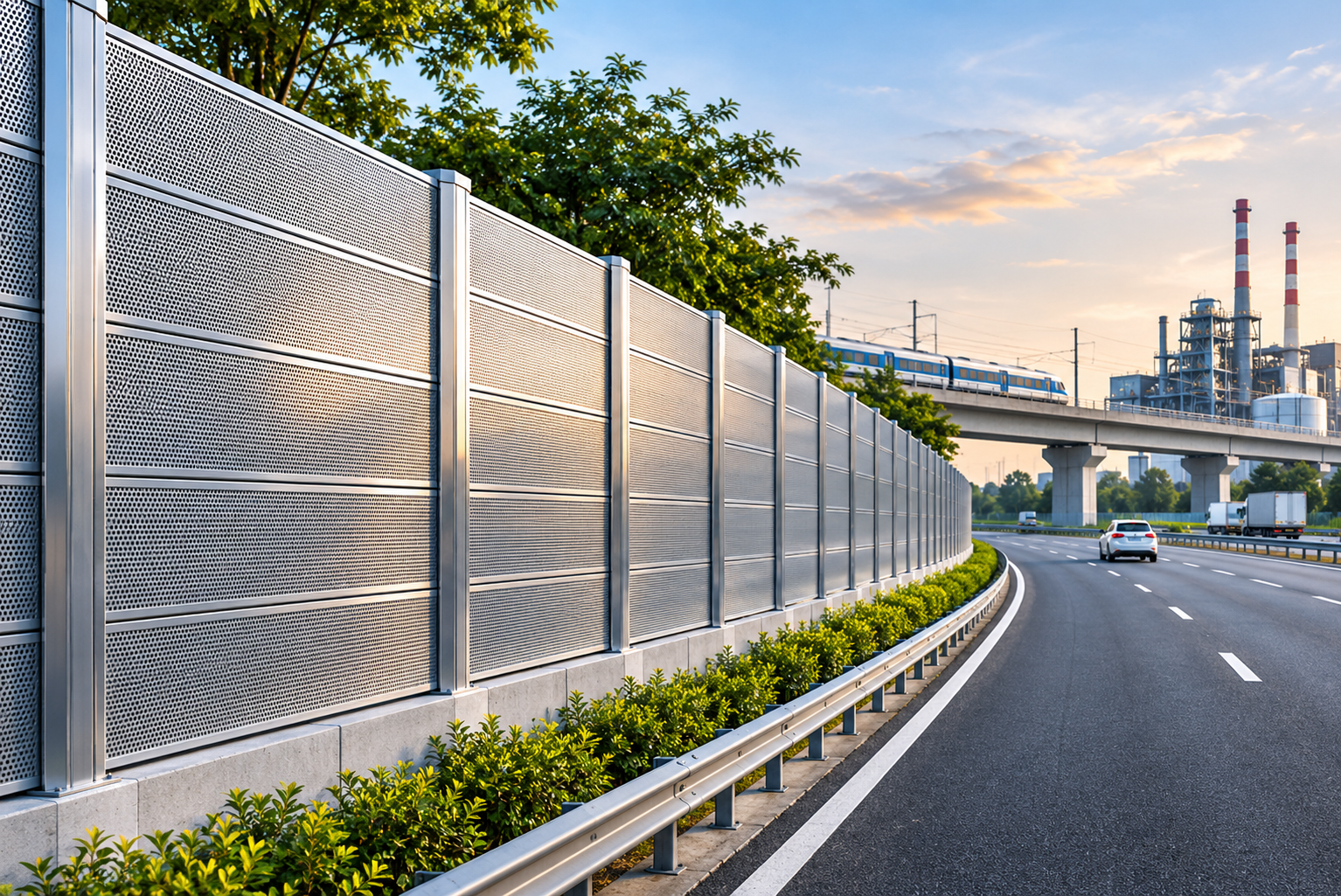
Traffic on an elevated highway, trains on a metro viaduct and machines at a factory boundary all create noise that spreads far beyond the site. For the people in nearby offices, schools, hospitals and housing, that noise is a daily problem. A metallic noise barrier is one of the most common ways to control it on large infrastructure and commercial projects.
This guide explains what a metallic noise barrier is, how it works, how it is designed in India and what to look for when you choose a manufacturer.
What is a metallic noise barrier?
A metallic noise barrier is a wall built from steel or aluminium acoustic panels fixed between steel posts. Each panel usually has a perforated front face that faces the noise, a sound absorbing infill such as mineral wool, and a solid back sheet. The perforated face and infill absorb part of the sound, and the solid back blocks what is left from passing through.
Because panels are made in a factory and bolted on site, a metallic barrier is quick to install, easy to repair and suitable for long stretches of road, rail or plant boundary. You can see our full range on the metallic noise barriers page.
How does a metal noise barrier reduce noise?
A barrier works by breaking the direct line between the noise source and the people who hear it. Sound has to bend over the top of the barrier to reach them, and it loses energy as it does. The taller the barrier and the closer it is to the source, the more noise it cuts.
The absorbing face matters too. A plain reflective wall can bounce noise to the other side of a road or back towards buildings. An absorptive metallic panel takes in much of that sound instead, which is why it is preferred where buildings stand on both sides of a highway or rail line.
Where metallic noise barriers are used
- Highways and expressways: elevated sections, flyovers and stretches near towns.
- Metro and railway corridors: viaducts, depots and lines passing close to offices or hospitals.
- Industrial plants: boundaries near generators, compressors, cooling towers and loading areas.
- Commercial and institutional sites: business parks, schools and hospitals next to busy roads.
- Airports and logistics hubs: around ground equipment and service roads.
How much noise reduction can you expect?
A well designed metallic noise barrier typically gives 10 to 25 dB(A) of noise reduction at the receiver, depending on its height, the distance to the source and the panel build. To the human ear, a 10 dB(A) drop sounds roughly half as loud, so even the lower end of that range is a clear improvement.
The result on site also depends on details: gaps under the panels, open joints or missing sections can let a lot of sound through. A barrier needs to be continuous and well sealed to perform as designed.
Designing a noise barrier: height, length and standards
In India, highway noise barriers are commonly designed with reference to IRC SP 90, the Indian Roads Congress guidelines on noise abatement. A proper design starts with measurements, not guesses:
- Measure existing noise levels at the nearest buildings, by day and night.
- Identify the noise sources and the receivers that need protection.
- Calculate the barrier height and length needed to reach the target level.
- Check wind load, foundations and how panels fix to the road, bridge or ground.
- Plan maintenance access, drainage and any gaps needed for safety.
A barrier that is too short or ends too early lets noise wrap around its ends. As a rough guide, it should extend well past the last building it is meant to protect. Our acoustic design consultancy team can model this before construction starts.
Metallic vs polycarbonate noise barriers
Many projects combine both: metallic panels on the lower rows for absorption and polycarbonate noise barriers on top to keep light and views. For short-term works, mobile noise barriers can protect neighbours while construction is under way.
What affects the cost of a metallic noise barrier?
- Height and total length of the barrier
- Panel material, thickness and finish (galvanised steel or aluminium)
- Type of infill and acoustic performance required
- Foundations, posts and fixing to bridges or parapets
- Site access, traffic management and working hours
For a useful quote, share the site location, the noise source, the buildings to protect and any drawings. A price based on a proper design is far more reliable than a rate per square metre on its own.
How to choose a metallic noise barrier manufacturer
- Ask for tested acoustic performance of the panels.
- Check experience on highway, metro or industrial projects of a similar size.
- Make sure they can design, manufacture and install, so responsibility stays with one team.
- Confirm coating, corrosion protection and warranty for outdoor use.
- Ask about after-sales support and replacement panels.
As a noise barrier manufacturer in India, Ecotone designs, makes and installs barriers in house. See our completed projects for examples.
Frequently asked questions
How long does a metallic noise barrier last?
With good galvanising or coating and basic maintenance, metallic barriers last many years outdoors. Damaged panels can be replaced one at a time.
Can noise barriers be fixed on flyovers and bridges?
Yes. Lighter panels and special brackets are used on bridge parapets, after checking wind and structural loads.
Do noise barriers work for low-frequency noise?
They help, but low-frequency noise from heavy trucks or large machines is harder to block. Taller barriers and treatment at the source work better for it.
Are noise barriers used inside tunnels?
Tunnels need a different approach. Absorbing panels and PA tuning are used to control echo there. See our tunnel acoustics page.
Plan your noise barrier project with Ecotone
Whether you are building a highway, a metro corridor or an industrial plant, our acoustic consultants can measure the noise, design the barrier and install it with our own team. Contact us with your site details for a survey and quote.
