Call ✆ +91 9809802016 | 9891320678


Micro Perforated Panels (MPPs) are wood, MDF, or metal panels drilled with thousands of pinhole-sized perforations (0.5 to 0.8 mm) that absorb sound without needing a fabric-wrapped or foam-based infill. Packsound manufactures them in India for auditoriums, offices, studios, hospitals, and home theatres, delivering an NRC of up to 0.85 while keeping the surface visually clean. If you need acoustic control that still looks like a finished wall or ceiling panel, this is the category to specify.
Micro Perforated Panels are engineered acoustic wall panels with extremely fine, closely spaced holes, typically 0.5 mm to 0.8 mm in diameter, drilled across a wood, MDF, WPC, or metal sheet. Sound waves entering these micro perforated plate surfaces lose energy as they squeeze through the narrow holes, and a mineral wool or rockwool backing absorbs what remains, cutting down echo and reverberation. Unlike standard perforated wall panels with visible 3 to 8 mm holes, the micro-scale perforation is almost invisible from a normal viewing distance, so the panel reads as a smooth, painted or laminated wall rather than a “acoustic product.
Sound enters through the micro-holes, friction inside each hole converts acoustic energy into a tiny amount of heat, and a backing cavity plus mineral wool absorbs the remaining energy before it can reflect back into the room.
The difference is hole size and function. Perforated wall panels usually have larger, visible holes (3 to 8 mm) chosen mainly for a decorative, slatted look, while true micro perforated panels use sub-millimeter holes engineered specifically for acoustic resonance absorption.
| Factor | Perforated Wall Panels (Standard) | Micro Perforated Panels |
|---|---|---|
| Hole size | 3 to 8 mm, visible | 0.5 to 0.8 mm, near-invisible |
| Primary purpose | Aesthetic + partial acoustics | Engineered acoustic absorption |
| Typical NRC | 0.4 to 0.6 | 0.7 to 0.85 |
| Surface finish | Grooved or slotted look | Smooth, laminate or veneer finish |
| Parameter | Specification |
|---|---|
| Product Name | Ultra Micro Perforated Acoustic Panel |
| Core Material | MDF / Ply / Fire-rated Ply / WPC / Metal |
| Panel Thickness | 16 mm (standard), 12 to 25 mm on request |
| Panel Size | 600 × 600 mm / 1200 mm / 2420 mm |
| Perforation Diameter | 0.5 to 0.8 mm |
| Perforation Spacing | 2 mm center to center |
| Perforation Density | Approx. 140,000 holes per square metre |
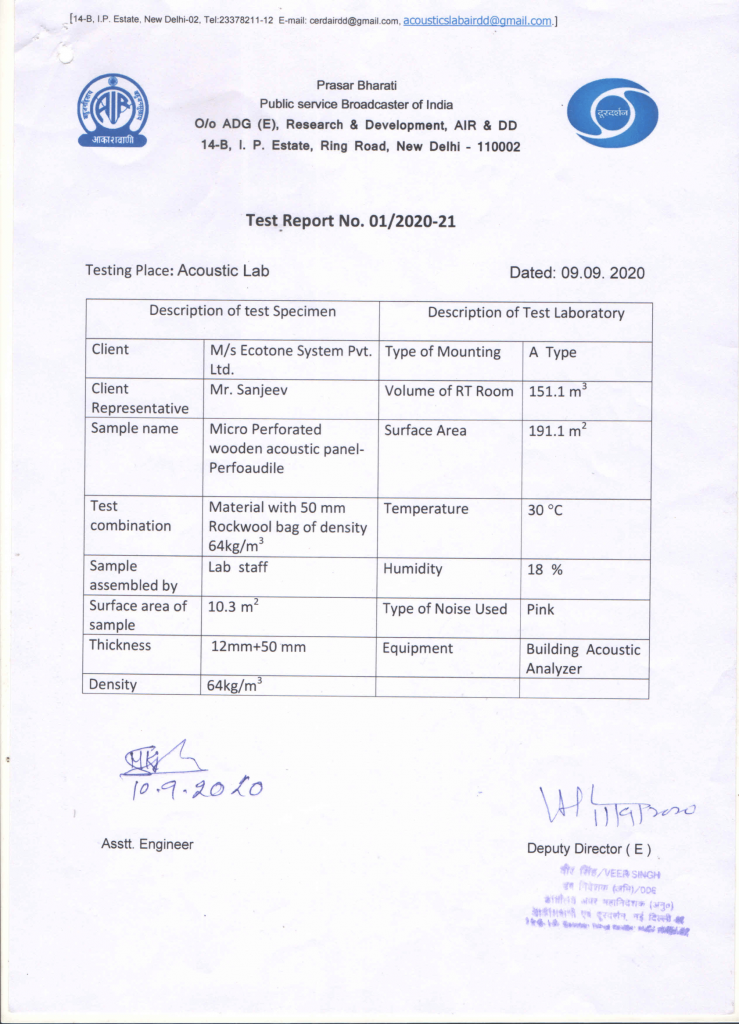
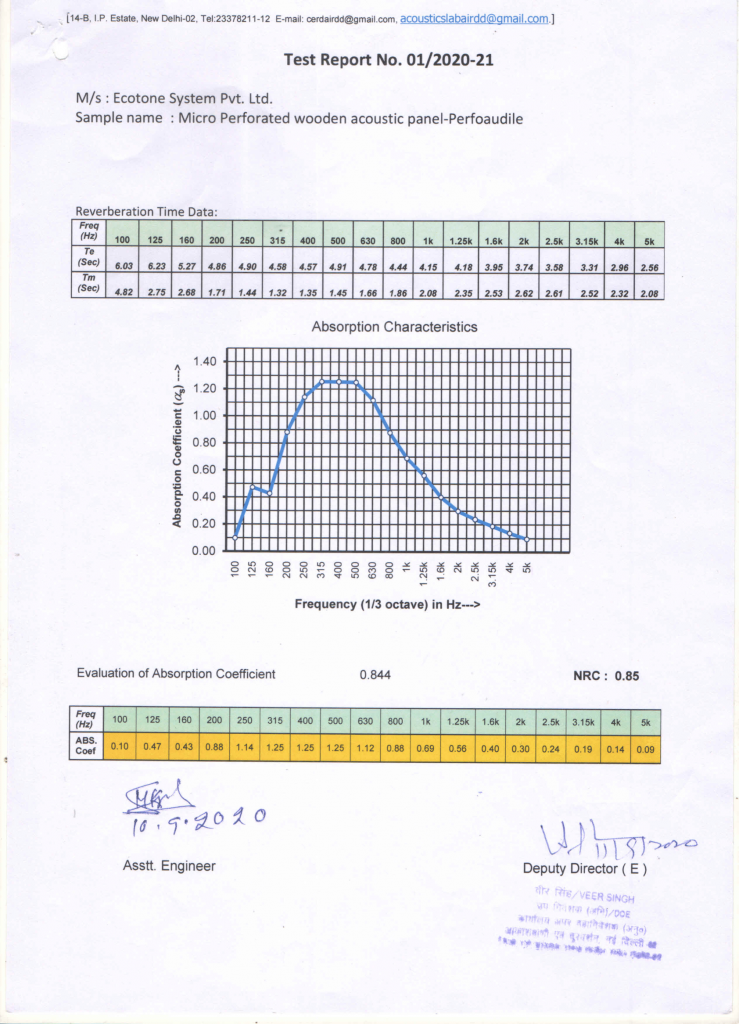
| NRC Value | 0.85 (with recommended cavity and infill) |
| Backing | Black acoustic fleece + Rockwool 60 kg/m³ (IS 8183) |
| Finish | 0.5 mm Mica laminate, veneer, or PU paint |
| Fixing System | GI 'Z' clamp on GI 'U' channel grid, SS screws |
| Colour Range | Approx. 50 standard shades, custom on request |
| Spec | Detail |
|---|---|
| Thickness | 16 mm standard |
| Hole Size | 0.5–0.8 mm |
| Hole Spacing | 2 mm c/c |
| NRC | Up to 0.85 |
| Core Options | MDF, Ply, WPC, Metal |
| Panel Sizes | 600 × 600 to 2420 mm |
| Fire Rating | Available on Fire-rated Ply core |
| Benefit | Why It Matters |
|---|---|
| High NRC (0.85) | Cuts echo and reverberation noticeably |
| Near-invisible holes | Looks like a plain finished wall |
| Multiple core options | Fits budget, fire, and moisture needs |
| 50+ colour choices | Matches interior design without compromise |
| Lightweight installation | Faster fit-out on GI grid system |
| Low maintenance | Wipeable laminate, no fabric to soil |
| Long service life | Dowel-jointed panels resist sagging |
| Sector | Typical Use |
|---|---|
| Auditoriums | Wall and ceiling reverberation control |
| Corporate Offices | Meeting rooms, boardrooms, open floors |
| Education | Classrooms, lecture halls, libraries |
| Healthcare | Wards, OPDs, diagnostic centres |
| Hospitality | Banquet halls, lobbies, restaurants |
| Studios | Recording, broadcast, podcast rooms |
| Transport | Metro stations, airports, tunnels |
| Step | Action |
|---|---|
| 1 | Site survey and NRC requirement calculation |
| 2 | Fix GI ‘U’ channel grid to wall/ceiling |
| 3 | Install GI ‘Z’ clamps on the grid |
| 4 | Fill cavity with Rockwool 60 kg/m³ |
| 5 | Wrap panel back with acoustic fleece |
| 6 | Mount micro perforated panel on clamps |
| 7 | Engineer/architect final approval and QC check |
| Step | Myth | Reality |
|---|---|---|
| 1 | Perforated panels look industrial and ugly | Micro holes are nearly invisible at normal viewing distance. |
| 2 | Any perforated panel blocks noise from next room | Perforated acoustic panels absorb echo, but they do not stop sound transmission between rooms. |
| 3 | Thicker panel always means better absorption | Cavity depth and infill material can matter more than panel thickness when designing an acoustic system. |
| 4 | Metal panels cannot look premium | Powder-coated perforated metal acoustic panels can complement modern and premium interior designs. |
| 5 | One NRC rating fits every room | The required NRC depends on the room volume, occupancy, surfaces, and intended use. |
| 6 | DIY installation gives lab-tested performance | Acoustic performance depends on correct installation, including grid arrangement, cavity depth, and Rockwool density. |
Yes, they absorb reflected sound energy through resonance, cutting reverberation time noticeably in most enclosed rooms.
They cost more upfront than foam but last longer, look better, and need almost no replacement.
Hole size and purpose differ; micro perforated holes are sub-millimetre and built for acoustic performance, not decoration.
Basic fixing is possible, but correct NRC performance needs a professional grid, cavity, and rockwool installation.
Powder-coated aluminium or GI panels resist rust well; untreated metal in humid areas can corrode faster.
Micro perforated wood panels are preferred for warmth, finish, and ease of on-site customization.
Most offices perform well with NRC 0.6 to 0.75; boardrooms often need 0.8 or higher.
Ceilings usually give more absorptive area, so treating the ceiling first often yields better results.
Buy directly from established manufacturers like Packsound with lab-tested NRC data and site support.
Laminate-finished panels only need occasional wiping; avoid pressure washing directly into the perforations.
[wpforms id=”7352″]