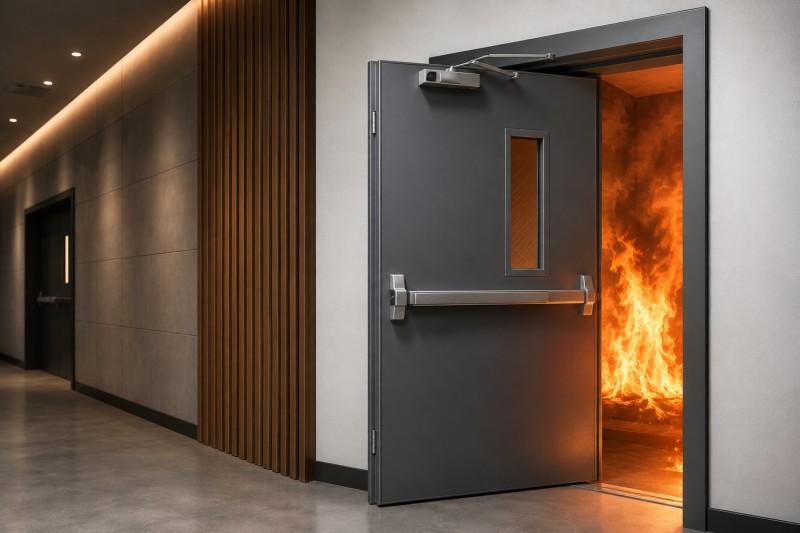
When a fire breaks out in a building, the door between a stairwell and an office floor is no longer just a door. It is a fire barrier — the last line of engineered defence between controlled evacuation and catastrophe. A correctly specified, certified, and installed fire rated door can hold back flames, heat, and toxic smoke for 30 to 180 minutes. An incorrect one — or a door that merely looks fire rated but carries no valid test certificate — may fail within minutes.

View Product → packsound.in/sonicguard/wooden-acoustic-doors/
The SonicGuard® Wooden Acoustic Fire Rated Door is Packsound’s flagship dual-performance product — certified for both fire resistance and professional-grade acoustic attenuation in a single tested assembly.
| Specification | Detail |
|---|---|
| Fire Rating | Up to 120 minutes (IS 3614 Part 2 / BS 476 Part 22) |
| Acoustic Performance | STC up to 55 dB |
| Core Construction | Advanced multi-layer wooden core + premium acoustic infill |
| Standard Sizes | 900×2100 mm, 1000×2100 mm (custom sizes available) |
| Finishes | Premium timber veneers, custom finishes |
| Vision Panels | Optional — double-glazed acoustic glass or laminated safety glass |
| Hardware | Heavy-duty hinges, matte black or satin stainless steel handles, mechanical or electromagnetic locking |
| Certification | IS 3614 Part 2, BS 476 Part 22 |
Applications: Hotel guest room corridor doors, hospital ward and theatre corridors, corporate offices, co-working spaces, recording studios, educational institutions, hospitality suites.
Why it’s specified: This door replaces two separate specifications — fire consultant’s FD 60/FD 120 requirement and acoustic consultant’s STC 40–55 requirement — with a single certified, supply-and-install solution.
View Product → ecotone.co.in/wooden-fire-door/
Packsound’s standard wooden fire rated door range provides IS 3614 Part 2 and BS 476 Part 22 certified fire performance for applications where aesthetic finish and compliance are both required, but dedicated acoustic performance is not the primary specification driver.
| Specification | Detail |
|---|---|
| Fire Rating | 30, 60, 90, 120, and 180 minutes |
| Core | Fire-resistant solid core — compressed vermiculite board, calcium silicate, or ceramic wool |
| Facing | Hardwood or engineered timber veneer |
| Frame | Fire-tested hardwood frame with intumescent packing |
| Seals | Intumescent strips + cold smoke seals |
| Self-Closer | Hydraulic door closer included (tested as assembly) |
| Certification | IS 3614 Part 2, BS 476 Part 22 |
Applications: Hotels, hospitals, schools, residential towers, office buildings, government buildings — any application where architectural finish and fire compliance are both required.
View Product → ecotone.co.in/acoustic-wooden-doors/
Where fire resistance is not required but acoustic performance is the primary specification target, Packsound’s dedicated wooden acoustic door range achieves outstanding sound isolation for recording studios, cinema halls, conference rooms, and private offices.
| Specification | Detail |
|---|---|
| Acoustic Performance | STC up to 55 dB |
| Construction | Multi-layer wooden core + acoustic infill |
| Applications | Recording studios, cinemas, boardrooms, meeting rooms, music rooms |
| Finishes | Wide range of premium timber veneers and custom finishes |
For complete acoustic treatment alongside your door specification, see our Acoustic Wooden Doors and Soundproof Fixed Partitions / Drywall pages.
View Product → packsound.in/acofascia/drywall-partition/
For projects where both fire and acoustic performance must be achieved across wall systems — not just door openings — the AcoFascia™ system delivers STC up to 55 alongside 120-minute fire resistance, fully integrated with the SonicGuard® door range for a single-source fire and acoustic wall solution.
Every Packsound fire rated door set is supplied as a complete, tested assembly including:
Request a Technical Datasheet or Project Quote: +91 98098 02016
Not all fire rated doors are the same. The right type depends on occupancy, architectural requirements, acoustic needs, traffic volume, and the specific fire risk of each zone.
The most common fire rated door type in industrial and institutional applications. Steel fire doors are constructed with a pressed steel skin over a fire-resistant infill — typically rock wool, ceramic wool, or a combination — providing both structural rigidity and thermal insulation during a fire event.
Typical applications: Plant rooms, electrical switch rooms, server rooms, warehouses, factory compartment walls, stairwell enclosures in industrial buildings, parking levels.
Ratings available: 30, 60, 90, 120, and 180 minutes under IS 3614 and BS 476.
Timber fire rated doors combine the aesthetic qualities of wood with certified fire resistance. They are constructed with a solid core of fire-resistant materials — compressed vermiculite board, calcium silicate, or fire-rated chipboard — enclosed within hardwood or engineered timber veneer facings.
Typical applications: Hotels, hospitals, schools, offices, residential towers, hospitality projects, co-working spaces.
Packsound range: ecotone.co.in/wooden-fire-door/ — IS 3614 Part 2 and BS 476 Part 22 certified, up to 180 minutes.
A purpose-designed acoustic fire rated door provides both certified fire resistance and meaningful acoustic attenuation in a single tested assembly. This is the specification category most commonly overlooked in Indian projects — and the one where Packsound holds a clear market advantage.
Most fire rated doors provide only incidental acoustic performance of 25–28 dB (Rw). Purpose-engineered acoustic fire doors achieve STC/Rw 40–55 dB alongside 60–120 minute fire ratings.
Packsound SonicGuard® Acoustic Fire Rated Doors: packsound.in/sonicguard/wooden-acoustic-doors/ — STC up to 55, fire up to 120 minutes.
Emergency exit fire rated doors are fitted with certified panic hardware — push bars or touch pads allowing unimpeded egress. Under NBC 2016, panic hardware is mandatory on fire exit doors in assembly buildings, hospitals, educational institutions, and any building with occupancy above 300 persons.
The panic bar must be part of the fire-tested assembly. A fire door fitted with a panic bar that was not tested with that door assembly has no valid fire rating in use.
Where opening widths exceed standard single-leaf dimensions — typically anything above 1,200 mm — double leaf fire doors are specified. These require intumescent meeting edge seals on both leaves, sequenced closing hardware, and a door sequencer or coordinator.
Failure to install a sequencer on a double leaf fire door is one of the most common compliance failures encountered in Indian projects.
A “60-minute fire door” does not mean the door survives a 60-minute fire. It means the door assembly passed a standardised IS 3614 Part 2 laboratory test for 60 minutes without losing integrity, insulation, or smoke control performance. Real fires can be hotter and longer. Fire ratings provide a minimum performance benchmark under defined conditions.
| Fire Rating | NBC 2016 Application | Typical Use Cases |
|---|---|---|
| FD 30 (30 min) | Low-risk internal compartmentation | Office interiors, internal corridors, domestic applications |
| FD 60 (60 min) | Standard commercial stairwells, service corridors | Most commercial buildings, hotels, office towers |
| FD 90 (90 min) | High-rise residential (>15 m), healthcare, education | Hospitals, schools, residential towers above 30 m |
| FD 120 (120 min) | Large industrial and storage building compartments | Warehouses, data centres, pharmaceutical plants |
| FD 180 (180 min) | Specialist high-risk industrial, utility, government | Power generation, defence, high-value asset protection |
Important: These are minimum NBC requirements. Your local state fire authority may impose more stringent requirements. Always obtain a No Objection Certificate (NOC) from your district fire office before finalising specifications.
IS 3614 is the Bureau of Indian Standards specification governing fire rated doors in India:
A valid IS 3614 test report must specify the exact door assembly tested (leaf, frame, seals, hardware by manufacturer and model), the tested fire rating achieved, the laboratory name and accreditation details, and the test date. CBRI test certificates are valid for 3 years from test date.
Beyond testing, manufacturers can obtain BIS ISI mark certification under IS 3614. ISI mark certification requires factory audits and ongoing product surveillance. The BIS has progressively made ISI certification mandatory for government procurement, smart city infrastructure, and green building compliance projects.
BS 476 Part 22 is the UK fire test standard widely referenced for projects with international joint venture involvement, UAE/GCC/UK-aligned specifications, and premium commercial projects with international consultant teams.
Packsound’s wooden fire rated doors are tested to both IS 3614 Part 2 and BS 476 Part 22 — among the very few Indian manufacturers holding dual certification on timber fire doors.
The Central Building Research Institute (CBRI), Roorkee is India’s most widely recognised testing authority for fire doors. A CBRI test report carries high credibility with fire authorities, government procurement teams, and insurance underwriters.
Under IS 3614 Part 2, a complete door assembly — leaf, frame, seals, hardware, and any glazing — is installed into a test furnace. The furnace temperature follows the standard time-temperature curve, reaching approximately 840°C at 30 minutes and 1,000°C at 90 minutes.
The assembly is evaluated against three failure criteria:
The test continues until any one criterion is met. The achieved duration at first failure is the fire rating of the assembly.
Key buyer implication: A door that passed a 60-minute fire test as a plain steel leaf without its frame, seals, and hardware has not been tested as it will be installed. Always verify that the assembly configuration in the test report matches exactly what you are purchasing.
| Location | Minimum Rating Required (NBC 2016) |
|---|---|
| Protected staircase enclosures (buildings >15 m) | FD 60 minimum |
| Lift lobby enclosures | FD 60 minimum |
| Escape corridor doors | FD 30 |
| Compartment walls in industrial buildings | FD 60–120 (risk-dependent) |
| Basement/parking to upper floors | FD 60 minimum |
| Electrical switch rooms / generator rooms | FD 60 minimum |
| Server rooms / data centres | FD 60–120 |
| Kitchen enclosures in commercial buildings | FD 60 minimum |
| Hospital theatre lobbies | FD 90 minimum |
| High-rise residential units above 30 m | FD 90 minimum |
| Pharmaceutical plant fire zones | FD 90–120 |
| Warehouse compartment walls (high fire load) | FD 120 minimum |
Note: State fire authority requirements may exceed NBC minimums. Always verify with your local fire authority.
Hospitals combine high occupancy, mobility-impaired occupants, flammable medical gases, high-value equipment, and 24-hour operation — a uniquely demanding fire safety environment. NABH accreditation guidelines and NBC 2016 both mandate comprehensive fire compartmentation. Wooden fire rated doors with acoustic performance are standard in patient ward corridors and theatre areas.
Packsound supplies complete acoustic and fire rated solutions for healthcare facilities. See our Acoustic Design & Consultancy service for NBC 2016 compliance support.
A typical 200-room hotel may require 250–400 fire rated doors. Guest room corridor doors in star-category hotels are increasingly specified with both fire rating and acoustic performance — corridor noise is among the top guest complaints and directly affects review scores. Packsound’s SonicGuard® Acoustic Fire Rated Door addresses both requirements in a single supply.
Educational buildings above ground floor require fire rated doors on stairwell enclosures and laboratory compartment walls. CBSE, UGC, and state building regulations progressively require fire NOC documentation including fire door test certificates.
Multi-tenanted buildings require fire rated doors at floor lobby enclosures, server/comms rooms, and exit corridors. Large IT parks and SEZs typically specify FD 60–90 across stairwell and service cores. Where soundproof office pods or private meeting rooms are installed, acoustic fire doors provide a single-source solution.
High fire load, flammable goods storage, and process hazards make industrial fire doors among the most technically demanding applications. FD 90 and FD 120 doors are standard for compartment walls separating production areas from warehousing and administrative blocks.
Data centres represent one of the fastest-growing demand segments for fire rated doors in India. FM Global insurance and Tier III/IV data centre certification standards typically require FD 120 on all compartment boundaries, with automatic fire door release integrated into the building management system.
Government buildings, PSU offices, defence establishments, and public sector facilities are subject to CPWD specifications, which increasingly mandate IS 3614-certified fire doors with ISI mark for all fire safety installations.
Pharma facilities following Schedule M (Indian GMP) and US/EU GMP guidelines require fire doors that also meet cleanroom hygiene standards. The fire door must not shed particles, must be cleanable, and must integrate with pressure differential management systems.
For noise and fire control in pharma and industrial facilities, see Metallic Noise Barriers and Soundproof Fixed Partitions.
| Parameter | Normal Door | Fire Rated Door |
|---|---|---|
| Core material | Hollow, timber, chipboard | Rock wool, ceramic wool, calcium silicate, vermiculite board |
| Frame | Standard timber or steel | Fire-tested, intumescent-packed frame |
| Seals | None or basic draught seal | Intumescent strips + cold smoke seals |
| Hardware | Standard hinges, handles | Fire-rated and tested as part of assembly |
| Closing | Manual or standard closer | Self-closing device mandatory |
| Glazing | Standard float glass | Fire-rated glass (if specified) |
| Test certification | None | IS 3614 / BS 476 test report required |
| Maximum gap tolerance | Unspecified | 3 mm at sides/top; 8 mm at bottom (IS 3614) |
| Compliance status | Non-compliant for NBC-regulated locations | Compliant when correctly installed |
A door that looks like a fire door — heavy, steel-clad, with a closer — but has no test certificate is a normal door. It provides no guaranteed protection and no regulatory compliance.
This is the specification category most commonly overlooked in Indian projects — and the one where Packsound holds a clear market advantage.
The problem is structural: fire and acoustic requirements are typically handled by different consultants on different project phases. The fire consultant specifies fire doors at statutory compliance stage; the acoustic consultant specifies sound isolation at interior design stage. The result is a specification conflict — fire-compliant doors that fail acoustic targets, or acoustically adequate doors that are not fire-certified.
The solution is Packsound’s SonicGuard® Acoustic Fire Rated Door — a purpose-designed assembly achieving both performance targets from a single manufacturer, with a single tested and certified product.
How acoustic fire doors differ from standard fire doors:
Packsound SonicGuard® performance:
Applications: Hotel guest room corridor doors, hospital ward doors, recording studio fire exits, co-working space room doors, conference centre corridor doors, school music room doors.
Complete acoustic solutions for your project:
- Acoustic Wooden Doors — acoustic-only range
- Soundproof Fixed Partition / Drywall — fire + acoustic wall systems
- AcoFascia™ Drywall Partition — STC 55, 120-min fire-rated wall system
- Acoustic Design & Consultancy — full project specification support
The most prevalent and dangerous mistake. A test report for a plain steel leaf without frame, seals, and hardware has no bearing on the performance of the installed assembly. Always verify: does the test report cover exactly the assembly being purchased?
Changing the door closer, hinge brand, or panic bar voids the fire certification. Hardware substitution on fire doors is widespread in Indian projects due to value-engineering pressure. The saving is typically ₹2,000–5,000 per door. The liability exposure in a fire failure is unlimited.
Double leaf fire doors installed without a mechanical sequencer cannot function as tested — the meeting edge seals cannot engage. Extremely common on Indian projects.
A fire door leaf installed in a non-fire-rated frame provides no meaningful fire resistance. The frame must be part of the tested and certified assembly, correctly fixed into the structural wall.
₹15,000 per door versus ₹45,000 per door — the price differential is real, and the reason is real. Certified, tested, properly manufactured fire doors cost more than doors that merely look similar. Lower-priced products are almost never IS 3614 certified assemblies.
A correctly specified fire door that has been incorrectly installed — gaps too wide, seals damaged during fitting, closer not properly adjusted — provides no rated protection. Post-installation inspection is essential.
Intumescent seals degrade. Closers lose tension. Gaps widen with building settlement. A fire door with no maintenance over five years may not perform to its rating. IS 3614 and NBC 2016 both require periodic maintenance.
A fire door that is not maintained is not a fire door. Under NBC 2016, building owners are responsible for maintaining fire safety installations including fire doors.
Fire rated door prices vary widely — from ₹12,000 to ₹1,50,000+ per door set. Understanding what drives price variation allows buyers to make informed procurement decisions.
| Factor | Effect on Price | Notes |
|---|---|---|
| Fire rating | Higher rating = higher cost | FD 120 is typically 40–60% more than FD 60 |
| Door material | Steel < Timber for standard finishes | Acoustic timber doors command a premium |
| Acoustic performance | STC 55 adds 25–50% over standard fire door | Combination doors cost more but replace two separate specifications |
| Leaf size | Larger leaf = higher material cost | Double leaf doors are 60–90% more expensive than equivalent single leaf |
| Finish quality | Powder coat < Veneer < Custom woodwork | Premium veneer finishes add ₹8,000–25,000 per leaf |
| Hardware specification | Panic bar + sequencer adds significant cost | Budget ₹12,000–40,000 for certified panic hardware |
| Certification level | Test report only < ISI mark | ISI-marked doors carry a small premium but are required for government projects |
| Vision panel | Fire-rated glass significantly adds to cost | Fire-rated glass is 5–10× the cost of standard float glass |
| Supply vs supply+install | Installation adds 15–25% | Certified installation recommended; incorrect installation voids performance |
Prices are indicative. Contact Packsound for project-specific quotations.
Ask for the IS 3614 Part 2 test report and verify: Is it from a NABL-accredited laboratory or CBRI? Is the test date within the last 3 years? Does the tested assembly match exactly what you are purchasing?
Does the company manufacture or resell? Genuine manufacturers have CNC machinery for door leaf fabrication, a controlled core lamination process, and in-house quality control.
A manufacturer who also installs has aligned incentives — they know that incorrect installation voids their product’s performance. Supply-only sourcing transfers all installation risk to the contractor and building owner.
Can the manufacturer provide a complete hardware schedule? Shop Drawings? An installation manual that matches the test configuration? Post-installation inspection support?
Ask for a project reference list in your sector. Hotel fire door installation is very different from an industrial warehouse installation — experience in your specific application matters.
Will the manufacturer support annual inspection visits? Can they supply replacement seals and hardware 5–10 years post-installation?
Packsound, manufactured by Ecotone Acoustic Limited, occupies a specific and differentiated position in India’s fire door market: we are the country’s leading manufacturer of acoustic fire rated wooden doors — assemblies that achieve both certified fire resistance and professional-grade acoustic attenuation from a single tested product.
Beyond fire rated doors, Packsound and Ecotone offer a complete acoustic and fire-rated building product ecosystem for architects and PMC consultants working on complex specifications:
Ecotone Acoustic Limited has delivered acoustic and fire rated solutions across commercial office buildings, five-star hotels, hospitals, educational institutions, recording and broadcast facilities, government buildings, and pharmaceutical plants across India. Our acoustic consultancy team provides NBC 2016 compliance guidance as part of the project support service.
Ready to specify or procure?
- Phone: +91 98098 02016 | +91 98913 20678
- Website: ecotone.co.in/contact-us/
- Catalogue: Download Packsound Master Catalogue
- Projects: View completed projects
- Awards & Recognition: ecotone.co.in/awards-recognition/
A 220-room four-star hotel required fire rated doors for all guest room corridor openings. The acoustic consultant’s brief specified a minimum STC 40; the fire consultant required FD 60 per NBC 2016. Packsound supplied 260 SonicGuard® acoustic fire rated wooden door sets — FD 60 / STC 45+ — with premium teak veneer finish and chrome hardware. Single-source supply eliminated the specification conflict and provided one test report covering both fire and acoustic compliance.
A 350-bed private hospital required fire rated doors at stairwell enclosures (FD 90), nursing station lobbies (FD 60), and operating theatre vestibules (FD 90). Packsound supplied 180 door sets across three specification grades, with technical support for the state fire authority NOC application.
A Schedule M-compliant pharmaceutical manufacturing facility required FD 120 fire doors at all process area compartment boundaries, combined with cleanroom-compatible finishes and magnetic hold-open devices integrated with the fire alarm system. Ecotone’s technical team provided specifications aligned with both IS 3614 requirements and the client’s US FDA compliance requirements.
A fire rated door is a tested and certified door assembly designed to resist fire, smoke, and heat for a specified duration — typically 30, 60, 90, or 120 minutes — under standardised test conditions. The term “fireproof” is technically inaccurate; no door is entirely fireproof. “Fire rated” or “fire resistant” reflects the door’s tested performance duration rather than an absolute immunity to fire.
IS 3614 is the Bureau of Indian Standards specification for fire check doors. Part 1 covers construction requirements; Part 2 covers the fire resistance test protocol. Compliance with IS 3614 is mandatory under NBC 2016 for fire doors in commercial, institutional, industrial, and high-rise residential buildings in India.
Under NBC 2016: buildings above 15 m require minimum FD 60 on stairwell enclosures; buildings above 30 m require FD 90; high-rise buildings above 45 m and high fire load industrial buildings require FD 120. Always verify with your state fire authority, as local requirements may exceed NBC minimums.
Yes. Timber fire rated doors are fully compliant with IS 3614 when correctly tested and certified. They use a fire-resistant solid core with timber veneer facings. Packsound manufactures IS 3614 and BS 476 Part 22 certified wooden fire rated doors in ratings up to 180 minutes. See: ecotone.co.in/wooden-fire-door/
A standard fire rated door is designed solely to resist fire and smoke. An acoustic fire rated door provides both certified fire resistance and meaningful sound attenuation — typically STC 40–55 dB — in a single tested assembly. Packsound’s SonicGuard® Acoustic Fire Rated Door achieves up to STC 55 alongside 60 or 120-minute fire ratings.
Yes. All hardware — hinges, door closer, lock, latch, and panic bar — must be those specified in the fire test report. Substituting any hardware component voids the fire certification of the entire assembly.
Monthly visual checks by building managers. Annual inspections by a competent person verifying gap tolerances, seal condition, and hardware function. Intumescent seals should be replaced every 3 years as standard practice. CBRI test certificates must be renewed every 3 years.
A complete fire rated door set comprises: the door leaf with fire-resistant core and face finishes, the fire-tested door frame, intumescent seals, cold smoke seals, a self-closing device, and all specified hardware. All elements must have been tested together as a certified assembly.
Prices vary significantly. A basic FD 60 steel fire door (supply only) starts at approximately ₹18,000–35,000. Timber fire rated doors with premium finishes and acoustic performance (Packsound SonicGuard®) range from ₹45,000–80,000 per leaf for FD 60 / STC 55. Contact Packsound for a project-specific quotation: +91 98098 02016.
Yes. Packsound (Ecotone Acoustic Limited) supplies and installs certified fire rated wooden doors and acoustic fire rated doors across India, including Delhi NCR, Mumbai, Bengaluru, Hyderabad, Chennai, Pune, Ahmedabad, Kolkata, and all major cities. Contact us.
Fire rated doors are among the most consequential building products specified in any commercial or institutional project. When correctly specified, certified, and installed, they are the primary passive fire protection system that buys evacuation time and limits structural and asset damage. When incorrectly specified, uncertified, or poorly installed, they provide a false sense of security with none of the actual protection.
Our recommendation for every architect, PMC consultant, or procurement team reading this:
Get a Free Technical Consultation, Project Quotation, or Datasheet:
+91 98098 02016 | +91 98913 20678
Download Packsound Master Catalogue
Services available:
Project fire door schedule review
NBC 2016 compliance check
IS 3614 / BS 476 specification support
Technical datasheet — SonicGuard® Wooden Acoustic Fire Door
Supply and installation PAN India
Post-installation inspection support