Call ✆ +91 9809802016 | 9891320678

Quick Answer: To treat the acoustics of spaces, panels, tiles, baffles and clouds (treatments) are either fixed to or suspended from ceilings. The treatments absorb sound, reduce echo and reverberation, and mitigate airborne noise. Architects, MEP consultants, contractors, and facilities managers specify treatments for offices, auditoriums, hospitals, schools, and factories, where speech clarity and noise control are imperative. Ecotone offers end-to-end solutions (manufactures and installs) for ceiling acoustic treatments in India from its Noida facility. Ecotone’s offerings are suspended ceiling acoustic treatments, acoustic ceiling treatment systems, and ceiling-mounted acoustic panels with NRCs in the range of 0.55 to 0.95. This document is for ceiling acoustics treatment in commercial spaces in India, while specifying, tendering, or troubleshooting.
Ceiling acoustic treatment means using sound absorbing materials like fiberglass or wood on a ceiling. Sound waves hit the treated ceiling and are absorbed instead of reflected back to the room. A bare cement ceiling will reflect sound. It will cause the room to be filled with echo and noise. A treated ceiling will absorb sound and make the room less noisy. This is why boardrooms and classrooms sound less noisy after they have ceiling acoustic treatment. This page explains ceiling acoustic treatment, the difference between suspended and directly fixed acoustic ceiling systems, the NRC value, and the installation of Ecotone’s ceiling acoustic panels in Indian commercial sites.
Sound energy is absorbed when the air passes through the porous or fibrous center of the panel and is converted to a small amount of heat. That’s why less sound is reflected back to the room.
All ceiling acoustic panels have the same core friction based sound absorption methodology. When a sound wave hits the open cell structure of either mineral wool, PET fiber or acoustic foam, the air molucles start moving and and rub against the walls of the fibers and dissipate the energy as noise. Panels that have a greater thickness and density are able to capture a greater amount of lower frequency sound. Also, a rigid air gap is created behind the panels which is suspended and that helps to absorb sound in the conversation range. Ecotone’s acoustic ceiling tiles and baffles use the very same principle.
| Factor | Suspended Ceiling Acoustic Solutions | Fixed Acoustic Ceiling Systems |
|---|---|---|
| Air gap behind panel | Yes, improves low frequency absorption | Minimal to none |
| Best for | New builds, offices, auditoriums | Retrofits, low ceiling height sites |
| Access to services | Easy, panels are demountable | Limited once installed |
| Typical NRC achieved | 0.75 to 0.95 | 0.55 to 0.75 |
| Lead time on site | Slightly longer, grid dependent | Faster |
With years of experience in the industry, we have acquired extensive knowledge and expertise in providing ceiling acoustic treatments for commercial spaces. Our team of professionals stays updated with the latest advancements in acoustic technology, allowing us to offer innovative solutions that are at the forefront of the industry.
We understand that every commercial space is unique, and a one-size-fits-all approach is not effective. At Packsound, we take a personalized approach to deliver tailored ceiling acoustic treatments that address the specific needs of your space. From acoustic analysis to the selection of materials and installation, we ensure that every aspect is customized to provide optimal results.
Our commitment to customer satisfaction is unwavering. We prioritize open communication, attentive customer service, and prompt resolution of any concerns. From the initial consultation to the completion of the project, we strive to exceed your expectations at every step. Your satisfaction is our ultimate goal.
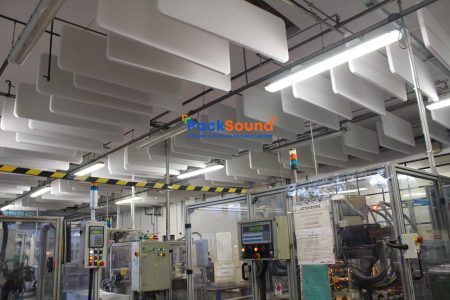
Acoustic hanging baffles are specialized panels designed to absorb sound waves, thereby reducing noise and improving the acoustic quality of a space. These baffles are typically made from sound-absorbing materials such as fiberglass, mineral wool, or foam enclosed in a fabric covering. They are available in various shapes, sizes, and colors to suit aesthetic preferences and acoustic requirements.

Our hanging clouds are meticulously designed to blend seamlessly with any architectural style. They not only enhance the acoustic performance but also add an aesthetic touch to your space. With various sizes, shapes, and finishes available, you can customize the hanging clouds to suit your specific design requirements.
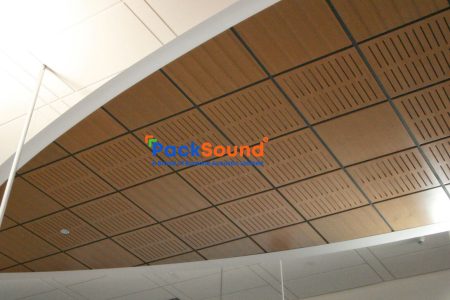
Acoustic ceiling panels, also known as sound-absorbing panels, are larger panels typically installed vertically or horizontally on walls or ceilings. They are often utilized in areas with high ceilings, such as auditoriums, theaters, and open-plan offices. There are two types of acoustic ceiling tiles: suspended and drop ceiling grids. These tiles are used to reduce echo in a room while providing an aesthetically pleasing look.
[wpforms id=”7352″]
Soundproofing blocks sound between rooms; acoustic treatment absorbs sound within a room to reduce echo.
Yes, most panels mount directly onto existing grids or are suspended below them.
Yes, tested panels with NRC 0.70 or higher measurably shorten reverberation and lower perceived noise.
It depends on room volume and hard surfaces; a site survey gives an accurate coverage number.
Reputable manufacturers offer Class A or Class B fire rated cores suitable for commercial use.
NRC measures the percentage of sound a panel absorbs; higher NRC means better echo control.
Painting perforated or fabric wrapped panels closes pores and reduces sound absorption performance.
PET fiber panels typically cost more but offer better finish options and eco friendly composition.
Yes, the air gap behind suspended panels improves low frequency sound absorption significantly.
Yes, incorrect mounting or gaps at edges can reduce real world acoustic performance considerably.