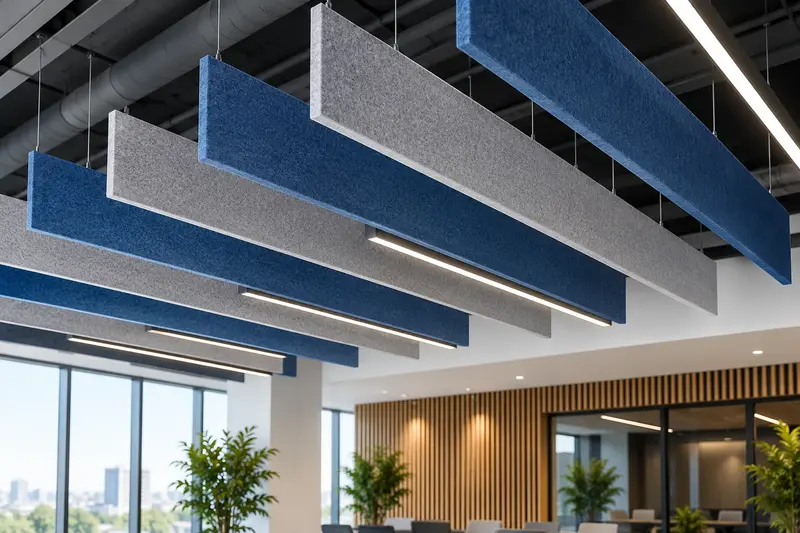
Acoustic Baffles Ceiling | Acoustic Hanging Baffles

Are you tired of the constant noise that fills your workspace or commercial area? Do you wish to create a more peaceful and productive environment? Look no further than the acoustic baffles ceiling. 

These innovative sound-absorbing panels are designed to reduce noise levels, enhance acoustics, and add a touch of aesthetic appeal to any space. This comprehensive guide will explore the benefits, installation tips, and design options of acoustic hanging baffles and baffle ceilings.

Acoustic hanging baffles are specialized panels designed to absorb sound waves, thereby reducing noise and improving the acoustic quality of a space. These baffles are typically made from sound-absorbing materials such as fiberglass, mineral wool, or foam enclosed in a fabric covering. 

They are available in various shapes, sizes, and colors to suit aesthetic preferences and acoustic requirements. These ceiling baffles, when combined with other acoustic products like acoustic wall panels give you a pleasant sound with perfect interior looks.

PACKSOUND is a manufacturer of Acoustic hanging Baffles, Hanging Sound Baffles, and Ceiling Sound Baffles in India. With the advent of technology, many new innovative techniques have been used to prevent sound and noise, which can generate havoc in people’s minds—in commercial places such as canteens, sports stadiums, industrial venues, and malls. Auditoriums, etc., where it is necessary to obtain control of sound and modulation, require avoiding any noise transmission.

We offer various high-performance acoustic hanging Baffles in multiple sizes and shapes. The acoustic baffle is very useful for many different types of areas, i.e., industrial shop floor, canteen, meeting room, food processing area, and indoor stadium. Sound Baffle offers a winning combination of exceptional performance, high NRC ratings, and cost-effectiveness, effectively addressing the most challenging noise reduction issues.

Features :-

Our Acoustic Baffles Ceiling Have

0.6 NRC Value
  • Light and medium weight
  • High performance with quality sound absorption
  • Smarter installation with sound modulation
  • A wide range of colors and wood tones
  • Noise control inverter to provide you complete satisfaction.

What Is the Difference Between Acoustic Baffles and Clouds?

Acoustic baffles and acoustic clouds are both effective ceiling-mounted sound absorption solutions, but they differ in design, installation, and the way they manage noise and aesthetics in a space. Understanding the difference between the two helps you choose the right acoustic treatment for your project.

1. Design and Orientation

  • Acoustic baffles are vertically suspended panels that hang from the ceiling, allowing sound waves to pass between them. This design maximizes sound absorption from multiple directions and enhances noise reduction in large, open spaces such as offices, factories, and auditoriums.

  • Acoustic clouds, on the other hand, are horizontally suspended panels installed parallel to the ceiling. They absorb sound waves that reflect off hard surfaces, making them ideal for spaces where reverberation control and clean visual aesthetics are important, like restaurants, studios, and conference rooms.

2. Sound Absorption Performance
Both baffles and clouds improve acoustic quality, but their performance depends on placement:

  • Baffles perform better in tall spaces because they intercept sound waves traveling in different directions.

  • Clouds are more efficient in areas where sound primarily reflects off the ceiling, reducing echo and improving speech clarity.

What Is an Acoustic Baffles Ceiling

An acoustic baffles ceiling is a system of sound-absorbing panels that hang vertically from the ceiling structure, suspended in parallel rows using cables, rods, or wire suspension systems. Unlike a conventional false ceiling that creates a solid horizontal plane across the entire ceiling area, acoustic hanging baffles leave open space between each panel. 


This open, fin-like configuration is the defining characteristic of baffle ceilings, and it is precisely what makes them so effective in large, tall, and noisy spaces. Each baffle panel hangs down into the room and presents both of its faces, front and back, to the sound energy filling the space. This means that every single panel in a baffle ceiling system is doing twice the acoustic work of a flat ceiling tile of the same size. 


Sound waves travelling horizontally through the room, reflecting diagonally off walls, and bouncing upward from the floor all encounter the absorptive surfaces of the hanging baffles. The energy of those sound waves is converted into a tiny amount of heat as it passes through the fibrous or porous core of the panel. The result is a measurable and significant reduction in reverberation and noise levels throughout the space. 


The open gaps between baffle panels also serve a practical purpose. Lighting fixtures, HVAC supply and return grilles, fire sprinkler heads, data cable trays, and structural beams can all remain visible and accessible above and between the baffles. This makes acoustic baffle ceilings much easier to retrofit into existing buildings than solid false ceiling systems, and much more practical in industrial and commercial spaces where ceiling services are complex.

Why Ceiling Acoustics Matter More Than Most Buyers Realise

The ceiling is the largest single uninterrupted reflective surface in most rooms. A typical office or classroom has walls broken up by windows, doors, shelving, and furniture, all of which absorb or scatter some sound energy. The floor often has carpet, workstation screens, or other soft furnishings that provide some absorption. But the ceiling is almost always a continuous hard surface, whether it is a concrete soffit, a metal deck, or a flat painted plasterboard. Every sound wave that travels upward and hits that hard ceiling bounces straight back into the room with very little energy lost. In spaces with ceiling heights above four metres, this problem is compounded. The larger the room volume, the more sound energy is present and the longer it takes for that energy to decay. Reverberation time, measured as RT60, is the time it takes for a sound to decay by 60 decibels after the source stops. 


In an untreated warehouse, factory, or sports hall, RT60 values of 4, 6, or even 8 seconds are common. For comparison, the recommended RT60 for an open-plan office is 0.4 to 0.6 seconds. The recommended value for a school classroom is similar. An untreated industrial canteen with an RT60 of 5 seconds creates noise levels that cause stress, fatigue, hearing risk, and communication failure. Treating the ceiling acoustically is the highest-impact single intervention in most of these spaces precisely because the ceiling is the dominant reflective surface. When acoustic hanging baffles are installed, they intercept sound energy throughout the full height of the room rather than only at the ceiling plane. 


The exposed surface area of a properly specified baffle system can represent three to four times the acoustic absorption area of flat ceiling tiles covering the same footprint, because both faces of every vertical panel are working simultaneously. This is why acoustic baffles ceiling systems are the standard specification for factories, warehouses, sports halls, canteens, food processing areas, indoor stadiums, large open-plan offices, schools, and any other high-volume space where noise control is a functional requirement.

Types of Acoustic Hanging Baffles Available in India

Not all acoustic ceiling baffles are the same. The material the panel is made from determines its acoustic performance characteristics, its durability in different environments, its fire rating, its weight, and its cost. Here is a clear breakdown of the main types available in India through Packsound. 


Fiberglass and Mineral Wool Acoustic Baffles 

Fiberglass and mineral wool are the most widely used core materials for acoustic hanging baffles in commercial and industrial applications. Both materials are highly porous and fibrous, which means they are exceptionally effective at converting sound energy into heat. Fiberglass baffles typically achieve NRC values of 0.75 to 0.95 depending on thickness, density, and mounting configuration. Mineral wool baffles perform similarly and offer the additional advantage of higher inherent fire resistance. 


These panels are encased in an acoustic-transparent fabric facing that protects the core material, gives the panel its visual finish, and allows sound waves to pass through freely to reach the absorptive core. The fabric facing is available in a wide range of colours, allowing the baffles to be specified as a design element rather than purely a functional installation. 


Fiberglass and mineral wool baffles are the standard specification for offices, educational facilities, healthcare spaces, canteens, and commercial interiors where high acoustic performance combined with fire safety compliance is required. 


Polyester Fibre Acoustic Baffles 

Polyester fibre baffles use a recycled polyester core rather than glass or mineral wool. This gives them specific advantages in environments where moisture is present. Polyester fibre does not absorb water the way mineral-based materials can, making it a practical choice for canteens, food processing areas, swimming pool halls, coastal buildings, and any space subject to humidity or occasional moisture exposure. Polyester fibre baffles achieve NRC values of 0.70 to 0.85 and are available in a similarly wide range of fabric finishes and colours. They are also lightweight, which simplifies installation and reduces the structural load on ceiling fixings. 


Wooden Acoustic Hanging Baffles 

Wooden acoustic hanging baffles use engineered timber as the primary material, either as a solid profile, a perforated panel, or a slatted construction with an acoustic absorptive backing. These baffles combine sound absorption with the visual warmth and architectural character of natural wood. Wooden baffles are the premium specification choice for hospitality spaces, corporate reception areas, high-end retail interiors, auditoriums, and any project where the ceiling treatment must function as an architectural feature rather than a background acoustic intervention. Packsound’s wooden acoustic hanging baffles are available in a range of timber finishes and profile options. See the full wooden baffle range at ecotone.co.in/wooden-acoustic-hanging-baffles


Industrial Acoustic Baffles 

For factory floors, warehouses, packaging halls, and heavy industrial environments, acoustic baffles need to withstand dust, moisture, temperature variation, and mechanical cleaning. Industrial-grade acoustic baffles are specified with durable outer facings, higher core densities, and suspension systems that handle the structural demands of large-span industrial ceilings. Packsound has completed baffle installations in industrial facilities including manufacturing plants and logistics centres across India.

Acoustic Baffles vs Acoustic Clouds: Understanding the Difference

This is one of the most common questions buyers ask when specifying ceiling acoustic treatment, and it is worth answering clearly because choosing the wrong product for a space can result in underperformance and wasted budget. 


Orientation is the fundamental difference. 

Acoustic ceiling baffles are vertically suspended panels that hang down into the room from the ceiling. Acoustic clouds are horizontally suspended panels that float parallel to the ceiling surface. This difference in orientation produces different acoustic behaviours and makes each product more suitable for different spaces. Acoustic ceiling baffles are best suited to tall spaces with high volumes. In a space with a five-metre ceiling height, a factory with a ten-metre soffit, or a sports hall with fifteen metres of clear height, the baffles hang down into the room and intercept sound waves throughout the full height of the space. Both faces of each vertical panel are absorbing sound simultaneously. 


The effective absorption area per unit of ceiling footprint is much higher with baffles than with horizontal clouds. In tall spaces, baffles consistently outperform clouds on acoustic grounds. 


Acoustic clouds are best suited to lower-ceilinged spaces where the primary acoustic problem is sound reflecting off the ceiling plane directly above the activity area. In a restaurant, a conference room, an office meeting space, or a small recording studio, a cloud suspended close to the ceiling captures the direct ceiling reflections before they return to the listener. Clouds are also the visual preference in many hospitality and corporate interior design schemes because they create a defined floating element with clean edges and a precise relationship to the architecture below. 


In many large projects, baffles and clouds are used together. Baffles address the mid and upper volume of a tall space while clouds are installed over specific activity zones such as workstation clusters, dining areas, or reception desks. Packsound offers both products and can advise on the right combination for your specific project during a free consultation. For more detail on acoustic clouds, see ecotone.co.in/acoustical-hanging-clouds.


Where Acoustic Ceiling Baffles Are Used Across India

The versatility of acoustic hanging baffles means they are appropriate across a very wide range of spaces. Here is how they are used in the most common project types. 


Industrial Factories and Warehouses 

Factory floors and warehouses are the original application for acoustic ceiling baffles. These spaces have hard floors, hard walls, metal machinery, high ceilings, and almost no natural sound absorption. Background noise levels from machinery, conveyor systems, and HVAC often exceed 80 to 90 decibels. At these levels, communication between workers is difficult, safety warnings can go unheard, and long-term occupational hearing damage is a genuine risk. Acoustic baffles ceiling systems are installed in rows above the work area, typically at one-third to two-thirds of the total ceiling height. The baffles intercept sound energy throughout the volume of the space and reduce reverberation time from values of 5 to 8 seconds down to 1.5 to 2.5 seconds, which is within the range where communication is practical and hearing risk is reduced. Packsound has completed factory and industrial acoustic baffle projects across India including manufacturing facilities in the National Capital Region and industrial estates in Maharashtra and Karnataka. 


School and College Canteens 

The canteen is arguably the most challenging acoustic space in any school or college campus. Large numbers of students eating and talking simultaneously in a hard-floored, hard-walled, hard-ceilinged room creates a noise environment that many teachers and students describe as overwhelming. Noise levels in untreated school canteens during busy periods regularly exceed 85 decibels, which is comparable to standing next to a running lawnmower. Acoustic hanging baffles installed across the canteen ceiling can reduce noise levels by 8 to 12 decibels in a properly specified installation. An 8 to 10 decibel reduction is perceived by the human ear as cutting the loudness roughly in half. The improvement in student and staff experience is immediate and dramatic. Acoustic ceiling baffles are particularly well-suited to canteen applications because they do not require the ceiling to be closed off, maintaining access to sprinkler systems and kitchen ventilation infrastructure above. 


Open-Plan Corporate Offices 

Modern open-plan office design creates a tension between the collaborative culture it is intended to foster and the acoustic privacy that individual concentration requires. When a hundred people are working in a single open floor with a polished concrete ceiling three metres above them, the result is a constant background noise level that reduces cognitive performance, increases stress, and makes telephone calls and video meetings difficult to conduct without disturbing neighbours. Acoustic ceiling baffles are one of the most effective interventions for open-plan office noise control, used in combination with acoustic wall panels and workstation screens. Baffles absorb the mid and upper-frequency speech energy that fills the space and reduces the reverberant tail that makes voices carry across the entire floor. Packsound has delivered open-plan office acoustic treatment projects for corporate clients in Delhi NCR, Gurugram, Mumbai, and Bengaluru, combining ceiling baffles with fabric acoustic wall panels for comprehensive noise management. 


Indoor Sports Halls and Gymnasiums 

Sports halls present one of the most extreme acoustic environments of any building type. Hard floors, brick or concrete walls, metal roof decks, and ceiling heights of eight to fifteen metres create reverberation times that can reach ten seconds or more in an untreated hall. This makes announcements unintelligible, whistle signals hard to distinguish, and coaching difficult to deliver clearly. For schools and community facilities, the sports hall is often also used for assemblies, performances, and examinations, making acoustic treatment an operational necessity. Acoustic hanging baffles are the standard solution for sports hall ceiling treatment in India. They can be installed at heights that keep them clear of ball sports play areas while still dramatically reducing the volume of the space. A well-specified baffle installation in a school sports hall typically reduces RT60 from eight to ten seconds down to two to three seconds, which brings the space within a usable range for both sports and multi-purpose activities. 


Auditoriums and Multipurpose Halls 


In auditoriums and multipurpose halls, acoustic ceiling baffles are used to control reverberation and shape the acoustic character of the space for the intended programme. The challenge in auditoriums is more nuanced than in industrial or canteen applications. Too much absorption creates a dead, flat sound that is unsuitable for music. Too little absorption creates an echoey, confusing sound environment for speech. The right balance depends on the RT60 target for the primary use case of the hall. Packsound’s acoustic consultants work with architects and clients to calculate the required absorption area, specify the right combination of baffles and acoustic wall panels, and achieve the target RT60 for the specific hall. For school auditoriums, the typical target RT60 is 0.8 to 1.0 seconds. For music performance spaces, the target may be 1.2 to 1.8 seconds. Packsound has completed school auditorium acoustic treatments in Bengaluru, Pune, and Delhi NCR. 


Restaurants, Food Courts, and Hospitality Spaces 

Restaurant noise has become one of the top complaints in online guest reviews across India’s dining sector. The combination of high occupancy, hard interior surfaces favoured by contemporary restaurant design, and background music creates noise levels that make conversation difficult and the dining experience stressful. Studies consistently show that excessive noise is one of the primary reasons guests do not return to a restaurant. Acoustic ceiling baffles are increasingly specified in restaurants, food courts, hotel dining areas, and hospitality lobbies. Wooden acoustic baffles are a particularly popular choice in premium hospitality interiors because they provide the acoustic performance required while also contributing to the warm, natural aesthetic that high-end hospitality design favours. See the wooden acoustic hanging baffles range for hospitality and premium commercial applications. 


Food Processing Facilities 

Food processing areas have specific requirements that standard commercial acoustic products cannot always meet. Hygiene regulations require that materials used in food areas are non-porous, resistant to moisture and cleaning chemicals, and do not harbour bacteria or particulates. Standard fabric-wrapped fiberglass baffles are not appropriate for direct installation above food processing lines. Packsound supplies acoustic baffles for food processing applications using appropriate facings and core materials that comply with food safety requirements. For outdoor or semi-exposed processing areas, polyester fibre baffles with sealed, moisture-resistant facings are specified. 


Healthcare Facilities 

Noise in hospitals and healthcare facilities has a direct and well-documented impact on patient recovery, staff performance, and patient satisfaction. The World Health Organization recommends noise levels below 35 decibels in patient rooms during daytime hours. Untreated hospital corridors, waiting areas, and open wards routinely exceed 55 to 65 decibels. Acoustic ceiling treatment using hanging baffles is increasingly specified in hospitals, diagnostic centres, rehabilitation facilities, and outpatient areas. Packsound supplies acoustic baffles for healthcare environments with surface treatments appropriate for clinical spaces.

How to Specify Acoustic Ceiling Baffles: A Step-by-Step Guide

Getting the specification right is critical for achieving the acoustic improvement you are investing in. This section walks through the process clearly so that buyers and specifiers know what decisions need to be made before ordering. 


Step One: Define the acoustic target 

Every acoustic specification starts with a target RT60 for the space. This depends on the primary use. Industrial and canteen spaces aim for RT60 below two seconds. Open-plan offices target 0.4 to 0.6 seconds. Sports halls and multipurpose halls target 1.5 to 2.5 seconds depending on the programme. Auditoriums are specified on a use-case by use-case basis. If you do not have an acoustic consultant on the project, Packsound’s technical team can advise on appropriate targets based on the space type and size during the free consultation. 


Step Two: Measure the space and calculate absorption required 

The amount of acoustic absorption needed to achieve the target RT60 is calculated from the room volume using the Sabine equation or its variants. This calculation takes into account the existing absorption from floor finishes, seating, furniture, and any other soft surfaces already present in the space. The difference between the existing absorption and the target absorption defines how much additional absorption the baffle installation must provide. Packsound’s technical team performs this calculation as part of the free site assessment and consultation process. For clients who want to understand the calculation, the Packsound acoustic consultancy team can provide a full acoustic design report. See ecotone.co.in/acoustic-design-consultancy for details.  


Step Three: Choose the baffle material and NRC specification 

Based on the absorption target, the right core material and panel thickness are selected. Thicker panels absorb more low-frequency sound and achieve higher NRC values at the lower end of the frequency range. For spaces with significant low-frequency noise such as machinery or HVAC, thicker or denser baffles are specified. For primarily speech-frequency problems in offices and canteens, standard 50mm panels are usually sufficient. Always ask for the full octave band absorption data from the manufacturer, not just the single NRC number. A panel rated NRC 0.90 might achieve most of that performance at mid frequencies and perform poorly at 250 Hz. For spaces with significant bass energy, you need to verify performance at 125 Hz and 250 Hz specifically. 


Step Four: Determine coverage area and spacing 

The baffles do not need to cover every square metre of ceiling area to be effective. A coverage ratio of 40 to 60 percent of the total ceiling footprint is typically sufficient for most commercial and industrial applications. Baffles are spaced at regular intervals, with the gap between panels equal to or slightly larger than the panel width. Closer spacing improves absorption efficiency. Wider spacing maintains more visual openness and reduces material cost. The panels should be installed at a height that places their mid-point within the primary sound propagation zone for the space. In a factory with a ten-metre ceiling, baffles are typically hung at four to six metres above floor level. In a school canteen with a four-metre ceiling, baffles may be hung just below the structural soffit to maximise absorption throughout the available height. 


Step Five: Verify fire rating compliance 

All acoustic baffles installed in commercial and institutional buildings in India must comply with relevant fire safety requirements under the National Building Code 2016. Core materials used in acoustic baffles, whether fiberglass, mineral wool, or polyester fibre, must meet the applicable flame spread and smoke development classifications for the occupancy type. Packsound provides fire rating certification for all products, and the technical team can confirm which specification meets the requirements for your specific building type and use. 


Step Six: Plan the installation method 

Acoustic hanging baffles are suspended from the ceiling structure using one of three main methods: adjustable wire cables, threaded rod suspension systems, or proprietary baffle mounting rails. The choice of suspension method depends on the structural ceiling material, the height adjustment range required, and the load capacity needed. Packsound’s installation team surveys the ceiling structure before specifying the suspension system and manages the installation from fixing to completion.

Key Features of Packsound Acoustic Hanging Baffles

Packsound manufactures acoustic hanging baffles for commercial, industrial, and institutional projects across India. Here is what distinguishes Packsound’s products and service from alternative suppliers. 


High NRC performance with independent test certification. 

Packsound acoustic baffles are tested by independent, accredited acoustic laboratories. NRC values are verified data from controlled test conditions, not marketing estimates. Full test certificates and product data sheets are available for every product. For projects requiring LEED, IGBC, or GRIHA credits, NABL-accredited test documentation is available. 


Wide range of colours and fabric finishes. 


Fabric-wrapped baffles are available in a broad palette of fabric finishes to suit any interior design scheme. Custom colour matching for branded corporate environments is possible on larger orders. 


Custom sizes and profiles. 

Standard baffle dimensions are available for fast delivery. Custom widths, depths, and lengths are manufactured to project-specific requirements. Custom profiles including tapered edges, rounded ends, and shaped silhouettes are achievable. 


Brass grommets and adjustable cable suspension systems. 

Packsound baffles use brass grommets at the hanging points, which are durable, corrosion-resistant, and maintain precise panel alignment over time. The adjustable cable suspension system allows panels to be set at exact heights during installation and adjusted if ceiling services are modified after installation.  


Vinyl casing option for industrial environments. 

For industrial, food processing, and high-moisture environments, Packsound offers baffles with vinyl outer casings that protect the absorptive core from dust accumulation, moisture ingress, and mechanical damage during cleaning. 


Lightweight construction. 

Packsound acoustic baffles are engineered to minimise weight while maintaining structural integrity and acoustic performance. This reduces the load on ceiling fixings and simplifies installation in older buildings where the ceiling structure may have limited load capacity. 


Full installation service across India. 

Packsound provides professional installation of acoustic ceiling baffles nationwide. The installation team is experienced in commercial, industrial, educational, and healthcare environments and handles all aspects from fixing survey through to final alignment and commissioning.

Acoustic Ceiling Baffles Price Guide for India in 2026

Pricing for acoustic ceiling baffles in India varies depending on the core material, panel dimensions, depth, fabric finish, and project scale. Here is a realistic guide to help buyers budget appropriately. Standard fiberglass and mineral wool acoustic baffles for commercial and industrial applications are priced from approximately Rs 700 to Rs 2,000 per square metre of ceiling area covered, depending on panel specification and depth. 


This range covers the majority of commercial office, canteen, and light industrial applications. Polyester fibre baffles are priced comparably to mineral wool baffles, from approximately Rs 800 to Rs 1,800 per square metre, with a slight premium for moisture-resistant facing options. 


Wooden acoustic hanging baffles carry a premium reflecting the higher cost of engineered timber materials and the precision required for consistent profile geometry across large installations. Pricing for wooden baffles ranges from approximately Rs 1,800 to Rs 5,000 per square metre depending on the timber species, finish, and profile design. 

Installation costs are additional and depend on ceiling height, complexity of the suspension system, and site access conditions. Packsound provides project-specific quotations covering both product supply and installation for all project sizes. For accurate pricing for your specific project, contact Packsound for a free consultation and quotation. The team can provide a detailed bill of quantities and cost estimate within two working days of receiving your project dimensions and specification requirements.

How Acoustic Ceiling Baffles Work with Other Acoustic Products

Acoustic ceiling baffles are highly effective as a standalone treatment in many spaces, but they work best as part of a complete acoustic strategy that addresses all the major reflective surfaces in a room. In open-plan offices, baffles on the ceiling are most effective when combined with fabric acoustic wall panels on the primary reflective walls, particularly the wall at the end of the open floor and any solid walls adjacent to workstation clusters. The combination of ceiling absorption from baffles and wall absorption from fabric panels reduces reverberation more effectively than either treatment alone, and the two product types visually complement each other in a well-designed interior.


In large canteens and food courts, baffles on the ceiling can be complemented by acoustic hanging clouds positioned over specific activity zones such as serving counters or seating clusters, providing targeted absorption where the noise source density is highest. In industrial spaces, baffles on the ceiling are sometimes supplemented by composite acoustic panels or fiberglass wall panels on the lower walls to address the lateral sound propagation between machine stations and walkways. For spaces that require both acoustic treatment and visual privacy, such as open-plan offices with meeting zones, Packsound’s acoustic wall panels and soundproof partitions can be specified alongside baffle ceilings to create a complete acoustic environment. 


For spaces that require a dramatic architectural feature as well as acoustic performance, the Packsound Auraluxe range includes premium acoustic ceiling solutions including 3D luxury acoustic ceiling clouds and acoustic ceiling lights that combine illumination and sound absorption in a single striking element.

Maintenance and Long-Term Performance of Acoustic Hanging Baffles

One of the practical advantages of acoustic hanging baffles over many other acoustic treatment options is their low maintenance requirement. Here is what buyers should know about keeping baffles in good condition over the long term. Fabric-wrapped baffles in office and commercial environments require very little regular maintenance. Light dust accumulation on fabric surfaces can be removed by gentle vacuuming using a soft brush attachment, typically once or twice a year. 


This maintains both the visual appearance and the acoustic performance of the panels, since heavy dust accumulation on the fabric face can slightly reduce the rate at which sound passes through to the absorptive core. In canteen and food service environments, baffles should be specified with wipeable fabric finishes or vinyl casings that can be cleaned with a damp cloth and mild cleaning solution. Standard fabric finishes are not suitable for direct contact with cooking grease or food steam, which is why the right specification of facing material at the product selection stage is important for these environments. In industrial environments with heavy dust or airborne particulates, vinyl-cased baffles should be inspected and cleaned as part of the site’s regular facility maintenance schedule. 


The frequency of cleaning depends on the nature of the industrial process and the rate of particulate production. Wooden acoustic baffles in standard commercial environments require minimal maintenance beyond occasional surface dusting. Timber finishes should be protected from direct water contact and should not be cleaned with abrasive or solvent-based cleaning products that could damage the surface. Packsound provides maintenance guidelines specific to the product and environment for all installations and is available to advise on maintenance programmes for large institutional or industrial clients.

BENEFITS OF HANGING SOUND BAFFLES

Acoustic baffles ceiling offer a range of benefits that make them a popular choice for noise reduction and sound management. Let’s take a closer look at some of the advantages:

  1. Noise Reduction: Acoustic hanging baffles effectively absorb sound waves, reducing echo and reverberation in large spaces. By minimizing noise levels, these baffles create a more peaceful and focused environment.
  2. Improved Speech Intelligibility: Excessive noise can hinder communication and productivity. With baffle ceilings, speech intelligibility is improved, allowing for better conversations and effective collaboration.
  3. Enhanced Acoustic Performance: Whether it’s a conference room, office, classroom, or restaurant, acoustic baffles ceiling significantly improve the overall acoustics of a space. By reducing unwanted noise, they enhance sound quality and clarity.
  4. Aesthetic Appeal: Apart from their acoustic benefits, hanging baffles also contribute to the visual appeal of a space. With a wide range of fabric options, colors, and shapes, they can be customized to complement the overall design scheme or make a bold statement.
  5. Easy Installation: Acoustic hanging baffles are designed for simple and convenient installation. They can be suspended from ceilings using hooks, cables, or mounting brackets, allowing for flexibility in placement and adjustment. This makes them an ideal choice for new constructions and retrofitting existing spaces.
  6. Brass Grommets: The material used to prepare Baffles is made of brass and is very light in weight.
  7. Adjustable Cable: An adjustable cable on the roof through acoustic assembling. This provides you with an unlimited amount of flexibility and ensures that you can hang, which is full of cable hanging kits.
  8. Vinyl Casing: The products are well crafted through the vinyl casing, which will help you provide a better fabric type. This will ensure you get the best experience that will provide you with different noise control.

EXPERIENCE A VARIETY OF DESIGN OPTIONS FOR ACOUSTIC BAFFLES CEILING

Acoustic baffles ceiling not only serve a functional purpose but can also enhance the visual appeal of your space. Here are some design options to consider:

  1. Color and Fabric Choices: Select baffles that complement the existing decor, or choose vibrant colors to make a bold statement. Consider fabric options that offer both visual appeal and acoustic performance.
  2. Customization: Many manufacturers offer customization options, allowing you to personalize the baffles with logos, patterns, or artwork. This adds a unique touch and reinforces your brand identity.
  3. Shape and Size Variations: Baffles come in various shapes and sizes, ranging from rectangular to curved or custom-designed options. Explore different configurations to find the perfect fit for your space.

With the ability to reduce noise, enhance acoustics, and add aesthetic value, acoustic baffles ceiling are an excellent investment for any space. By transforming your environment into a more peaceful and productive one, these hanging sound baffles and baffle ceilings positively impact individuals and businesses alike. Embrace the benefits, unleash your creativity, and enjoy the harmonious ambiance that acoustic baffles bring to your space.

Our Success Stories

Projects Completed
1 +
Positive Feedback
1 %

Frequently Asked Questions About Acoustic Baffles Ceiling


What NRC rating do Packsound acoustic hanging baffles achieve?

Packsound fabric-wrapped acoustic hanging baffles achieve NRC values of 0.75 to 0.95 depending on core material, density, thickness, and mounting configuration. Wooden acoustic baffles achieve NRC values typically in the 0.40 to 0.70 range depending on the panel design and the presence of an acoustic backing layer. Full octave band absorption data and independent test certificates are available for all products.


How are acoustic baffles fixed to the ceiling?

Packsound acoustic hanging baffles are suspended from the ceiling structure using adjustable wire cable systems with brass grommets at the baffle hanging points. The cables attach to fixed anchors in the concrete soffit, metal deck, or structural steel above. The adjustable cable system allows precise height setting during installation. No permanent modification to the ceiling structure is required beyond the fixing anchors.


Can acoustic baffles be installed in rooms with low ceilings?

Yes, though the design of the installation needs to account for available vertical clearance. In rooms with ceiling heights of three to four metres, shorter baffle panels are specified to maintain adequate headroom below. Even shallow baffles in low-ceilinged spaces provide meaningful acoustic improvement. Packsound’s installation team will advise on the appropriate panel depth and suspension height for your specific ceiling height.


How many baffles does a room need?

The number of baffles required depends on the room volume, the existing acoustic conditions, and the target RT60. As a general starting point, covering 40 to 60 percent of the total ceiling area with baffles is typically sufficient for most commercial and industrial applications. Packsound’s technical team calculates the required coverage area for your specific space as part of the free consultation.


Are the baffles fire rated for use in commercial buildings?

Yes. Packsound acoustic baffles are available with fire ratings appropriate for commercial, industrial, educational, and healthcare occupancies under the National Building Code of India 2016. Fire rating certificates and test documentation are available upon request for all products.


Do acoustic ceiling baffles help with soundproofing between floors?

No. Acoustic hanging baffles reduce reverberation and echo within a room, but they do not prevent sound from passing through the floor or ceiling structure to adjacent spaces. Sound isolation between floors requires a different solution involving mass-loaded construction and structural decoupling. If your project requires both in-room acoustic treatment and sound isolation between spaces, Packsound’s team can recommend the appropriate combination of products.


What is the lead time for Packsound acoustic baffles?

Standard product specifications are available within two to four weeks depending on order quantity and project timing. Custom sizes, special fabric colours, and bespoke profiles require additional lead time. Packsound’s team confirms lead times at the point of order confirmation. For urgent projects, expedited production may be possible depending on capacity at the time of enquiry.


Do you supply and install across all cities in India?

Yes. Packsound supplies acoustic ceiling baffles and provides professional installation services across India including Delhi NCR, Mumbai, Bengaluru, Hyderabad, Chennai, Pune, Kolkata, Ahmedabad, Chandigarh, and other cities. Contact the team to discuss project logistics for your specific location.


Why Choose Packsound for Acoustic Ceiling Baffles in India

Packsound is the acoustic solutions brand of Ecotone Acoustic Limited, based in Greater Noida, Uttar Pradesh. Since 2015, Packsound has completed over 150 acoustic projects across India serving corporate offices, schools, hospitals, factories, auditoriums, restaurants, and institutions.

Packsound manufactures acoustic products in India for Indian projects. This means faster delivery, better customisation, competitive pricing, and technical support from a team that understands Indian construction standards, local building codes, and the practical realities of delivering acoustic projects in Indian commercial spaces.

The complete Packsound product range covers every acoustic requirement from ceiling baffles and acoustic clouds to fabric wall panels, wooden panels, soundproof partitions, and the ThinkPod range of acoustic office work pods. You can explore the full range at ecotone.co.in.

For a free consultation, site assessment, and project quotation, contact Packsound directly. The team is available Monday to Saturday from 9:00 AM to 7:00 PM.

Call: +91 9809802016 or +91 9891320678 Email: Sales@packsound.in or Abhinav@packsound.in Visit: NX One, A-717, Techzone-4, Greater Noida West, Uttar Pradesh 201306

Request a Free Consultation


Related Products to Explore

If you are specifying acoustic treatment for a full space rather than the ceiling alone, these related Packsound products work together with acoustic ceiling baffles to deliver a complete acoustic solution.

Packsound is a brand of Ecotone Acoustic Limited, Greater Noida, India. All NRC values quoted are based on independent laboratory test data available on request. Pricing ranges are indicative for 2026 and subject to project-specific variation. Contact the Packsound team for accurate quotations for your project.