Call ✆ +91 9809802016 | 9891320678

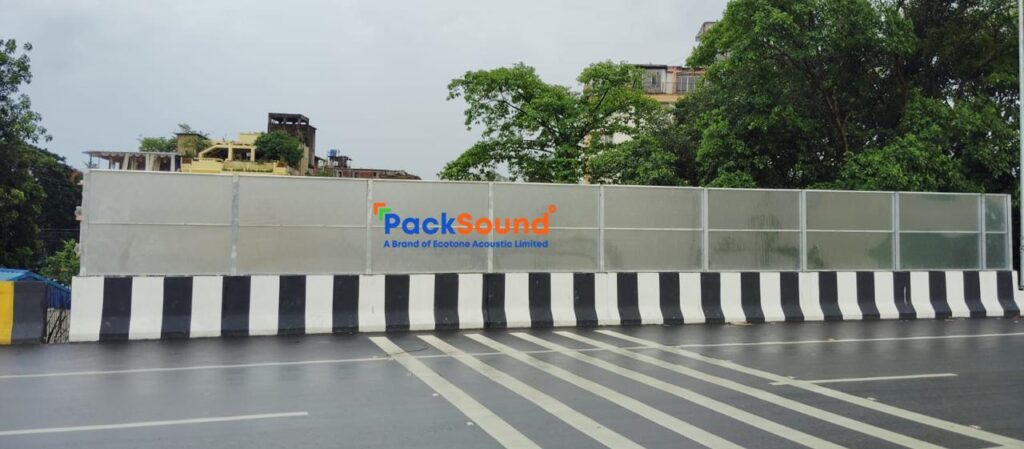
A Polycarbonate Noise Barrier is a transparent acoustic panel system that cuts traffic, rail, and industrial noise by 25 to 36 STC while keeping visibility intact. It suits highway authorities, metro corridors, factory boundaries, and residential complexes near busy roads. If you need noise control without blocking sunlight or sightlines, this is the panel category to specify. Ecotone Noise Barrier manufactures and installs these barriers pan-India, with in-house engineering support for site-specific STC targets.
It works through mass, damping, and airtight sealing, not absorption. Dense polycarbonate sheets resist sound wave transmission, while the panel-to-frame gasket seal stops leakage at the joints, which is usually where cheaply installed barriers fail.
A standard 10-15mm polycarbonate barrier from Ecotone achieves an STC rating of 32 to 36, which reduces perceived traffic or rail noise by roughly 50 percent to the human ear. Thicker sheets and staggered panel joints push this higher.
| Sheet Thickness | Typical STC Rating | Best Suited For |
|---|---|---|
| 10 mm | 32 | Residential boundary walls |
| 12 mm | 34 | Highway and arterial road frontage |
| 15 mm | 36 | Rail corridors, industrial plant boundaries |
Sound Transmission Class figures for polycarbonate barriers are commonly benchmarked against the European EN 1793 test series, the standard used internationally to evaluate airborne sound insulation for road traffic noise devices, as documented in CEDR’s technical report on managing road traffic noise.
| Parameter | Specification |
|---|---|
| Material | Virgin-grade UV-coated polycarbonate sheet |
| Thickness Options | 10 mm / 12 mm / 15 mm |
| STC Rating | 32 / 34 / 36 |
| Light Transmittance | 90% clear, 80% coloured |
| Tensile Strength | Minimum 60 N/mm² |
| Modulus of Elasticity | Minimum 2000 N/mm² |
| Fire Retardance | EN 1794-2, Annex A, Class 2 |
| Stone Impact Resistance | EN 1794-1, Annex C |
| Yellowing Index | Below 10 as per ASTM D 1925 |
| Frame Material | Hot-dip galvanized steel or aluminium |
| Panel Life Stability | Properties vary under 10% over 10 years |
| # | Key Benefits |
|---|---|
| 🔇 | Cuts road, rail, and plant noise by up to 36 STC |
| 👁️ | Keeps sightlines and daylight fully intact |
| 🛡️ | Survives stone impact, storms, and vandalism without cracking |
| ☀️ | UV coated and resists yellowing for a decade or more |
| ⚡ | Lighter than concrete, making installation faster and more cost-effective |
| 🔥 | Fire retardant to EN 1794-2 Class 2 |
| 🔧 | Low long-term maintenance with no repainting required |
| S.No. | Application Areas |
|---|---|
| 01 | Highways and Expressway Sound Walls |
| 02 | Metro and Railway Corridor Screens |
| 03 | Residential Complexes Facing Busy Roads |
| 04 | Industrial and Factory Plant Boundaries |
| 05 | Flyovers and Elevated Road Stretches |
| 06 | Schools and Hospitals Near Traffic |
| 07 | DG Set and Machinery Enclosure Surrounds |
| Step | Installation Process |
|---|---|
| 1 | Site survey and noise level assessment |
| 2 | Foundation and post layout marking |
| 3 | Galvanized steel or aluminium frame erection |
| 4 | Polycarbonate panel fitting with gasket seals |
| 5 | Joint sealing to prevent sound leakage |
| 6 | Ground-level acoustic sealing at base |
| 7 | Final inspection and STC verification |
| Myth | Reality |
|---|---|
| Transparent barriers cannot block real traffic noise | Polycarbonate barriers reach 32 to 36 STC, close to solid panels |
| Polycarbonate yellows and clouds up within a year or two | UV-coated sheets stay clear for a decade under ASTM D 1925 |
| Clear barriers are always more expensive than concrete | Lighter weight cuts installation and foundation costs significantly |
| Any polycarbonate sheet works fine as a noise barrier | Only acoustic-grade sheets with sealed frames deliver rated STC |
Ecotone Acoustics designs, fabricates, and installs polycarbonate noise barriers from its own manufacturing facility, which means STC ratings quoted in the proposal are the ones tested on site, not borrowed from a generic datasheet. As a polycarbonate noise barrier manufacturer working directly with highway contractors, metro agencies, and industrial clients across India, Ecotone handles structural design, panel fabrication, and frame installation under one roof, so acoustic performance is not lost in handoffs between a sheet supplier and a separate installation contractor.
Yes, a properly sealed polycarbonate barrier reaches 32 to 36 STC, cutting audible traffic noise noticeably.
Polycarbonate handles low-frequency noise and impact better; acrylic offers slightly clearer optical transparency.
UV-coated panels typically perform reliably for 10 or more years with minimal degradation.
Quality UV-coated sheets stay clear; uncoated or cheap sheets yellow within a few years.
Yes, they meet EN 1794-1 stone impact and high wind-load resistance standards.
12mm to 15mm is standard for highway and rail corridor sound insulation projects.
Yes, Ecotone’s panels meet EN 1794-2 Class 2 fire retardance requirements.
It reduces noise like a wall but keeps full visibility and natural daylight.
Polycarbonate is often cheaper overall due to lighter foundations and faster installation.
Specialized acoustic manufacturers like Ecotone handle design, fabrication, and on-site installation together.
[wpforms id=”7352″]