Call ✆ +91 9809802016 | 9891320678

Quick Answer: Sound absorbing materials for walls, reduce echo and reverberation inside a room by converting sound energy into heat as it passes through a porous or resonant surface. They do not block noise from entering a room. Ecotone manufactures the full range, tested to ASTM C423 and ISO 354, for offices, studios, schools, restaurants and auditoriums across India.
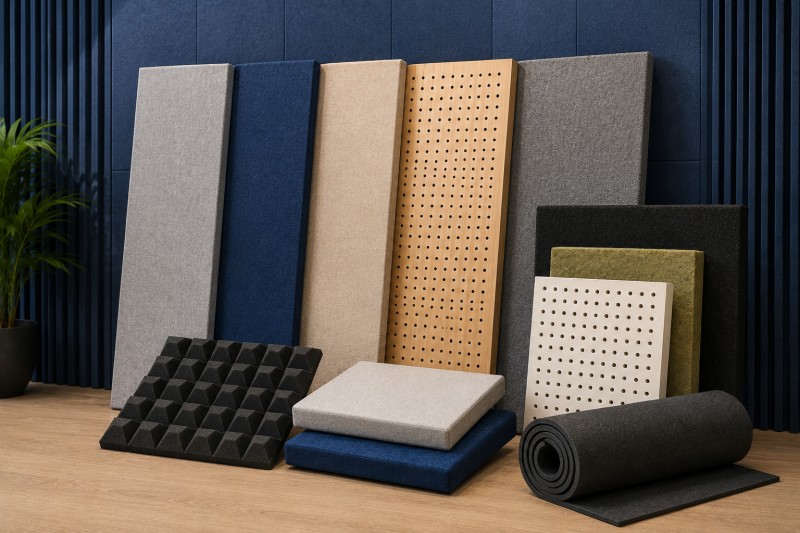
Sound absorbing materials are surface treatments, panels or sheets that pull sound energy out of a room instead of letting it bounce back. In plain terms: when you clap in an empty concrete room, the sound rings and lingers. Add sound absorbing materials to the walls, and that ring disappears because the material’s fibres or resonant cavity turn the sound wave into a tiny, harmless amount of heat. This is measured using the Noise Reduction Coefficient, a single number from 0 to 1 that averages a material’s absorption at 250, 500, 1000 and 2000 Hz, tested under the ASTM C423 reverberation room method, the standard test procedure used industry-wide to evaluate sound absorption. Noise Reduction Coefficient.
This range is built for architects, interior designers, facility managers, acoustic consultants and homeowners in India specifying sound absorbing materials for walls across five categories: acoustic foams, fabric wrapped panels, grooved panels, perforated panels and sound dampening sheets. It supports decisions for corporate offices, home theatres, schools, hospitality venues, studios and auditoriums, whether you are treating a single meeting room or an entire 5,000 sq. ft. facility. Use this page to compare NRC performance, shortlist a material by application, and get manufacturer-direct specifications before you contact our acoustic team.
| Material | Core Function | Best Suited For |
|---|---|---|
| Acoustic Foams | Open cell foam absorbs high frequency echo and flutter. | Home studios, podcast rooms, practice spaces. |
| Fabric Wrapped Panels | Fiberglass or rock wool core wrapped in acoustic fabric. | Boardrooms, offices, premium interiors. |
| Grooved Panels | Timber slats with slot resonance for mid frequency control. | Feature walls, hospitality, auditoriums. |
| Perforated Panels | Drilled timber or metal face with hidden absorption core. | Auditoriums, galleries, premium commercial spaces. |
| Micro Perforated Panels | Sub-1 mm perforations absorb sound through viscous friction without fibrous backing. | Museums, galleries, offices needing near-invisible acoustic treatment. |
| Sound Dampening Sheets | Thin, dense barrier layer for retrofit and partition lining. | Retrofit walls, partitions, ceiling voids. |
| Parameter | Value |
|---|---|
| Material Range | Acoustic Foam, Fabric Wrapped Panel, Grooved Panel, Perforated Panel, Sound Dampening Sheet |
| NRC Range | 0.60 to 1.00 (material and thickness dependent) |
| Thickness Range | 9 mm (sheets) to 100 mm (foam and panel assemblies) |
| Core Density | 24 to 80 kg/m³ depending on core material |
| Fire Rating | Class A / Class 1 on select wood and fiberglass range |
| Standard Panel Size | 600 × 1200 mm, 1200 × 2400 mm (Custom sizes available) |
| Test Standards | ASTM C423, ISO 354 |
| # | Specification |
|---|---|
| 1 | Core options: acoustic foam, fiberglass, rock wool, PET fiber |
| 2 | Facing: fabric wrap, perforated veneer, grooved timber, plain sheet |
| 3 | NRC rating from 0.60 to 1.00 depending on material selection |
| 4 | Thickness from 9 mm sheets to 100 mm foam profiles |
| 5 | Class A fire rating available on wood and fiberglass range |
| 6 | 40+ fabric shades, natural veneer, and paintable finishes |
| 7 | Bespoke panel sizes for site-specific wall layouts |
| # | Benefit |
|---|---|
| 1 | Cuts echo and reverberation for clearer speech and playback. |
| 2 | Reduces acoustic fatigue in offices, studios and classrooms. |
| 3 | Improves speech privacy across open plan work areas. |
| 4 | Adds design value through fabric, veneer and grooved finishes. |
| 5 | VOC free options suit schools, clinics and green buildings. |
| 6 | Lightweight sheets enable fast retrofit without structural rework. |
| 7 | Wide NRC range fits both budget and premium project briefs. |
| # | Application |
|---|---|
| 1 | Home theatres and media rooms needing echo control |
| 2 | Corporate boardrooms and open plan offices |
| 3 | Recording studios, podcast rooms and broadcast booths |
| 4 | Restaurants, cafes and hospitality interiors |
| 5 | Schools, classrooms and lecture halls |
| 6 | Auditoriums, multiplex halls and conference centres |
| 7 | Gyms, sports facilities and industrial control rooms |
| Myth | Reality |
|---|---|
| Thicker foam blocks outside noise completely | Foam absorbs echo only, while mass and proper sealing stop noise transfer. |
| Any fabric board qualifies as acoustic grade | Core density and panel thickness, not the fabric alone, determine the actual NRC performance. |
| Egg cartons work like acoustic foam panels | Egg cartons provide negligible sound absorption. Professionally tested acoustic foam performs significantly better. |
| More panels always sound better | Excessive absorption can make a room sound unnaturally dull and reduce speech warmth. |
| Perforated panels only suit industrial spaces | Modern perforated wooden acoustic panels complement premium hospitality, commercial, and corporate interiors. |
Most guides describe NRC numbers from a datasheet. After executing 350+ site installations across India, three patterns rarely get mentioned. First, painting a fabric wrapped panel with a non-breathable enamel coat after installation can drop its real world NRC by a noticeable margin, because the paint film seals the fabric’s open weave. Second, humid coastal and monsoon-exposed sites need moisture-tested cores; standard fiberglass panels installed without a vapour check have sagged within one season in our field visits. Third, clients frequently over-treat a single feature wall while leaving its parallel wall bare, which leaves flutter echo untouched even after spending the full acoustic budget. Correct placement across opposing walls matters more than panel count.
Yes, tested acoustic foam genuinely reduces high frequency echo, but it will not stop outside noise.
Absorption reduces in-room echo; soundproofing blocks noise transfer using mass, sealing and decoupling.
DIY panels help slightly but lack tested NRC data, core density control, and fire safety compliance.
Typically 25 to 40% wall coverage with NRC 0.85+ panels, depending on room size and use.
Foam suits budget home studios; fabric wrapped panels give higher NRC plus a premium finish.
No, panels absorb echo inside your room; they do not block sound coming through walls.
20 to 50 mm suits mid and high frequencies; 50 to 100 mm is needed for bass control.
Only when fire rated cores and fabrics are specified; always verify Class A certification before purchase.
Roughly ₹75 to ₹450 per sq. ft., depending on material, thickness, and finish specification.