
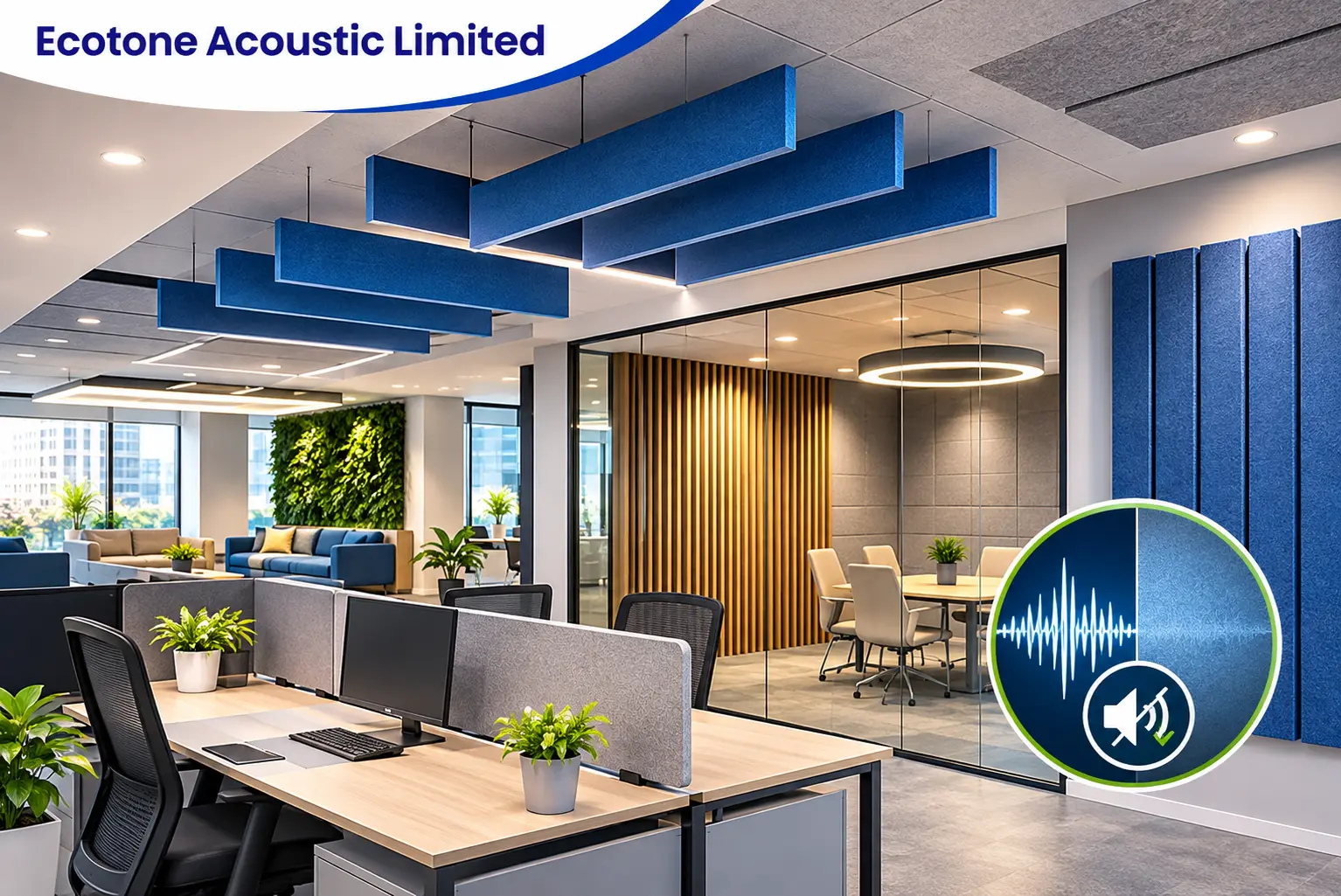
Noise costs businesses more than most owners realise. Staff lose focus in loud offices, hotel guests complain about lift and plant noise, and factories face notices when sound crosses the boundary. Good noise control solutions fix the problem at its source, along its path or at the room where people hear it. At Ecotone Acoustic Limited, we design and install these solutions for commercial and industrial projects across India.
What are noise control solutions?
Noise control is the planned reduction of unwanted sound. It works in three places:
- At the source: quieter equipment, enclosures and anti-vibration mounts.
- Along the path: walls, doors, barriers and sealed openings that stop sound travelling.
- At the receiver: absorbing panels and ceilings that reduce echo and background noise in the room.
The right answer is usually a mix of all three. That is why the first step is always measurement, not buying material.
Common noise problems in commercial buildings
| Space | Typical Problem | Main Solution |
|---|---|---|
| Open office | Echo and chatter, poor focus | Ceiling and wall absorbers, pods |
| Meeting rooms and cabins | Speech heard next door | Sealed partitions, MLV, acoustic doors |
| DG and plant rooms | Machine noise reaching offices | Enclosures, steel acoustic doors, duct treatment |
| Hotels | Noise between rooms, lift and banquet noise | Wall and floor insulation, doors |
| Factories | Noise at the boundary and inside workshops | Noise barriers, enclosures, absorbers |
| Construction sites | Short-term noise near neighbours | Mobile noise barriers |
Noise control in offices
Most office complaints come from echo and from speech passing between rooms. Hanging baffle ceilings and acoustic panels cut echo in open areas. For privacy, meeting rooms need partitions taken right up to the slab, sealed joints and a solid door. Where rooms must open into one hall, an acoustic sliding folding partition does the job. For quick private space without construction, acoustic office pods work well.
Noise control for DG sets, plant rooms and HVAC
Generators, chillers, pumps and air handling units are some of the loudest sources in a commercial building. Useful steps include:
- Heavy walls lined with PACKSOUND mass loaded vinyl and insulation.
- Acoustic steel doors with full perimeter seals.
- Acoustic louvres and attenuators on air inlets and exhausts.
- Anti-vibration mounts so noise does not travel through the structure.
- Duct lagging and silencers to stop noise reaching offices through the air system.
Industrial and outdoor noise control
Factories and infrastructure sites must keep noise at the boundary within legal limits. A noise barrier along the boundary, enclosures around loud machines and absorbers inside workshops are the usual mix. For temporary works such as piling or demolition, mobile noise barriers can be moved as the job progresses.
What are the CPCB noise limits?
India’s Noise Pollution (Regulation and Control) Rules, 2000 set ambient noise limits by area:
| Area | Day Limit dB(A) | Night Limit dB(A) |
|---|---|---|
| Industrial | 75 | 70 |
| Commercial | 65 | 55 |
| Residential | 55 | 45 |
| Silence zone | 50 | 40 |
Day time is 6 am to 10 pm and night time is 10 pm to 6 am. A site next to a residential area or a hospital may need to meet the stricter limit at that boundary.
Soundproofing vs noise control
The words are often used as if they mean the same thing. Soundproofing usually means stopping sound passing through a wall, floor or door. Noise control is the wider job: it covers soundproofing, echo control, machine treatment and outdoor barriers, all planned together to meet a target.
How a noise control project works
- Site survey: measure noise levels at the source and where people are affected.
- Target setting: agree the level needed, based on comfort, contracts or CPCB limits.
- Design: choose the mix of source, path and room treatment.
- Supply and installation: fit materials with proper sealing and detailing.
- Re-measurement: test again to confirm the target is met.
Working with an acoustic consultant who also manufactures and installs keeps the design practical and the responsibility with one team.
What affects the cost of noise control?
- How loud the source is and how quiet the receiver must be
- Size of the area and number of rooms or machines
- Materials needed: panels, partitions, doors, barriers or enclosures
- Working hours and access on a live site
A survey-based quote is far more accurate than a per-square-foot rate, because the solution depends on the problem.
Frequently asked questions
Can noise be reduced without major construction?
Often, yes. Absorbing panels, door seals, pods and enclosures can make a big difference with little civil work.
How much noise reduction is possible?
It depends on the source and the fix. A sealed wall build-up or a well designed barrier can reduce noise by a clearly noticeable amount; a survey tells you what is realistic for your site.
Do you work on running offices and factories?
Yes. Work can be planned in phases, at night or on weekends to avoid disturbing operations.
Get a noise control survey
Ecotone Acoustic Limited designs and installs noise control solutions for offices, hotels, hospitals, factories and infrastructure across India. See our completed projects, or contact our team to book a site survey.
