
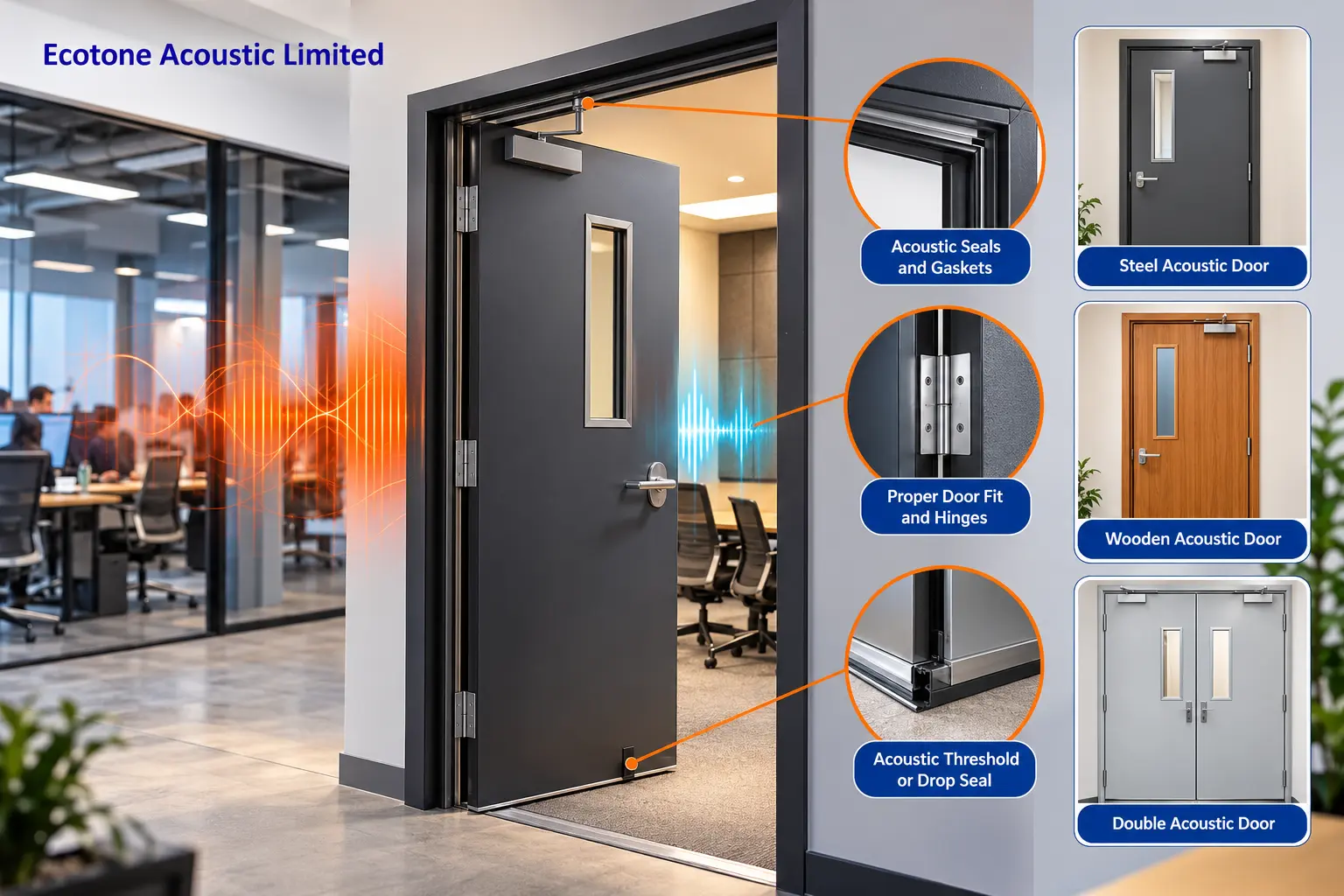
Acoustical doors are the quickest way to fix the weakest link in a quiet workspace. Walk through any busy office and you will notice the same thing: the walls hold up fine, but the doors let everything through. Voices, phone calls, footsteps and machine hum slip right past them.
If you are trying to figure out how to block sound from a door in a commercial space, the problem is usually easy to diagnose. The fix depends on how bad the noise is and how much you are willing to change. This guide covers why doors leak sound, which quick fixes are worth the money, and when it makes more sense to switch to acoustical doors.
Why a Normal Door Lets So Much Sound Through
A standard interior door is the weakest point in most rooms, for three reasons.
It is light. Most interior doors are hollow core, which means two thin skins with a honeycomb of cardboard between them. Sound waves make a hollow door vibrate like a drum, and that vibration carries the noise to the other side.
It has gaps. Sound behaves like water. If air can pass through a gap, sound will too. The space under the door, the edges along the frame and the area around the latch all let noise leak through. Even a gap of a few millimetres can undo a lot of good insulation in the wall.
It is poorly sealed. Most doors are fitted for easy opening and closing, not for acoustic performance. That means loose clearances and no proper seals.
Once you understand these three points, the solutions make a lot more sense. You need to add mass, close the gaps, or do both.
Quick Fixes to Block Sound From a Door
If you are not ready to replace the door, start here. These fixes cost little and can make a noticeable difference.
1. Seal the gaps first
This is the cheapest and most effective step. Check the door with the lights off in the room and a torch on the other side. Any light you see is a path for sound.
- Fit adhesive foam or rubber weatherstripping around the frame.
- Add a door sweep or automatic door bottom to close the gap at the floor.
- Use acoustic sealant around the frame where it meets the wall.
Sealing alone often cuts noise by a clear margin, especially for speech and mid-range sounds.
2. Add mass to the door
Heavier doors block more sound. If your door is hollow, you can add weight with mass loaded vinyl or a dense acoustic panel fixed to the surface.
3. Fill the hollow core
Some facility teams drill small holes and fill hollow doors with dense insulation material. It works to a degree, but it is fiddly and you lose the door’s original finish. For anything more than a mild noise problem, it is not worth the effort.
4. Treat the room, too
If sound bounces around inside the room, it feels louder than it is. Acoustic wall panels, ceiling baffles and soft furnishings reduce echo and make the whole space feel quieter.
When Quick Fixes Are Not Enough
DIY fixes have limits. If you are dealing with any of the following, you need a better solution than foam strips:
- Open plan offices where private calls and meetings need real privacy
- Conference rooms and boardrooms
- Recording studios, podcast rooms and broadcast booths
- Hospitals, clinics and consulting rooms
- Hotels and guest rooms
- Factories with control rooms next to loud machinery
In these cases the door itself needs to do more of the work. That is where acoustical doors come in.
What Are Acoustical Doors?
Acoustical doors are built specifically to reduce sound transfer. Instead of a light hollow shell, they use a dense, layered core made from materials such as high density board, gypsum, damping layers or mineral wool. They come fitted into a frame with proper perimeter seals and an automatic drop seal at the bottom, so the gaps are handled from the start.
The key number to look at is the STC rating (Sound Transmission Class). The higher the STC, the better the door blocks airborne sound. A normal hollow core door sits somewhere around STC 20 to 25. Good acoustical doors can reach the mid 30s, 40s and beyond, depending on construction. A rough guide:
| STC Rating | What You Hear |
|---|---|
| 25 | Normal speech is easily understood |
| 30 | Loud speech is audible but hard to follow |
| 35 | Loud speech is heard as a murmur |
| 40 to 45 | Loud speech is barely audible |
| 50+ | Most sounds are blocked |
When you compare products, always ask for tested STC values for the complete door set, not just the door leaf. A great door in a poor frame will not perform.
Why Choose Acoustical Wooden Doors?
Many buyers assume that soundproofing means a heavy steel door that looks like it belongs in a factory. That is not always the case. Acoustical wooden doors give you strong sound control while still looking like a proper part of your interior.
Here is why they are popular for offices, clinics and hospitality spaces:
They look good. Wooden doors come in veneers, laminates and finishes that match your office furniture, wall panels and joinery. You get privacy without a clinical look.
They offer solid performance. A well made acoustical wooden door uses a dense core, tight tolerances and quality seals. This brings noise down to a comfortable level for meetings, calls and focused work.
They are easier to install. Compared with specialist steel or double leaf systems, wooden acoustical doors fit into standard openings with less structural work.
They are comfortable to use. The weight is manageable, so staff and visitors do not have to wrestle with them all day.
They are flexible. You can choose vision panels, fire ratings, different swing directions and various hardware options to suit the space.
For most commercial interiors, acoustical wooden doors strike the best balance between performance, appearance and budget.
How to Choose the Right Acoustical Door
Before you buy, run through this short checklist.
Know your noise problem. Is it speech, music, machinery or traffic? Low frequency noise like bass and machines needs heavier construction than speech.
Pick a target STC rating. A meeting room may be fine at STC 35 to 40. A recording studio or a plant control room needs higher.
Buy the full system. Door, frame, seals and threshold should all work together.
Check the wall. If the partition has poor insulation, a great door will not fix the leak. Sound will take the weaker route.
Think about fire and safety needs. Many commercial spaces need doors that are both acoustic and fire rated.
Plan for correct installation. Even the best door fails if it is hung badly. Gaps and misaligned seals ruin performance.
Common Mistakes to Avoid
- Spending on a heavy door but ignoring the gap at the bottom
- Using foam egg crate sheets and expecting them to block sound (they absorb echo but do very little to stop transmission)
- Fitting one acoustical door in a room with a thin partition wall next to it
- Choosing a door based on thickness alone, without checking tested STC data
- Leaving air vents and ducts open near the door
How Ecotone Acoustics Limited Can Help
Ecotone Acoustics Limited supplies acoustic solutions for offices, studios, clinics, hotels and industrial facilities that need real noise control, not just good looking surfaces. Our range of acoustical doors and acoustical wooden doors is designed to deliver tested sound reduction without compromising on finish or day to day usability.
Whether you are planning a quiet conference room, a private cabin or a studio entry, share your requirements with our team and we will help you match the right door to your wall construction and noise targets.
Final Thoughts
Learning how to block sound from a door comes down to three ideas: add mass, seal every gap, and match the solution to the problem. Simple weatherstripping and a door sweep can help with light noise. For serious privacy and long term performance, acoustical doors are the dependable choice, and acoustical wooden doors give you that performance in a finish that suits any commercial interior.
Ready to quiet your workspace? Contact Ecotone Acoustics Limited to discuss your project and find the right acoustical door.
Frequently Asked Questions
Yes. Seal the gaps, add a door sweep, and increase the mass of the door with acoustic panels or mass loaded vinyl. This works well for light to moderate noise.
Dense, heavy materials work best. A solid core with multiple layers, quality seals and a drop seal at the bottom outperforms any single add-on material.
No door is completely soundproof, but a properly built acoustical wooden door can reduce speech to a faint murmur or less, depending on its STC rating and installation.
Not always. Density, core construction and sealing matter more than thickness alone.
For private offices and meeting rooms, STC 35 to 40 is a common target. Higher ratings suit studios and sensitive spaces.
