
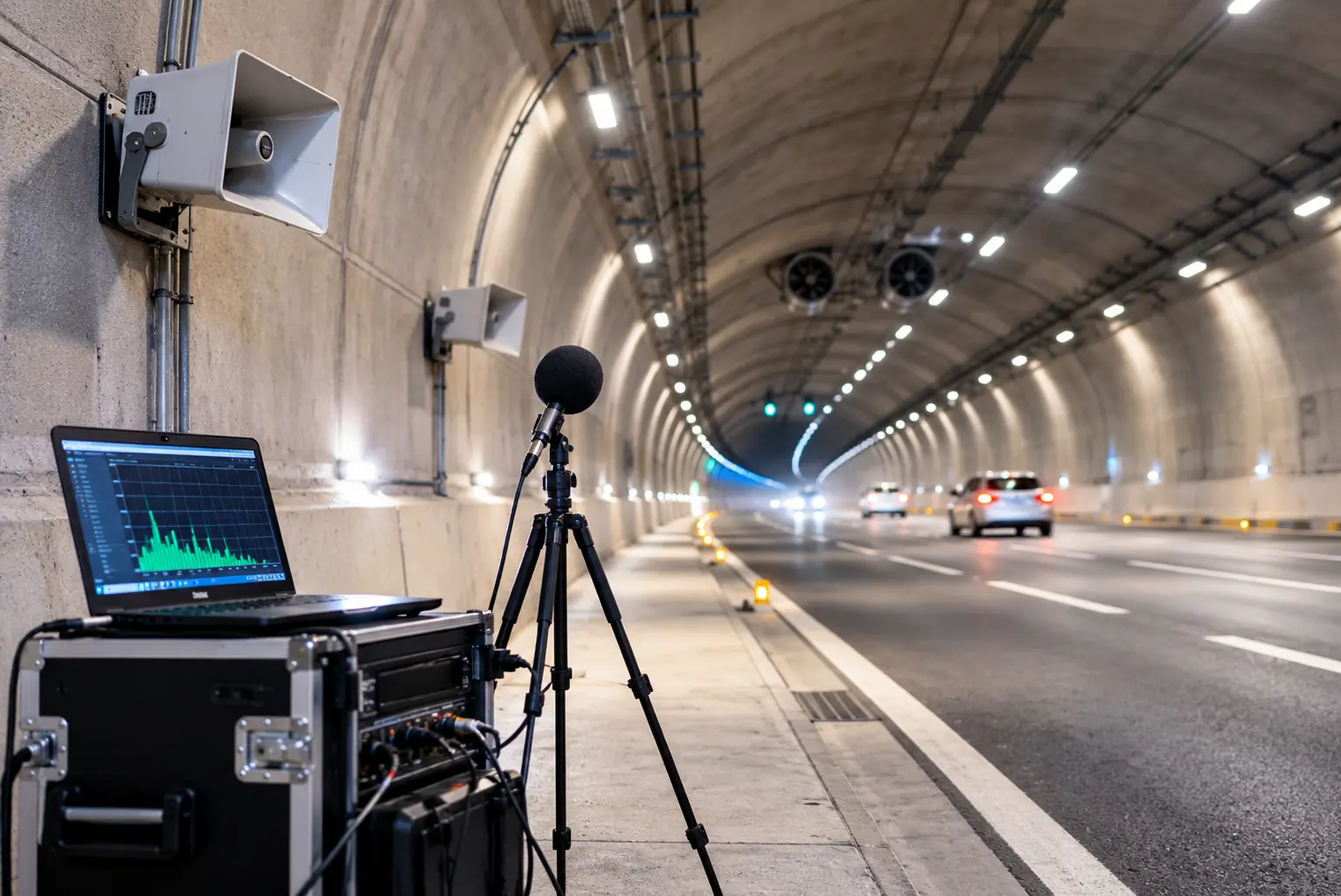
When a fire alarm sounds inside a metro tunnel or an underground car park, the announcement that follows has one job: people must understand it the first time. In a long concrete tube full of fan noise and echo, that is harder than it sounds. This is exactly what SIT testing for tunnels checks.
In the industry the test is properly called STI testing, short for Speech Transmission Index. Many project documents and tenders in India write it as SIT, but both refer to the same thing: a measured score that shows how clearly speech from the public address (PA) and voice alarm system reaches people in the tunnel. This guide explains how the test works, what score you should aim for and what to do when a tunnel does not pass.
What is SIT (STI) testing for tunnels?
STI is a number between 0 and 1 that rates how well speech is carried from a loudspeaker to a listener. A score close to 1 means almost every word is clear. A score close to 0 means speech turns into noise. The method is defined in the international standard IEC 60268-16, and the score does not depend on the language being spoken, which makes it useful for Indian projects where announcements may be in Hindi, English and a regional language.
For PA and voice alarm systems, testers use a faster version called STIPA (STI for Public Address). A special test signal is played through the installed loudspeakers and a calibrated meter records the result at each listening point. One reading takes around 15 to 25 seconds, so a full tunnel can be tested in a single planned shutdown.
| STI Score | Rating | What People Hear |
|---|---|---|
| 0 to 0.30 | Bad | Most words are lost |
| 0.30 to 0.45 | Poor | Only short, familiar phrases get through |
| 0.45 to 0.60 | Fair | Most messages are understood with effort |
| 0.60 to 0.75 | Good | Clear speech with little effort |
| 0.75 to 1.00 | Excellent | Near perfect clarity |
Why tunnels need speech intelligibility testing
Tunnels are some of the hardest spaces to get right acoustically. Three things work against clear speech:
- Long reverberation. Bare concrete, tiled walls and track beds reflect sound again and again. In a long tunnel the reverberation time (RT60) can run to several seconds, so each word blurs into the next.
- High background noise. Jet fans, ventilation shafts, traffic, trains and pumps all raise the noise floor. An announcement has to be heard above all of it.
- Long distances and late echoes. Loudspeakers are spaced along the tunnel, so sound from a distant speaker can arrive late and act like an echo of the nearest one.
In an emergency, people may need to find the nearest cross passage, escape door or refuge. If the announcement is unclear, they lose time. That is why metro authorities, highway agencies, airport operators and owners of large commercial complexes ask for measured STI results before handover, not just a working amplifier.
Where SIT testing is used in commercial and infrastructure projects
- Metro and rail tunnels, including platforms, concourses and cross passages
- Road and highway tunnels with jet fan ventilation
- Airport tunnels, baggage tunnels and underground walkways
- Basement car parks in malls, office parks and hotels
- Service and utility tunnels in large commercial campuses and industrial plants
Our tunnel acoustics work covers each of these, from early design checks to final testing.
What STI score does a tunnel need?
There is no single number that fits every tunnel, because the target is set by the project specification, the client and the fire safety design. As a general guide, an STI of 0.50 or higher is considered acceptable for most public address and voice alarm uses, and many specifications ask for an average of about 0.50 across the measured area with no single point falling far below it.
Before testing starts, agree three things in writing: the target average STI, the lowest acceptable value at any single point, and which areas are included. Escape routes, platforms and cross passages usually matter more than plant rooms that people rarely occupy.
How SIT testing for tunnels is carried out
A good test is planned as carefully as the system itself. A typical process looks like this:
- Review drawings and the PA design. Check loudspeaker layout, spacing, zoning, delay settings and the areas the system must cover.
- Agree targets and measurement points. Points are marked along the tunnel, at platforms, at cross passages and along escape routes, at roughly head height.
- Measure background noise. Readings are taken with the tunnel in its normal operating state, for example with ventilation fans running, because that is when announcements must work.
- Measure reverberation time (RT60). This shows how long sound lingers and explains many low STI results.
- Run the STIPA test. The test signal is played through the installed system at the normal announcement level and the STI is recorded at every point.
- Report the results. Each point is listed against the target, with a clear pass or fail and a plan for any area that falls short.
- Fix and retest. After corrections, the failed areas are measured again so the final report shows the tunnel meets the agreed target.
Testing is normally done during a night shutdown or a planned possession so trains and traffic do not affect the readings or create safety risks for the team.
Why tunnels fail STI tests
| Problem | What Causes It | Typical Fix |
|---|---|---|
| Low STI along the whole tunnel | Long RT60 from hard surfaces | Add sound absorbing panels on walls or soffit |
| Low STI only when fans run | Background noise too high | Raise announcement level, add speakers, reduce fan noise |
| Low STI between speakers | Speakers too far apart or wrong angle | Add or re-aim speakers |
| Echo-like blurring | Late sound from distant speakers | Set correct delay and zoning |
| Poor results near portals and shafts | Outside noise and open ends | Local absorption and barriers |
How to improve speech intelligibility in a tunnel
Most failures come from either too much reverberation or too little signal above the noise. The right fix depends on which one is to blame, which is why measurement comes first.
Reduce reverberation with absorption
Weather resistant acoustic panels fixed to tunnel walls or the soffit shorten the reverberation time and make each word stand out. Materials must handle moisture, dust, vibration, washing and fire safety rules. Perforated metal panels with mineral wool infill, similar to the systems used in our metallic noise barriers, are a common choice. You can read more about suitable sound absorbing materials for demanding spaces.
Improve the PA system itself
Closer loudspeaker spacing, better aiming, directional speakers and correct delay settings often lift STI without major civil work. In many tunnels a mix of absorption and PA tuning gives the best result for the budget.
Control background noise
Where fans or traffic dominate, look at attenuators on ventilation equipment, barriers near portals and, where possible, reducing fan speed during announcements. Our noise barrier team can help where outside noise enters through tunnel openings.
Treat stations, concourses and underground halls
Platforms and concourses connected to the tunnel often have high ceilings and hard finishes. Hanging baffle ceilings and wall panels work well here because they absorb sound without blocking lights, sprinklers or air flow.
Plan for STI at the design stage
The cheapest time to get speech intelligibility right is before the tunnel is built. An acoustic model at design stage predicts RT60 and STI, so speaker spacing and absorption can be planned into the drawings instead of being added after a failed test. Our acoustic design consultancy team works with civil, MEP and systems contractors to set realistic targets and the details needed to meet them.
Choosing a tunnel acoustic testing partner
When you appoint someone for SIT testing for tunnels, check that they:
- Use calibrated, STIPA capable meters and can share calibration certificates
- Test to IEC 60268-16 and to the project specification
- Measure RT60 and background noise, not just STI, so they can explain why a result is low
- Can recommend and supply practical fixes, then retest the same points
- Have worked on live infrastructure sites and understand shutdown and safety procedures
As an acoustic consultant that also manufactures and installs acoustic products, Ecotone can take a tunnel from first measurement to a passing retest under one team. See our completed projects for the kind of commercial and infrastructure work we handle.
Frequently asked questions
Yes. STI (Speech Transmission Index) is the correct name. SIT is a common way of writing it in Indian tenders and site documents. Both refer to the same speech intelligibility test.
STI and STIPA are defined in IEC 60268-16. Fire and voice alarm codes used on many projects refer to this method, and the project specification sets the exact pass value.
Each STIPA reading takes well under a minute. A full tunnel, including setup, background noise and RT60 readings, is usually completed over one or a few night shutdowns depending on its length and the number of zones.
Sometimes. If the main issue is speaker spacing, aiming or delay, tuning can be enough. If reverberation is very long, absorption is usually needed as well.
Both. Existing tunnels are often tested after a PA upgrade, a fire safety audit or complaints that announcements are hard to follow.
Get your tunnel tested
If you are commissioning a metro, road or underground commercial project, or you need to check an existing tunnel, contact our team for a site assessment. Share the tunnel length, PA layout and target STI, and we will propose a testing plan and, where needed, customized acoustic solutions to meet it.
