
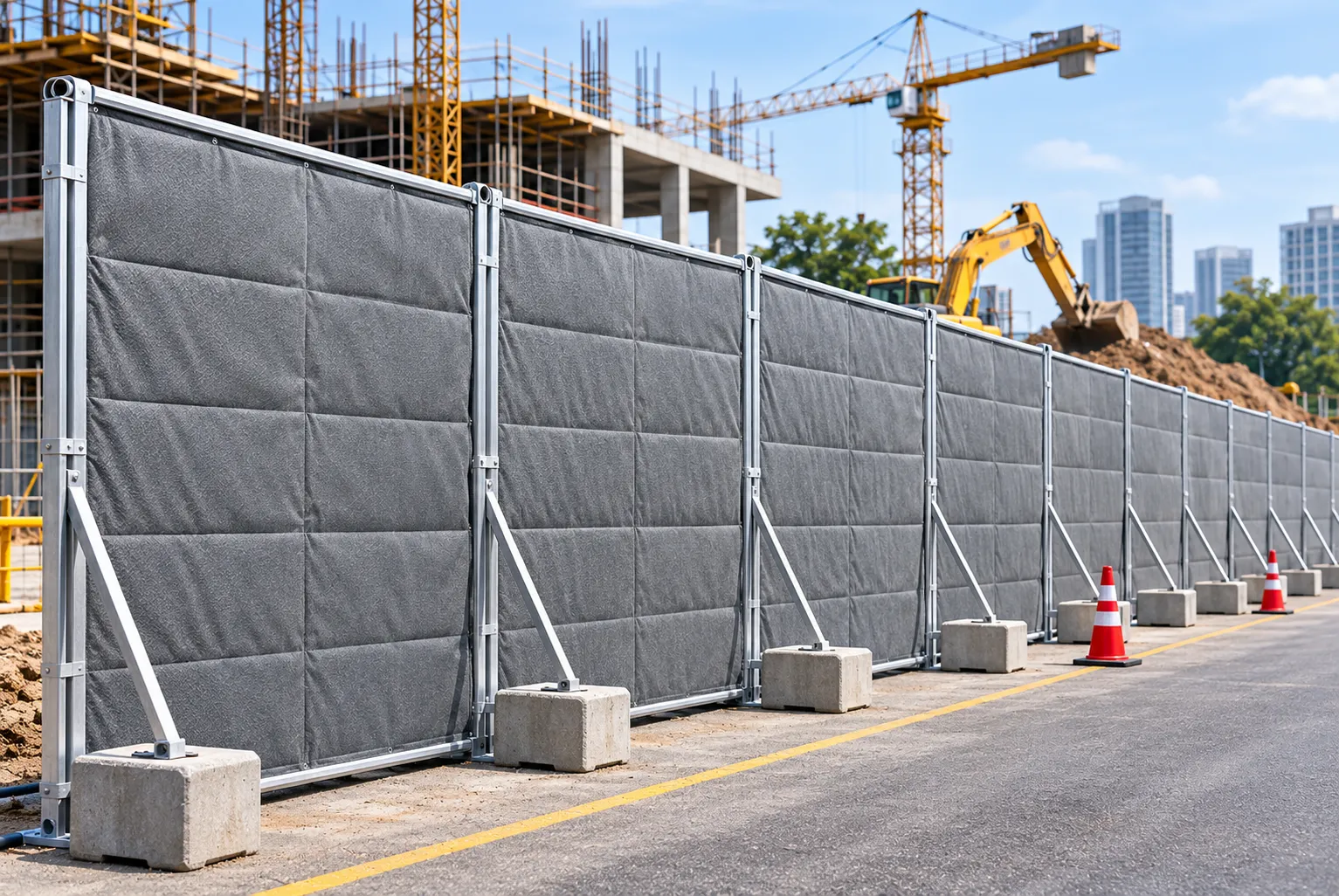
Summary: A temporary noise barrier is a freestanding acoustic screen that blocks noise between a source and its neighbours without foundation work. Mounted on wheels, skids or ballast blocks, it can be set up in hours and moved when the work moves. Field performance is typically 15 to 30 dB(A) at the receiver, depending on barrier height, distance and panel density. It is used on construction sites, around DG sets, at events and in industrial units that must meet CPCB noise limits.
Key Takeaways
- A temporary noise barrier reduces noise by blocking the direct path from source to receiver. It works best when it breaks the line of sight.
- Realistic reduction is 15 to 30 dB(A). It is not a magic fix for every noise problem.
- Ecotone mobile barrier panels are 50 mm to 100 mm thick, with core density of 25 to 40 kg/sqm and STC 25 to 35.
- A common rule for DG sets is a barrier about 1.5 times the height of the noise source, measured from the source.
- Gaps, short length and low height reduce performance quickly, so layout matters as much as the panel.
- Low frequency generator noise is the hardest to control; an enclosure often works better than a screen alone.
Why Temporary Noise Barriers Matter
A piling rig, breaker or generator can produce very high noise levels close to the machine, often in the range of 85 to 100 dB(A) at a short distance. When that work sits next to homes, hospitals, schools or offices, complaints, stop work notices and delays follow. Building a masonry wall is slow, costly and permanent. A mobile solution solves the problem at the source and travels with the job.
That is why temporary noise barrier walls are now a standard part of site planning for contractors, facility managers and event organisers across India. Ecotone Acoustic Limited, with 40+ years of acoustic experience and 500+ projects delivered, supplies these systems under the Ecotone Acoustic Limited brand. You can see the full product on our mobile noise barrier page.
How a Temporary Sound Barrier Wall Works
Sound travels from a source to a receiver along the shortest path. A temporary sound barrier wall interrupts that path in three ways:
- Blocking: the dense solid back of the panel stops sound from passing straight through. This is measured by STC.
- Absorbing: the sound absorbing face turned toward the noise soaks up energy and reduces reflections bouncing around the site.
- Diffraction control: sound still bends over the top and around the ends, so height and length decide how much quiet you get behind the screen.
Each Ecotone unit has a sturdy frame, an absorbing face toward the noise and a solid back, set on wheels, skids or ballast blocks so it stays stable in wind. Panels lock together to form a continuous screen around generators, piling rigs, breakers or stages. For the material side of this, see our guide to sound absorbing materials.
Technical Data: Mobile Noise Barrier Specifications
Height, length, base type, finish and the absorbing face can all be customised. A barrier around a DG set needs to be taller and heavier than one used to screen a short outdoor event, so we size each barrier from your noise readings and the distance to the nearest neighbours. Read more about the customised noise barrier range.
How Much Noise Reduction Can You Expect?
Realistic field performance of temporary noise barriers is 15 to 30 dB(A), depending on three things:
- Barrier height: taller screens break the line of sight to more receivers.
- Distance from source: a barrier close to the source works better than one close to the receiver.
- Panel density: heavier panels (25 to 40 kg/sqm) block more sound, especially at low frequency.
A reduction of 10 dB is heard as roughly halving the loudness, so even the lower end of the range is a clear improvement for neighbours.
CPCB Noise Limits You Need to Design For
India’s Noise Pollution (Regulation and Control) Rules set ambient limits by area type. Day is 6 am to 10 pm and night is 10 pm to 6 am.
| Area Type | Day Limit dB(A) | Night Limit dB(A) |
|---|---|---|
| Industrial | 75 | 70 |
| Commercial | 65 | 55 |
| Residential | 55 | 45 |
| Silence Zone (Hospitals, Schools, Courts) | 50 | 40 |
A well placed temporary noise barrier can bring many construction zone readings within the residential limits of 55 dB by day and 45 dB by night. Always confirm the current limits with your local pollution control board before finalising the design.
Where Are Temporary Noise Barriers Used?
- Construction sites: piling, breakers, concrete cutting and crushers near residential boundaries.
- DG sets and utilities: temporary generators in commercial complexes and during power cuts.
- Outdoor events: festivals, weddings and concerts that need to protect nearby neighbourhoods.
- Industrial units: compressors and pumps during inspection windows.
- Metro rail and highway projects: EPC contractors who need barriers that move with the work front.
- Hospitals and schools under renovation: to keep quiet zones within limits during works.
For permanent roadside or boundary needs, look at our polycarbonate noise barrier and metallic noise barrier. For tunnels and long linear projects, see tunnel acoustics.
Benefits of Temporary Noise Barriers
- No foundation work. Set up the same day, with no civil approvals in most cases.
- Relocatable. Move the screen as the noise source moves, then reuse it on the next project.
- Faster compliance. Helps you stay within CPCB limits and avoid complaints and stoppages.
- Weather resistant. Galvanised frames and durable panels handle monsoon exposure and uneven ground.
- Customisable. Height, length, base and finish are matched to the site.
- Lower cost than permanent walls for short and medium duration works, with rental available on project basis.
Temporary Noise Barrier vs Permanent Acoustic Barrier
If a supplier quotes a fixed steel or polycarbonate wall with no wheels or base plate, that is a permanent barrier, not a temporary one. The terms acoustic barrier, mobile sound barrier and portable sound reduction panel are often used loosely, so check the base and mounting system before you compare quotes.
How to Choose the Right Temporary Noise Barrier
- Measure the source. Note the noise level at 1 m and the height of the equipment.
- Locate the receiver. Find the nearest homes, offices or sensitive areas and the distance to them.
- Set the height. For DG sets, aim for roughly 1.5 times the source height, measured from the source.
- Plan the layout. Make the screen long enough to avoid sound wrapping around the ends, and keep gaps between panels sealed.
- Choose the base. Wheels for frequent moves, skids for rough ground, ballast blocks for wind exposure.
- Match the STC. STC 25 to 30 handles most equipment; go higher near hospitals or schools.
- Get a site survey. Our team can assess the site and recommend the layout.
For complex projects, our acoustic design consultancy and acoustic consultant teams can model the noise and design the barrier.
Installation Process
- Site survey and noise reading to fix the target reduction.
- Layout and sizing of panel height, length and base type.
- Delivery and positioning by hand, trolley, forklift or crane.
- Locking panels together into a continuous screen with sealed joints.
- Stabilising the base with ballast, skid fixing or wheel locks.
- Verification with a noise reading at the receiver after setup.
- Relocation when the work front moves, with no rebuild.
Myths vs Reality
- Myth: any screen will cut noise by half. Reality: gaps, low height and a wrong position can reduce performance sharply.
- Myth: a barrier fixes low frequency rumble. Reality: low frequencies bend around barriers, so enclosures work better for gensets.
- Myth: thicker is always better. Reality: density and sealing matter more than raw thickness.
- Myth: temporary barriers need a permit. Reality: generally no permit is needed, but check local municipal or CPCB norms.
Buy or Rent Temporary Noise Barriers?
Renting suits short term sites, one off events and trial periods. Buying suits contractors who move between projects, because the panels can be reused many times. Ecotone offers project based rental for short term sites, and pricing depends on height, material and quantity, so we give a site specific quote instead of a fixed price list.
Why Choose Ecotone Acoustic Limited
- 40+ years of acoustic experience and 500+ projects delivered across India.
- In house manufacturing at our Greater Noida facility, with panels sized to your site.
- Survey, supply and installation across India from one team.
- Built for Indian conditions: monsoon exposure, uneven ground and CPCB compliance deadlines.
- Wider range: from mobile barriers to acoustic panels and soundproof sheets, so one supplier can cover site and building noise.
See our projects to understand the scale we work at.
Frequently Asked Questions
Get a Site Specific Quote for Your Temporary Noise Barrier
Tell us your noise source, site layout and the nearest receiver, and our acoustic engineers will recommend the right height, base and quantity. Request a free quote or call +91 98098 02016, or email Sales@packsound.in.
Explore the full mobile noise barrier product page or browse all noise barrier solutions.
