
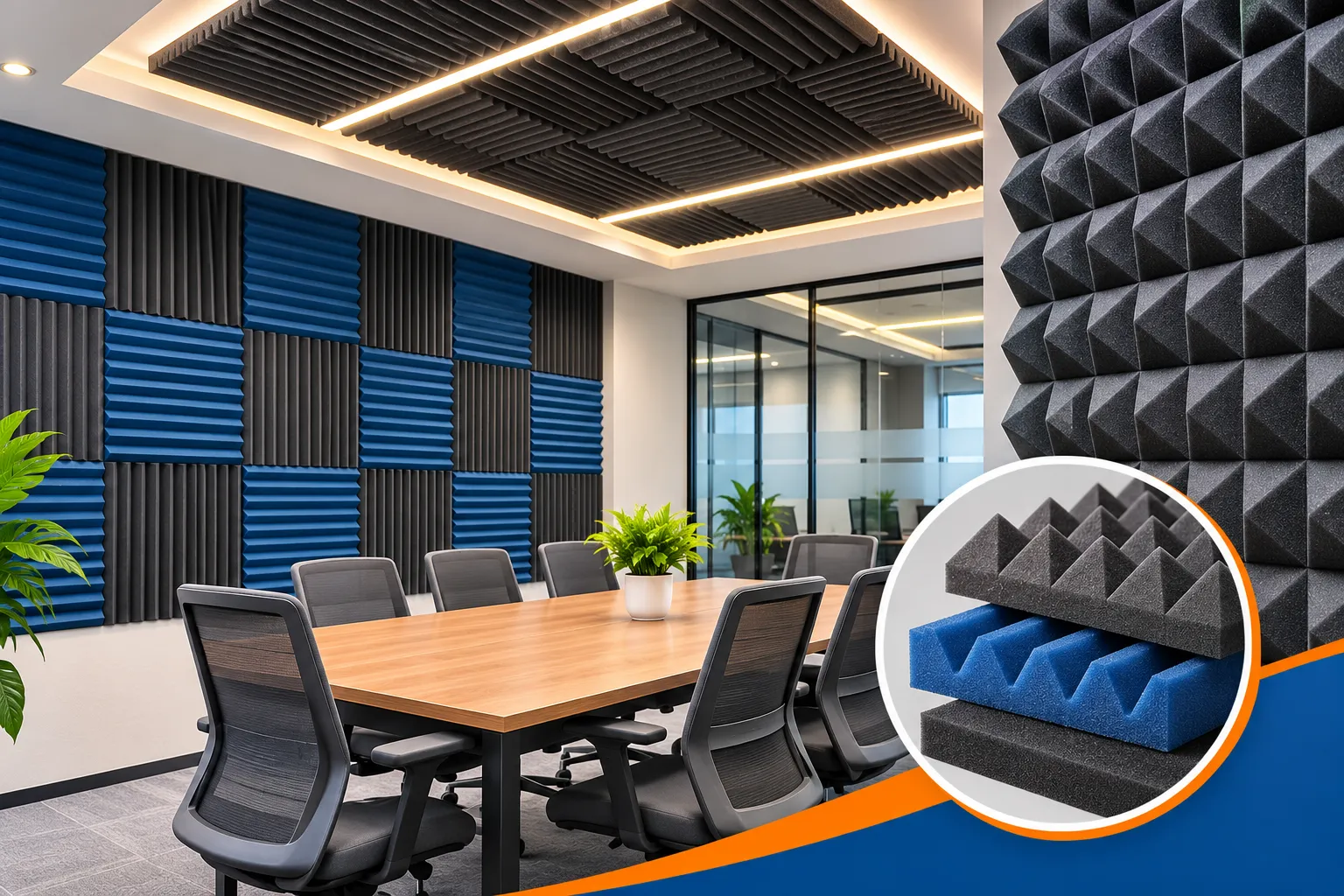
Open offices that hum all day, conference rooms where every voice bounces off glass, and call centres where agents struggle to hear customers all share one problem: too much reflected sound. Acoustic foam panels are one of the quickest and most affordable ways to bring that echo under control. At Ecotone Acoustic Limited, we supply and install foam treatment for offices, studios and commercial facilities across India.
This guide explains what acoustic foam does, which profile and thickness to choose, how much area to cover and what to check for fire safety in commercial buildings.
What are acoustic foam panels?
Acoustic foam panels are open-cell foam tiles, usually made of polyurethane or melamine, that absorb sound striking a wall or ceiling. Sound enters the open cells, loses energy as friction and turns into a tiny amount of heat. The result is less echo, lower background noise and clearer speech inside the room.
Foam is light, easy to cut and fixes directly to walls and ceilings with adhesive, which makes it a quick fix for existing commercial rooms. You can see our range on the acoustic foam panels page.
Do acoustic foam panels soundproof a room?
No, and this is the most common misunderstanding. Foam absorbs sound inside a room; it does not block sound passing through walls. If your problem is noise from the next cabin, a corridor or a DG room, you need mass and sealing, such as PACKSOUND mass loaded vinyl or other soundproof sheets. Many projects use both: a soundproof wall build-up to stop noise coming in, and foam to make the room itself sound clear.
Types of acoustic foam profiles
| Profile | Best For | Notes |
|---|---|---|
| Flat panels | Offices, meeting rooms, ceilings | Clean look, easy to cover with fabric |
| Wedge | Studios, broadcast rooms, control rooms | Good mid and high absorption, classic studio look |
| Pyramid | Studios, training rooms, conference walls | Even absorption from many angles, slight diffusion |
| Egg crate | Call centres, equipment rooms | Affordable, good surface area |
| Bass trap corners | Studios, AV rooms, small halls | Thicker blocks for low frequencies in corners |
| Melamine foam | Public buildings, hospitals, auditoriums | Higher fire rating and stable in humidity |
Which thickness should you choose?
Thicker foam absorbs more sound and reaches lower frequencies. Based on PackSound product data, NRC ranges from about 0.55 for 25 mm panels to about 0.95 for 100 mm panels.
| Thickness | Typical NRC | Commercial Use |
|---|---|---|
| 25 mm | About 0.55 | Light echo control, small cabins, ceilings |
| 50 mm | Between the two | Meeting rooms, offices, call centres |
| 75 mm | Higher | Training rooms, studios, AV rooms |
| 100 mm | About 0.95 | Broadcast studios, control rooms, bass control |
Foam mainly controls mid and high frequencies, which covers most speech. For deep machine hum or heavy bass, add corner bass traps or use thicker sound absorbing materials such as mineral wool panels.
How much wall area should you cover?
You rarely need to cover every wall. A useful starting point for commercial rooms:
| Space | Suggested Coverage |
|---|---|
| Corporate meeting rooms | 25 to 35 percent of walls |
| Training rooms and classrooms | 20 to 30 percent of rear and side walls |
| Server and equipment rooms | 40 percent or more |
| Broadcast and recording studios | 40 to 60 percent of walls, plus ceiling reflection points |
Too little foam leaves echo in place; too much can make a room feel dull. Start with the surfaces closest to the people speaking and the points where sound first reflects, then add more if needed.
Where to place foam panels in commercial rooms
- Meeting rooms: side walls at seated head height and the wall behind the screen.
- Open offices: ceiling areas above desks, partitions and walls near collaboration zones.
- Call centres: walls and ceilings around agent clusters to lower background chatter.
- Studios and podcast rooms: first reflection points beside and behind the speaker, plus corners.
- DG and compressor canopies: inside the enclosure lining, using foam made for that purpose.
A small air gap behind the foam can improve absorption at lower frequencies. In rooms with high ceilings, hanging baffle ceilings can work better than wall foam alone.
Are acoustic foam panels fire safe?
This is critical for commercial buildings. Ordinary polyurethane foam can burn easily, so standard foam should never be used in public spaces. Always specify fire retardant foam and ask for the fire test report. PackSound foam is available in Class B fire retardant grade, and melamine foam offers a Class A option where fire norms are strict.
In auditoriums, hospitals, malls and restaurants, check the fire requirements with your fire consultant before choosing foam. Where foam is not allowed, fabric wrapped or PET acoustic panels are a good alternative.
Acoustic foam vs other sound absorbing panels
| Option | Strength | Watch Out For |
|---|---|---|
| Acoustic foam | Low cost, quick to install, strong mid and high absorption | Fire grade, dust in some rooms, studio look |
| Fabric wrapped panels | Premium look for offices and boardrooms | Higher cost |
| PET felt panels | Durable, colourful, often recycled content | Lower absorption at thin sizes |
| Mineral wool panels | Very good broadband absorption | Needs facing or fabric |
Compare the options on our sound dampening panels page, or speak to our acoustic consultants for a recommendation based on your room.
Common mistakes to avoid
- Buying foam to stop noise from another room, when the real need is soundproofing
- Using non fire retardant foam in a commercial or public building
- Covering only one wall and leaving parallel hard walls facing each other
- Choosing very thin foam for rooms with low frequency noise
- Ignoring cleaning access in dusty or humid spaces
Frequently asked questions
How long do acoustic foam panels last?
Indoors and away from direct sunlight, good quality foam lasts several years. Fire retardant and melamine grades are better suited to long-term commercial use.
Can foam be used in open offices?
Yes, on ceilings, partitions and selected walls. Many offices combine foam with acoustic office pods for private calls.
How are foam panels installed?
Most panels are fixed with spray or contact adhesive directly to painted walls, plaster, wood or metal. Larger projects may use boards or frames for easy removal.
What size are foam panels?
A common size is 600 x 600 mm, with custom sizes available for large walls and ceilings.
Get the right foam for your space
Ecotone Acoustic Limited supplies and installs fire retardant acoustic foam panels for offices, meeting rooms, call centres, studios and commercial facilities across India. See our completed projects, or contact our team with your room size and problem for a free recommendation.
