
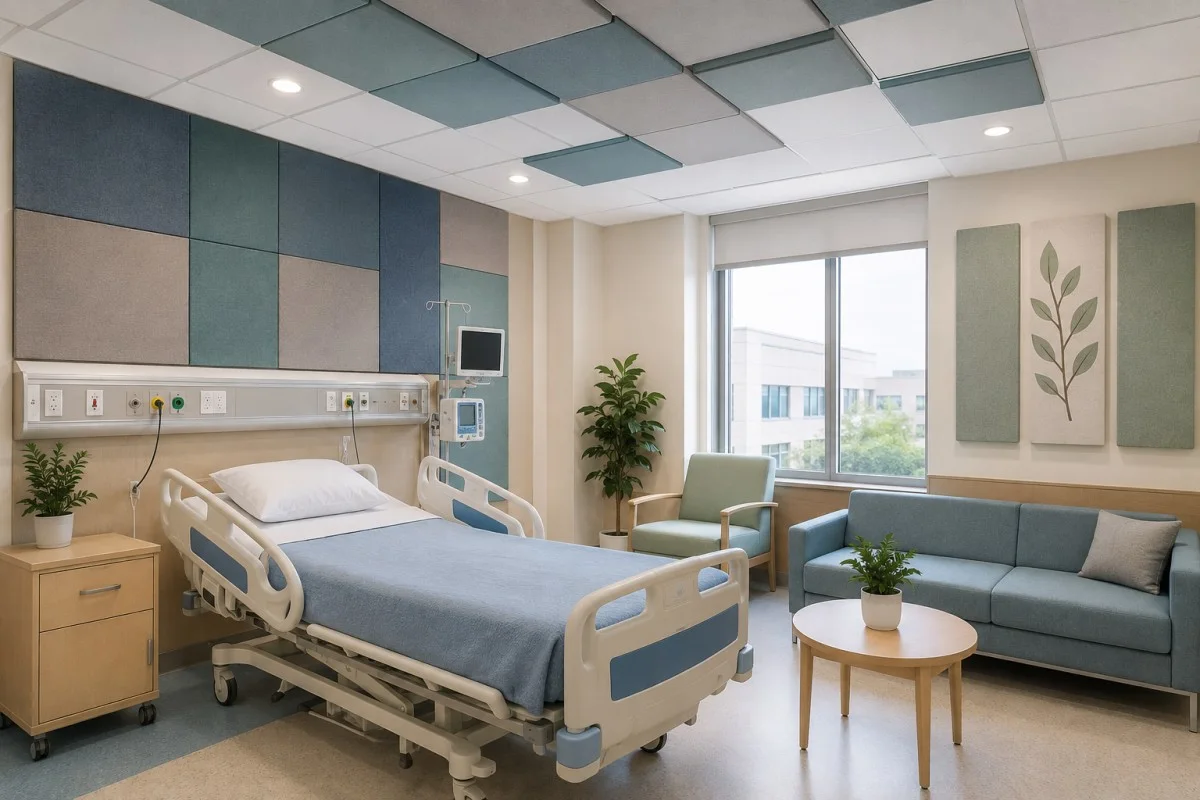
Summary: Acoustic Panels for Hospitals address two outcomes that matter most in patient care: privacy and comfort. By absorbing reflected sound, Acoustic Panels for Hospitals reduce ambient noise toward WHO-recommended levels, protect sensitive conversations, and support better sleep and faster recovery. Prioritising ICUs, consultation rooms, and nursing stations, and choosing infection-safe materials, gives hospitals a practical way to improve the patient experience without major structural changes.
Why Do Hospitals Need Acoustic Panels for Hospitals?
Hard surfaces like tiled floors, glass partitions, and painted walls reflect sound instead of absorbing it. In a busy ward, this reflected noise compounds quickly, disturbing rest and interrupting sleep cycles critical for recovery. Hospital Acoustic Panels address this at the source, absorbing airborne sound before it bounces between surfaces and reducing reverberation across nursing stations, ICUs, and patient rooms.
How Do Hospital Acoustic Panels Improve Patient Privacy?
Patient privacy is a clinical and ethical requirement, not just a comfort feature. Thin partition walls and open nursing stations often let conversations about diagnoses or personal history travel beyond the intended room. Acoustic Solutions for Healthcare, including wall-mounted and ceiling panels, reduce sound transmission between consultation rooms and patient bays, limiting speech intelligibility for unintended listeners and helping hospitals meet confidentiality expectations without full structural rebuilds.
What Role Does Hospital Soundproofing Play in Patient Comfort?
Comfort in a hospital setting ties closely to sleep quality, stress levels, and perceived safety. Studies referenced by the Center for Health Design link elevated hospital noise with fragmented sleep and slower recovery. Hospital Soundproofing measures, such as wall panels, ceiling baffles, and door seals, cut disruptive peaks from alarms, footsteps, and conversations, helping patients rest more consistently through the night. Also Check for: Sound Absorbing Panels for Restaurants and Cafes.
Where Should Healthcare Acoustics Be Prioritised First?
Not every zone needs identical treatment. Priority areas typically include:
- ICUs and recovery rooms, where alarm fatigue and sleep disruption harm outcomes most
- Consultation rooms, where speech privacy is non-negotiable
- Nursing stations and corridors, where reflected noise travels furthest
- Waiting areas, where crowd noise adds to family anxiety
Healthcare Acoustics planning usually starts with a decibel audit before selecting panel density and placement.
Which Materials Support Effective Hospitals Noise Reduction?
Hospital environments demand materials that meet infection control and fire safety codes. Common choices include:
- Perforated wood or metal panels with acoustic backing for corridors
- Fabric-wrapped fiberglass panels for patient rooms, offering high absorption
- PVC-coated or washable panels for areas needing frequent disinfection
- Ceiling baffles and clouds for open nursing stations with high ceilings
At us, this is the approach we follow when designing hospital noise reduction solutions, matching absorption ratings to each department’s hygiene needs rather than using one product across an entire facility.
Conclusion
Noise is often treated as unavoidable in hospital life, but evidence suggests otherwise. Acoustic Solutions for Healthcare, applied thoughtfully across high-impact zones, can bring wards closer to recommended sound levels while protecting the dignity and privacy every patient deserves. For hospitals reviewing infrastructure, acoustic treatment deserves the same planning attention as lighting or ventilation, because quieter spaces heal better.
Frequently Asked Questions:
1. Do acoustic panels actually reduce noise in hospital wards?
Yes, Acoustic Panels for Hospitals absorb reflected sound rather than blocking it entirely, which measurably lowers reverberation and background noise in busy wards.
2. Are hospital acoustic panels safe for infection control?
Many panels now come with washable, non-porous, or antimicrobial-coated finishes designed specifically for clinical hygiene standards.
3. How much can acoustic panels reduce hospital noise levels?
Reduction varies by material and placement, but well-planned installations typically cut reverberation time and perceived noise noticeably, even if reaching full WHO targets is difficult in active care areas.
4. Do sound panels help with patient confidentiality during consultations?
Yes, panels reduce speech transmission through walls and open areas, making it harder for conversations to be overheard nearby.
5. Can existing hospitals retrofit acoustic panels without major renovation?
Most panel systems are designed for retrofit installation on existing walls and ceilings, avoiding the cost and disruption of structural changes.
