
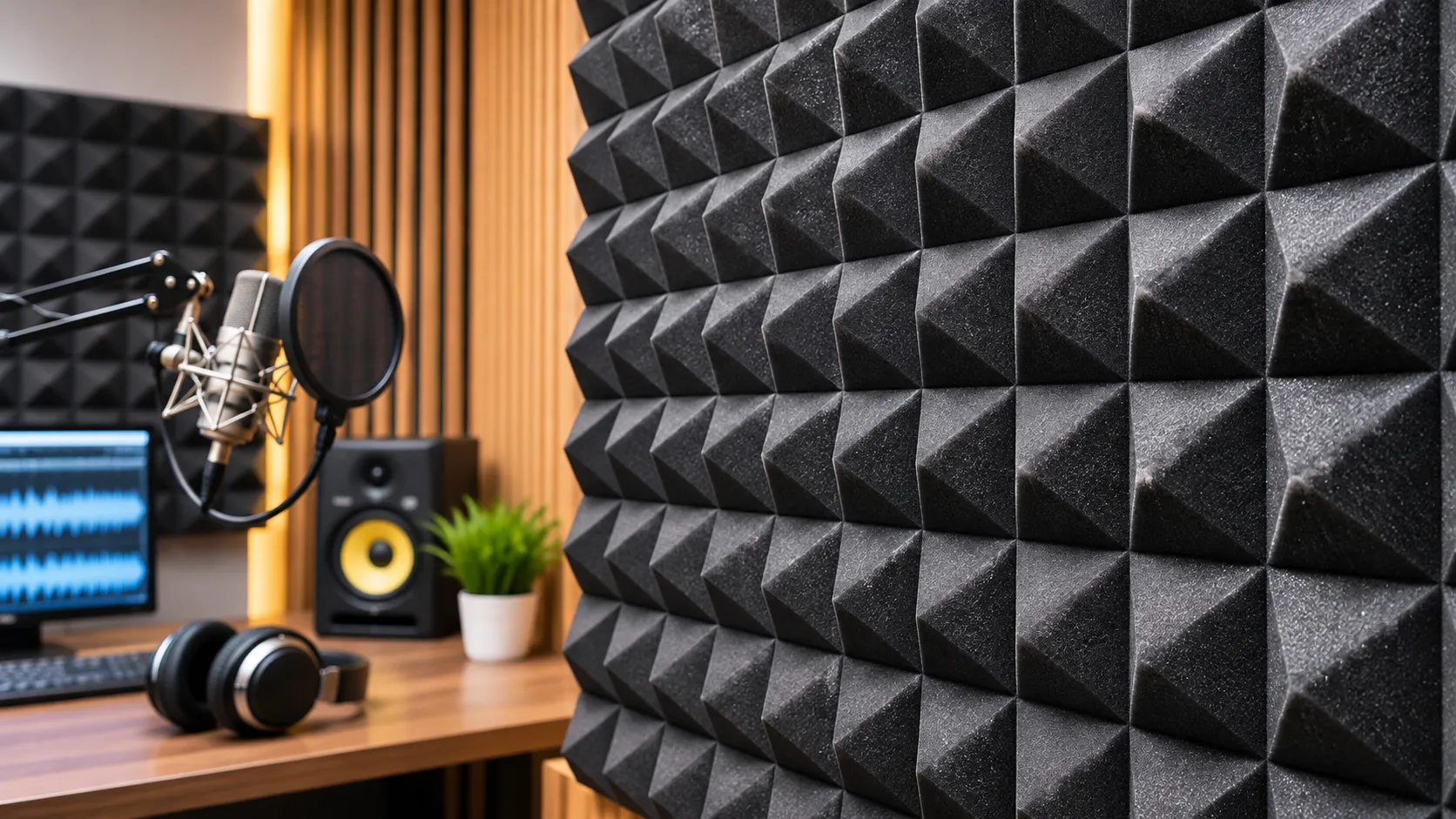
Walk into a podcast studio, a broadcast control room or a corporate training hall with a hard echo, and you can hear the problem before you see it. Voices smear, recordings sound hollow and people tire quickly. Pyramid acoustic foam is one of the simplest ways to fix that. At Ecotone Acoustic Limited, we supply and install pyramid foam for studios, offices and other commercial rooms across India.
This guide covers what pyramid foam does, how it compares with wedge foam, which thickness to pick, how much wall to cover and what to check for fire safety in a commercial building.
What is pyramid acoustic foam?
Pyramid acoustic foam is open-cell polyurethane or melamine foam cut into rows of small pyramids. Sound enters the open cells and loses energy as friction, so less of it reflects back into the room. The pyramid shape adds surface area and catches sound arriving from many directions, which gives an even, natural sound.
It belongs to the wider family of acoustic foam panels and other sound absorbing materials we use on commercial projects.
Does pyramid soundproof foam really soundproof a room?
This is the question we hear most. The honest answer is no. Foam absorbs sound inside the room; it does not block noise passing through a wall. The term “pyramid soundproof foam” is common in searches, but the foam itself only treats echo and reverberation.
If you need to stop noise from a corridor, a neighbouring office or a plant room, you need mass and sealing, such as PACKSOUND mass loaded vinyl or soundproof sheets, along with sealed doors. Most good commercial rooms use both: a soundproof build-up to keep noise out, and pyramid foam to make the room sound clean.
Pyramid vs wedge acoustic foam
Both profiles absorb mid and high frequencies well. The difference is mainly in how they handle angles and how they look.
| Point | Pyramid Foam | Wedge Foam |
|---|---|---|
| Shape | Four-sided peaks | Parallel ridges |
| Sound from angles | Even, from all directions | Best when sound hits across the ridges |
| Diffusion | Slight scattering | Very little |
| Look | Modern, textured | Classic studio look |
| Best commercial use | Training rooms, podcast studios, conference walls | Vocal booths, control rooms, broadcast rooms |
For rooms where people sit and speak from different positions, like a training hall or a meeting room, pyramid usually gives a more balanced result. For a single fixed mic position, wedge works very well too.
Which thickness should you choose?
Thicker foam absorbs lower frequencies. As a simple guide for commercial rooms:
- 25 mm: light echo control in small cabins and meeting rooms, mostly speech clarity.
- 50 mm: the most common choice for offices, training rooms and podcast studios. Good balance of cost and performance.
- 75 to 100 mm: recording studios, control rooms and rooms with strong low-frequency build-up. Add corner bass traps where needed.
Always ask the supplier for tested NRC values by thickness rather than general claims.
How much wall area should you cover?
Covering every surface makes a room sound dead and uncomfortable. For most commercial rooms, start with 15 to 30 percent of wall area, placed at first reflection points: the side walls between the speaker and listener, the wall behind the main speaking position and the rear wall. Studios and control rooms may need more. For larger halls or critical rooms, our acoustic design consultancy team can calculate reverberation time and give an exact layout.
Fire safety in commercial buildings
This is where many low-cost foam products fall short. Offices, schools, hospitals and public buildings need materials that do not spread flame or release heavy smoke. Look for:
- Fire retardant (FR) grade polyurethane foam with test reports.
- Melamine pyramid foam for higher fire ratings and humid areas.
- Class ratings that match your building and fire NOC requirements.
For a full fire strategy, foam should work alongside other rated elements such as fire rated acoustic doors.
How to stick acoustic foam to the wall
This is the most searched installation question, and doing it right saves walls and panels later.
- Clean the wall and make sure it is dry and dust free.
- Mark a grid so rows stay level and the pyramids line up.
- Use a spray adhesive or contact adhesive suited to foam. On rented or finished walls, mount foam on thin MDF or ply backing boards first.
- Press each panel for a few seconds and check edges after an hour.
- For ceilings, use mechanical fixing along with adhesive for safety.
Where pyramid foam works best
- Podcast, video and recording studios
- Broadcast and OB control rooms
- Corporate training rooms and conference walls
- Call centres and voice-based workstations
- Equipment rooms and test labs that need echo control
For a more finished look in executive areas, you can also combine foam with fabric acoustic panels. You can see some of this work on our projects page.
Is pyramid acoustic foam worth it?
For commercial rooms where echo is the main complaint, yes. It is affordable, light, quick to install and makes an immediate difference to speech clarity and recording quality. Just keep expectations right: it treats sound inside the room and does not stop noise from outside.
Frequently asked questions
What sizes does pyramid foam come in?
Common sheet sizes are 300 x 300 mm and 600 x 600 mm, with larger pyramid foam sheets available for bigger walls.
Is white pyramid acoustic foam available?
Yes. White and light grey foam suit offices and modern interiors, though light colours show dust faster in busy areas.
Can pyramid foam be used on ceilings?
Yes, as long as it is FR grade and fixed mechanically as well as with adhesive.
Get pyramid acoustic foam for your project
Whether you are setting up a studio, a training centre or a busy office, Ecotone Acoustic Limited can help you choose the right profile, thickness and fire rating, and install it properly. Share your room size and use on our contact page and our team will send a recommendation.
