
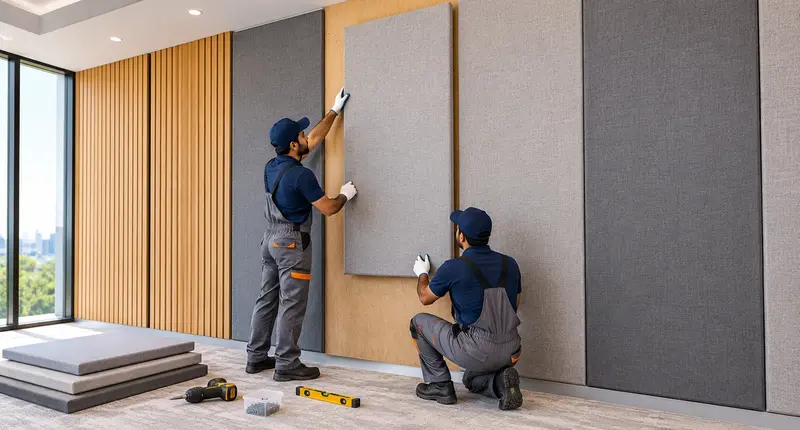
Noisy conference rooms, echoing auditoriums, and reverberating cinema halls affect comfort, communication, and productivity. If you are wondering how to install acoustic panels correctly in offices, hospitals, or large public venues, this guide walks you through the entire process, from planning to final mounting, with practical tips that any facility team can follow.
Offices, auditoriums, hospitals, and cinema halls all deal with hard surfaces like glass, concrete, and tile that bounce sound around the room. Acoustic wall panels and acoustic foam absorb these reflections, reducing echo and background noise. Also Check: NRC vs STC Rating
In hospitals, sound absorbing panels help maintain patient privacy and lower stress levels. In cinema halls and auditoriums, acoustic sound panels improve speech clarity and audio balance for audiences.
Before you begin, gather a measuring tape, spirit level, stud finder, pencil, utility knife, adhesive or mounting clips, screws, and a drill.
Decide whether you need acoustic wall panels, an acoustic ceiling system, or a combination of both, depending on the room’s size and purpose. Larger venues like auditoriums often require both wall and ceiling treatment for balanced sound control.
How to Install Acoustic Wall Panels in Offices and Auditoriums?
In open offices, place acoustic wall panels along shared walls and behind workstations to reduce speech transfer between teams. In auditoriums, focus on side walls and the rear wall to control slap echo, since these surfaces reflect sound directly back toward the stage and audience.
How to Install Acoustic Ceiling Panels in Hospitals and Cinema Halls?
Hospital corridors and waiting areas benefit from an acoustic ceiling, since wall space is often limited by equipment and signage. Suspended or direct-mount ceiling panels absorb overhead noise without disrupting floor layouts. In cinema halls, ceiling treatment paired with wall panels prevents sound buildup in large, high-volume rooms, improving dialogue clarity throughout the seating area.
What Mistakes Should You Avoid During Installation?
Avoid covering only one wall, since uneven treatment creates imbalanced acoustics. Do not skip surface preparation, as dust or moisture weakens adhesive bonds. Never ignore manufacturer spacing guidelines, and always verify fire safety ratings before installing panels in hospitals or cinema halls, where compliance is mandatory.
Do acoustic panels need professional installation? +
How many acoustic panels are needed for an office? +
Can acoustic foam be used in hospitals? +
What is the difference between acoustic wall panels and ceiling panels? +
How long does installation typically take? +
Learning how to install acoustic panels correctly makes a measurable difference in offices, hospitals, auditoriums, and cinema halls. Careful planning, proper surface preparation, and correct mounting techniques ensure long-lasting sound control and a more comfortable environment for staff, patients, and audiences alike.
This guide on how to install acoustic panels covered assessment, coverage calculation, mounting methods, and placement strategies for commercial spaces including offices, auditoriums, hospitals, and cinema halls, helping facility teams achieve effective, long-term noise control.
For panel specifications and professional options, Packsound.in offers acoustic solutions suited to commercial installations.
