
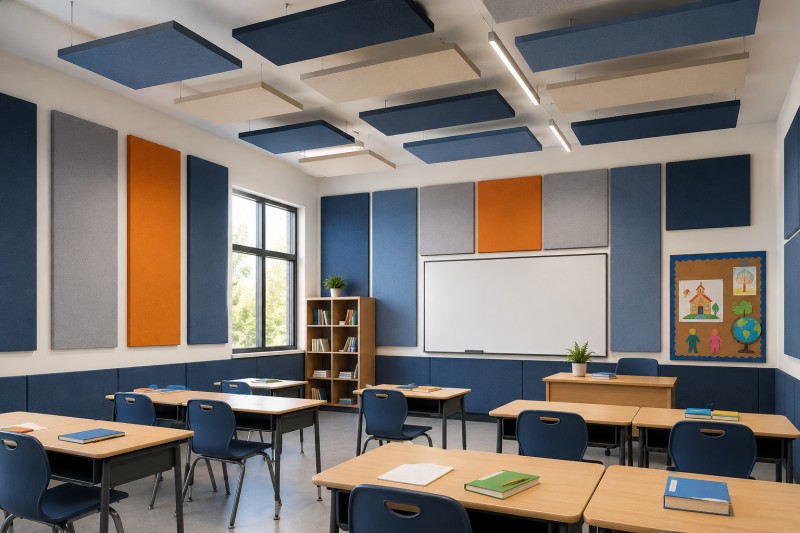
Intro: Why do some classrooms feel calm and focused while others feel chaotic and loud? The answer often lies in acoustics. Acoustic panels for schools help absorb excess noise, reduce echo, and create learning spaces where students can actually hear their teachers clearly.
Why Does School Acoustics Matter for Learning?
Poor school acoustics lead to garbled speech, higher teacher vocal strain, and lower student comprehension, especially for younger children and those with hearing difficulties. Research referenced by the American National Standards Institute shows that classrooms meeting recognized noise and reverberation benchmarks support noticeably better academic outcomes.
What Is the Ideal Acoustic Design for Classroom Spaces?
Effective acoustic design for classroom environments balances two factors: background noise control and reverberation time. Hard surfaces like glass, concrete, and tile reflect sound and cause echo, while absorptive materials shorten reverberation so speech stays clear from the front to the back of the room. Also Check for: Acoustic Panels Price Guide.
How Do Acoustic Panels for Classrooms Actually Work?
Acoustic panels for classrooms are made from sound-absorbing cores, often fabric-wrapped foam or PET felt, that trap sound waves instead of bouncing them around the room. Installed on walls or ceilings, they cut down on echo, improve speech intelligibility, and make group activities easier to manage.
Which Acoustical Solutions for Schools Should You Consider?
- Wall panels: Cost effective and easy to install in existing classrooms.
- Ceiling baffles or clouds: Useful in high ceiling halls, libraries, and auditoriums.
- Fabric wrapped tiles: Combine acoustic performance with classroom decor.
- Acoustic partitions: Help with school soundproofing between adjoining rooms.
The right mix of acoustical solutions for schools depends on room size, ceiling height, and existing noise sources like HVAC systems or corridors.
What Should You Check Before Buying Acoustic Panels for Schools?
- NRC rating: Higher Noise Reduction Coefficient means better absorption.
- Fire safety certification: Essential for institutional use.
- Installation type: Adhesive, mechanical, or suspended mounting.
- Durability: Panels should withstand daily classroom activity.
- Aesthetic flexibility: Colors and shapes that suit learning environments.
How Does School Soundproofing Differ from Sound Absorption?
School soundproofing blocks sound from moving between rooms, while acoustic panels absorb sound within a room. Most schools need both, insulated partitions for privacy and absorptive panels for clarity.
At Ecotone, we help schools select acoustic panels and layouts suited to their specific room dimensions and budget, based on established acoustic performance guidelines rather than guesswork.
Conclusion
Investing in acoustic panels for schools is not just about comfort, it directly supports better communication, concentration, and academic performance. By understanding acoustic design principles, choosing the right acoustical solutions for schools, and addressing both absorption and soundproofing needs, institutions can create classrooms where every student hears clearly.
Frequently Asked Questions:
Q1: Do acoustic panels really reduce classroom noise?
Yes, they absorb sound reflections and shorten reverberation time significantly. This improves speech clarity for students seated at any distance from the teacher.
Q2: How many acoustic panels does a classroom need?
It depends on room size and existing noise levels, typically covering 15 to 25 percent of wall or ceiling area. A proper acoustic assessment gives the most accurate estimate.
Q3: Are acoustic panels expensive to install in schools?
Wall-mounted panels are generally affordable compared to structural soundproofing. Costs vary based on material, size, and installation method chosen.
Q4: Can acoustic panels be added to existing classrooms without renovation?
Yes, most panels use simple adhesive or mechanical mounting systems. No major construction or downtime is usually required.
Q5: What is the difference between soundproofing and acoustic treatment?
Soundproofing blocks sound between rooms, while acoustic treatment absorbs sound inside a room. Schools often need a combination of both for best results.
