
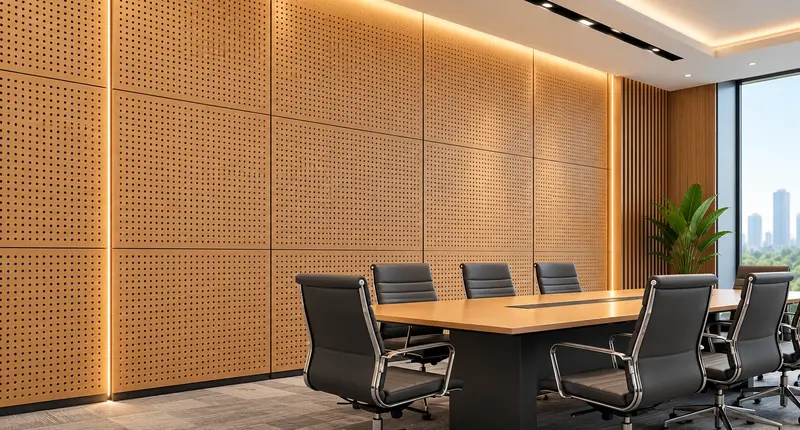
Open floor plans look great on paper, but they often turn into echo chambers where phone calls, keyboard clatter, and footsteps blend into constant background noise. Perforated acoustic wall panels for offices solve this exact problem by combining a visually clean surface with functional sound absorption. If you have ever wondered why these panels are now standard in modern workplaces, this guide breaks down what they are, how they work, and why they matter for productivity and wellbeing.
What Are Perforated Acoustic Wall Panels?
Perforated acoustic wall panels are surface coverings made from wood, metal, or composite material that feature evenly spaced holes across their face. Behind this perforated layer sits a sound absorbing core, usually mineral wool, foam, or felt. This combination lets sound waves pass through the tiny openings and get trapped inside the core instead of bouncing back into the room. Unlike solid decorative panels, a perforated acoustic panel is engineered specifically to manage reverberation while still looking polished enough for client facing spaces.
How Do Perforated Wood Panels Actually Reduce Noise?
The science behind perforated wood acoustic panels relies on a principle called Helmholtz resonance. When sound waves enter the small perforations, air inside each hole vibrates and loses energy as friction heat within the absorbent backing. This converts sound energy into a negligible amount of heat rather than letting it reflect off a hard wall surface. The size, depth, and spacing of the holes directly affect which frequencies get absorbed best, which is why manufacturers test different perforation patterns before finalizing a design. Also Check: Perforated Gypsum Board Ceiling.
Why Do Offices Specifically Need Acoustic Perforated Wood Panels?
Modern offices combine hard flooring, glass partitions, and minimal soft furnishings, all of which reflect sound rather than absorb it. This creates a reverberant environment where conversations carry across the floor and concentration suffers. Acoustic perforated wood panels address this by adding controlled absorption to walls without sacrificing floor space or aesthetics. Meeting rooms, call booths, and collaborative zones benefit the most, since speech clarity and privacy improve once reflected sound is reduced.
What Makes Perforated Wood Acoustic Wall Panels Different From Regular Acoustic Panels?
Standard acoustic foam panels are functional but rarely suit a professional interior. Perforated wood acoustic wall panels solve this by pairing genuine timber or wood veneer finishes with hidden acoustic performance, so the wall still looks like a design feature rather than a retrofit. They are available in various perforation patterns, from simple round holes to custom geometric designs, allowing architects to match a brand identity while meeting noise control requirements.
What Should You Consider Before Installing Perforated Acoustic Panels?
Before choosing a perforated acoustic panel system, consider the room’s existing reverberation time, ceiling height, and the specific noise sources you want to control. Panels placed at ear level and on parallel walls typically perform better than scattered placement. It also helps to check the Noise Reduction Coefficient, or NRC, rating of a product, since this number indicates how much sound a panel absorbs compared to a fully reflective surface. A qualified acoustic consultant or supplier like Packsound.in can help match panel specifications to actual room conditions rather than guessing.
How Are These Panels Installed in a Working Office?
Installation usually involves mounting a track or batten system to the wall, then fixing the panels using clips or adhesive depending on the manufacturer’s method. Most installations are non-invasive and can be completed without disrupting daily office operations, especially when panels arrive pre-cut to size. For homes, the same principle applies on a smaller scale, where panels are often used in home theaters, study rooms, or music corners to reduce echo in a similar way.
Conclusion
Perforated acoustic wall panels for offices are not just a design trend, they are a practical response to the acoustic challenges created by open, hard surfaced workspaces. By combining visible perforations with hidden absorptive cores, these panels reduce echo, improve speech clarity, and support better concentration across the workday. Whether you choose perforated wood panels for a warm, natural look or metal variants for an industrial aesthetic, the underlying science remains the same: trapped sound energy means a quieter, more productive office.
Frequently Asked Questions
1. Do perforated acoustic panels actually reduce noise or just look decorative?
genuinely absorb sound through their perforation pattern and backing material, and are not purely decorative additions.
2. What is the ideal perforation percentage for good sound absorption?
Research on perforated wood panels generally shows strong absorption performance when the perforation ratio falls between 20 and 40 percent of the surface area.
3. Can perforated wood acoustic panels work without additional insulation behind them?
They perform noticeably better with an absorbent core or air gap behind them, since the perforations alone do little without a backing material.
4. Are these panels suitable for small home offices too?
Yes, smaller formats of perforated acoustic panels are commonly used for homes, study rooms, and compact workspaces needing echo control.
5. Do perforated panels block sound from entering a room, or only reduce echo inside it?
They are primarily designed for sound absorption within a room, not for blocking external noise, which requires separate soundproofing measures.
