
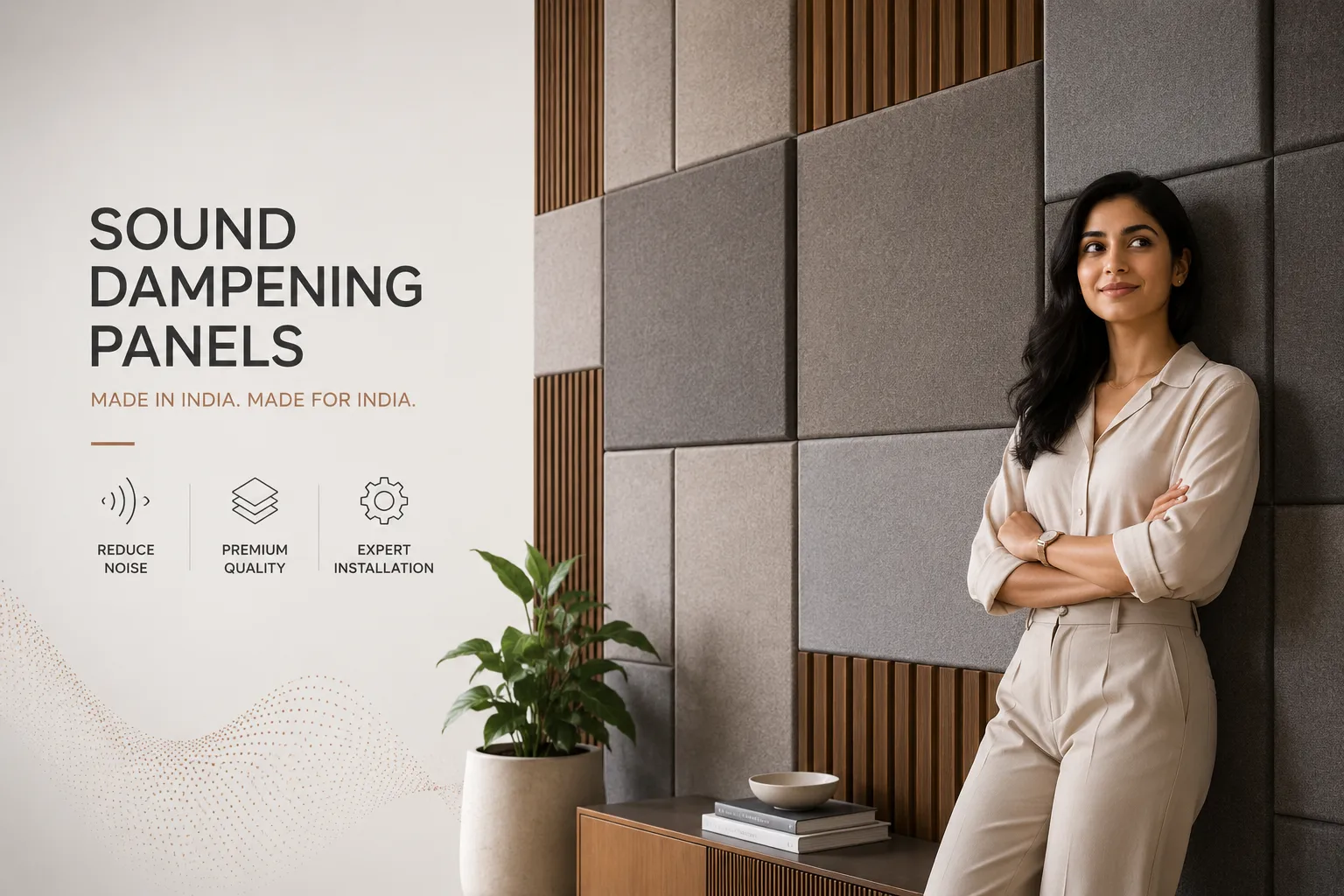
There is a critical difference between a room that is quiet and a room that sounds good.
Bare concrete walls, glass partitions, and hard floors create spaces where sound ricochets off every surface — conversations blur into noise, music becomes muddy, voices on a conference call turn incomprehensible. The fix is not silence. The fix is control. And the tool that delivers control, in every type of space from boardrooms to recording studios, is a correctly specified sound dampening panel.
Packsound, manufactured by Ecotone Acoustic Limited, produces and supplies a complete range of sound dampening panels in India — fabric-wrapped panels, grooved wooden panels, fiberglass panels, polyester fibre panels, melamine foam panels, and composite acoustic panels — all manufactured to certified NRC performance standards, available in custom sizes and finishes, and backed by an in-house acoustic consulting team that can specify exactly what your space needs before a single panel goes on the wall.
Whether you are an architect specifying treatment for a 2,000-seat auditorium, a corporate facilities manager dealing with an echo-plagued open office, or a studio designer building a critical listening room, we manufacture the right panel at the right performance level and deliver it with the technical documentation to prove it.
Get a Free Quote on Sound Dampening Panels →
What Are Sound Dampening Panels and How Do They Work?
Sound dampening panels — also called sound absorbing panels, acoustic wall panels, or acoustic treatment panels — are surface-mounted or suspended products designed to reduce the amount of sound energy that reflects off hard surfaces inside a room.
When a sound wave strikes a hard surface like plaster, concrete, or glass, the majority of its energy bounces straight back into the room. This reflected energy overlaps with the original sound, creating reverberation (the sense of the sound continuing after the source has stopped), echo (distinct repetitions of the original sound), and a general elevation of background noise levels that makes speech harder to understand and music harder to hear clearly.
Sound dampening panels interrupt this cycle. Their porous or fibrous structure allows sound energy to enter the panel rather than reflecting off its surface. Inside the panel, the sound wave’s energy is converted into a small amount of heat through friction as air molecules in the pores or fibres are set in motion. The energy does not return to the room. The result is a reduction in reverberation time, a quieter background noise level, and dramatically improved speech intelligibility and tonal clarity.
What sound dampening panels do not do: They do not block sound from entering or leaving a room. That function — soundproofing or sound isolation — is performed by mass and decoupling: thick, heavy, airtight constructions such as our soundproof fixed partitions, acoustic wooden doors, and soundproof sliding folding partitions. Sound dampening panels treat the acoustic environment within a room. Both are often needed — and our acoustic consultants will advise you on how much of each your project requires.
The Science That Separates Good Panels from Cheap Ones: NRC Explained
NRC — Noise Reduction Coefficient — is the single most important number when evaluating any sound dampening panel. It is a standardised measure of how much sound energy a material absorbs, tested across the key frequency octave bands (250 Hz, 500 Hz, 1000 Hz, 2000 Hz) and reported as a single average figure between 0.0 and 1.0.
NRC 0.0 means the surface absorbs nothing — all sound reflects back. NRC 1.0 means the surface absorbs everything. In practice, high-performance acoustic panels achieve NRC values between 0.75 and 0.95+.
Why this matters in practice: A panel with NRC 0.55 absorbs roughly 55 percent of incident sound energy. A panel with NRC 0.90 absorbs 90 percent. In a 100 sq metre conference room, replacing NRC 0.55 panels with NRC 0.90 panels of the same surface coverage cuts the reflected energy by more than half — which translates directly into a shorter reverberation time, lower background noise level, and measurably better speech intelligibility. These are not subjective impressions. They are calculable outcomes using Sabine’s equation, and our acoustic consultants model them for your specific room before you buy.
Every Packsound sound dampening panel is tested to ISO 354:2003 (reverberation room method) or ASTM C423 standards and ships with a certified NRC test report. When a competitor cannot show you a third-party test certificate for their NRC claim, the number is marketing — not measurement.
The Packsound Sound Dampening Panel Range
We manufacture multiple panel types because different applications demand different combinations of acoustic performance, fire rating, aesthetics, and budget. Here is the complete range.
Fabric-Wrapped Acoustic Wall Panels
The benchmark commercial-grade sound dampening panel. A rigid frame of MDF or aluminium is filled with a high-density acoustic infill — fiberglass batts, mineral wool, or polyester fibre — and wrapped tightly in acoustically transparent fabric. The fabric covering allows sound energy to pass through to the absorptive core while presenting a clean, professional surface finish that integrates with any interior design scheme.
- NRC: 0.80 to 0.95 depending on infill and thickness.
- Thickness: 25 mm, 40 mm, 50 mm standard; custom thicknesses available.
- Sizes: Standard 600×600 mm, 600×1200 mm, 1200×2400 mm; any custom size available.
- Finishes: Hundreds of fabric colours and textures; Guilford of Maine, Blazer, and custom fabric options.
- Fire rating: Class B1 standard; Class A / B-s1,d0 available with fire-rated infill.
- Applications: Corporate offices, conference rooms, boardrooms, classrooms, hospitality interiors, healthcare facilities, home theatres.
View Fabric-Wrapped Acoustic Panels →
Grooved Wooden Acoustic Panels
Where acoustic performance must coexist with premium interior design quality, grooved wooden panels are the specification of choice. MDF or HDF boards with precisely routed parallel grooves are mounted over an acoustic felt or fibre backing, allowing sound to enter through the grooves and be absorbed by the backing layer. The result is a panel that reads visually as high-end wall cladding while delivering meaningful sound dampening performance.
- NRC: 0.65 to 0.80 depending on groove geometry, backing specification, and air gap.
- Thickness: 15 mm to 25 mm panel face; additional backing layer as specified.
- Finishes: Natural oak, walnut, ash, and a full range of lacquered and stained options.
- Applications: Hotel lobbies, corporate reception areas, premium boardrooms, restaurant interiors, luxury residential, auditorium side walls.
View Grooved Wooden Acoustic Panels →
Fiberglass and Mineral Fiber Acoustic Panels
High-density fiberglass and mineral fiber panels offer among the highest NRC values achievable in a rigid panel format — and because the rigid board itself is the acoustic material, no separate infill layer is required. These panels are used extensively in ceiling applications, where their rigidity allows large-format panels to be suspended without sagging, and in wall applications requiring maximum performance in minimum thickness.
NRC: 0.90 to 1.00+ at tested frequencies. Thickness: 25 mm, 50 mm standard. Finishes: Factory-painted, fabric-wrapped, or perforated metal facing. Fire rating: Class A incombustible. Applications: Auditoriums, recording studios, broadcast facilities, industrial noise control, healthcare facilities.
View Fiberglass and Mineral Fiber Acoustic Panels →
Melamine Foam Acoustic Panels
The highest-NRC, lowest-weight sound dampening panel in our range, and the only panel type that is inherently fire resistant without chemical treatment. Melamine foam’s open-cell three-dimensional filament structure achieves NRC 0.95 at a density of 9 to 11 kg/m³ — meaning it adds almost no load to walls and ceiling systems while delivering exceptional broadband absorption.
- NRC: 0.95 (ISO 354:2003).
- Density: 9 to 11 kg/m³.
- Temperature resistance: Up to 200°C continuous.
- Fire rating: B1 DIN 4102-1 | V-0 UL 94 | Class A ASTM E84 — inherently, without added chemicals.
- Applications: HVAC duct liners, recording studios, railway carriages, industrial enclosures, cleanrooms, healthcare, home theatres.
- Profiles: Flat, pyramid, wedge, convoluted — custom CNC profiles available.
View Melamine Foam Acoustic Panels →
Composite Acoustic Panels
A multi-layer panel system combining sound absorption and a degree of sound blocking in a single product. Composite panels use mass-loaded layers sandwiched with absorptive cores to provide both NRC performance and a contribution to partition STC — useful where a single panel element must address both the within-room acoustic quality and partial attenuation of sound between adjacent spaces.
- NRC: 0.70 to 0.85.
- STC contribution: 20 to 28 dB (used as supplementary treatment, not as a primary partition).
- Applications: Industrial environments, mechanical plant rooms, home theatre walls, recording studio room-within-room constructions.
View Composite Acoustic Panels →
Polyester Fibre Acoustic Panels (PET Panels)
Made from 100 percent recycled PET fibre — the same material as plastic bottles — polyester fibre panels deliver strong NRC performance with the bonus of sustainability credentials. Completely free of VOC emissions, resistant to moisture and mould, and available in a wide range of bold colours, PET panels are increasingly specified for LEED and WELL certified building projects where both acoustic performance and environmental responsibility are client requirements.
- NRC: 0.70 to 0.85 depending on thickness.
- Thickness: 9 mm and 12 mm standard; 25 mm available for higher performance.
- Colours: 30+ standard colours; custom colour available.
- Fire rating: Fire retardant per ASTM E84.
- Applications: Open offices, schools, healthcare, co-working spaces, restaurants, retail environments.
Acoustic Ceiling Tiles and Panels
Sound dampening is not only a wall treatment discipline. In open-plan offices, restaurants, and any space with a hard ceiling, ceiling-mounted absorptive panels deliver the highest acoustic return on investment because they intercept sound at the first reflection point — directly above the sound source — before it has bounced multiple times off walls and returned as reverberant noise.
Our acoustic ceiling tiles, acoustic hanging baffles, and acoustical hanging clouds extend the sound dampening strategy from walls to ceiling planes, completing the acoustic treatment of any space.
Where Sound Dampening Panels Make a Measurable Difference
Open-Plan Corporate Offices
Open offices concentrate noise from dozens of simultaneous conversations into a single reverberant space. The result is a raised noise floor that forces everyone to speak louder — which raises the noise floor further, in a self-reinforcing cycle acousticians call the Lombard effect. Correctly specified sound dampening panels on walls and ceilings break this cycle by reducing the reverberant field. A reverberation time target of 0.4 to 0.6 seconds is achievable in most open offices with appropriate panel coverage, and the productivity improvement is measurable: studies consistently show that reducing office noise by 10 dB improves cognitive performance on complex tasks by over 20 percent.
Conference Rooms and Boardrooms
A conference room that echoes makes every remote call sound unprofessional and every in-person meeting harder to follow. Sound dampening panels bring reverberation time to the 0.4 to 0.5 second range ideal for speech — the point at which every syllable is heard clearly without the previous syllable still ringing in the room. Fabric-wrapped panels in corporate fabric finishes, or premium grooved wooden panels for executive boardrooms, deliver both the acoustic result and the visual quality that senior meeting spaces demand.
Recording Studios and Podcast Studios
In any critical listening environment, the goal is a room that tells the truth. Early reflections from untreated walls colour the sound that reaches the mix engineer’s ears, leading to mix decisions that are an artefact of the room rather than the recording. Sound dampening panels at first reflection points — the side walls at the listening position, the ceiling above the console, and the rear wall — eliminate these early reflections and create the neutral acoustic environment that professional recording demands.
For a complete studio acoustic specification, combine our acoustic wall panels for broadband mid-high absorption with our acoustic foam panels for lower-cost treatment in vocal booths and isolation rooms, and with bass traps in corners for low-frequency control. Our acoustic design and consultancy team models the complete treatment strategy for your studio dimensions and listening position before a single product is purchased.
Auditoriums, Theatres, and Multiplex Cinemas
Performing arts acoustics require the most precise calibration of sound absorption of any building type. Too little absorption and the reverberation time is too long for speech intelligibility. Too much absorption and the room feels acoustically dead — the life and richness of live orchestral music drains away. Our auditorium acoustic treatment service combines our full panel range with acoustic simulation modelling to hit the specific RT60 targets defined for the intended use of the space — whether that is a drama theatre at 0.9 seconds, a multi-use hall at 1.2 seconds variable, or a concert hall at 2.0 seconds.
Hotels, Restaurants, and Hospitality Spaces
The acoustic character of a restaurant determines whether guests enjoy an intimate, convivial atmosphere or give up trying to converse over the noise. The target reverberation time for a restaurant is approximately 0.8 to 1.0 seconds — lively enough to feel buzzing, controlled enough that conversation across the table is comfortable. Grooved wooden panels and fabric-wrapped panels in hospitality finishes deliver this target while enhancing the visual character of the space. In hotel meeting rooms and function suites, our sound dampening panels are specified alongside movable wall partitions to provide flexible, acoustically controlled spaces for simultaneous events.
Schools and Educational Institutions
Classroom acoustics are a children’s educational rights issue. The World Health Organization recommends a maximum background noise level of 35 dB(A) and a maximum reverberation time of 0.6 seconds in classrooms. In Indian school buildings with hard wall and ceiling finishes, reverberation times of 1.5 to 2.0 seconds are common — conditions under which children with any hearing difficulty, and children learning in a non-native language, struggle to follow spoken instruction. Sound dampening panels on classroom rear walls and ceiling bring these spaces into the WHO recommended range and deliver a measurable improvement in learning outcomes.
Healthcare Facilities
Noise is a clinical concern in hospitals. ICU noise levels above 55 dB(A) are associated with delayed patient recovery and disrupted sleep. Staff communication errors increase in high-noise clinical environments. Sound dampening panels in wards, corridors, and reception areas reduce the reverberant noise contribution and improve the signal-to-noise ratio of spoken communication between clinical staff. Our panels for healthcare use are specified with moisture-resistant facings, anti-microbial properties, and fire ratings appropriate for patient areas.
Home Theatres and Dedicated Listening Rooms
For the committed audiophile or home cinema enthusiast, sound dampening panels transform an untreated room into a controlled acoustic environment. Eliminating flutter echo and controlling reverberation time to the 0.3 to 0.5 second range produces a listening experience that commercial cinemas work hard to achieve — and our panels, combined with a free consultation from our acoustic team, make that experience achievable in any home setting.
How Much Coverage Do You Need? A Practical Guide
One of the most common mistakes in acoustic treatment projects is under-specification — installing a small number of panels that make the room look treated without delivering the acoustic result. Here is a practical framework for estimating panel coverage.
For offices and conference rooms targeting RT60 of 0.4 to 0.6 seconds: As a rule of thumb, panels covering 25 to 40 percent of total wall and ceiling surface area with NRC 0.85+ panels will achieve the target in a standard room with hard floor and moderate furnishing. Our acoustic consultants calculate this precisely using the Sabine equation for your specific room dimensions and existing surface finishes.
For recording studios and critical listening rooms: First reflection point treatment is the priority — the points on side walls and ceiling from which sound bounces directly from a speaker to the listening position. These points can be identified with a mirror (the point at which you can see a speaker reflection from the listening position). Full-wall treatment of the rear wall and ceiling cloud treatment above the listening position completes the basic treatment package.
For auditoriums and large spaces: Acoustic simulation is the only reliable method. The interaction of room geometry, volume, surface finishes, and audience absorption at different frequencies is too complex for rules of thumb to give reliable results. Our acoustic modelling service delivers the precise panel quantities, positions, and specifications needed to hit any target RT60 with confidence.
Contact us for a free acoustic assessment of your space — we will calculate the panel coverage required and specify the right product for your budget and performance target.
Why Sound Dampening Is Not the Same as Soundproofing
This distinction is worth stating clearly because it is the single most common misconception in the acoustic treatment market, and confusing the two leads to expensive mistakes.
Sound dampening (absorption) reduces the amount of reflected sound energy within a room. It controls reverberation, echo, and the reverberant noise floor. It does not prevent sound from passing through walls, ceilings, or floors.
Soundproofing (isolation) prevents sound from passing between spaces. It requires mass (heavy construction), decoupling (resilient mounting to prevent vibration transmission), and airtight sealing. It does not improve the acoustic quality within a room.
A recording studio needs both: isolation between the studio and the outside world (achieved through the building construction and our partition and door products), and absorption within the studio (achieved through sound dampening panels). An open office typically needs only absorption — the walls between the office and adjacent spaces are usually adequate, but the reverberant noise within the open floor is intolerable.
Understanding which problem you are solving determines which product you need. Our acoustic consultants diagnose both issues correctly and specify the right combination of solutions.
Choosing Between Panel Types: The Decision Framework
| Your Priority | Best Panel Type |
|---|---|
| Maximum NRC performance, fire-critical environment | Melamine foam or fiberglass mineral panels |
| Premium interior aesthetics with solid NRC | Grooved wooden panels or fabric-wrapped panels |
| Sustainability credentials (LEED / WELL) | PET polyester fibre panels |
| Budget-conscious broadband absorption | Fabric-wrapped panels with polyester infill |
| Both absorption and partial isolation | Composite acoustic panels |
| Ceiling treatment in open offices | Acoustic hanging baffles or clouds |
| Auditorium / performing arts precision | Full acoustic design and consultancy service |
Not sure which category fits your project? Our acoustic consultants provide a free specification recommendation — just describe your space, its use, and your key requirements.
Why Buy Sound Dampening Panels from Packsound?
We manufacture, not just supply.
Packsound is the brand of Ecotone Acoustic Limited, a dedicated acoustic products manufacturer based in Greater Noida West. Every panel in our range is manufactured at our own facility to consistent quality standards. You are not buying generic commodity panels with our name on the box.
Certified NRC performance on every product.
All Packsound panels are tested to ISO 354:2003 or ASTM C423 by accredited third-party laboratories. NRC certificates ship with every project order. If a supplier cannot provide a third-party test certificate, their NRC claim is unverified.
Custom sizes, profiles, and finishes as standard.
Standard panel sizes are a starting point, not a constraint. We cut and fabricate panels to any dimension your project requires, in any specified finish. This matters on fit-out projects where standard grid sizes do not align with architectural layouts.
Integrated design-supply-install capability.
We are not just a panel manufacturer. We are an acoustic solutions business. Our acoustic design and consultancy team can specify the complete treatment strategy for your space. Our installation teams install to Packsound technical standards. And our acoustic consultants carry out post-installation measurement to verify that the acoustic targets have been achieved.
Pan-India project delivery.
We supply and install across Delhi NCR, Mumbai, Bengaluru, Hyderabad, Chennai, Pune, Ahmedabad, and all major Indian cities. Our logistics network handles bulk project deliveries with the coordination that professional interior fit-outs demand.
Frequently Asked Questions About Sound Dampening Panels
What is the difference between sound dampening panels and soundproof panels?
Sound dampening panels absorb sound energy within a room, reducing echo and reverberation. Soundproof panels (mass-loaded or composite) reduce sound transmission through walls. Most spaces need absorption; spaces requiring privacy between rooms need isolation. Our acoustic consultants advise on which solution your project needs.
What NRC rating should I look for?
For offices and conference rooms, NRC 0.80 or above is a reliable specification threshold. For recording studios and auditoriums, NRC 0.85 to 0.95+ at the key treatment positions. Our consultants calculate the exact NRC requirement for your target RT60.
How are sound dampening panels installed?
Panels can be mounted directly to walls and ceilings using adhesive, Z-clips, or a batten system. Suspended panels are hung from ceiling cables. We supply full installation hardware and instructions with every order, and our installation teams handle turnkey installation for commercial projects.
Do sound dampening panels require maintenance?
Fabric-wrapped and wooden panels are low-maintenance. Dust can be removed with a soft vacuum brush attachment. In high-traffic environments, fabric panels can be re-covered after several years. Our panels are not consumable items — with normal care they last the lifetime of the building.
Can panels be customised with branding or printed graphics?
Yes. Fabric-wrapped panels can be produced with full-colour printed fabric facing, allowing corporate branding, wayfinding graphics, or decorative artwork to be integrated into the acoustic treatment. This is popular in corporate offices, reception areas, and educational institutions.
What is the typical lead time for a supply order?
Standard sizes and finishes carry stock or can be manufactured within 7 to 10 working days. Custom sizes and finishes typically require 10 to 15 working days from approved specification. We confirm lead times at the quotation stage.
Get a Quote for Sound Dampening Panels Today
Packsound supplies the full range of sound dampening panels in India directly from our manufacturing facility, cut to your project specification, with full NRC certification and pan-India delivery.
Whether you need a specification recommendation for a new fit-out, a sample set for design approval, a quantity estimate for budgeting, or a complete supply-and-install proposal — our team responds within one working day.
Call us: +91 9809802016 | +91 9891320678 Email: Sales@packsound.in | Abhinav@packsound.in Address: NX One, A-717, Techzone-4, Greater Noida West, U.P. 201306
Explore our complete range of acoustic wall panels, acoustic ceiling tiles, and acoustic foam panels, or speak to our acoustic consultants for a free project specification. View our completed acoustic projects across India to see what Packsound delivers in practice.
