Call ✆ +91 9809802016 | 9891320678

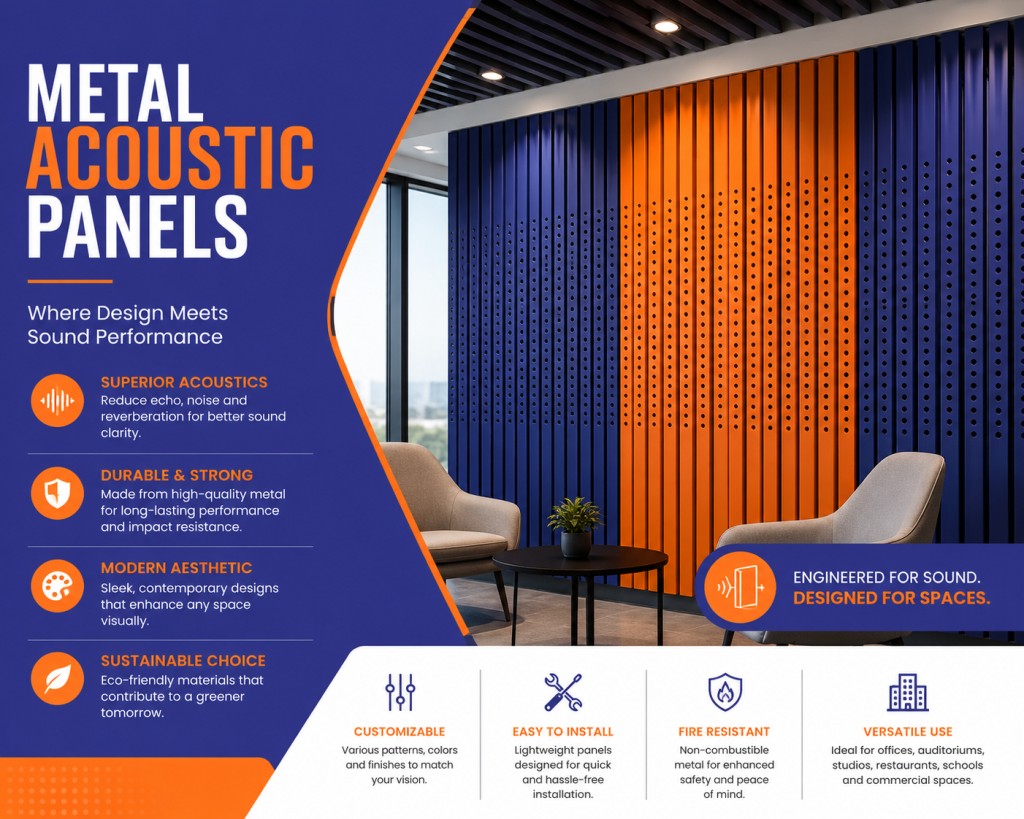
Metal Acoustic Panels are precision-engineered wall and ceiling systems made from perforated aluminium or steel sheets, backed with a sound-absorbing infill such as mineral wool or glass fibre. When sound waves strike the panel surface, they pass through the perforations and are trapped and dissipated by the backing layer, reducing echo, reverberation, and ambient noise levels measurably. In commercial interiors such as open-plan offices, airport terminals, hotels, and hospitals, where hard concrete, glass, and tile surfaces create acoustic environments that damage speech intelligibility and staff productivity, Metal Acoustic Panels for Sound Absorption deliver quantified NRC values of 0.70 to 0.95 alongside fire resistance, hygiene compliance, and design flexibility that softer alternatives cannot match. This page covers everything a specifier, architect, or facilities manager needs to evaluate, select, and install the right panel system for their project.
Custom Metal Acoustic Panels are used in commercial spaces to reduce reverberation and control ambient noise in environments where durability, hygiene, and aesthetics must coexist with acoustic performance. They are manufactured from perforated aluminium or steel with NRC ratings typically between 0.70 and 0.95, are non-combustible, cleanable, and available in custom perforation patterns and powder-coat finishes. Sectors that specify them include corporate offices, airports, healthcare facilities, educational institutions, auditoriums, and hospitality interiors. As a High Performance Metal Acoustic Panel solution, they outperform fabric-wrapped or foam alternatives in durability and long-term cost of ownership.
| Parameter | Detail |
|---|---|
| Material | Aluminium / Mild Steel / Galvanised Steel |
| Panel Thickness | 0.7 mm to 1.5 mm face sheet |
| Perforation Diameter | 0.5 mm (micro) to 3.0 mm (standard) |
| Open Area Ratio | 15% to 25% for optimal NRC |
| NRC Rating | 0.70 to 0.95 (dependent on backing depth and density) |
| Fire Rating | Non-combustible, Class A (ASTM E84 / NBC 2016 compliant) |
| Available Finishes | Powder-coat (50+ colours), anodised, brushed, custom RAL |
| Benefit | One-Line Detail |
|---|---|
| High Sound Absorption | NRC up to 0.95 eliminates echo in large commercial volumes |
| Non-Combustible | Zero flame spread makes them mandatory-compliant in public buildings |
| Hygienic and Cleanable | Wipe-clean surface suits hospitals, food-grade, and pharma interiors |
| Design Flexibility | Custom perforations, patterns, and powder-coat colours match any brief |
| Long Service Life | Metal does not sag, warp, or degrade the way fabric or foam panels do |
| Lightweight | 3 to 6 kg/m2 reduces structural load vs gypsum or concrete alternatives |
| Low Maintenance | No specialist care required; periodic damp wipe maintains performance |
| Space Type | Why Metal Acoustic Panels Work Here |
|---|---|
| Corporate Offices | Reduce open-plan noise and improve speech privacy at workstations |
| Airport Terminals | Withstand high footfall, easy to clean, and control PA clarity |
| Healthcare Facilities | Non-porous surface meets infection control and improves patient comfort |
| Educational Institutions | Raise Speech Transmission Index for better student comprehension |
| Hotels and Hospitality | Decorative perforation patterns become a design feature rather than a fix |
| Auditoriums and Theatres | Tuned open-area ratios control frequency response across seating zones |
| Industrial Facilities | Tough enough to resist impact while cutting machinery noise levels |
| Step | One-Line Summary |
|---|---|
| Acoustic Design Sign-Off | Confirm NRC target, panel coverage area, and frequency profile with consultant |
| Substrate Preparation | Install GI frame or T-grid suspension system at specified centres |
| Backing Layer Placement | Fix mineral wool or glass fibre infill at approved density (48 to 60 kg/m3) |
| Panel Fixing | Clip, screw, or Z-clamp panels to frame; all fixings in stainless steel |
| Joint Treatment | Align perforations at joints; apply dowel connections to prevent unevenness |
| Inspection and Testing | Verify NRC achievement with in-situ measurement or reverberation time test |
| Handover Documentation | Provide test reports, NABL certificates, and maintenance guide to client |
| Myth | Reality |
|---|---|
| Metal panels are too industrial-looking for premium interiors | Custom patterns and powder-coat finishes suit luxury hospitality and corporate design |
| Higher perforation percentage always means better absorption | Exceeding 25% open area reduces absorption efficiency by bypassing Helmholtz resonance |
| Metal acoustic panels are soundproof | They absorb sound within a room; soundproofing requires mass and decoupling |
| All metal panels deliver the same NRC | NRC varies significantly with perforation size, open area, cavity depth, and backing density |
| Metal panels are too heavy for suspended ceilings | At 3 to 6 kg/m², they are lighter than gypsum and within standard grid load limits |
They absorb sound energy measurably; NRC up to 0.95 is lab-certified and auditable.
Absorption reduces echo inside a room; soundproofing blocks noise between rooms.
Yes, with powder-coat or anodised finish; specify galvanised steel for coastal projects.
Target NRC 0.80 or above for speech-critical spaces; consult frequency data, not just NRC.
Yes; powder-coat in 50-plus colours and custom perforation patterns including logos are standard.
Correctly installed metal panels last the building lifetime; fabric alternatives need replacement in 7 years.
Yes, most systems clip onto standard T-grid; verify load capacity with your ceiling contractor.
Non-combustible by material; aluminium and steel carry Class A rating under ASTM E84.
MOQ varies; most Custom Metal Acoustic Panels Manufacturers accept project-quantity orders from 50 sqm.
Only with correct cavity depth (100 mm plus) and backing density; shallow cavities miss low frequencies.