Call ✆ +91 9809802016 | 9891320678

Over 75% of businesses using movable office partitions report higher employee satisfaction and collaboration.
If your hall needs flexibility and sound control, an acoustic hall partition is the perfect solution—transforming large spaces into private, quiet areas within minutes.
Modern acoustic partitions, including sliding folding partitions and foldable partition walls, combine superior noise reduction with easy space customization. Acoustic sliding folding partition systems offer STC 35–55+, while fixed acoustical partition walls deliver reliable sound insulation for diverse applications.
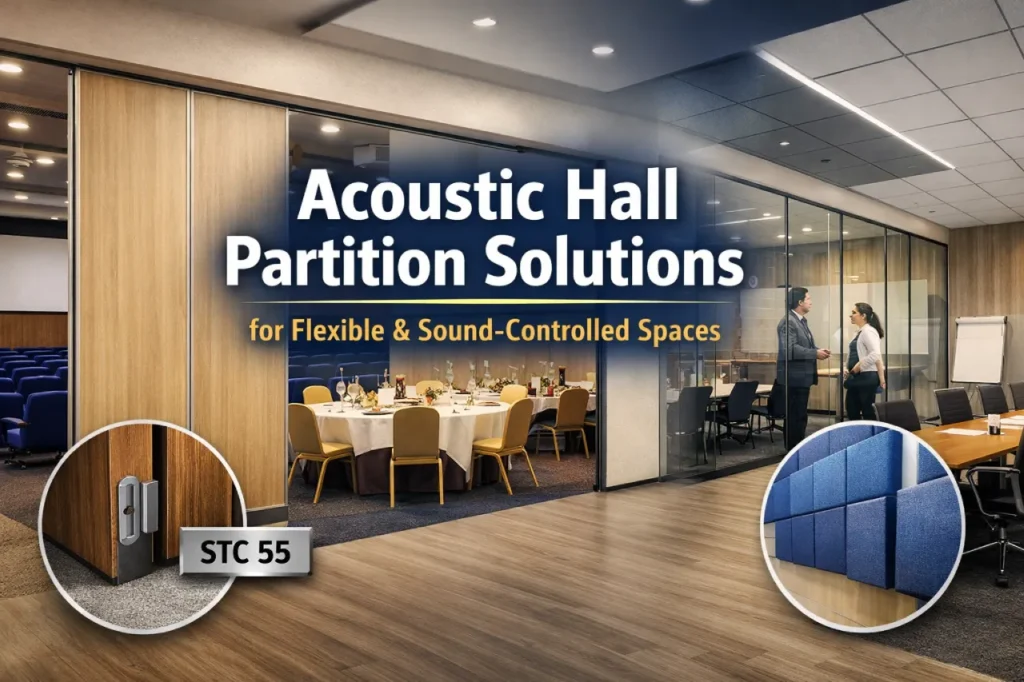
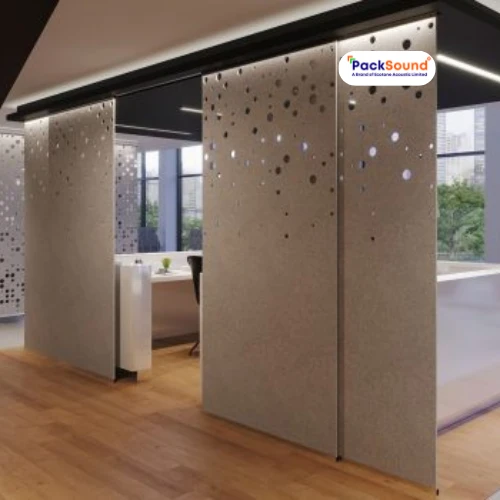
Flexible hall division with STC up to 55 for superior sound insulation.
Enquire Now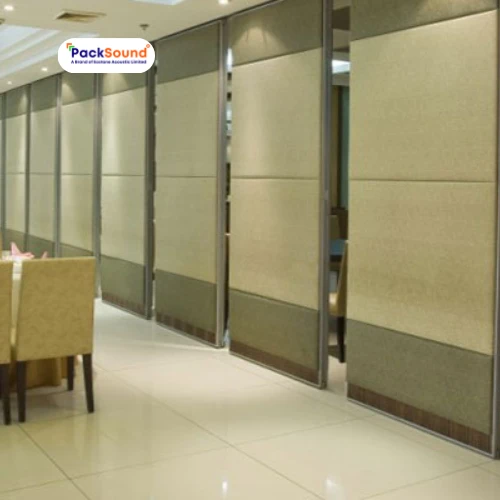
Compact stacking movable walls for multipurpose halls and banquets.
Enquire Now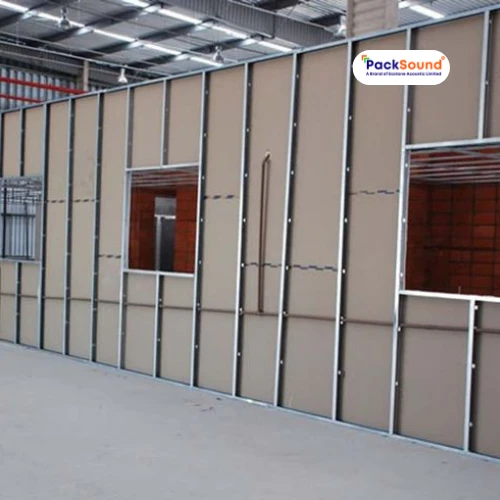
Fire-rated drywall system with high acoustic privacy performance.
Enquire NowAn acoustic hall partition is a purpose-built wall or divider system designed to reduce noise transmission between two spaces. Unlike conventional partitions that only separate areas visually, acoustic partitions focus on sound control and help create quieter, more comfortable environments.
The main purpose of an acoustical partition wall is to limit the movement of sound from one area to another. Excessive sound affects concentration, productivity, privacy, and comfort in busy or noise-sensitive environments. Acoustic partitions manage these issues by absorbing and blocking sound waves. This results in improved acoustic performance within buildings.
Acoustical partitions are designed barriers that control sound transmission between different spaces. These systems are engineered to minimize noise pollution and create acoustically optimized environments. They ensure privacy and improve productivity. Mani Pathak, a specialist in architectural acoustics, explains that the difference between standard room dividers and acoustic hall partition systems lies in their engineered approach to noise control rather than simple spatial separation.
Acoustic partitions work by combining multiple noise-control principles. They are constructed using high-density insulation materials, sound-absorbing layers, and rigid panels that reduce sound vibrations. Proper sealing around joints, edges, and frames prevents sound leakage further.
The effectiveness of an acoustic partition is measured by its Sound Transmission Class (STC) rating, which indicates how well it blocks sound. Higher STC numbers mean better soundproofing, with ratings ranging from 35 to 60 dB depending on the system.
Sound waves bounce back and create echoes when they hit hard surfaces. Acoustic partitions reduce this effect by absorbing sound energy instead of reflecting it. Materials such as mineral wool, rockwool, and acoustic fabric are used inside partitions to trap sound waves. This results in clearer acoustics, reduced background noise, and a more comfortable environment in enclosed or open-plan spaces.
Acoustic sliding folding partition systems also act as barriers that limit sound transmission between adjacent spaces. These partitions interrupt the direct path of sound and help maintain privacy while reducing distractions. They prove useful in meeting rooms, event halls, and production areas where noise separation is essential.
The success of foldable partition wall systems depends on several integrated components working together. High-performance partitions combine sound-absorbing cores with durable outer panels. Common material options include perforated metal sheets, high-density boards, and acoustic foams.
Sliding folding partition systems feature top-hung designs without the need for floor tracks. Panels range from 600mm to 1200mm wide and come in thicknesses of 65mm, 80mm, 85mm, or 100mm. Each panel is suspended on trademark trolley systems with maintenance-free multiple ball bearings.
Sealing mechanisms are critical components. The guillotine mechanism, like a jack system, creates compression and insulation by pushing insulated profiles with rubber wicks under and above the panels with an average force of 500 N. Retractable top and bottom seals ensure effortless movement while maintaining acoustic integrity. Users turn a waist-high operating handle 45 degrees to extend or retract these seals.
High-density rockwool at 150 kg/m³ serves as the standard insulation material. Soundproofing barriers at 3mm thickness on both sides and acoustic junction wedges at four corners on each panel improve performance. Vertical sound insulation barriers (guillotine systems) and horizontal concave-convex aluminum caps with insulation cords complete the acoustic package.
Telescopic panels provide the final closure mechanism and ensure air-tight sealing throughout the acoustical partition wall system. EPDM rubber sealing strips seal gaps between sliding panels and tracks or floors. These components work together to guarantee sound insulation of up to 60 decibels when other components in the space are compatible.
Sliding folding partition systems represent the most versatile category of acoustic hall partition solutions. These moveable wall systems consist of soundproof panels connected by hinges that operate on a top-hung or floor-supported track system. The panels slide and fold neatly to one or both sides of a room and let you adjust spaces within minutes.
The system operates through hinged panels that slide and fold at the same time, like an accordion. The panels stack in a compact way when fully opened, leaving a wide, unobstructed passage. Top-hung systems eliminate the need for floor tracks and offer a clean surface while reducing cleaning and maintenance costs.
You can choose from multiple configurations to match your space requirements. Center-folding systems allow panels to stack on both sides. Side-folding options concentrate panels at one end. Bi-parting systems provide additional flexibility for larger openings. Panel heights range from 2 meters to 12 meters and accommodate various ceiling heights.
Foldable partition wall systems come in several operational styles. Each suits specific applications. Paired panel systems feature panels hinged in pairs that move in a straight line within the opening. This design allows for quick setup and is ideal for applications that need exceptional durability and frequent use.
Single panel systems provide ultimate versatility and allow multiple room setups and changes in the location of pass doors and work surfaces. According to Mani Pathak, a specialist in acoustic design, single panel configurations offer maximum flexibility for venues that need to adapt their layout daily.
There’s another option where panels are connected together in a train and extend as one complete unit. This automation enables quick deployment without moving each panel into place by hand. Vertically folding retractable walls store into the ceiling with the push of a button for spaces with limited floor area.
Acoustic sliding folding partition systems deliver sound reduction ranging from 35 dB to 55 dB or higher, depending on the configuration. Panel thickness influences acoustic performance. Systems with 85mm thick panels achieve STC ratings of 40-45, while 100mm panels reach STC 45-50.
Advanced acoustic materials create this performance level. Rock wool insulation, mass-loaded vinyl, MDF layers and specialized acoustic seals work together to control sound transmission. Double or triple-layer core panels are available for applications that need higher sound attenuation.
Panel specifications vary by manufacturer. Width ranges from 750mm to 1230mm. Heights extend from 2000mm to 9500mm for thicker systems. Panel weight affects both acoustic performance and structural requirements, ranging from 28 kg/m² for 85mm panels to 37 kg/m² for 100mm options.
Surface finishes allow you to match interior esthetics while maintaining acoustic function. Options include wood veneer, laminate, fabric, melamine, polyester board and grooved slates. Glass configurations are also available. Integrated magnetic or mechanical seals at the top, bottom and sides boost sound insulation by closing gaps that could allow sound leakage.
Movable acoustical partition wall systems offer adaptability that fixed walls cannot match. These reconfigurable walls allow you to adjust room sizes within minutes and respond to daily, weekly or seasonal changes in space use. Installation occurs faster than traditional walls and causes minimal disruption, often requiring no heavy construction tools or wet trades like plastering.
Fixed partition walls are permanent structures that provide better sound insulation. Once installed, they cannot be reconfigured to create open space, making them more robust but less adaptable. Fixed walls with materials like gypsum or acoustically treated glass are ideal for executive rooms and private offices where confidentiality is significant.
Movable partition walls eliminate load-bearing requirements and support lightweight construction. They improve overall building efficiency while maximizing usable space. Panels can be added or removed over time, making these systems future-proof without major renovation costs. But for therapy rooms or recording studios where privacy is paramount, fixed walls with proper insulation may outperform movable systems unless you select high-end acoustic operable walls.
Noise pollution affects health and wellbeing substantially, especially in urban environments where people live and work. Acoustic partitions address this challenge and deliver measurable benefits across multiple dimensions, from improved productivity to substantial cost savings.
Acoustic hall partition systems reduce noise transmission through specialized sound-absorbing materials that trap sound waves rather than reflect them. Sound waves bounce back and create echoes when they hit hard surfaces. Acoustic partitions absorb this sound energy and result in clearer acoustics with reduced background noise.
The World Health Organization recognizes noise pollution as a significant health concern, especially for those in cities. Acoustical partitions can reduce perceived noise levels from floors above, including footsteps or furniture movements, up to a factor of eight. This dramatic reduction creates protection from external noise and improves comfort with privacy.
Excessive noise causes fatigue, stress, and poor concentration. Acoustic sliding folding partition systems make it easier for people to focus on tasks without constant interruptions by controlling sound levels. Reduced noise also improves speech clarity, which matters in collaborative and communication-driven environments.
Acoustical partition wall systems limit sound transmission between adjacent spaces and interrupt the direct path of sound. This helps maintain privacy and reduces distractions, which proves useful in meeting rooms, call centers, and event halls where noise separation matters. According to Mani Pathak, a specialist in architectural design, knowing how to control both airborne and impact noise distinguishes quality acoustic systems from standard room dividers.
Sliding folding partition systems offer adaptability that fixed walls cannot match. These reconfigurable walls allow you to adjust room sizes within minutes and respond to daily, weekly, or seasonal changes in space use. Businesses can transform office spaces into individual workspaces in the morning, training rooms at lunchtime, and social event venues in the evening.
This transformation delivers maximum efficiency with minimal physical effort. Companies offering flexible office solutions are 40% more successful in talent acquisition and retention, with users more engaged and productive in user-focused spaces. Foldable partition wall systems maximize available square footage and create multi-functional spaces.
Spaces can be rearranged as operational needs change without major construction work. Installation occurs faster than traditional walls. Disruption stays minimal, and the overall cost is lower than permanent soundproof structures. As Mani Pathak notes, this flexibility proves invaluable for venues requiring daily layout adaptations.
Building permanent walls can get pricey and time-consuming. Acoustic partitions offer a more affordable alternative that can be installed with minimal disruption to ongoing operations. They provide long-term cost savings and eliminate the need for expensive renovations when space requirements change.
Acoustical partition wall systems are constructed from high-quality materials to withstand years of use and can be rearranged or relocated as needs change. This adaptability provides lasting value and supports facilities that need to grow or rearrange spaces without generating unnecessary waste.
Partitions can be reinstalled in new configurations instead of replacing walls or undergoing time-consuming rebuilds. This enables you to retain a professional, cohesive look even after multiple moves. This approach supports sustainability principles and reduces landfill waste while conserving resources.
Proper maintenance of acoustic partitions matters for longevity, safety, and functionality. Regular service and preventive maintenance can save you from pricey repairs and the inconvenience of replacement systems.
Investing in high-quality systems from the start reduces long-term maintenance requirements. No amount of careful maintenance can prevent low-quality walls from deteriorating quickly. This makes original quality selection significant. Well-maintained partitions function smoothly and contribute to a better user experience.
Regular maintenance will give sliding folding partition systems their expected lifespan or even exceed it. Addressing issues early through maintenance prevents more significant problems that might be more expensive to fix. Routine cleaning should be performed weekly or bi-weekly, depending on usage, with mild cleaning solutions and soft materials.
Selecting the right acoustic hall partition requires understanding specific performance standards and technical features. These specifications determine how your system controls sound and adapts to your facility’s unique requirements.
Sound Transmission Class (STC) ratings indicate how well a partition blocks airborne sound traveling from one room to another. Higher numbers show better sound reduction performance, with ratings applying to complete wall assemblies rather than individual components.
Testing follows ASTM E90 standards, where wall assemblies are mounted between two chambers. Testers play sound in the source chamber and measure decibel levels in the receiving chamber across 16 frequencies between 125 Hz and 4000 Hz. The transmission loss at these frequencies determines the final STC rating.
The International Building Code designates STC 50 as the minimum design rating for unit-to-unit multifamily construction. For acoustical partition wall systems, ratings range from 35 to 58 dB depending on panel thickness and construction. A partition with STC 40 reduces loud speech to a murmur. STC 45 makes it inaudible. Systems rated 60 or above block most sound transmission.
Mani Pathak, a specialist in architectural acoustics, notes that doubling a partition’s mass improves sound insulation by about 5 dB. This principle guides the selection of panel thickness for specific applications.
Manual partition systems accommodate varying panel heights and sound insulation requirements. Systems with panel heights up to 3.5 meters achieve maximum sound insulation of 44 dB. Those supporting heights up to 12 meters reach 58 dB.
Track systems must account for building requirements without compensating for structural deflection. Structural designers must ensure zero deflection in steel design, as panel seals have limited capacity to address this issue.
Acoustic seals are categorized by location and function. Horizontal seals at top and bottom panel edges create barriers between panels and overhead structures, tracks, and floors. Vertical seals, called astragals, ensure tight acoustic sealing between adjacent panels. Perimeter seals prevent sound from flanking around the wall assembly at fixed building elements.
Sound bypasses panels through flanking paths when seals don’t function as intended. This compromises overall performance. Adherence to ASTM E90 for laboratory testing and ASTM E557 for architectural design ensures successful acoustic performance in the field.
Acoustic partitions employ various high-performance materials. Fiberglass offers superior sound absorption across wide frequency ranges and suits auditoriums and boardrooms. Wood panels add warmth through slatted, grooved, or perforated designs. PET panels made from recycled plastic bottles provide eco-friendly, felt-like options with 60% recycled content.
Fabric-wrapped panels offer extensive customization in patterns and colors. Vinyl-covered boards deliver durability and cleanability for healthcare and educational settings.
Manufacturers now offer finishes that blend with modern interiors rather than standing out. Sliding folding partition systems support raw MDF, painted finishes, mica laminates, fabric textures, and acoustic boards. Wood veneers create warm, inviting esthetics.
Customization extends to dimensions, colors, patterns, engravings, and branding. Digitally printed graphics can be integrated onto panels. This allows corporate spaces to use acoustic partitions as branded storytelling elements while maintaining sound control functionality.
Acoustic hall partition systems serve diverse sectors where space flexibility meets sound control requirements. These applications help you identify the right configuration for your specific venue.
Sliding folding partition systems deliver flexibility for banquet operations. You can combine or divide banquet areas depending on event size and control both space and sound to ensure guest comfort. These venues benefit from quick room reconfiguration between weddings, receptions, business events and cultural performances.
Banquet spaces with marble, glass and gypsum finishes create excessive reverberation and poor speech clarity when they lack proper acoustic treatment. Acoustic partitions address long reverberation times, high ceiling amplification, microphone feedback and noise fatigue during extended events.
Convention centers face unique challenges. Time between event tear-down and setup is limited and requires efficient partition systems. Acoustical partition wall solutions let venues create varied room sizes for predicted events, from small breakout sessions to expansive exhibition halls.
These facilities accommodate conferences, lectures and corporate events that just need versatile spaces. Foldable partition wall systems let you reshape venues instantly with independent entrances for each partitioned space. Exhibition halls and conference centers benefit from smart zoning without permanent walls and host parallel events without compromising acoustics.
Schools, colleges and universities deploy acoustic partitions in classrooms, auditoriums and seminar halls to create flexible learning environments. These movable barriers reduce noise transfer and allow improved focus during exams, presentations and group activities.
Noise pollution in educational settings disrupts student focus. It interferes with communication between teachers and students. Acoustic sliding folding partition systems minimize external and internal noise distractions and enable students to absorb information while reducing teacher voice strain.
Hotels use acoustic partitions to maximize banquet area functionality. Lightweight composite partition walls with high sound insulation improve sound environment quality throughout hospitality facilities. Training halls, meeting rooms and multi-function venues benefit from excellent sound insulation.
Open-plan offices use acoustic partitions to create temporary meeting rooms, training spaces and private zones while maintaining collaborative workplace atmosphere. These systems support flexible office solutions and contribute to better talent acquisition and retention.
Churches and religious facilities serve as vibrant community hubs beyond traditional worship services. Acoustic partitions transform multipurpose rooms for Bible study groups, ministry workshops, weddings, blood drives, voting polls and concerts. Sound-absorbing partitions minimize distractions and create respectful, focused environments for participants. Mani Pathak notes that these applications demonstrate how acoustical partitions support both spiritual activities and community service functions at the same time.
Selecting an acoustic hall partition demands careful evaluation of multiple factors. Your choice determines both immediate functionality and long-term value.
Get into the layout and dimensions of the area you intend to divide or transform. Acoustic sliding folding partitions are available in various panel configurations, including center-fold and end-fold options. Select a configuration that best accommodates your space and intended usage.
Determine the level of acoustic performance that suits your intended use of the divided spaces. Environments demanding high levels of privacy and noise isolation need partitions equipped with superior acoustic sealing and insulation. Residential buildings require walls separating apartments to achieve a sound reduction of at least 45 dB. Offices need STC levels around 35-50, and healthcare facilities require STC ratings of 50 or above. Mani Pathak notes that matching STC ratings to your specific application prevents both under-performance and unnecessary expense.
Establish a clear budget for your partition project. The cost of detailed acoustic design including detailed recommendations starts at €3,500 to €6,500 for measurements alone. Investment in acoustics must be thought about from a long-term cost-benefit analysis view. Return on investment is calculated based on recovered productivity and improved health outcomes.
Acoustic sliding folding partitions can be suspended from a ceiling track or mounted on a low-profile surface floor track. Factor in the long-term maintenance of the partition system. Some partitions may need more maintenance than others because of their design or materials.
Acoustic hall partition systems revolutionize how you manage space while keeping superior sound control intact. These sliding folding partition and foldable partition wall solutions deliver measurable benefits through noise reduction and operational flexibility compared to permanent construction.
You might be managing a banquet hall, conference center, educational facility, or corporate office. Acoustic partitions adapt to your changing needs. The right acoustical partition wall system depends on your specific STC requirements, space dimensions, and budget.
Choose quality systems with sealing technology and maintenance support. With the correct acoustic sliding folding partition solution, you’ll create versatile, sound-controlled environments that improve productivity, privacy, and user satisfaction over the years.
Acoustic partitions are specifically engineered to control sound transmission between spaces using high-density insulation materials, sound-absorbing layers, and specialized sealing systems. Unlike standard room dividers that only provide visual separation, acoustic partitions focus on reducing noise transfer and are measured by their Sound Transmission Class (STC) rating, which typically ranges from 35 to 60 dB depending on the system design and construction.
Acoustic hall partitions can be reconfigured within minutes, allowing you to transform large spaces into smaller private areas or combine rooms for larger events. The sliding and folding mechanism enables quick deployment without requiring construction tools or heavy labor, making them ideal for venues that need daily layout changes such as banquet halls, conference centers, and educational facilities.
The required STC rating depends on your specific application. Offices typically need STC levels around 35-50, residential buildings separating apartments require at least 45 dB, and healthcare facilities need STC ratings of 50 or above. For banquet halls and conference centers, systems with STC ratings between 40-55 provide adequate sound control for most events, while recording studios or therapy rooms may require ratings of 60 or higher.
Yes, acoustic partitions offer significant cost advantages over permanent walls. They can be installed faster with minimal disruption, require no heavy construction or wet trades like plastering, and eliminate expensive renovation costs when space requirements change. The systems are constructed from durable materials that can be reconfigured or relocated multiple times, providing long-term value and supporting sustainability by reducing waste.
Acoustic partition systems require routine cleaning weekly or bi-weekly depending on usage, using mild cleaning solutions and soft materials. Regular preventive maintenance ensures smooth operation, extends the system’s lifespan beyond expectations, and prevents costly repairs. Investing in high-quality systems from reputable manufacturers reduces long-term maintenance requirements, as proper sealing technology and durable components minimize wear and operational issues.