Call ✆ +91 9809802016 | 9891320678

Quick Answer: An acoustic wooden door is a solid, engineered door built with a dense internal core and compression seals designed to reduce sound transfer between two spaces. Acoustic wooden doors are generally rated between 30 and 48 STC as a tested assembly. As a working rule: 30 to 35 STC is enough to stop normal speech from carrying through, 40 to 45 STC is the working range for meeting rooms, hospital cabins, and home theatres, and 45 STC and above is used for recording booths and studios where near-total speech privacy is required. Packsound manufactures wooden acoustic doors and wooden fire doors in India for exactly these use cases, this page covers ratings, sizes, core build, specifications, and installation so you can specify the right door the first time.
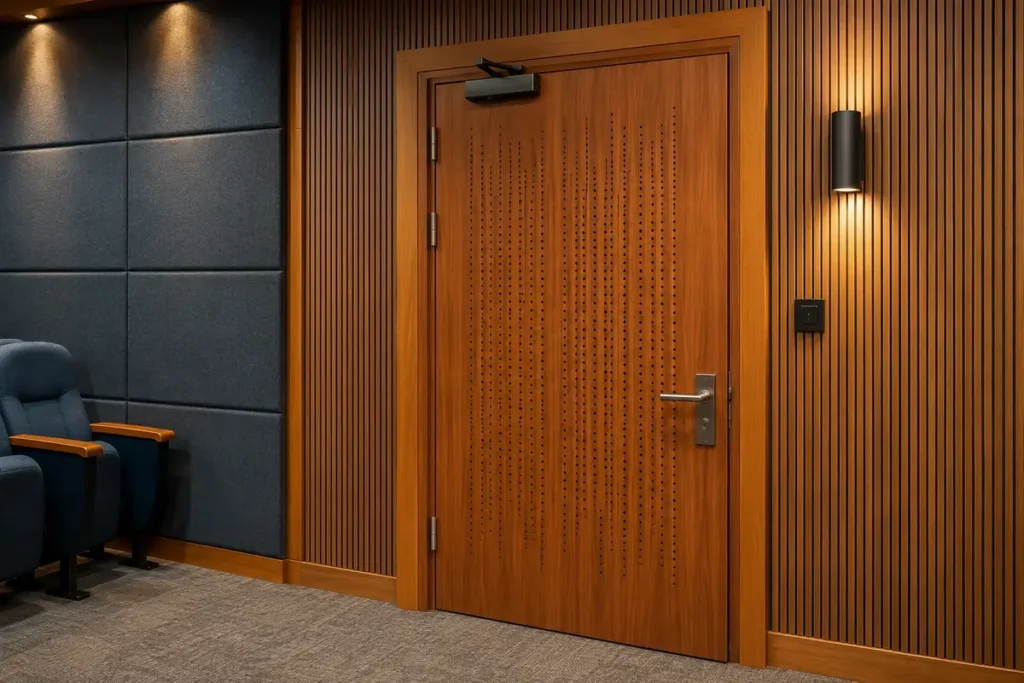
A wooden acoustic door, also called an acoustic wooden door, is a door engineered with a high density core, a solid rebated hardwood frame, and perimeter compression seals, so that airborne sound loses energy as it tries to pass through the leaf and around its edges. It is not simply a heavier version of a standard door. Sound Transmission Class, according to the standard STC calculation defined under ASTM E413, measures this performance across the speech frequency range and gives it a single comparable number (Wikipedia: Sound Transmission Class). A standard solid wood door with no acoustic detailing typically tests at only 28 to 30 STC even before gaps are accounted for, which is why purpose-built acoustic wooden doors exist as a separate product category.
| Space Type | Recommended STC | What You Can Expect |
|---|---|---|
| Home office / Standard cabin | 30–35 | Loud speech is muffled; words are hard to make out |
| Meeting / Conference room | 38–42 | Normal conversation is not audible outside |
| Home theatre / Media room | 42–45 | Bass and dialogue are significantly reduced |
| Recording studio / Podcast room | 45–48+ | Near-complete speech privacy with a sealed frame. |
Standard Indian door openings that Packsound builds for are 900mm x 2100mm and 1000mm x 2100mm, with custom sizes available up to 1200mm x 2400mm for auditorium and studio openings. Thickness runs from 45mm for a basic acoustic door up to 72mm for a high STC, fire rated wooden doors, since a thicker sandwich core is what allows the higher rating. If your opening is a non-standard size (very common in retrofit and heritage buildings across India), get it measured on site before ordering. A 10 to 15mm error in a masonry opening is common and changes the frame rebate needed for the seal to compress correctly.
The core is what separates an acoustic wooden door from a regular flush door. A typical wooden acoustic door specification includes:
| Point | Detail |
|---|---|
| Core | High density mineral wool or composite sandwich |
| Frame | Solid rebated hardwood |
| Thickness | 45mm to 72mm |
| STC Range | 30 to 48+ (tested assembly) |
| Finish | Laminate, veneer, or factory paint |
| Fire Rating (Optional) | 30 to 180 minutes, IS 3614 Part 2 |
| Seals | Perimeter compression seal plus automatic drop seal |
| Point | Detail |
|---|---|
| Noise control | Cuts sound transfer between adjoining rooms |
| Privacy | Prevents conversations from carrying through cabins |
| Focus | Reduces distraction in offices, studios, libraries |
| Design | Available in finishes that match interior schemes |
| Fire safety | Fire rated variant slows flame and smoke spread |
| Climate resistance | Laminate finish resists warping in humid regions |
| Lifespan | Long service life with periodic seal checks |
| Point | Detail |
|---|---|
| Corporate | Meeting rooms, boardrooms, conference cabins |
| Media | Recording studios, podcast rooms, edit suites |
| Residential | Home theatres and media rooms |
| Healthcare | Consultation rooms, diagnostic and procedure rooms |
| Hospitality | Hotel guest rooms and banquet partitions |
| Education | Libraries, exam halls, music rooms |
| Public Venues | Cinema halls and auditoriums |
| Step | Detail |
|---|---|
| 1 | Site survey and exact opening measurement |
| 2 | Frame fixing with shimming for true alignment |
| 3 | Hinge and closer selection matched to door weight |
| 4 | Perimeter seal and automatic drop seal fitting |
| 5 | Door leaf hanging and gap alignment check |
| 6 | Optional field acoustic verification (ASTM E336) |
| 7 | Finish touch-up and handover documentation |
| Myth | Reality |
|---|---|
| Any thick wooden door is automatically soundproof | Thickness fails without a dense core and sealed perimeter |
| Fire doors and acoustic doors perform the same job | Fire doors resist flame spread, acoustic doors block sound |
| A higher STC number means total silence | Higher STC reduces sound greatly, it does not erase it |
| Lab STC rating equals real site performance | Site rating drops from frame gaps and installation quality |
| Painting an old door improves its soundproofing | Paint changes looks only, not the door’s acoustic core |
This is the part most product pages skip, and it is the part that actually determines whether your room is quiet. A door leaf tested in a lab at 45 STC can perform 8 to 10 points worse once installed, because the lab test uses a perfectly sealed, rigid frame, and a real site rarely gives you that. In our experience fitting doors on Indian sites, three things cause this drop more often than the door itself:
If acoustic performance is critical, ask your wooden acoustic door manufacturer for a field verification (ASTM E336 covers on-site testing) rather than relying only on the lab-rated ASTM E90/E413 number on the data sheet.
| Parameter | Specification |
|---|---|
| Product type | Solid core wooden acoustic door / wooden fire door |
| Standard sizes | 900mm × 2100mm, 1000mm × 2100mm (custom available) |
| Thickness range | 45mm to 72mm |
| Core material | High density mineral wool / composite block board |
| Frame material | Solid hardwood, rebated profile |
| Mass layer (optional) | Loaded vinyl / barium sulphate sheet |
| STC rating | Up to 45 to 48 STC, tested assembly |
| Fire rating | 30 to 180 minutes per IS 3614 Part 2 / BS 476 Part 22 |
| Finish options | Laminate, natural veneer, factory paint |
| Reference standards | ASTM E90 / E413 (acoustic), IS 3614 Part 2 (fire) |
| Manufacturer | Packsound, Greater Noida, India |
Yes, if the core is dense and the perimeter is fully sealed on all sides.
Aim for 45 STC or higher to control most speech and instrument leakage.
No, fire doors resist flame spread, acoustic doors block sound transmission.
Costs vary by STC rating, size, and finish, expect a premium over standard doors.
Adding seals helps somewhat, full core replacement gives real improvement.
Mostly yes, but perimeter sealing matters just as much as core weight.
Usually 45mm to 72mm, thicker sandwich cores allow higher STC ratings.
Wood generally, since it dampens resonance better than a hollow steel leaf.
Decades if maintained, though seals need periodic inspection and renewal.
Special rebated frames with drop seals are required for a rated assembly.