
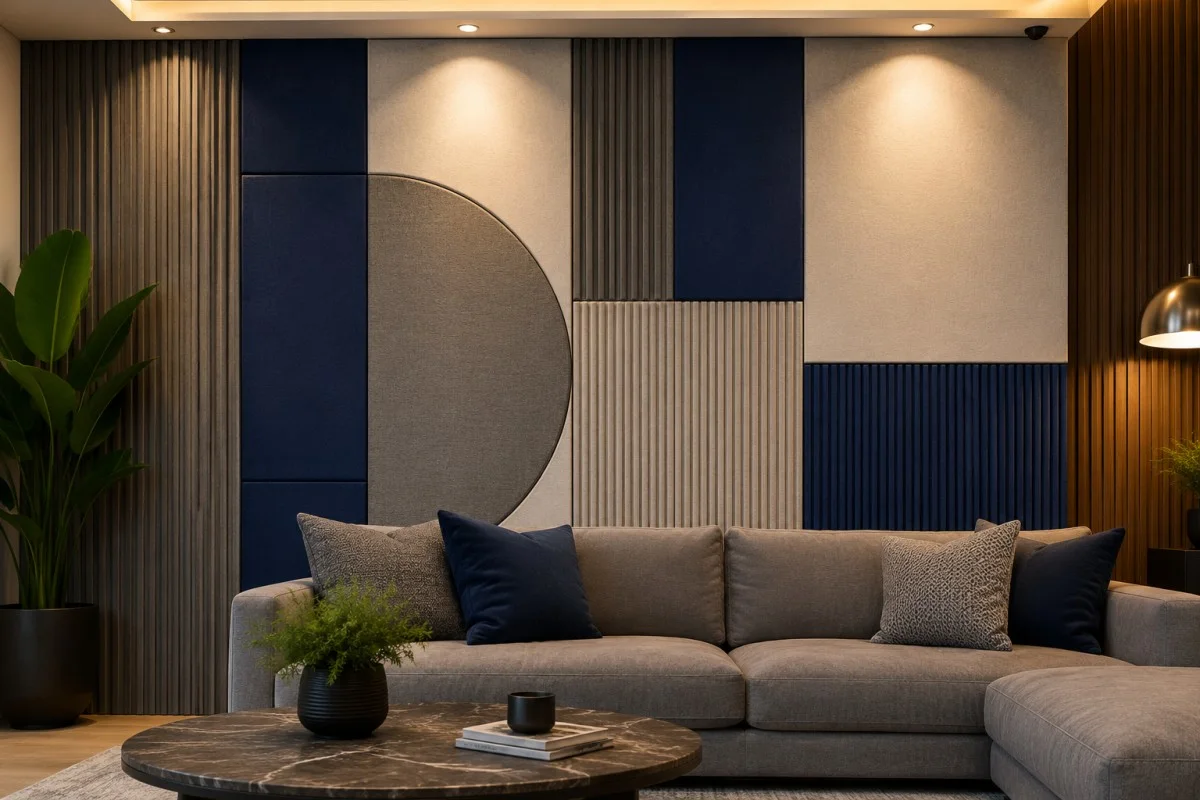
Decorative Acoustic Wall Panels

Decorative Acoustic Wall Panels for Conference Rooms: Achieving Better Speech Clarity

Conference rooms are where business decisions are made, presentations are delivered, and ideas are exchanged. Yet a surprising number of organisations invest heavily in AV equipment, high-end furniture, and video conferencing systems while completely ignoring the one variable that undermines everything else: the acoustic quality of the room itself. Decorative acoustic wall panels address this gap by combining engineered sound absorption with visual sophistication, transforming an ordinary conference room into a space where every word is heard clearly and every meeting becomes more productive.

Why Wall Acoustics Are the Hidden Bottleneck in Conference Room Performance

Most conference room complaints are diagnosed as “bad speakers” or “poor microphone placement.” In reality, the underlying problem is almost always poor wall acoustics. Sound waves emitted from a speaker or presenter travel outward and strike hard surfaces such as glass, concrete, gypsum board, and flooring. Each surface reflects a portion of that sound energy back into the room. When multiple reflections arrive at the listener’s ear within 30 to 50 milliseconds after the direct sound, the brain perceives them as reverberation, which degrades the intelligibility of speech.
The metric used to quantify this degradation is the Speech Transmission Index (STI), a value between 0 and 1. An STI below 0.45 is considered poor; above 0.75 is considered excellent. Most untreated conference rooms with glass walls and hard flooring register STI values between 0.35 and 0.55, well into the range where listeners struggle to follow complex sentences, miss numbers and proper nouns, and experience listening fatigue within 20 to 30 minutes.
Decorative acoustic sound panels, when correctly specified and positioned, can raise the STI of a conference room by 0.2 to 0.35 points without any changes to the AV system, making them one of the highest-return investments a facilities manager can make.

Understanding Acoustic Wall Panel Materials and Their Impact on Speech Clarity

What NRC Actually Means in a Conference Room Context

The Noise Reduction Coefficient (NRC) is the standard measure of a panel’s sound-absorbing capacity, expressed as a value from 0 (perfect reflection) to 1.0 (perfect absorption). However, NRC is a single-number average across four frequencies (250 Hz, 500 Hz, 1000 Hz, and 2000 Hz), and this single number can be misleading when choosing acoustic wall panel material for speech-heavy environments.
Human speech occupies the frequency range from approximately 125 Hz to 8000 Hz, with the consonant-heavy range (the sounds that carry intelligibility) concentrated between 1000 Hz and 4000 Hz. A panel with an NRC of 0.85 that absorbs primarily in the low frequency range may do far less for speech clarity than a panel with an NRC of 0.75 that targets the 1000 Hz to 4000 Hz band strongly.
When reviewing acoustic wall panel material options, always request the full absorption coefficient table at each octave band, not just the composite NRC figure.

Core Material Families and Their Real-World Trade-offs

Fabric-Wrapped Panels: These consist of a rigid or semi-rigid core (typically fibreglass, mineral wool, or recycled polyester fibre) wrapped in an acoustically transparent fabric. They offer among the highest mid and high frequency absorption available, typically achieving NRC values of 0.85 to 1.0. The fabric face can be specified in hundreds of colours, textures, and patterns, making them the most design-flexible option for corporate interiors. Ecotone’s fabric wrapped panels for walls are a flagship choice for board rooms and executive conference suites where both performance and aesthetics must meet the highest standards.

Grooved Wooden Panels for Walls: These use precision-machined parallel grooves or slots in pre-laminated MDF to create acoustic apertures. Sound enters the slots, travels into the cavity and backing material, and is absorbed. They achieve NRC values typically in the 0.65 to 0.80 range depending on groove spacing, cavity depth, and backing material. Ecotone’s EchoStop Grooved Wooden Slat Panels are available in over 50 finishes including natural teak, walnut, wenge, beech, and custom laminates, and are frequently specified for premium conference rooms where a warm, architectural aesthetic is required alongside solid acoustic performance.

Perforated Acoustic Panels: Perforated panels use micro-holes drilled through a face material (wood, metal, gypsum, or composite) backed with an absorptive layer. The percentage open area and hole diameter determine the frequency range most effectively absorbed. Higher perforation percentages tend to push absorption toward higher frequencies, which is beneficial for speech clarity. Ecotone’s perforated wooden acoustic panels are particularly well-suited to conference rooms with a fixed seating arrangement where the primary concern is controlling mid-to-high frequency reflections from side walls and the rear wall.

PET Panels: Polyethylene terephthalate (PET) panels are manufactured from recycled plastic bottles compressed into dense felt boards. They offer NRC values of 0.70 to 0.95, are lightweight, easily cut into custom shapes and designs, and carry strong sustainability credentials. Ecotone’s PET panels are increasingly specified in tech sector and startup office conference rooms where a contemporary, colourful aesthetic and environmental responsibility are both priorities.

3D Panels: Textured or three-dimensional surface panels serve a dual function: they scatter (diffuse) sound waves in addition to absorbing them. Diffusion is particularly valuable in larger conference rooms where simple absorption alone can make a space feel acoustically dead or unnatural. 3D panels create a scattered reflection pattern that maintains a sense of spaciousness while reducing flutter echo.

Acoustic Wood Wall Panels: Why the Finish Matters More Than Most Buyers Realise

Acoustic wood wall panels represent one of the most popular specification choices in Indian corporate interiors, particularly for conference rooms, boardrooms, and executive meeting suites. However, a poorly understood variable significantly affects their performance: the surface finish.

A fully sealed, high-gloss lacquer finish on a grooved or perforated wood panel dramatically reduces its acoustic performance because the lacquer partially or fully blocks the apertures that allow sound to enter the absorptive backing. A wood panel specified with a semi-open or oil finish will outperform an identical panel with a sealed gloss finish by as much as 15 to 25 percent on measured NRC.

This is rarely discussed in product brochures or sales conversations, but it is one of the most practically important details when specifying acoustic wood wall panels. Always request NRC test certificates that correspond to the specific finish you intend to specify, not just the panel construction.

Acoustic Wall Panel Design: Placement Strategy Is More Important Than Coverage Area

One of the most persistent misconceptions in conference room acoustics is that more panel coverage automatically produces better results. This is not true. The placement, distribution, and geometry of decorative acoustic wall panels matters more than total coverage area, particularly for speech clarity.

The Rule of Non-Parallel Surfaces

In a rectangular conference room, the two primary acoustic problems are flutter echo (rapid repetitive reflections between two parallel hard surfaces) and late reverberation (long decay tails that blur successive words together). Treating only one wall of a parallel pair reduces flutter echo only marginally. Acoustic wall panel design must address both walls of each parallel pair to break the reflection path, or alternatively place absorption plus diffusion on one wall to scatter the reflection pattern.

The First Reflection Zone Principle

The most acoustically critical positions on a conference room wall are the first reflection points: the locations where sound from the primary speaker or presenter first strikes the side walls before reaching listeners. A simple mirror test can locate these points. Panels placed at first reflection zones deliver a disproportionate improvement in speech clarity relative to the total area treated, because they intercept the earliest and strongest reflections that degrade STI.

Rear Wall Treatment

The rear wall of a conference room receives direct sound from both presenters and the main speakers and reflects it back toward the audience. This back-reflected energy arrives relatively late and with significant energy, producing a distinct echo that is particularly disruptive during presentations. A combination of absorptive panels (fabric-wrapped or PET) and diffusive elements (3D panels) on the rear wall is widely considered best practice in conference room acoustic design.

Height Considerations

Most acoustic treatment guidance focuses on wall surface area at seated head height (approximately 1.0 m to 1.8 m above floor level). However, in high-ceiling conference rooms, the first 1.8 m of wall may represent only a fraction of the total reflective surface area. In rooms with ceiling heights above 3.5 m, extending panel treatment up to 2.5 or even 3.0 m height, or supplementing wall panels with acoustic clouds suspended from the ceiling, produces substantially better results than limiting treatment to standing height.

Ecotone’s Full Product Range for Conference Room Acoustics

Ecotone Acoustic Limited manufactures and installs the complete spectrum of acoustic treatment products required for conference rooms, boardrooms, and multipurpose meeting halls. Each product addresses a specific acoustic and design requirement.

Fabric Wrapped Panels for Walls

Ecotone’s fabric wrapped panels for walls combine a high-density rockwool or fibreglass core with an acoustically transparent fabric available in a wide range of colours and textures. With NRC values reaching 1.0, these panels are the highest-performing absorbers in the product range and are particularly effective at mid and high frequencies critical to speech intelligibility. They are the preferred specification for executive conference rooms, boardrooms, and any space where acoustic performance is the primary requirement.

Grooved Wooden Panels for Walls (EchoStop)

The EchoStop range of grooved wooden panels for walls uses precision-machined parallel grooves across a pre-laminated MDF face. Available in over 50 wood-grain and solid colour finishes, these panels achieve NRC values of 0.65 to 0.80 and are the standard specification for premium conference rooms in corporate campuses, five-star hotels, and high-end commercial interiors across India.

Perforated Acoustic Panels

Perforated wooden acoustic panels offer a visually refined appearance with a pattern of drilled holes that allow sound to pass into the backing absorber. They are available in a range of perforation patterns and finishes and are frequently used as the primary wall treatment in conference rooms with a modern, minimal design language.

PET Panels

Recycled PET panels are available in a wide range of colours and can be cut into custom shapes including hexagons, chevrons, and bespoke designs. They are lightweight, easy to install, and achieve strong mid-to-high frequency absorption. Their sustainability credentials make them a natural fit for organisations seeking LEED or GRIHA building certification.

3D Panels

Ecotone’s three-dimensional textured panels provide acoustic diffusion alongside partial absorption, making them well-suited to the rear walls and upper sections of conference room side walls where complete absorption would create an unnaturally dead acoustic environment.

Acoustic Clouds

For conference rooms where wall space is limited by glass, screens, or whiteboards, acoustic clouds suspended from the ceiling provide an alternative treatment surface that intercepts the direct-to-ceiling reflection path. Ecotone manufactures polyester fibre clouds, mineral fibre clouds, and wooden acoustic hanging baffles in a range of dimensions, shapes, and finishes.

Myth vs Reality: What the Industry Gets Wrong About Conference Room Acoustics

Myth 1: Acoustic Panels Are Only for Recording Studios

Reality: Recording studios represent a very small fraction of the global acoustic panel market. The largest application category is commercial interiors: conference rooms, open-plan offices, training rooms, and reception areas. Speech intelligibility in the workplace has measurable effects on productivity, decision quality, and employee wellbeing. Acoustic panels in conference rooms are as much a business productivity tool as a microphone or a projector.

Myth 2: A Higher NRC Always Means Better Speech Clarity

Reality: NRC is an average across four frequencies. A panel with an NRC of 0.90 that performs poorly at 2000 Hz and 4000 Hz will deliver less intelligibility improvement than a panel with an NRC of 0.70 that peaks in absorption between 1000 Hz and 4000 Hz. Specify panels based on octave-band absorption data, not composite NRC alone.

Myth 3: You Only Need to Treat the Front Wall Behind the Screen

Reality: In most rectangular conference rooms, the side walls and rear wall contribute more reflective energy to a typical listener’s position than the front wall. A room treated only at the front will still suffer from strong side-wall flutter echo and rear-wall echo, both of which are highly disruptive to speech intelligibility.

Myth 4: Glass Walls Cannot Be Acoustically Treated

Reality: Glass is a highly reflective surface and is one of the primary causes of poor conference room acoustics in modern open-plan office buildings. While glass itself cannot be covered with panels without blocking sightlines, the acoustic consequences of glass can be compensated by increasing the absorption on the remaining non-glass surfaces. Acoustic panels on solid walls, acoustic clouds above, and carpeted flooring can collectively offset the reflectivity of significant glass area. In some cases, acoustically transparent fabric panels can be mounted in front of glass panels on a discrete frame without completely blocking visibility.

Myth 5: Soundproofing and Acoustic Treatment Are the Same Thing

Reality: This is the most common and costly misconception in this field. Soundproofing (sound isolation) refers to blocking the transmission of sound between adjacent spaces. Acoustic treatment refers to controlling the behaviour of sound within a single space. Decorative acoustic wall panels are an acoustic treatment product, not a soundproofing product. They improve how sound behaves inside a conference room. They do not prevent sound from passing through walls to adjacent spaces. Both problems may exist in the same conference room, but they require different product solutions.

Edge Cases and Hidden Realities Competitors Rarely Discuss

The Over-Treated Conference Room Problem

Acoustic professionals are frequently called to diagnose conference rooms that have been acoustically treated to excess. Over-treating a room by applying absorptive panels to more than 60 to 70 percent of all wall surfaces produces a space that feels acoustically dead and unnaturally anechoic. Speakers raise their voices instinctively to compensate, accelerating vocal fatigue. Participants report that the room feels uncomfortable, though they rarely identify the cause. The correction typically involves replacing some absorptive panels with diffusive or partially reflective elements to restore a balanced, natural acoustic environment.

Low-Frequency Problems That Wall Panels Cannot Solve

Standard decorative acoustic wall panels, regardless of material, are largely ineffective below 200 Hz. Bass frequencies with wavelengths longer than the panel depth pass through or around the panel with minimal absorption. Conference rooms with significant low-frequency problems such as bass thump from external traffic, HVAC rumble, or resonance from large flat surfaces require bass traps, heavy mass constructions, or decoupled floating floors to address. Placing standard acoustic wall panels in a room with a dominant low-frequency problem and expecting comprehensive results is a common and expensive mistake.

The HVAC Noise Interaction

Conference room acoustic treatment reduces reverberation, which makes the room quieter and more intimate. However, reduced reverberation also makes the background noise from HVAC systems more perceptible and more annoying. In a poorly designed conference room with a noisy air handling unit, treating the acoustics can actually make occupants more aware of the HVAC noise rather than less. The correct sequence is to address HVAC noise at the source first, then apply acoustic treatment to the room surfaces.

Humidity and Panel Selection in Indian Climates

India’s variable climate, particularly high humidity in coastal and monsoon-affected regions, affects the long-term performance of certain acoustic wall panel materials. Fibreglass panels exposed to high humidity over extended periods can experience binder degradation. MDF-core wooden panels may experience dimensional changes with humidity variation unless properly sealed on all edges and backs. When specifying acoustic panels for conference rooms in high-humidity environments, mineral wool cores with appropriate edge and back treatments, or PET panels which are inherently moisture-resistant, are better long-term choices than untreated fibreglass or unsealed MDF.

How to Specify Decorative Acoustic Wall Panels: A Decision Framework

Selecting the right acoustic wall panel product for a conference room requires working through five key variables in sequence.

Step 1: Define the acoustic target. Establish the desired reverberation time (RT60) for the room based on its primary use. A small meeting room for six to eight people should target an RT60 of 0.3 to 0.5 seconds. A larger boardroom or training room should target 0.5 to 0.7 seconds.

Step 2: Calculate the existing RT60. Use Sabine’s formula with the known room volume and existing surface absorption data, or commission a pre-treatment acoustic measurement. This establishes the gap between current performance and target performance.

Step 3: Determine the required total absorption. The difference between existing and target RT60, combined with the room volume, determines how much additional absorption (measured in metric Sabins) is required.

Step 4: Select the panel type based on design priorities. If the primary constraint is visual aesthetics, acoustic wood wall panels (grooved or perforated) or fabric wrapped panels in specified fabric colours are appropriate. If sustainability is a primary criterion, PET panels are the natural choice. If budget is the primary constraint, composite acoustic panels with rockwool backing offer strong performance at lower cost.

Step 5: Determine placement using first reflection analysis. Map first reflection zones on side walls, identify the rear wall treatment requirement, and consider whether acoustic clouds are needed to compensate for ceiling reflections or limited wall space.

Frequently Asked Questions

Q1: How much of a conference room wall should be covered with acoustic panels?

This is one of the most common questions on Reddit and Quora acoustic forums, and the correct answer is: it depends on the room geometry, existing surface materials, and target reverberation time. As a general starting point for a typical rectangular conference room with hard flooring and gypsum board ceilings, treating 25 to 40 percent of the total wall surface area with panels achieving an NRC of 0.80 or above will typically bring the room within the target RT60 range of 0.4 to 0.6 seconds. However, a proper acoustic calculation based on actual room dimensions will always produce more accurate results than any rule of thumb.

Q2: Can decorative acoustic panels help with video conferencing quality, or do I need better microphones?

Both matter, but room acoustics have a larger effect on video call intelligibility than most people expect. Even the best directional microphone picks up reflected energy from hard room surfaces. When that reflected energy reaches the microphone within 30 to 50 milliseconds of the direct speech, it creates comb filtering and colouration that degrades the transmitted audio. Treating the room acoustically reduces the reflected energy the microphone captures, improving the quality of the signal before it ever reaches the codec. The combination of properly treated room acoustics and a good quality directional microphone consistently outperforms either solution alone.

Q3: Are acoustic wall panels fire-safe for commercial installations?

All panels specified for commercial interiors in India should comply with relevant fire rating standards. Ecotone Acoustic Limited’s panels are available with fire-retardant treatment and come with test certificates. Fabric wrapped panels using mineral wool cores are inherently non-combustible at the core level. MDF-based products, including grooved wooden panels, should be specified with fire-retardant treatment to meet commercial building code requirements. Always request fire rating certificates and confirm compliance with local authority requirements before finalising specification.

Q4: What is the difference between acoustic panels and acoustic foam for a conference room?

Acoustic foam is primarily effective at mid to high frequencies and performs best in relatively small spaces such as recording studios and vocal booths. For conference rooms, acoustic foam has several practical limitations: it is visually unsuitable for professional environments, it lacks the structural durability required for commercial applications, and it does not perform as well at the lower mid frequencies (250 Hz to 500 Hz) that contribute to the warmth and intelligibility of speech. Decorative acoustic wall panels using mineral wool, rockwool, or fibreglass cores outperform foam at commercially relevant frequencies and are manufactured in finishes appropriate for professional environments.

Q5: Do acoustic panels help in conference rooms that already have a drop ceiling with acoustic tiles?

Standard drop ceiling tiles with typical NRC values of 0.50 to 0.65 provide useful absorption at the ceiling plane but are insufficient on their own to achieve acceptable speech clarity in most conference rooms. The ceiling treats only one surface; the four vertical walls and the floor continue to reflect sound energy. Wall acoustic panels are not redundant in a room with a drop ceiling. They address the reflective energy from vertical surfaces that ceiling tiles cannot treat, and together the two systems produce substantially better results than either alone.

Ecotone Acoustic Limited manufactures and installs the complete range of decorative acoustic wall panels discussed in this article, including fabric wrapped panels for walls, grooved wooden panels for walls, perforated acoustic panels, PET panels, 3D panels, and acoustic clouds. All products are NRC-tested, fire-rated, and available with full technical documentation. Free acoustic consultation and PAN India installation are available. Contact Ecotone at +91 9809802016 or visit- ecotone.co.in.

Similar Posts

Leave a Reply

Your email address will not be published. Required fields are marked *