
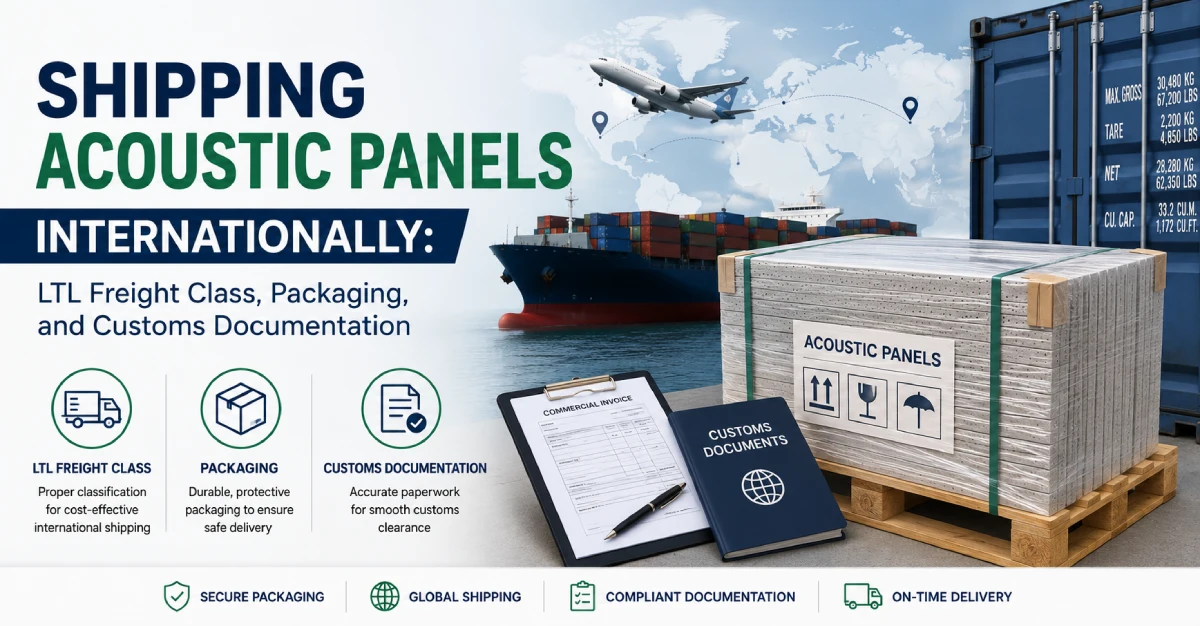
By Ecotone Acoustic Limited / PackSound | Greater Noida, India
Most guides written for acoustic panel buyers cover what to buy and how to install it. (Shipping Acoustic Panels Internationally)
Almost none cover what happens between the factory floor and the job site when that job site is in another country.
This guide fills that gap.
If you are an architect in Dubai specifying acoustic ceiling clouds for a hotel fitout, a studio builder in New York sourcing fabric-wrapped panels from an Indian manufacturer, or a contractor in Singapore procuring wooden slat panels for a corporate office — the acoustic product itself is only half the picture. The other half is getting it there undamaged, on time, correctly classified, and cleared through customs without a single preventable delay.
This is the complete practical guide to shipping acoustic products from India internationally — covering export packaging for fragile panel products, customs documentation and HS codes, the domestic freight classification system that catches most first-time US importers off guard, and the country-specific requirements that cause the most shipment delays in the UAE, UK, Australia, and Southeast Asia.
Why Acoustic Panels Are Genuinely Difficult to Ship
Before getting into process, it is worth understanding why acoustic panels present specific logistics challenges that most other construction materials do not.
They are large, flat, and fragile at the edges. A fabric-wrapped fiberglass panel measuring 1200mm × 600mm × 50mm has an extremely high surface-area-to-volume ratio. Edge damage during handling — a corner crushed on a pallet, a panel sliding against a crate wall — destroys the aesthetic finish even when the acoustic core is intact. This is not a product you can wrap in a single layer of bubble film and call it done.
They are low density relative to their volume. Acoustic panels — particularly ceiling baffles, hanging clouds, and PET felt panels — are engineered to be lightweight. This is acoustically correct but logistically expensive. Low density means high freight class in the US LTL system, higher air freight costs, and unfavourable volumetric weight calculations across all carriers. We will cover exactly what this means for each product type below.
Fabric faces and wooden finishes are finish-critical. Unlike raw construction materials where minor surface marks are acceptable, acoustic panels with fabric, wood veneer, or printed finishes must arrive in showroom condition. A smudge on a fabric-wrapped panel that a client intends to install in a luxury boardroom is a rejection — and a replacement shipment from India takes weeks.
Wooden products require phytosanitary compliance. Acoustic panels with solid wood components, wooden slat surfaces, or wood-based crating require ISPM 15 certification in most destination markets. This is a plant quarantine standard, not a product quality standard, and it catches many first-time Indian exporters completely unprepared at the port.
Understanding these four challenges shapes every decision in the sections that follow.
Section 1: Export Packaging for Acoustic Panels — What Actually Works
Packaging is the single most controllable variable in international acoustic panel shipments. It is also the area where most Indian manufacturers cut corners, because good export packaging adds 8–15% to the shipping cost and the consequences of bad packaging only become visible to the buyer — in another country, weeks later.
Fabric-Wrapped Panels and Fiberglass Core Panels
These are the most damage-sensitive products in the acoustic range. The fabric face scuffs against almost anything, and the core — while robust — can deform under point loading.
The correct export packaging sequence:
- Face protection first. Each panel face gets a sheet of polyethylene foam (minimum 3mm) cut to size and taped, not stapled, to the panel surface. For premium fabric finishes, interleave with acid-free tissue.
- Panel-to-panel stacking. Never stack panels face-to-face without foam interleaving. Stack in uniform sizes only — mixing panel dimensions in a single stack causes uneven loading and edge cracking.
- Bundle banding. Panels are stacked in bundles of 6–10 (depending on thickness and weight) and banded with polyester strapping, not steel banding, which cuts into fabric edges.
- Moisture barrier. The full bundle gets wrapped in polyethylene film before crating. Acoustic panels in sea freight containers are exposed to humidity variations that can cause fiberglass cores to absorb moisture and fabric to develop mildew. This step is non-negotiable for any destination with high ambient humidity — UAE, Singapore, Mumbai transit points.
- Wooden crating. The wrapped bundle sits in a custom wooden crate with a minimum 50mm clearance on all sides, filled with expanded polystyrene (EPS) corner blocks and foam void fill. The crate interior is lined with a moisture-resistant barrier.
PackSound’s fabric-wrapped acoustic wall panels and fiberglass ceiling tiles are crated using this system for all export shipments.
Wooden Slat and Grooved Panel Panels
Grooved wooden acoustic panels and perforated wooden panels have an additional concern: the slats and grooves are structurally weaker than a solid panel face. Under compressive loading from improper stacking, the slat edges can crack or delaminate.
Stack these panels with the grooves running in the same direction and alternate the stacking orientation every third panel to prevent groove-alignment stress concentration. Each panel needs edge protectors — L-profile cardboard minimum, aluminium extrusion profile for premium finishes — before entering the crate.
Critical: ISPM 15 compliance. If the crating uses solid wood framing (as most wooden export crates do), the wood must be heat-treated or fumigated under ISPM 15 standards and stamped with the IPPC mark before shipment. The USA, UAE, Australia, UK, and virtually every major destination market requires this. Missing the ISPM 15 mark on wooden crating is one of the most common causes of shipment detention at destination ports — the entire container can be held while compliance is established, at the importer’s cost.
The ISPM 15 certificate must be obtained from an authorised fumigation service provider registered with the Indian Plant Quarantine organisation. At Ecotone, we source ISPM 15-compliant crating as standard for all wooden panel exports.
Acoustic Baffles and Ceiling Clouds
Acoustic hanging baffles and acoustic hanging clouds present a unique packaging challenge: they are often large (600mm × 1200mm–2400mm), irregularly shaped in custom projects, and extremely low density. A ceiling cloud may weigh 4–6kg but occupy a crate volume equivalent to a 500kg stone shipment.
For baffles, the most efficient export configuration is vertical stacking in tall narrow crates, which minimises the crate footprint while maintaining adequate per-panel clearance. Clouds, particularly custom-shaped or 3D-profiled clouds, require individual foam-lined cells within a master crate — similar to how fragile glassware is packed in cells within a cardboard case.
The low density of baffles and clouds has a direct financial consequence in the US market that we address in detail in Section 3.
Acoustic Sliding Partitions and ThinkPods
Sliding acoustic folding partitions and soundproof office pods ship as flat-pack or partially disassembled components in most export configurations. Each component panel requires individual wrapping, hardware must be separated and bagged by assembly group, and the full shipment must include an illustrated assembly guide in the destination market’s language.
For ThinkPods, the standard export configuration is full container load (FCL) — a single 20ft container can typically accommodate two to three single-occupancy pods disassembled. For smaller orders, LCL (Less-than-Container-Load) consolidation through a freight forwarder is standard.
Section 2: Customs Documentation — What Every Indian Exporter Needs
The documentation requirements for international acoustic panel shipments are consistent across most destinations, with a few country-specific additions. Missing or incorrectly prepared documents is the single most common cause of customs delay — and in many markets, a delay means demurrage charges that quickly exceed the cost of the documents themselves.
The Universal Export Document Set
1. Commercial Invoice
The commercial invoice is the primary customs document and must contain: exporter and importer name and address, IEC number of the Indian exporter, full product description (not generic — “acoustic fiberglass ceiling panels, NRC 0.90, 50mm thickness” rather than “construction materials”), quantity, unit price in the agreed currency, total value, country of origin, payment terms, and Incoterms (typically FOB, CIF, or DAP for most acoustic panel exports).
2. Packing List
The packing list must correspond exactly to the commercial invoice. Each carton, crate, or pallet gets its own line: dimensions, gross weight, net weight, number of pieces, and product description. For a multi-SKU acoustic panel shipment — ceiling panels, wall panels, and baffles in the same container — every product type is listed separately. Discrepancies between the packing list and the physical shipment are the most common trigger for customs examination.
3. Bill of Lading or Airway Bill
The Bill of Lading (sea freight) or Airway Bill (air freight) is the carrier-issued document of title. For sea freight, the original Bill of Lading must reach the consignee before the goods arrive at destination — a routine challenge on fast routes like India–UAE (7–12 days sea transit) where the vessel sometimes arrives before the courier carrying the documents. Telex release (electronic release) is the standard solution for regular trade lanes.
4. Certificate of Origin
A Certificate of Origin establishes the Indian origin of the goods and is required for customs purposes by virtually every destination country. It is also essential for claiming preferential tariff rates under trade agreements — most importantly the India–UAE Comprehensive Economic Partnership Agreement (CEPA), under which over 80% of Indian goods, including acoustic panels, qualify for zero customs duty into the UAE. Without a valid Certificate of Origin from an authorised issuing body (FIEO, EEPC, or the relevant Export Promotion Council), you cannot claim CEPA benefits.
5. GST-Compliant Tax Invoice and Shipping Bill
The Shipping Bill is the primary Indian customs export declaration, filed electronically through the ICEGATE system. It references the IEC number, HS code, declared value, and destination details. GST zero-rating on exports (export is treated as a zero-rated supply under IGST) requires the correct Shipping Bill to claim the refund.
HS Codes for Acoustic Products
The Harmonized System code is the product classification number that every customs authority in the world uses to identify goods, determine applicable duties, and apply regulations. Selecting the wrong HS code — which is easier than it sounds, given the variety of acoustic panel materials — causes duty miscalculations, compliance flags, and potential penalties.
For Ecotone and PackSound’s product range, the most commonly applicable HS codes are:
| Product Type | Primary HS Code | Description |
|---|---|---|
| Fiberglass / glasswool acoustic panels | 7019.90 | Glass fibres and articles thereof |
| Rockwool / mineral fibre panels | 6806.90 | Slag wool, rock wool, mineral wools |
| Fabric-wrapped acoustic panels | 6811.82 | Articles of asbestos-cement (non-asbestos) / or 3921.90 for composite panels |
| Wooden acoustic / grooved slat panels | 4410.90 | Particle board and similar board of wood |
| PET felt acoustic panels | 5602.10 | Needleloom felt of synthetic fibres |
| Micro-perforated metal ceiling panels | 7308.90 | Structures and parts of structures of iron or steel |
| Acoustic foam panels | 3921.19 | Other plates/sheets of cellular plastics |
| Mass loaded vinyl / MLV sheets | 3921.90 | Other plates, sheets of plastics |
Important: HS codes are verified at the 6-digit level internationally but extended to 8 digits in India (ITC-HS). Destination countries add their own national subheadings. Always confirm the destination-country HTS/tariff code with your freight forwarder or customs broker before finalising the commercial invoice, as misclassification is the exporter’s liability.
Country-Specific Requirements
United Arab Emirates: UAE customs requires a Certificate of Origin endorsed by the Indian Chamber of Commerce and legalised by the UAE Embassy in India for some product categories. Under CEPA, a simplified self-declaration of origin may be acceptable for eligible exporters — confirm with your freight forwarder. Dubai Customs uses the Dubai Trade portal for electronic customs filing. Standard import duty is 5% on most construction materials, but CEPA-eligible acoustic panels may enter at zero duty.
United States: US Customs and Border Protection (CBP) requires an Importer Security Filing (ISF, also called “10+2”) to be submitted at least 24 hours before vessel departure from the last foreign port. This is the importer’s (not the exporter’s) responsibility, but the exporter must provide accurate cargo details promptly. All wooden crating must comply with ISPM 15 — this is strictly enforced by US CBP.
Australia: Australian Border Force enforces strict biosecurity controls. ISPM 15 compliance on wooden packaging is mandatory without exception. Additionally, Australia requires a Declaration as to Treatment for all timber products and maintains a list of high-risk wood species that require additional documentation. For fabric-wrapped panels, the fabric content declaration may be required.
United Kingdom (post-Brexit): Exports from India to the UK now require a standard UK customs entry (no longer covered by EU procedures). UK Global Tariff applies — most acoustic construction materials attract 0–5% import duty. An EORI number is required for the UK importer. ISPM 15 applies.
Singapore: Singapore Customs is among the most efficient globally and rarely delays compliant shipments. GST (9% as of 2024) applies at import. For acoustic panels used in Green Mark certified buildings, documentation of NRC ratings and material content may be required by the building authority.
Section 3: LTL Freight Class for Acoustic Panels in the USA — The Detail Most Indian Exporters Miss
If your acoustic panels are bound for the United States, understanding what happens after the container clears US Customs is just as important as the international leg. The domestic delivery from the US port to your buyer’s project site almost always involves LTL (Less-Than-Truckload) shipping — and LTL in the USA uses a classification system completely unlike anything encountered in Indian logistics.
What LTL Freight Class Is
LTL carriers in the United States price shipments using the National Motor Freight Classification (NMFC) system — a standardised scale of 18 freight classes from Class 50 to Class 500. Your freight class is determined primarily by density: the weight of your shipment in pounds divided by its volume in cubic feet.
The logic is straightforward: denser, heavier shipments are cheaper to move per unit of value (they fill trailers efficiently, are easier to stack, and less prone to damage). Lighter, bulkier shipments occupy carrier capacity disproportionate to their weight, require more careful handling, and attract higher freight class numbers — which means significantly higher shipping rates.
This matters enormously for acoustic products because acoustic panels are engineered to be lightweight relative to their volume. A product optimised for low weight and high sound absorption is, by definition, in an unfavourable position on the NMFC density scale.
Where Acoustic Products Typically Fall on the NMFC Scale
Different acoustic product types land in very different freight class ranges:
Fabric-wrapped fiberglass or rockwool panels (50mm, crated): Density approximately 8–12 lbs/cubic foot when properly crated. This typically places them in Class 92.5–110 — a mid-range class that is manageable but not inexpensive.
Grooved wooden slat ceiling panels (crated): MDF or solid wood base makes these denser than fiberglass panels. Density approximately 12–18 lbs/cubic foot. Typically Class 85–92.5, which is more favourable.
Acoustic ceiling baffles and hanging clouds (crated): These are where the problem gets acute. A baffle or cloud panel may weigh 3–5kg but require a crate of 1500mm × 600mm × 200mm or larger. Density can fall to 3–6 lbs/cubic foot, pushing these products into Class 150–250 — a range where domestic LTL rates can be 3–4× higher than for denser commodities.
PET felt panels (crated): Similar density challenge to baffles. Typically Class 125–175.
Acoustic foam panels: Among the most extreme cases. High-quality foam panels are almost air by weight. Density below 3 lbs/cubic foot is common, placing these firmly in Class 250–300+.
Sliding acoustic partitions (flat-packed): Dense panel components improve density somewhat, but hardware packs and void space in packaging commonly result in Class 100–125.
Why Getting This Right Before You Quote Matters
If you are an Indian manufacturer quoting a delivered price to a US buyer — which is common when buyers request DAP (Delivered at Place) pricing — a freight class error can destroy your margin entirely. Consider a shipment of acoustic ceiling clouds:
A crate measuring 200cm × 100cm × 80cm weighing 40kg has a volume of approximately 90 cubic feet and a density of roughly 9.8 lbs/cubic foot. That is Class 100 — a reasonable domestic LTL rate.
But if the crating is not optimised and the same 40kg of panels goes out in a crate of 200cm × 120cm × 100cm, the volume jumps to 135 cubic feet and the density falls to 6.5 lbs/cubic foot — Class 125 to 150. The domestic freight bill increases by 25–40% on the same product.
This is why packaging efficiency for density is not just about protection — it directly affects your freight class, your US buyer’s landed cost, and your competitiveness against domestic US suppliers.
Before finalising packaging dimensions for any US-bound acoustic panel shipment, run the crate dimensions and weight through a freight class calculator to get the NMFC class. Adjust crating dimensions to maximise density before committing to a packing design. A one-class reduction on a regular export programme can save thousands of dollars annually in domestic US freight costs — a concrete and quotable advantage when your US buyer is comparing your landed cost against a domestic manufacturer.
Practical Density Optimisation for Acoustic Panels
The most effective strategies for pushing acoustic panel shipments toward lower freight classes:
Eliminate dead air space in crates. The most common packaging mistake is oversized crates with excessive void fill. A crate that is 20cm too large in each dimension adds over 30% unnecessary volume at zero benefit.
Stack panel types together by density. When shipping mixed orders, place denser products (wooden panels, rockwool panels) and lighter products (PET felt, baffles) in separate crates rather than mixing them. Mixed crates are classified at the highest class present in the crate.
Use compression for compressible products. PET felt panels and some polyester fibre products can be vacuum-compressed without damage, significantly increasing density and potentially reducing freight class by 1–2 brackets.
Minimise pallet overhang. US LTL carriers measure to the edge of the freight including any overhang beyond the pallet. Overhanging freight increases the measured dimensions used in the density calculation.
Section 4: Sea Freight vs Air Freight — Choosing the Right Mode for Acoustic Products
The choice between sea freight and air freight for acoustic panels is rarely a simple cost comparison. Lead time, product type, shipment size, and destination all factor into the decision.
Sea Freight: When It Works
Sea freight is the standard mode for most commercial acoustic panel exports from India. Full Container Load (FCL) options — 20ft and 40ft containers — are well-suited to large project shipments such as complete auditorium treatments, full office floor fitouts, or hotel acoustic packages.
Transit times from Indian ports to major destinations:
- India to UAE/Dubai (Nhava Sheva/Jebel Ali): 7–10 days
- India to UK (Nhava Sheva/Felixstowe): 18–22 days
- India to USA East Coast (Nhava Sheva/New York): 22–28 days
- India to USA West Coast (Nhava Sheva/Los Angeles): 18–22 days
- India to Australia (Nhava Sheva/Sydney): 18–24 days
- India to Singapore (Mundra/Singapore): 10–14 days
For Less-than-Container-Load (LCL) shipments — which apply to smaller orders that don’t fill a full container — allow an additional 7–10 days for consolidation and deconsolidation at each end.
Sea freight limitation for acoustic products: Container humidity is a real risk. Containers sitting in tropical ports — Mumbai, Dubai, Singapore — experience significant temperature and humidity cycling that can damage moisture-sensitive acoustic products. Ensure the moisture barrier wrapping described in Section 1 is in place before any ocean shipment.
Air Freight: When the Cost Is Justified
Air freight for acoustic panels makes commercial sense in three situations: samples and mock-up panels for client approval (typically under 10kg, urgent); urgent replacement panels for a project already under installation; and high-value, low-volume premium products (luxury 3D panels, custom printed panels) where the product value justifies the air freight premium and time is critical.
Air freight rates for India to UAE are typically USD 4–8 per kg; India to USA is USD 7–12 per kg depending on airline, season, and route. These rates make air freight uneconomical for standard-density acoustic panels at any significant volume, but appropriate for the scenarios above.
Air freight also eliminates the ISPM 15 crating requirement in most cases — cardboard, foam, and non-wood packaging is acceptable for airfreight, removing one documentation step.
Section 5: Working with Freight Forwarders for Acoustic Panel Exports
Most acoustic panel manufacturers — including large ones — do not manage international logistics in-house. A freight forwarder who understands construction materials is the critical intermediary between the factory floor and the destination port.
What to require from your freight forwarder when shipping acoustic panels:
Experience with construction materials. A forwarder experienced in acoustic products or construction fitout materials understands the dimensional and fragility requirements. Ask for references from similar shipments.
In-house customs brokerage or a reliable partner broker. Customs documentation errors are expensive. A forwarder who manages both freight and customs under one relationship reduces the handoff risk.
Knowledge of ISPM 15 requirements by destination. This requirement is not universal in its specifics — the USA, UAE, Australia, EU, and Southeast Asian nations all have slightly different implementations. A good forwarder knows which crating treatments are required before the container is sealed.
Cargo insurance. Acoustic panels — particularly custom, large-format panels — should travel under a cargo insurance policy that covers the full replacement value including production lead time, not just the FOB value of the panels. Standard carrier liability (typically SDR 2 per kg) is wholly inadequate for premium acoustic products.
Checklist: International Acoustic Panel Shipment Readiness (Shipping Acoustic Panels Internationally)
Before any international acoustic panel shipment leaves the Ecotone factory, this checklist applies:
Packaging
- [ ] Foam interleaving between all panel faces
- [ ] Polyethylene moisture barrier around all bundles
- [ ] ISPM 15-compliant crating with visible IPPC stamp (wooden crates)
- [ ] Edge protectors on all slat and grooved panel edges
- [ ] Crate dimensions optimised for freight class (US shipments — verify with a freight class calculator before finalising)
- [ ] Hardware and fixings separated, labelled, and bagged by assembly group
- [ ] Assembly guide included (for partitions and ThinkPods)
Documentation
- [ ] Commercial invoice with full product description, HS code, and declared value
- [ ] Packing list matching invoice exactly
- [ ] Bill of Lading / Airway Bill
- [ ] Certificate of Origin (legalised if required by destination)
- [ ] Shipping Bill (filed on ICEGATE)
- [ ] NRC test certificates (required by many US and Australian projects)
- [ ] ISPM 15 / Fumigation certificate (wooden crating)
- [ ] Cargo insurance certificate
Destination-specific additions
- [ ] UAE: CEPA Certificate of Origin if claiming zero duty
- [ ] USA: ISF (10+2) filing 24 hours before vessel departure (importer’s responsibility — provide cargo details promptly)
- [ ] Australia: Biosecurity declaration and timber treatment documentation
- [ ] UK: EORI number confirmed with UK importer
Getting Your International Acoustic Panel Order Right from the Start
Ecotone Acoustic Limited manufactures and exports a complete range of acoustic products — from fabric-wrapped fiberglass panels and wooden slat acoustic ceiling systems to acoustic baffles, noise barriers, and soundproof office pods — to clients across the UAE, USA, UK, Singapore, and beyond.
Every export shipment from our Greater Noida facility includes export-grade packaging, ISPM 15-compliant crating, complete customs documentation, and NRC performance certificates. Our team manages the freight coordination, documentation, and handoff to your local freight forwarder or customs broker at the destination port.
For project enquiries, sample requests, or export pricing:
📞 Call / WhatsApp: +91 9809802016 📧 Email: sales@packsound.in 🌐 Website: ecotone.co.in
Download our full product catalogue: ecotone.co.in/wp-content/uploads/2026/01/Packsound-Master-catalogue-.pdf
Related Articles
How to Export Acoustic Panels from India to the UAE and Dubai
The complete guide to CEPA zero-duty benefits, Dubai Customs documentation, and sea freight logistics for Gulf construction projects.
Acoustic Ceiling Panels vs False Ceiling: What Is the Difference?
Understanding the product before specifying it internationally — acoustic ceiling systems explained for architects and contractors.
NRC vs STC Rating Explained: Indian Buyer’s Guide to Acoustic Ratings
The two acoustic performance ratings that appear most often in international project specifications — explained from first principles.
Fiberglass Acoustic Insulation: NRC Performance, Applications and Costs
The most commonly exported acoustic panel core material — performance data, specifications, and Indian pricing.
Acoustic Baffles vs Ceiling Panels: What Works Best for Large Halls?
Specifying the right ceiling acoustic system before the international order is placed — avoiding costly change orders mid-project.
Best Acoustic Panel Supplier in India: Wall and Ceiling Panels Guide
What international buyers should look for when evaluating Indian acoustic manufacturers for export supply.
Published by Ecotone Acoustic Limited / PackSound | Updated 2026. All transit times and duty rates are indicative and subject to change. Verify current requirements with your freight forwarder and customs broker before shipment.
