Call ✆ +91 9809802016 | 9891320678

At a glance: Perforated acoustic panels are precision-engineered wall and ceiling panels with patterned holes that allow sound energy to enter and be absorbed by a backing layer — cutting echo, reverberation, and noise in any space. This guide covers everything from how they work to what you should actually look for when specifying them.
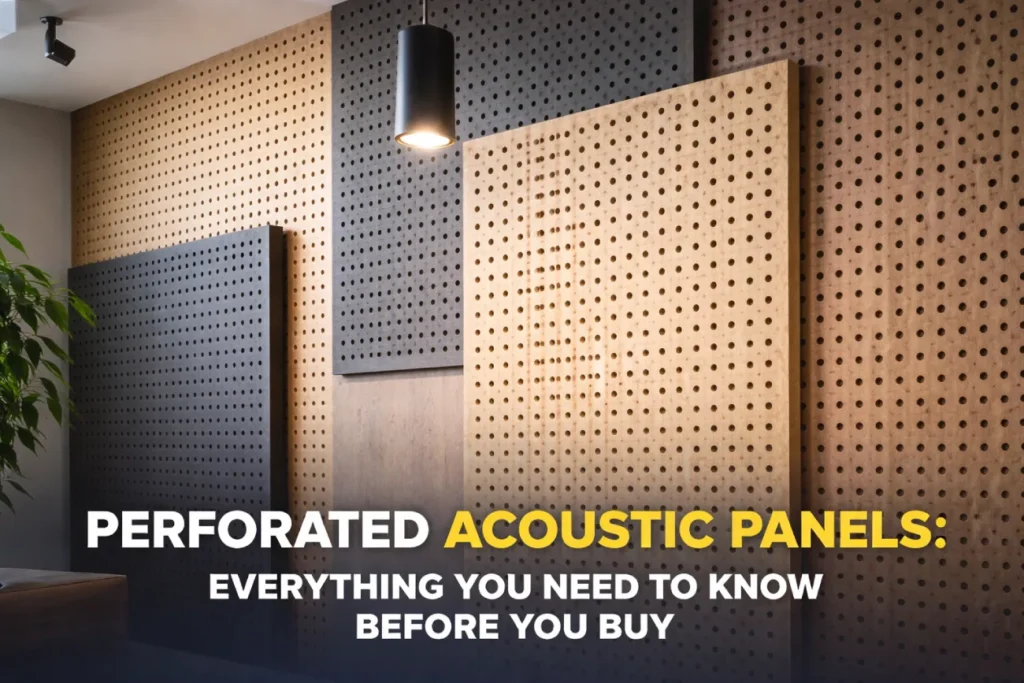
If you’ve ever sat in a meeting room where everyone sounds like they’re talking inside a tin can — or tried to teach a class in an auditorium that echoes every word back twice — you already understand the problem that perforated acoustic panels solve.
Noise isn’t just annoying. Research consistently shows that poor acoustics damage productivity, strain communication, and reduce wellbeing in workplaces, schools, and healthcare environments. The fix doesn’t have to be complicated, and it doesn’t have to be ugly.
At Ecotone Acoustic Limited, we’ve been solving acoustic problems across India — from corporate offices and educational institutions to auditoriums and luxury hotels. This guide shares what we’ve learned from hundreds of real projects.
Perforated acoustic panels are rigid panels — made from wood, MDF, metal, or mineral board — with precisely placed holes punched or routed into their surface. Behind those holes sits an absorptive layer (typically mineral wool or glass fibre) that captures and dissipates incoming sound energy.
The result is a panel that looks like a design element but behaves like an acoustic engineer.
What separates a genuinely high-performing panel from a decorative one:
Most commercial spaces benefit from panels rated NRC 0.65 or higher. High-demand acoustic environments — recording studios, auditoriums, broadcast spaces — should target NRC 0.80+.
Sound is simply vibrating air. When those vibrations hit a hard, flat surface — a concrete wall, a glass partition, a bare gypsum ceiling — they bounce back almost entirely. Add several hard surfaces and you get reverberation: sound waves bouncing between surfaces, stacking up, and making a space feel loud, muddy, and exhausting.
When sound hits a perforated acoustic panel instead, something different happens:
This process works across a broad range of frequencies, not just the midrange. The right panel specification can target the specific frequency problem in your space — whether that’s boomy low-end, harsh high frequencies, or muddy speech intelligibility.
Why this matters for real spaces: A room with a reverberation time (RT60) of 1.5 seconds feels uncomfortably loud in speech. Proper acoustic panel installation can bring this down to 0.6–0.8 seconds — the range where speech is clear, music sounds controlled, and concentration is possible.
Not all perforated panels are the same. The right material depends on your project’s acoustic targets, aesthetic requirements, environmental conditions, and budget.
The premium choice for high-visibility interiors. Perforated wood acoustic panels layer a natural timber veneer — oak, walnut, teak, maple, beech — over an MDF or HDF core, with an absorptive backing. The perforation pattern can be round, slot, or geometric, and the veneer finish gives them a warmth that synthetic materials simply can’t match.
Performance: NRC 0.60–0.90 depending on perforation density and backing depth
Best for: Auditoriums, boardrooms, hotel lobbies, corporate offices, performing arts centres, high-end hospitality
Ecotone Acoustic Limited application: Our wood acoustic panel range uses sustainably sourced veneers and FSC-certified cores
Standard perforated panels have visible holes — which can be a feature or a constraint, depending on the design brief. Micro-perforated panels use ultra-fine holes (0.45–0.9 mm diameter) that are nearly invisible at normal viewing distances, delivering acoustic absorption without any visible perforation.
Performance: NRC 0.50–0.75
Best for: Museums, galleries, luxury residential, premium corporate environments where a seamless surface is essential
Fabricated from powder-coated aluminium, galvanised steel, or stainless steel, these are built for durability in demanding conditions. Moisture-resistant, impact-resistant, fire-rated, and cleanable — they’re the specification choice for transport infrastructure, industrial facilities, and external applications.
Performance: NRC 0.55–0.85 with appropriate backing
Best for: Metro stations, airports, parking structures, factories, sports facilities, exterior facades
A practical, cost-conscious solution for institutional and commercial projects where acoustic performance matters but budget is a constraint. MDF-based panels are highly paintable, accept laminates and digital prints, and suit standard T-grid ceiling systems or direct-fix wall installation.
Performance: NRC 0.50–0.80
Best for: Schools, hospitals, government offices, retail spaces, co-working environments
Often used in suspended ceiling systems, mineral fibre panels combine the structural panel with the absorptive layer in a single product. Lightweight, easy to install, and highly effective for broadband absorption.
Performance: NRC 0.70–0.95
Best for: Offices, healthcare, education — anywhere a suspended ceiling grid system is already in place
The modern open-plan office is designed for collaboration but engineered for distraction. Background noise from calls, keyboards, and conversation layers into a constant low-grade din that erodes focus throughout the day.
Perforated acoustic wall panels installed on feature walls or as suspended ceiling clouds absorb this ambient noise before it builds. The improvement in speech intelligibility on video calls alone often justifies the investment.
→ Explore our office acoustic solutions designed for Indian workplace environments.
A conference room with untreated hard surfaces amplifies every conversation and every background noise equally. Perforated panels on rear and side walls reduce reverberation time to the 0.4–0.6 second range ideal for speech — making calls clearer, presentations more intelligible, and meetings less tiring.
Excess reverberation in large classrooms measurably increases the time students need to understand spoken instructions — a hidden cost that compounds across an entire school year. Perforated acoustic ceiling panels and rear wall treatment in classrooms can reduce reverberation time by 40–60%, directly improving learning outcomes.
→ We’ve designed acoustic solutions for educational institutions across India from primary schools to university lecture halls.
Professional auditorium design relies on perforated wood acoustic panels for good reason: they deliver precisely tuned frequency absorption and diffusion while contributing to the architectural character of the space. Side wall and rear wall panels absorb excess energy; ceiling panels and reflectors direct useful early reflections toward the audience.
Getting auditorium acoustics right requires detailed room modelling — our team provides full acoustic design support for projects of this scale.
Noise in hospitals directly affects patient recovery and staff performance. Perforated acoustic ceiling panels in corridors, waiting areas, and patient rooms reduce sound transmission between spaces, create calmer environments, and support acoustic privacy in consultation rooms.
Guests experience acoustic quality instinctively even when they can’t articulate it. A hotel lobby that feels calm and intimate versus one that feels chaotic and loud is often separated by nothing more than the right acoustic treatment on the ceiling. Perforated wood panels with premium veneer finishes achieve both goals simultaneously.
For audiophiles and content creators, acoustic control is a functional requirement. Perforated acoustic panels on side walls and ceilings eliminate flutter echo and tame problematic mid-frequency buildup. Paired with bass traps in the corners, they form the foundation of a properly controlled listening or recording environment.
This is where most buying decisions go wrong: people choose panels based on appearance alone, install them, and then wonder why the room still sounds difficult. Acoustic performance comes from the specification, not just the product category.
Here’s the framework we use with every client:
Are you dealing with:
| Space type | Recommended RT60 | Target NRC |
|---|---|---|
| Open-plan office | 0.4–0.6 sec | 0.65–0.80 |
| Conference room | 0.3–0.5 sec | 0.70–0.85 |
| Classroom / lecture hall | 0.4–0.6 sec | 0.65–0.80 |
| Auditorium (speech) | 0.6–0.8 sec | Varies by seat count |
| Recording studio | 0.2–0.4 sec | 0.80–0.95 |
| Restaurant / hospitality | 0.6–1.0 sec | 0.55–0.70 |
The same panel delivers different performance at different depths from the wall. Increasing the air gap behind a panel shifts its absorption curve toward lower frequencies. If you have a bass problem, mounting panels away from the wall (or using a deeper frame system) will outperform flush-mounted panels of identical specification.
Our recommendation: Before specifying panels for any space larger than 50 sqm, invest in a basic room acoustic assessment. The difference between panels specified correctly vs. guessed at is often the difference between a space that works and one that still feels wrong. Contact our acoustic consultants for a free project review.
| Treatment | Strengths | Weaknesses | Best use |
|---|---|---|---|
| Perforated panels | Durable, design-flexible, high NRC, cleanable | Higher upfront cost than foam | Feature walls, ceilings, long-term installations |
| Acoustic foam | Low cost, easy to fit | Degrades quickly, low-frequency performance poor, looks temporary | Home studios on a tight budget |
| Fabric-wrapped panels | Very high NRC achievable | Collects dust/allergens, not cleanable | Spaces without hygiene concerns |
| Acoustic plaster | Seamless finish, very high NRC | Expensive, irreversible, requires specialist | Luxury new-build projects |
| Wooden slat panels | Diffusion + partial absorption, premium look | Lower NRC than perforated; best combined with absorbers | Auditoriums, concert halls, high-end offices |
| Mineral fibre tiles | Cost-effective, easy suspension ceiling install | Limited design options | Offices, education, healthcare |
The most effective acoustic treatments combine absorption (perforated panels, mineral fibre) with diffusion (slat panels, irregular surfaces). Pure absorption can make a room feel acoustically dead — particularly in performing arts spaces where some liveliness is desirable.
If your project is targeting LEED, GRIHA, or IGBC certification — or if you simply care about the environmental footprint of your building — the materials you specify for acoustic treatment matter.
At Ecotone Acoustic Limited, every perforated acoustic panel in our range is:
Our India-based supply chain also means shorter transport distances, faster delivery, and specification support that understands local building codes and climate conditions.
→ Learn more about our eco-friendly acoustic panel range
What NRC rating should I look for in perforated acoustic panels?
For most commercial spaces — offices, classrooms, meeting rooms — panels rated NRC 0.65–0.80 are appropriate. High-demand environments like recording studios or broadcast spaces benefit from NRC 0.80–0.95. The right target depends on your room’s existing reverberation time and the surface area you’re treating.
Can perforated acoustic panels be used on ceilings?
Yes — and ceilings are often the highest-impact location for acoustic treatment because they represent the largest unobstructed surface in most rooms. Perforated ceiling panels can be installed in suspension grid systems, as direct-fix tiles, or as floating acoustic clouds.
Are perforated acoustic panels fire-rated?
Quality panels from reputable manufacturers are available with Class A fire ratings (A1 or B-s1,d0). This is a non-negotiable specification requirement for any commercial, educational, or healthcare project. Always request fire test certificates from your supplier.
How do perforated panels differ from plain acoustic foam?
Acoustic foam is cheap, quick to install, and fine for basic home studio use — but it degrades, looks informal, performs poorly at low frequencies, and is not appropriate for commercial environments. Perforated acoustic panels are durable, professionally finished, fire-ratable, and deliver consistent performance for decades.
Can perforated acoustic panels be customised?
Yes. Panel dimensions, perforation patterns, veneer species or paint finish, edge profiles, and NRC ratings can all be customised for your project. For large-scale or architecturally significant projects, bespoke panel design is standard practice. Talk to our team about your project requirements.
How are perforated acoustic panels installed?
Installation methods vary by product: tongue-and-groove for wood panels, T-grid suspension systems for ceiling tiles, direct fix with clips or adhesive for wall panels. Most systems are designed for installation by a general contractor without specialist acoustic knowledge. We provide full installation documentation with every project.
What maintenance do perforated wood panels need?
Most UV-lacquered wood panels need only periodic dusting with a dry or lightly damp cloth. Avoid abrasive cleaners. Metal panels can be wiped down with a mild detergent. With correct specification and installation, perforated acoustic panels require essentially no maintenance beyond routine cleaning.
If you’ve read this far, you’re serious about getting your acoustic treatment right — and that’s exactly the approach that leads to spaces that actually work.
The next step is simple. Tell us about your project — space type, dimensions, acoustic problems you’re trying to solve — and our team will come back to you with panel recommendations, NRC calculations, and indicative pricing. No obligation, no jargon.
Get a free acoustic consultation from Ecotone Acoustic Limited →
Or if you’d prefer to browse first:
Explore our full range of acoustic panels →
Published by the Ecotone Acoustic Limited Acoustic Team — Ecotone Acoustic Limited.co.in
We design and supply eco-friendly acoustic solutions for commercial, institutional, and residential projects across India.


