How to Make a Room Soundproof: The Complete India Guide (2026)
Published by PackSound / Ecotone Acoustic Limited | Soundproofing Guide | March 2026
Noise is one of the most disruptive forces in modern Indian living and working life. Traffic from the road below, a neighbour’s television through the wall, HVAC hum from the unit above the ceiling, a colleague’s conversation bleeding through a glass partition — all of it chips away at the ability to concentrate, rest, record, or simply think clearly. The demand for quiet has never been higher, and the solutions available in India have never been better.
But here is what most guides on how to make a room soundproof get wrong: they treat it as a single problem with a single solution. It is not. Soundproofing means different things depending on whether you are trying to keep noise out of a bedroom, achieve speech privacy in a meeting room, get a clean recording in a home studio, or reduce machinery noise on a factory floor. The right approach for each is different. The materials are different. The cost is different. And crucially, the difference between sound absorption and sound isolation — a distinction that almost no general guide explains properly — determines whether the money you spend actually solves the problem you have.
This guide covers everything. The science behind why rooms are noisy. The four fundamental principles of soundproofing and what each one does. A room-by-room breakdown of what works. Honest cost ranges in Indian rupees for 2026. And clear product recommendations backed by tested performance data — not brand names invented for a brochure.
The Science First: Understanding How Sound Travels in a Room
Before spending a rupee on materials, it helps to understand what you are actually fighting. Sound is mechanical energy — vibrating air molecules — that travels outward from its source in all directions. It does not stop at a wall. It passes through it, bounces off it, and travels around it through gaps and structural connections. Every path sound can take is a potential problem, and effective soundproofing addresses all of them.
There are two distinct ways sound reaches you from an unwanted source.
Airborne sound travels through the air from the source to your wall, floor, or ceiling, then causes that surface to vibrate, which radiates sound on the other side. Traffic noise, voices from an adjacent room, and music from a neighbour are all primarily airborne problems.
Structure-borne sound travels through the physical building fabric — concrete slabs, steel frames, pipes, and joists — as mechanical vibration that re-radiates as noise inside your room. Footsteps from the floor above, the vibration of a compressor bolted to the roof, and the rumble of a lift motor are structure-borne problems. Adding mass to walls helps with airborne sound but does very little for structure-borne transmission; those paths need decoupling.
Understanding which type of problem you have determines which solution to apply. Most real-world noise problems involve both, which is why comprehensive soundproofing addresses multiple transmission paths simultaneously.
The Four Principles of Soundproofing: What Actually Works
Every effective soundproofing solution in the world — from a professional recording studio to a well-treated home office — is built on four engineering principles. Understanding them prevents the most common and expensive mistake in soundproofing: spending money on one principle while ignoring another.
1. Mass
Adding mass to a wall, floor, or ceiling increases the force required to make that surface vibrate, which reduces how much airborne sound passes through it. This is the primary mechanism behind heavy wall constructions. Dense blockwork, multiple layers of drywall, and mass-loaded vinyl all work on this principle. The relationship between mass and sound reduction is logarithmic — doubling the mass of a wall adds roughly 6 dB of isolation. A 6 dB improvement is noticeable but not transformative. To achieve the 30 to 50 dB of isolation needed to make an adjacent space genuinely quiet, mass must be combined with the other principles.
Drywall partitions from PackSound’s AcoFascia range use multi-layer drywall constructions with acoustic core infill to combine mass with the absorption and decoupling principles for meaningful STC performance in commercial applications.
2. Absorption
Sound absorption reduces the acoustic energy bouncing around within a space. Absorptive materials — mineral wool, fiberglass, polyester fibre, acoustic foam — convert sound energy into heat through friction as the wave passes through their porous structure. Absorption inside wall, floor, and ceiling cavities reduces the energy available to excite the outer skin of the construction. Absorption on room surfaces reduces the reverberant sound level inside the room.
This is where the most common confusion in soundproofing lies. Acoustic wall panels on the inside of a room improve the acoustic quality within that room. They do not prevent sound from passing through the wall to an adjacent space. If your problem is echo and reverberation inside your recording studio, fabric wrapped acoustic panels solve it. If your problem is your neighbour hearing what you record, you need mass, decoupling, and sealing in the wall construction itself.
Both are valid problems. Both have effective solutions. But they are different problems and confusing them wastes money.
3. Decoupling
Decoupling separates two structural elements so that vibration cannot travel directly from one to the other. A wall built with two independent leaves — two separate rows of studs with a cavity between them, not touching each other — is far better at blocking sound than a wall of equivalent mass with a single rigid construction, because there is no direct mechanical path for vibration to travel across.
Decoupling is the principle behind resilient mounts under machines, floating floors in recording studios, independent ceiling constructions in home theatres, and the automatic seals in sliding folding acoustic partitions that break the rigid connection between the panel edge and the floor at lock-in.
In Indian concrete-frame construction, true decoupling is more difficult to achieve than in timber-frame buildings because the rigid slab provides many paths for structure-borne vibration to bypass even a well-specified wall. This is why professional acoustic consultancy is valuable for serious soundproofing projects: the decoupling specification needs to account for the specific building structure.
4. Sealing
Sealing is the most underestimated of the four principles and the one that is most commonly overlooked. Sound behaves like air: it finds every gap, crack, and penetration and passes through with very little resistance. A wall construction that achieves STC 50 — which is excellent — but has a 1 cm gap at the bottom where the skirting does not meet the floor will perform more like STC 30 because the gap transmits sound directly. A 1 percent open area can reduce a partition’s effective isolation by 10 dB or more.
Every electrical back-box in a shared wall, every pipe penetration, every gap around a door frame, and every unsealed joint in a partition construction is a potential acoustic leak. Acoustic sealant, perimeter seals on partitions, door sweeps, and proper installation discipline are all part of effective soundproofing. Sealing costs almost nothing and can recover more acoustic performance than any other single intervention.
Room by Room: How to Soundproof Different Spaces in India
How to Soundproof a Bedroom
The bedroom soundproofing goal is typically to reduce external noise — traffic, neighbours, barking dogs — to a level that allows sleep without disturbance. The primary transmission paths are windows, external walls, and in apartments, the floor-ceiling assembly above.
Windows are almost always the weakest link in a bedroom’s acoustic envelope in Indian urban apartments. Standard single-glazed aluminium windows with poor perimeter seals transmit external noise with little resistance. Upgrading to double-glazed units improves isolation by 5 to 10 dB. Acoustic secondary glazing — a second panel fitted inside the existing window with a large air gap — improves performance further. For renters or those who cannot change the windows, heavy thermal curtains with a close-fitting track reduce transmitted noise modestly while adding thermal benefit.
Doors are the second most common weak point. Hollow-core flush doors, which are standard in most Indian residential construction, achieve STC ratings as low as 20 to 25 dB. Wooden acoustic doors from PackSound’s SonicGuard range are specified to achieve STC 35 to 45 dB and include perimeter seals and door bottom sweeps that close the gaps that hollow-core doors leave open. For bedrooms in apartments adjacent to lifts, common corridors, or party walls with neighbours, a solid acoustic door makes a measurable difference.
Walls in Indian apartment construction are typically 115 to 230 mm brick or blockwork, which provides reasonable airborne sound isolation at mid-frequencies but less than ideal performance at low frequencies. Where a party wall with a particularly noisy neighbour is the specific problem, an independent internal wall construction with a mineral wool cavity provides meaningful additional isolation. This is a construction intervention that requires proper execution — cutting corners by simply adding a layer of plasterboard bonded directly to the existing wall without a cavity provides very little benefit.
Floors and ceilings in multi-storey apartments in India are the most difficult surfaces to treat effectively. Impact noise from the floor above — footsteps, furniture moving — is a structure-borne problem that requires decoupled floor treatment to address properly. Thick rugs with dense underlay provide modest attenuation of impact noise. A floating floor construction — a resilient layer decoupled from the structural slab — is more effective but is a significant intervention.
How to Soundproof a Home Office or Study
Home office soundproofing has a more specific goal than general bedroom treatment: achieving a quiet enough environment to concentrate during the day and to make video calls without audible background noise. Most home office problems are at the moderate end of the severity scale and can be addressed without construction.
Sealing the door gap with acoustic door bottom seals is often the single most impactful intervention. An unsealed gap beneath a standard door allows significant sound to enter from adjacent rooms. Door seals cost very little and install without tools.
Adding absorptive treatment to wall surfaces with fabric wrapped acoustic panels improves the acoustic quality within the room — reducing the echo that makes your voice sound hollow on video calls and improving your own concentration by lowering the reverberant noise level. A 10 to 15 percent wall coverage with absorptive panels is sufficient for most home offices.
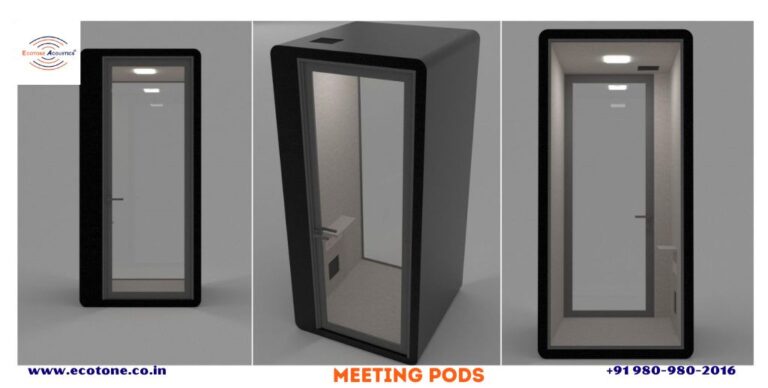
For those who need a fully enclosed, acoustically isolated work environment within an existing home or office without construction, PackSound’s ThinkPod compact office pod and ThinkPod Lite SE single-occupancy pod provide self-contained acoustic environments with integrated ventilation and power.
How to Soundproof a Recording Studio or Music Room
Recording studio soundproofing is the most demanding residential soundproofing application and the one where the distinction between isolation and absorption matters most. A home recording studio needs both: isolation to prevent external noise from entering the recording chain and to prevent recorded sound from disturbing the rest of the house, and absorption to control room acoustics so that recordings are clean and accurate.
For isolation, the principle of room-within-a-room — an independent inner shell that is structurally decoupled from the outer room — is the gold standard. Walls, floor, and ceiling of the inner shell float on resilient mounts, breaking the direct path for structure-borne sound. This is a significant construction undertaking that should be professionally designed if the budget allows, because the performance of the system depends on the weakest link, and home studio builds routinely fail by overlooking flanking paths through shared building elements.
For absorption, fabric wrapped acoustic panels at first-reflection points on side walls and the rear wall control mid and high-frequency reflections. Thicker panels at 75 mm to 100 mm extend absorption into the lower mid-range. Corner bass traps using deep-profile mineral wool panels absorb low-frequency energy that builds up at room boundaries and makes recordings sound boomy. PackSound’s grooved wooden slat panels and CNC PET panels combine absorptive performance with visual character that suits premium studio interiors.
For ceiling treatment in a home studio, acoustic ceiling clouds suspended above the mix position control the ceiling reflection that would otherwise blur stereo imaging and reduce monitoring accuracy.
How to Soundproof a Meeting Room or Home Theatre
Meeting room soundproofing has two goals that must be addressed independently: isolation (keeping the conversation private from adjacent spaces) and absorption (improving speech clarity within the room). The isolation goal is a construction specification issue — the walls, doors, and any glazing must achieve the STC rating needed for the adjacency. The absorption goal is a room treatment issue.
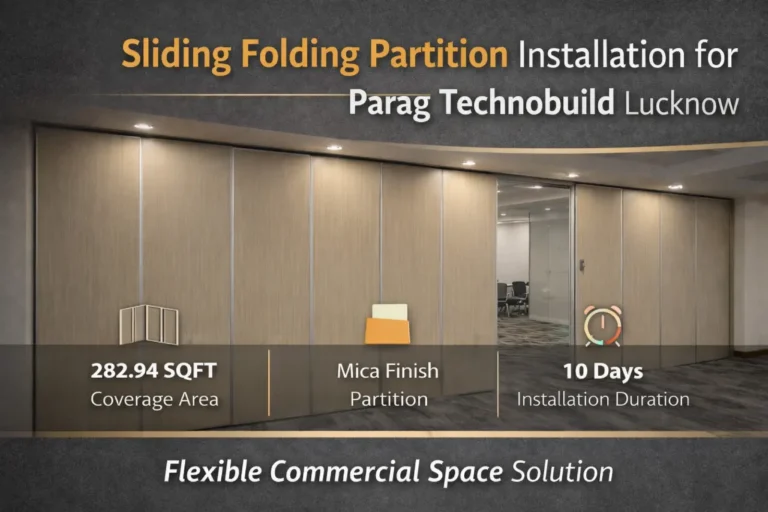
For partition STC performance, PackSound’s acoustic sliding folding partitions achieve STC up to 55 dB for the most demanding adjacencies. Acoustic divider partitions and drywall partitions address permanent separation requirements at different performance levels. Acoustic wooden doors with perimeter seals complete the envelope by matching the wall’s isolation performance.
For room absorption in a meeting room, 30 to 40 percent of total wall area treated with fabric wrapped panels combined with an acoustic ceiling tile or cloud treatment typically achieves a reverberation time of 0.4 to 0.6 seconds — the target range for speech clarity.
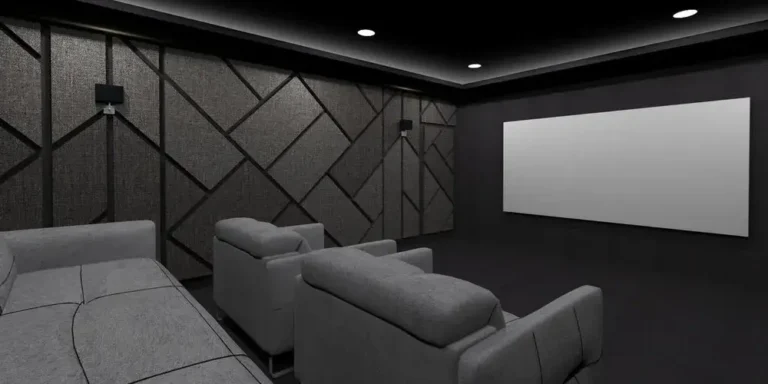
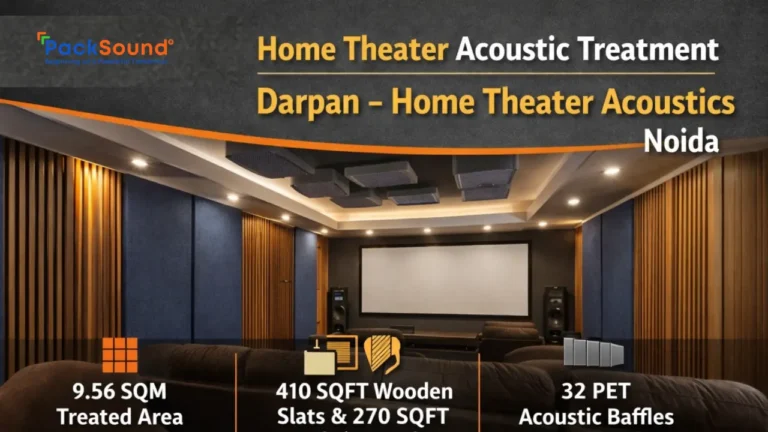
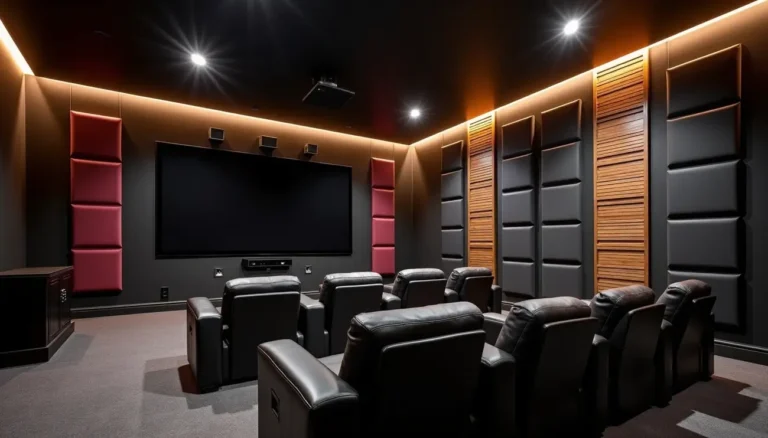
Home theatre soundproofing follows similar principles: isolation to keep movie sound within the room, and absorptive and diffusive treatment on walls and ceiling to optimise the listening environment. The bass frequencies in cinema content are among the most difficult to contain, requiring significant mass and decoupled construction in the walls and floor.
How to Soundproof an Office in a Commercial Building
Commercial office soundproofing is a professional specification exercise rather than a DIY project. The acoustic requirements for open-plan offices, meeting rooms, executive suites, and reception areas are well-defined by LEED v4.1, WELL Building Standard v2, and NBC 2016 Part 8 standards. Meeting these requirements requires acoustic zoning at the design stage, STC-rated partition specifications, NC-level HVAC design, and absorptive treatment to achieve target reverberation times.
For open-plan areas, ceiling treatment with acoustic baffles and acoustic ceiling clouds reduces the reverberant noise floor. Acoustic screens at desk level reduce direct transmission between workstations. For teams needing fully private acoustic environments within the open plan, PackSound’s ThinkPod Pro series offers single to four-occupancy pods that install without construction and can be relocated as needs change.
For meeting rooms within commercial tenancies, Ecotone’s acoustic design and consultancy service provides full specification support including acoustic modelling, partition STC recommendations, and NABL-accredited product test documentation for LEED and IGBC credit submissions.
What Materials Actually Work for Soundproofing in India?
Acoustic Panels for Walls
Fabric wrapped acoustic panels with high-density mineral fibre cores achieve NRC ratings of 0.85 to 1.0. They improve the acoustic quality within the room by reducing reverberation and echo. Available with NABL-accredited test documentation. Suitable for studios, offices, meeting rooms, and premium residential applications.
Grooved wooden slat panels combine real timber aesthetics with NRC ratings of 0.70 to 0.90. Ideal for home theatres, premium offices, restaurants, and residential rooms where the panel is also a design feature. Available in Oak, Walnut, Teak, Ash, and custom finishes.
Composite acoustic panels provide both absorption and isolation in a single panel, making them suitable for machine enclosures and industrial partitions where the panel must act as a barrier as well as a room treatment.
CNC PET panels from recycled polyester fibre offer NRC ratings of 0.75 to 0.90 with decorative CNC-cut patterns, excellent moisture resistance, and sustainability credentials. A strong choice for schools, co-working spaces, and retail environments.
Micro perforated panels provide absorptive performance with a hard, wipe-clean surface for environments where exposed fibres or fabric are not acceptable — food processing facilities, pharmaceutical labs, and healthcare spaces.
Acoustic Ceiling Treatment
Acoustic ceiling tiles for standard 600×600 grid systems provide cost-effective large-area ceiling coverage in offices and educational buildings. PackSound’s Soft Fiber Acoustic Ceiling Tile, FeatherLite Ceiling Tile, and AirLite Ceiling Tile are designed for standard grid systems. Ecotone’s fiberglass ceiling tiles and wooden acoustic ceiling tiles extend the range for specific NRC and fire rating requirements.
Acoustic baffles and acoustic ceiling clouds suit exposed ceiling applications where a grid system is not used. Ecotone’s acoustic hanging baffles, mineral fibre clouds, and polyester fibre clouds cover industrial, institutional, and commercial applications at different performance and budget levels.
Acoustic Partitions and Doors
Sliding and folding acoustic partitions achieving STC up to 55 dB are the right product for meeting rooms, hotel event spaces, and any application where flexible separation is needed between spaces. Automatic acoustic seals deploy at lock-in to close the gap at the panel perimeter that cheaper systems leave open.
Drywall partitions for permanent STC 45 to 55 separation. Soundproof fixed partitions from Ecotone cover the same requirement with additional specification options. Acoustic wooden doors matching the wall STC performance ensure the door is not the weak link. Ecotone’s acoustic wooden doors cover the same requirement for projects coordinating door and wall specifications together.
Noise Barriers for External Noise
For spaces where external noise from traffic, construction, or industrial operations is the primary problem, noise barriers installed at the site boundary or around the specific noise source address the problem at its point of entry rather than at the room. Ecotone manufactures metallic noise barriers, polycarbonate noise barriers, and mobile noise barriers for different outdoor applications.
Soundproofing Costs in India: Honest Estimates for 2026
One of the most searched questions alongside how to make a room soundproof is how much it costs. Here is an honest breakdown by application for 2026.
Basic acoustic treatment for a home office or study room (absorptive panels on walls, door seal, ceiling treatment): ₹25,000 to ₹80,000 for a standard 10×12 ft room, depending on panel specification and coverage level. This addresses echo and reverb within the room but does not significantly improve isolation from adjacent spaces.
Bedroom soundproofing (door upgrade to acoustic door, window seal improvement, absorptive wall treatment): ₹60,000 to ₹2,00,000 depending on the scope. A full window upgrade to double glazing and a solid acoustic door with perimeter seals form the majority of the cost. Absorptive wall treatment is the smaller component.
Home recording studio (acoustic treatment for absorption and basic isolation measures short of a full room-within-a-room): ₹1,50,000 to ₹5,00,000 for a 10×12 to 12×14 ft studio. A full room-within-a-room construction for professional isolation adds significantly to this, typically ₹4,00,000 to ₹12,00,000 for the same room size depending on the isolation target.
Meeting room acoustic fit-out (acoustic partition, acoustic door, wall panels, ceiling treatment for a 6-person boardroom): ₹3,00,000 to ₹8,00,000 depending on partition STC specification, panel selection, and finishes.
Commercial open-plan office treatment (ceiling baffles or clouds, acoustic screens at desks): ₹500 to ₹1,200 per square foot of floor area depending on ceiling type, product specification, and installation complexity.
Industrial factory noise control (mineral fibre baffles across ceiling area of a standard factory shed): ₹700 to ₹1,800 per square metre of ceiling coverage including installation, delivering 4 to 8 dB(A) reduction in reverberant noise level.
These ranges reflect professionally supplied and installed products with tested NRC or STC performance. DIY approaches using uncertified materials may cost less upfront but rarely achieve the acoustic outcome targeted and sometimes need to be replaced or supplemented within a few years.
Common Soundproofing Mistakes to Avoid
Treating only the walls and ignoring the ceiling. The ceiling is often the largest uninterrupted reflective surface in a room. In a concrete or metal deck ceiling without any acoustic treatment, it contributes a disproportionate share of the total reverberation. Treat the ceiling before the walls for the best return on investment.
Using acoustic foam and expecting soundproofing. Acoustic foam reduces echo within the room. It does not prevent sound from passing through the wall. If you put foam panels on your walls and can still hear your neighbour clearly, the foam has not failed — it was never designed to stop that kind of transmission.
Forgetting to seal the door gap. A 1 cm gap at the bottom of a door transmits more sound than a well-constructed wall. Always address door perimeter seals as part of any soundproofing project.
Buying products without tested performance data. The Indian market contains a wide range of acoustic products at different price points. Products that do not carry NABL-accredited NRC or STC test documentation may perform significantly below their stated specifications. Always request test certificates before purchasing, particularly for commercial projects where acoustic performance targets must be demonstrated to a certifying body.
Confusing soundproofing with acoustic treatment. Read the first section of this guide again if necessary. Understanding which problem you have before spending money saves a great deal of frustration.
When to Call a Professional
Some soundproofing projects are well within the scope of a competent homeowner or fit-out contractor. Installing acoustic panels, sealing door gaps, and adding ceiling tiles are all straightforward interventions.
Others benefit significantly from professional input. Recording studios, where the performance of the entire construction depends on avoiding flanking paths that are not obvious to non-specialists. Large commercial projects targeting LEED or IGBC acoustic credits, where documentation standards are specific. Industrial facilities where occupational noise compliance is a regulatory requirement. Any project where the noise problem is severe, the isolation target is high, or the budget is significant enough to justify getting the specification right before construction rather than correcting it after.
Ecotone Acoustic Limited’s acoustic consultant service provides site assessments, acoustic modelling, product specifications, and contractor documentation for projects of any scale. The acoustic design and consultancy team works across India and has delivered acoustic solutions for projects ranging from home studios and corporate offices to government buildings, hotels, airports, and industrial facilities.
Frequently Asked Questions
Can I completely soundproof a room?
Complete soundproofing — reducing noise transmission to zero — is not practically achievable in most real-world buildings. However, a well-designed soundproofing treatment can reduce noise levels by 30 to 50 dB, which is the difference between clearly hearing a conversation through a wall and being completely unaware of activity on the other side. For most residential and commercial applications, this level of improvement is more than sufficient.
Does acoustic foam soundproof a room?
No. Acoustic foam reduces echo and reverberation within the room where it is installed. It does not prevent sound from passing through walls, floors, or ceilings. If your problem is that the room sounds echoey, acoustic foam will help. If your problem is noise from adjacent spaces, you need mass, decoupling, and sealing in the construction — not surface treatment.
What is the cheapest way to soundproof a room?
The cheapest effective intervention is sealing gaps — around door frames, window frames, pipe penetrations, and electrical back-boxes. Acoustic sealant and door bottom sweeps cost very little and can recover significant acoustic performance. Beyond sealing, a quality door bottom sweep and perimeter seal on an existing door is the next most cost-effective intervention. Acoustic panels on walls improve the room’s internal acoustic quality; if that is the problem, fabric wrapped panels at key first-reflection points give good results without treating the entire room.
How long does professional soundproofing take?
A standard acoustic treatment installation for a single meeting room or home office — wall panels, ceiling treatment, door seals — typically takes one to two days. A full commercial office floor plate takes one to three weeks depending on scope. A home recording studio build with structural work can take four to eight weeks depending on the complexity of the isolation specification.
Is soundproofing worth the cost in India?
For anyone dealing with significant noise intrusion in a home, office, or studio in an Indian urban environment, well-targeted soundproofing consistently delivers results that justify the investment. The key word is well-targeted: money spent on the right products addressing the right transmission paths produces dramatic improvements. Money spent on the wrong products for the wrong problem is largely wasted. An hour spent with an acoustic consultant before committing to a specification is the most cost-effective step in any soundproofing project.
Ready to make your room genuinely quiet? Whether you need acoustic panels for a home studio, a soundproof partition for a meeting room, a full commercial office fit-out, or professional guidance on where to start, our specialists are here to help. Share your project details and we will recommend exactly what is needed for your specific situation.
Get a Free Soundproofing Consultation