Home Theater Acoustic Panels: The Complete Guide to Better Sound in Your Home Cinema
You spent months planning the room. You bought a projector with 4K HDR. You ran speaker cables through the walls. The subwoofer is positioned exactly where the manual said. And on the first proper movie night, something sounds wrong. The bass is booming and indistinct. Dialogue sounds slightly muffled. Action sequences feel loud rather than powerful. Every seat in the room sounds slightly different from every other seat.
None of that is your equipment’s fault. It is your room’s fault.
Almost every home theater problem that people try to solve with more expensive hardware — a better AV receiver, different speakers, room correction software — is actually caused by untreated room acoustics. The walls, floor, and ceiling of your room are actively working against your audio system, creating reflections, resonances, and bass buildup that no amplifier or equaliser can fully correct.
Home theater acoustic panels are the solution. But using them correctly requires understanding what each type does, where it goes, and how much of it you actually need. This guide covers all of it.
Why Your Room Sounds the Way It Does
When a speaker produces sound, that sound does not travel in a neat straight line to your ears. It radiates in multiple directions, bouncing off every hard surface in the room before it reaches the listening position. You receive not one sound from each speaker but dozens of copies of the same sound, each arriving at a slightly different time and from a different direction.
In small to medium rooms — which is what most home theaters in Indian apartments and houses actually are — three acoustic problems compound each other.
Reverberation is the decay of sound after the source stops. In an untreated room, hard surfaces reflect so much energy that sound lingers far longer than it should. You hear dialogue as a smear rather than crisp words. Gunshots decay slowly instead of cutting cleanly. The room is adding artificial reverb to everything your speakers play, and not the pleasant kind.
Flutter echo is a rapid, repetitive echo caused by sound bouncing back and forth between two parallel hard surfaces, like opposite walls. You can test for it right now by standing in the centre of your room and clapping sharply once. If you hear a metallic, buzzing decay after the clap, that is flutter echo. It is present in virtually every untreated rectangular room.
Room modes are the acoustic villain that most home theater owners never hear about. When a speaker produces a bass frequency whose wavelength relates mathematically to one of the room’s dimensions, that frequency resonates and builds up dramatically in certain positions in the room. At those positions, bass sounds enormously exaggerated. A metre away, the same frequency may be nearly inaudible. This is why bass sounds different from every seat in an untreated room, and why no amount of subwoofer repositioning fully solves it.
The RT60 is the single number that captures all of this. It measures how long it takes for sound to decay by 60 decibels after the source stops. According to acoustic science and the standards used by professional cinema designers, the ideal RT60 for a home theater is between 0.3 and 0.5 seconds. Most untreated rooms have an RT60 between 0.6 and 1.0 seconds or higher. Acoustic panels bring that number down to where it belongs.
The Three Types of Home Theater Acoustic Panels
Professional cinema acoustics always combines three different types of treatment, each solving a different problem. Using only one type is the most common mistake people make.
Absorption Panels
Absorption panels are what most people picture when they think of acoustic treatment. They are panels made from porous materials — fabric wrapped mineral wool, polyester fibre, acoustic foam, or fiberglass — that trap incoming sound waves within their structure and convert that sound energy into a tiny amount of heat through friction.
The critical number for absorption panels is their NRC (Noise Reduction Coefficient), a scale from 0 to 1.0. An NRC of 0.90 means the panel absorbs 90 percent of the sound energy that strikes it and reflects only 10 percent back into the room. Panels with NRC values below 0.65 will not deliver meaningful acoustic improvement in a home theater and are generally not worth installing.
Absorption panels solve reverberation and flutter echo extremely effectively. They do not solve room modes. For that, you need bass traps.
Thickness matters more than most people realise. A 25mm absorption panel absorbs well at frequencies above 1,000 Hz but does essentially nothing below 500 Hz. A 50mm panel starts to work meaningfully from 250 Hz upward. For a home theater, where the full frequency range from 20 Hz to 20,000 Hz needs to be managed, 50mm minimum thickness is the starting point, and 75mm to 100mm is significantly better. This is why thin foam tiles sold cheaply online consistently disappoint — they are treating only the top slice of the frequency range while leaving the mid and low frequencies completely untouched.
Bass Traps
Bass traps are specifically designed to absorb low frequency sound energy, typically below 300 Hz. They work because they are much thicker and denser than standard absorption panels — usually 100mm to 200mm of dense mineral wool, rock wool, or rigid fiberglass. At those thicknesses, the material starts to interact with the wavelengths of bass frequencies, which can be several metres long.
Bass traps are placed in corners, specifically the trihedral corners where two walls meet a floor or ceiling. These corners are where low frequency pressure builds up most intensely in any room. A bass trap installed floor to ceiling in a corner addresses the room mode problem more efficiently than any other single acoustic treatment you can install. Starting treatment in the corners gives you the biggest improvement per square metre of material placed.
Without bass traps, no amount of wall panels will fix boomy, one note bass. Room EQ systems like Dirac Live and Audyssey MultEQ can partially compensate in the digital domain, but they are working against a physical problem. Physical treatment always produces better and more consistent results than digital correction alone.
Diffusers
Diffusers are the most misunderstood acoustic panel type. While absorbers remove energy from the room, diffusers redistribute it. A diffuser has a surface made up of wells, ridges, or angled elements at varying depths. When sound strikes a diffuser, it scatters in multiple directions rather than reflecting as a single strong wavefront.
The result is that your room retains a sense of spaciousness and life without the harsh, directional reflections that cause flutter echo and comb filtering. A room treated entirely with absorption can start to feel unnaturally dead and fatiguing to listen in for long periods. Films are mixed in environments where a careful balance of absorption and diffusion is maintained, and your home theater will sound closest to that reference when you use both.
Diffusers are most effective on the rear wall behind the seating position, and only when the seating is at least two metres from that wall. If your room is compact and the rear wall is closer than two metres to the main listening seat, place an absorption panel there instead.
Where to Place Home Theater Acoustic Panels
Getting the placement right matters as much as the panels themselves. Here is a systematic approach to treating each surface.
The Front Wall and Screen Wall
The front wall, behind and around your screen, should be treated primarily with absorption. Any sound that escapes from the front speakers at angles directing it toward the front wall will reflect back toward the listening position and arrive as an early reflection, smearing the perceived soundstage and muddying the separation between left, centre, and right channels.
Place absorption panels on the front wall to the left and right of the screen. If your screen is a projector screen that allows sound to pass through, panels can also go directly behind it. Avoid over-treating directly behind a fixed LED or OLED panel display, where the treatment would absorb sound meant to reach your ears from the front speakers.
The Side Walls — First Reflection Points
The side walls are where acoustic treatment makes the single biggest audible difference in a home theater. The first reflection points on the side walls are the locations where sound from your main speakers first bounces off the wall before arriving at the listening seat. These early reflections, arriving just a few milliseconds after the direct sound, cause a subtle but audible smearing of the stereo image and a reduction in dialogue clarity.
To find your first reflection points, sit in your listening position and have someone hold a mirror flat against the side wall at ear height. Move the mirror along the wall until you can see one of the front speakers reflected in it. That mirror position is the first reflection point. That is where your absorption panel goes. For a standard rectangular room, this position is typically about halfway between the screen and the seating position on each side wall.
Place panels at ear height, roughly 0.9 to 1.2 metres from the floor when measured to the centre of the panel. Cover a surface area of at least 0.6 by 0.9 metres at each first reflection point, though larger is better.
The Ceiling Between Speakers and Seats
The ceiling above the path between your speakers and listening seat is a first reflection surface that most home theater owners forget entirely. A ceiling cloud — a panel or cluster of panels mounted horizontally on or suspended below the ceiling — placed in this zone dramatically improves dialogue intelligibility and reduces the fatiguing quality of the sound at the listening seat.
You do not need to treat the entire ceiling. Target the area roughly above and between the speakers and the primary seating row.
The Rear Wall
In most home theater rooms, the rear wall needs treatment to prevent sound from the surround speakers or from the front speakers travelling over the listening seats from bouncing back as a delayed reflection. What you place here depends on your room depth. In deeper rooms where the rear wall is more than two metres behind the primary seats, a combination of absorption and diffusion works well, with diffusion panels in the centre and absorption panels at the sides. In compact rooms, treat the full rear wall with absorption.
The Corners
Bass traps go floor to ceiling in as many corners as possible, starting with the two front corners of the room closest to the main speakers and subwoofer. Even one floor to ceiling bass trap in each of the two front corners will make a clearly audible difference to bass quality and consistency. Adding bass traps to the rear corners further improves low frequency smoothness across all seating positions.
How Much Coverage Do You Actually Need?
A general rule used by professional acoustic consultants is to cover between 25 and 35 percent of the total wall and ceiling surface area with absorption material in a dedicated home theater room. In a converted bedroom or living room used as a home theater, 20 percent treatment of the walls will produce a significant improvement even if it falls short of the theoretical ideal.
Do not try to achieve this coverage all at once on a single wall. Distribute treatment as evenly as possible around the room. One fully treated wall and five bare walls will not perform as well as a moderate, balanced treatment spread across all surfaces.
Panel Materials Compared for Home Theater Use
Fabric Wrapped Mineral Wool Panels
This is the best performing acoustic panel type for the majority of home theater applications. A fabric wrapped panel consists of a rigid mineral wool or rock wool core — typically 50mm or 75mm thick — wrapped tightly in an acoustically transparent fabric. NRC values for quality 50mm panels run from 0.85 to 1.05 across the critical mid and high frequency range.
Fabric wrapped panels are the choice when you want both performance and a finished, professional appearance. They can be installed in custom sizes, with frames, and in any fabric colour that complements your theater’s interior design. Because the core material is mineral wool, these panels are also non combustible, which is an important consideration for any enclosed room used for extended viewing sessions.
Ecotone Acoustic Limited manufactures the EchoStop Fabric Wrapped Panel through its PackSound brand, available at packsound.in/acoustic-wall-panels/fabric-wrapped-panel/. These are premium mineral wool core panels with acoustically transparent fabric and are well suited to dedicated home theater installations where both performance and interior finish quality matter. Our fabric wrapped acoustic panels page on ecotone.co.in carries additional specification information and NRC data for this range.
Acoustic Foam Panels
Acoustic foam is the most widely recognised material and the most widely misused. Good quality, high density acoustic foam (25 to 50 kg per cubic metre) does absorb sound effectively in the mid to high frequency range. The problems start with thickness and density.
Most of the acoustic foam sold at consumer prices is too thin (less than 25mm) and too light (less than 16 kg per cubic metre) to provide meaningful absorption below 1,000 Hz. This means that foam tiles typical of budget home theater setups treat only the top third of the audio frequency range while leaving the most problematic acoustic frequencies in the 125 to 500 Hz range completely unaddressed.
For home theater use, if you choose foam as a material, use a minimum thickness of 50mm and purchase from suppliers who can provide NRC data with octave band values, not just a single NRC number. Avoid pyramid foam panels that are less than 30mm tall at the pyramid peak — the shaped surface area is visually impressive but acoustically thin.
Our acoustic foam range at Ecotone Acoustic Limited includes options suitable for home theater applications, and our team can advise on which specifications are appropriate for your room size.
CNC PET Fibre Panels
PET acoustic panels are made from recycled polyester fibres compressed into rigid or semi rigid boards. They have several practical advantages for home theater use: they are lightweight, available in a wide range of colours and textures, can be cut to size with standard tools, and are moisture resistant. NRC values for 12mm PET panels are modest (typically 0.4 to 0.55), but at 24mm thickness NRC values climb to 0.7 to 0.85 for mid and high frequencies.
PET panels work well as part of a layered treatment strategy where their visual appeal is an asset and their acoustic performance fills the mid to high frequency role while dedicated bass treatment addresses the low end separately. They are particularly popular in home theaters where the design aesthetic matters as much as the acoustic outcome.
Ecotone Acoustic Limited’s PackSound brand offers a CNC PET Panel range at packsound.in/acoustic-wall-panels/cnc-pet-panel/, which can be precision cut into custom shapes and patterns. This makes them a practical option for home theater owners who want a distinctive visual element in their treatment panels without compromising acoustic function.
Grooved Wooden Acoustic Panels
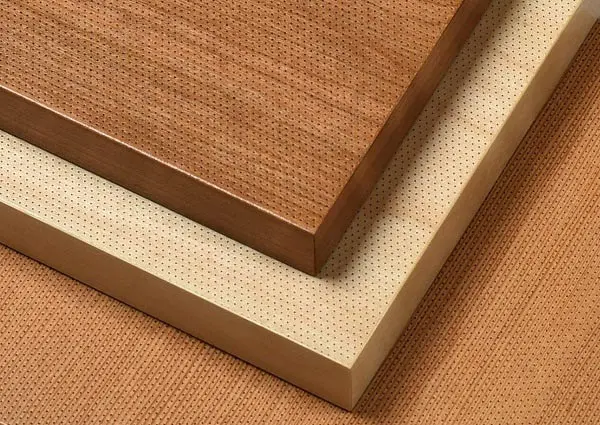
Grooved wooden slat panels deserve a mention for home theater use specifically because of the design conversations they enable. A home theater that reads visually as a legitimate, considered room rather than a padded box retains its value as an attractive space that people genuinely enjoy spending time in. Grooved wooden panels bring NRC performance between 0.60 and 0.85 depending on groove geometry, backing material, and installation depth, while presenting a warm, architectural surface that blends naturally into a designed interior.
They work best on the side walls and rear wall where mid to high frequency absorption is needed and where the visual surface is visible from the seated position. They are not the right choice for bass trapping or for surfaces where maximum NRC is the only priority. Ecotone Acoustic Limited’s PackSound brand carries grooved wooden slat panels at packsound.in/acoustic-wall-panels/grooved-wooden-slat/.
Hanging Baffles and Ceiling Clouds
Acoustic hanging baffles suspended vertically from the ceiling and acoustic ceiling clouds mounted horizontally above the listening position are extremely efficient ways to add absorption without touching the walls. Because they are exposed on multiple faces, a single hanging baffle presents two absorbing surfaces to the room simultaneously, effectively doubling the absorption per unit volume of material compared to a wall mounted panel.
For home theaters in rooms where wall space is limited by speakers, screens, or windows, ceiling baffles and clouds provide a way to achieve the required total absorption without compromising the wall layout.
Ecotone Acoustic Limited supplies both product types through the PackSound brand. Acoustic baffles are available at packsound.in/acoustic-ceiling-panels/acoustic-baffles/, and acoustic ceiling clouds at packsound.in/acoustic-ceiling-panels/acoustic-clouds/. For home theater rooms with standard 2.7 to 3.0 metre ceiling heights, clouds suspended 200 to 300mm below the ceiling are the most practical configuration, providing effective treatment without reducing the perceived room volume or interfering with recessed lighting.
Soundproofing Versus Acoustic Treatment: An Important Clarification
This distinction trips up a large number of home theater builders and is worth being very clear about.
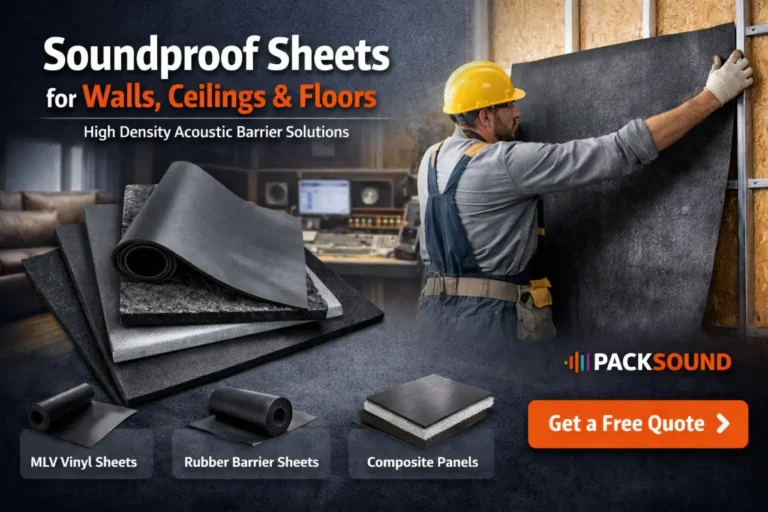
Acoustic treatment (what acoustic panels do) improves the way sound behaves inside your room. It reduces reverberation, controls flutter echo, tames room modes, and improves the clarity and accuracy of what you hear. Acoustic panels do not stop sound from leaving your room or prevent external noise from entering.
Soundproofing (also called sound isolation) prevents sound from travelling between rooms. It requires mass, decoupling of building elements, and airtight sealing. It involves double stud walls with resilient channels, floating floors, heavy acoustic doors, and sealed ventilation systems. You can fill a room with acoustic panels and achieve no improvement in how much sound travels to the next room or apartment.
Most people who say they want to soundproof their home theater actually want acoustic treatment — they want what they hear inside the room to sound better. If you genuinely need to prevent your cinema from disturbing neighbours or other family members, that is a structural and architectural project, not a panel project. The acoustic consultancy team at Ecotone Acoustic Limited can advise on both requirements through our acoustic consultant page.
How to Check Your Room Acoustics Before Buying Panels
Before purchasing and installing panels, do a simple test that takes five minutes and costs nothing.
Stand in your primary listening seat and clap your hands sharply once, as loud as you can. Listen carefully to what happens after the clap. A sustained, metallic, or buzzing decay that lasts noticeably after the clap indicates significant flutter echo between parallel walls. A long, slow decay that takes more than half a second to become inaudible indicates high reverberation that will cause problems with dialogue and fine acoustic detail.
A second test: play a familiar piece of music or a film you know well at moderate volume. Walk slowly toward different corners of the room while it is playing. If the bass seems to increase dramatically as you approach certain corners, those positions are experiencing bass pressure buildup from room modes. If bass is dramatically louder in the corners than at the seating position, bass traps will make a very audible difference.
The free software REW (Room EQ Wizard), available for Windows, Mac, and Android, combined with a USB measurement microphone available for approximately 2,000 to 3,000 rupees, will give you accurate RT60 measurements at each frequency so you can understand exactly what your room is doing and quantify the improvement after treatment.
Getting It Right the First Time
Here is the order in which treatment produces the biggest audible return for a typical home theater room.
Start with bass traps in the two front corners, floor to ceiling. This single step will produce a more audible improvement in bass quality than almost any other acoustic treatment you can install.
Next, treat the side wall first reflection points with 50mm or thicker absorption panels at ear height. This step improves stereo imaging, surround sound localisation, and dialogue clarity more than any other mid and high frequency treatment.
Then, treat the ceiling above the path between speakers and seats with a ceiling cloud.
After that, treat the rear wall with absorption, or with a combination of absorption and diffusion if your room depth allows.
Finally, add bass traps to the rear corners and distribute additional absorption panels to bring total surface coverage to 25 to 30 percent of wall area.
At each stage, the improvement is audible and measurable. You do not need to do everything at once.
Working With Ecotone Acoustic Limited on Your Home Theater
Ecotone Acoustic Limited supplies home theater acoustic treatment solutions across India under its PackSound brand and directly through ecotone.co.in. Our range covers fabric wrapped absorption panels, acoustic foam in suitable densities and thicknesses, hanging baffles, ceiling clouds, grooved wooden acoustic panels, and CNC PET panels in custom sizes and shapes.
Every product comes with NRC test data from NABL-accredited laboratories so you can specify with confidence rather than guesswork. Physical samples are available for all panel types and are dispatched within five working days.
If you would like guidance on how many panels your specific room needs, the right combination of materials for your room size and shape, or a complete acoustic design for a dedicated home theater build, our acoustic consultancy team is available to review your room dimensions and provide a treatment plan.
You can explore our complete acoustic wall panels range on ecotone.co.in, or visit packsound.in to browse the full PackSound product catalogue including premium and designer acoustic panel options for residential and luxury home theater applications.
Contact Ecotone Acoustic Limited Call: +91 9809802016 | +91 9891320678 Email: Sales@packsound.in Website: ecotone.co.in/contact-us/ | packsound.in/contact-us/
Physical product samples available on request. Our team responds to all technical and specification enquiries within one working day.
Ecotone Acoustic Limited is a manufacturer of acoustic products for residential, commercial, and institutional applications across India. Products are sold under the PackSound brand and manufactured domestically. All products are tested at NABL-accredited laboratories.