
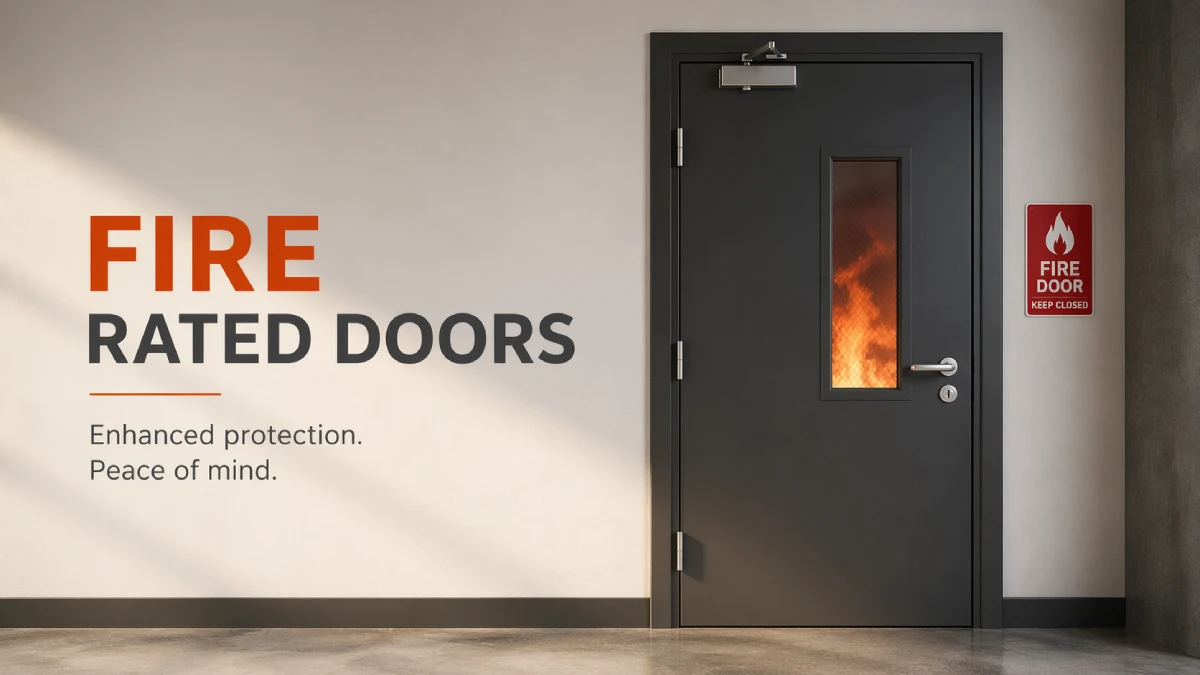
A fire rated door is one of the most important safety components in any commercial, industrial, or institutional building. It is also one of the most frequently misspecified, miscertified, and poorly installed building products in the Indian construction market. When a fire breaks out, the door between a corridor and a stairwell, between a server room and an open office, or between a kitchen and a dining area is not simply a door anymore. It is a fire barrier. Its job is to hold back flames, smoke, and toxic gases long enough for every person in the building to reach safety.
This guide covers everything a buyer in India needs to know about fire rated doors in 2026. What they are, how fire ratings work, which door type is right for which application, what Indian and international standards apply, how to read a fire rating specification, what to look for from a manufacturer, and how Packsound supplies and manufactures certified fire rated wooden doors for commercial and institutional projects across India.
Whether you are an architect specifying fire doors for a new high-rise, a facility manager replacing non-compliant doors in an existing building, a contractor sourcing fire rated doors for a hospital fitout, or a builder looking for a certified fire rated door manufacturer in Delhi, Mumbai, Bengaluru, or any other Indian city, this guide answers your questions completely
What Is a Fire Rated Door and Why Does It Matter
A fire rated door is a door assembly that has been tested and certified to resist the passage of fire and smoke for a defined period of time. That period is the fire rating, and it is expressed in minutes or hours. A 60-minute fire rated door is certified to hold back fire for at least 60 minutes under standard test conditions. A 120-minute fire rated door is certified to resist fire for at least two hours. Some heavy-duty applications require 180-minute or even higher ratings.
The key word here is assembly. A fire rated door is not just the door leaf. It is the complete assembly of door leaf, door frame, hardware, hinges, seals, and vision panel if present. Every component in the assembly must be specified and installed correctly for the assembly to perform as rated. A 120-minute fire rated door leaf fitted with non-rated hardware, installed in a non-rated frame, with gaps around the perimeter, provides nowhere near 120 minutes of fire resistance. In a real fire, that assembly will fail much earlier.
This is why specifying fire rated doors requires understanding the complete door set, not just selecting a leaf from a catalogue.
Why fire rated doors matter for life safety
Fire kills primarily through smoke inhalation, not through direct flame contact. In a building fire, smoke and toxic gases spread far faster than flames. A well-designed fire compartmentation strategy using certified fire rated doors contains the fire and smoke to the compartment of origin, keeps escape routes clear of smoke, and gives building occupants the time they need to evacuate safely.
In India, fire safety requirements for commercial buildings are governed by the National Building Code of India 2016 (NBC 2016) and by local state fire service regulations. These codes mandate fire rated doors at specific locations in commercial, institutional, industrial, and high-rise residential buildings. Buildings that do not comply with these requirements face regulatory action, insurance invalidation, and most critically, life safety risk.
Fire Door Ratings Explained: 30 Minute to 180 Minute
Fire door ratings are determined by standardised fire resistance tests. In India, the primary standard is IS 3614 Part 2. The equivalent international standard widely referenced in India is BS 476 Part 22. Many Indian fire door manufacturers and specifiers also reference UL standards for projects that require global compliance documentation.
Here is what each rating means in practice.
30-Minute Fire Rated Door (30 Min / FD30)
A 30-minute fire rated door is the minimum rating used in most commercial interiors. It is appropriate for internal doors within a single fire compartment where the primary requirement is to slow the passage of fire rather than to provide a full barrier. 30-minute fire doors are commonly specified in hotel corridors leading to individual rooms, in office buildings for internal room dividers within a single floor, and in low-risk areas where the primary evacuation route does not depend on the door holding for a longer period.
60-Minute Fire Rated Door (1 Hour / FD60)
The 60-minute fire rated door is the most commonly specified rating for stairwell doors, lobby doors, and corridor doors in mid-rise commercial and residential buildings. A one-hour fire door gives occupants and fire services a full 60 minutes to respond to and evacuate from a fire event. For most standard commercial buildings in India, a 60-minute rating on stairwell enclosure doors and service corridor doors satisfies NBC 2016 requirements.
90-Minute Fire Rated Door (FD90)
90-minute fire rated doors are specified where additional resistance time is required by the building design or by the local fire authority. Common applications include doors to plant rooms, electrical switch rooms, server and data centre rooms, and building service shafts in mid to high-rise buildings.
120-Minute Fire Rated Door (2 Hour / FD120)
The two-hour fire rated door is the standard specification for high-rise buildings, hospitals, hotels above a certain height, and industrial facilities where the fire load is high. A 2-hour fire door buys critical time in large buildings where evacuation cannot be completed quickly. Packsound’s wooden fire doors are available with up to 120-minute ratings confirming to BS 476 Part 22 and IS 3614 Part 2.
180-Minute Fire Rated Door (3 Hour / FD180)
Three-hour fire rated doors are specified for the most demanding industrial, petrochemical, and critical infrastructure applications. These doors are also increasingly specified in hospitals and large institutional buildings with complex occupancy profiles.
Packsound manufactures wooden fire rated doors up to 120 minutes and 180 minutes confirming to BS 476 Part 22 and IS 3614 Part 2. Contact the team to confirm availability for your specific rating requirement.
Types of Fire Rated Doors Available in India
Fire rated doors are available in several materials and configurations. Understanding which type is appropriate for your application is important for both compliance and long-term performance.
Wooden Fire Rated Doors
Wooden fire rated doors are the most widely specified fire door type in commercial, hospitality, healthcare, educational, and institutional buildings in India. They are manufactured using engineered or solid timber cores with intumescent seals, fire-rated door frames, and rated hardware. The outer faces are available in a wide range of finishes including laminate, veneer, and paint, allowing wooden fire doors to integrate seamlessly with the interior design of any building.
Packsound’s wooden fire doors use a 55mm to 72mm thick sandwich-type composite construction with a hardwood door frame. The multi-layer construction includes soundproof insulation material within the door core, which means Packsound’s wooden fire doors provide both fire resistance and sound insulation simultaneously, achieving an STC rating of 45. This dual-function performance is a significant advantage for buildings that require both fire safety compliance and acoustic privacy.
Available finishes include painted, mica laminate, and veneer options. Custom sizes, glazing panels, and hardware configurations are available for project-specific requirements.
Fire Rated Steel Doors and Metal Doors
Fire rated steel doors are used in industrial, utility, and heavy-duty commercial applications where a painted metal finish is appropriate and where the door may be subject to mechanical impact or harsh environmental conditions. Steel fire doors are common in factories, warehouses, plant rooms, parking structures, and service corridors.
Fire rated steel doors and metal doors are typically heavier than wooden fire doors and require appropriate frame and hardware specifications to handle the door weight across the operational life of the building.
Fire Rated Glass Doors and Vision Panels
Fire rated glass doors use specially manufactured fire-rated glass within a rated frame assembly. Standard glass will crack and fail within a few minutes of fire exposure. Fire rated glass is designed using either wired glass, ceramic glass, or multi-layer gel-interlayer glass that maintains its integrity for the required fire resistance duration.
Fire rated glass doors are commonly specified in lobbies, reception areas, corridor barriers where visibility must be maintained, and in commercial office environments where a modern glazed aesthetic is required alongside fire safety compliance. When specifying fire rated glass doors, it is essential that the entire assembly, including the frame, hardware, and glass specification, is tested and certified as a complete rated assembly.
A vision panel can also be incorporated into a standard wooden fire door leaf. Packsound’s wooden fire doors are available with rated vision panel options for applications where door visibility is required alongside fire resistance.
Fire Rated Sliding Doors
Fire rated sliding doors are specified where floor space constraints make a conventional swing door impractical or where traffic flow requirements demand an automatic sliding operation. Fire rated sliding doors are used in hospitals to allow bed and trolley movement through fire compartment boundaries, in airports and transit facilities, and in some commercial kitchen and service corridor applications.
Fire rated automatic sliding doors use an electromagnetic hold-open mechanism that releases on fire alarm activation, allowing the door to close automatically and provide the specified fire resistance.
Acoustic Fire Rated Doors
An acoustic fire rated door provides both fire resistance and sound insulation in a single door assembly. This is an important product category for buildings where a room or space must simultaneously meet fire compartmentation requirements and acoustic privacy requirements. Recording studios, server rooms, hospital consultation rooms, meeting rooms in fire-separated compartments, and cinema halls are common applications for acoustic fire rated doors.
Packsound’s wooden fire doors inherently provide both functions. With a construction that includes soundproof insulation material within the fire-rated composite core and an STC rating of 45, these doors are suitable for applications requiring both fire resistance and noise control. See the full wooden fire door and acoustic door range at ecotone.co.in/wooden-fire-door and ecotone.co.in/acoustic-wooden-doors.
Indian and International Standards for Fire Rated Doors
Understanding which standards apply to your project is critical for compliance. Here is a clear breakdown of the standards most relevant to fire rated door specification in India.
IS 3614 Part 2
IS 3614 Part 2 is the Indian Standard for fire resistance tests for door and shutter assemblies. Testing under IS 3614 Part 2 verifies the fire resistance of the complete door assembly including the leaf, frame, hardware, and seals. A fire rated door confirmed to IS 3614 Part 2 has been tested in an Indian Standards Institution accredited laboratory and meets the requirements of the National Building Code of India.
Packsound’s wooden fire doors are confirmed to IS 3614 Part 2. Test documentation is available upon request.
BS 476 Part 22
BS 476 Part 22 is the British Standard for fire resistance tests of non-loadbearing elements of construction. It is widely referenced in India alongside IS 3614 Part 2 and is accepted by most fire safety authorities and insurance underwriters as equivalent for specification purposes. Many architectural specifications for commercial and institutional projects in India reference BS 476 Part 22 explicitly.
Packsound’s wooden fire doors confirm to BS 476 Part 22 at both 120-minute and 180-minute ratings.
National Building Code of India 2016
The NBC 2016 sets out mandatory fire safety requirements for all building types in India. Part 4 of the NBC covers fire and life safety and specifies where fire rated doors must be installed in different occupancy types. Buildings above 15 metres in height require fire rated doors at stairwell enclosures. Hospitals, hotels, educational buildings, and assembly buildings have specific requirements for fire door locations and ratings. Local state fire services may impose additional requirements beyond the NBC 2016 baseline.
UL Standards
Underwriters Laboratories (UL) fire door certification is referenced for projects with international clients, for multinational company fitouts, or for export-oriented industrial facilities. UL certification for fire doors in India is available through UL-accredited testing facilities.
Where Fire Rated Doors Are Mandatory in Indian Buildings
The NBC 2016 and state fire service regulations mandate fire rated doors at specific locations. Here is a summary of the most common mandatory installation points.
Stairwell enclosure doors in buildings above 15 metres height must be fire rated. In high-rise buildings above 24 metres, stairwell fire doors of minimum 60-minute rating are typically required. Buildings above 45 metres generally require 90-minute or 120-minute ratings at stairwell enclosures.
Lift lobby doors in high-rise buildings must be fire rated to contain smoke and fire within the lift shaft in the event of a fire. Lift lobby fire doors prevent the chimney effect that can carry smoke rapidly through the full height of a building via the lift shaft.
Fire compartment boundary doors that separate zones within a floor must be fire rated where those zones represent separate fire compartments under the building’s fire strategy. In large floor plates, compartmentation may be required at regular intervals to limit the spread of fire across the floor.
Service shaft and duct access doors, including doors to electrical riser rooms, mechanical service shafts, and building service risers, must be fire rated to prevent fire entering and spreading through the building’s service infrastructure.
Plant room doors, including doors to boiler rooms, generator rooms, transformer rooms, and electrical switchgear rooms, must be fire rated. These rooms contain high fire loads and must be contained from the rest of the building.
Hospital and healthcare facility doors at specific locations including operating theatre areas, pharmacy rooms, electrical rooms, and gas storage areas must be fire rated under healthcare building fire safety regulations.
Fire Rated Door Hardware: What Must Be Specified
The hardware fitted to a fire rated door is as important as the door itself. Using non-rated hardware in a fire rated door assembly voids the door’s fire certification and creates a potential point of failure during a fire event. All hardware on a fire rated door must be tested and rated for use with fire doors.
Intumescent seals are fitted around the door perimeter, in the frame rebate, and sometimes in the door leaf edges. When exposed to heat, intumescent material expands dramatically, sealing the gap between the door leaf and the frame and preventing smoke and hot gases from passing through. Without correctly installed intumescent seals, a fire rated door will allow smoke to pass around the edges very rapidly, even if the door leaf itself remains intact.
Door closers on fire rated doors must be rated for fire door use and must be specified to close the door completely from any position, including a fully open position. A door closer that fails to close the door fully from the open position negates the door’s fire resistance. Self-closing mechanisms on fire rated doors are mandatory under most fire safety codes for doors that provide escape route protection.
Hinges on fire rated doors must be load-rated for the weight of the door leaf and must be tested for fire door use. Typically three hinges are used on a fire rated door leaf rather than the two that are standard on ordinary doors. The additional hinge reduces the risk of the leaf dropping and jamming in the frame under the thermal distortion that occurs during a fire.
Locks, latches, and handles on fire rated doors must be fire-rated components. A standard lever handle or cylinder lock that is not rated for fire door use may deform or seize during fire exposure, preventing the door from being opened and trapping occupants. Panic hardware and emergency escape hardware on fire rated doors must also be rated for fire door use.
Vision panel glazing must use rated fire glass. Clear float glass used in standard doors will fracture within seconds of fire exposure. Rated fire glass maintains integrity for the required resistance period. The size and location of the vision panel must be within the limits established by the door’s fire test certificate.
Packsound supplies complete fire rated door sets including leaf, frame, and all rated hardware components. This ensures that the complete assembly is covered by the fire test certification and that there is no risk of compliance gaps from the use of non-rated hardware components.
Fire Rated Door Specifications: What to Check Before Buying
When evaluating fire rated doors from any supplier or manufacturer, these are the specification points you must verify before committing to a purchase.
Fire test certificate number and test standard. Every fire rated door should have a fire test certificate from an accredited testing laboratory. The certificate should state the test standard (IS 3614 Part 2 and/or BS 476 Part 22), the fire resistance period achieved, and the scope of the tested assembly including door leaf dimensions, frame specification, and hardware. Ask for the full test certificate, not just a marketing claim.
Door leaf thickness and construction. Fire rated wooden doors are typically 55mm to 72mm thick. Thinner doors may achieve lower ratings but are generally not suitable for 60-minute or higher specifications. The internal construction of the door leaf, the core materials used and their arrangement, determines the fire resistance performance. Packsound’s fire doors use a 55mm to 72mm thick sandwich-type composite with a hardwood frame and soundproof insulation material within the core.
Frame specification. The door frame must be part of the rated assembly. A rated door leaf fitted in a non-rated or incorrectly dimensioned frame will not perform as rated. The frame must be manufactured to the dimensions and specification established in the fire test certificate.
Intumescent seal specification and installation. Verify that intumescent seals are specified for the door perimeter and that they are the correct seal type and size for the fire rating required. Smoke seals may be specified in addition to intumescent seals for doors on escape routes where smoke containment is also required.
Door size and clear opening. Fire rated doors must meet minimum clear opening width requirements for escape routes under the NBC 2016 and relevant state fire codes. For single-leaf fire doors, a minimum clear opening of 850mm is typically required on primary escape routes. For double-leaf assemblies, the active leaf must provide the required minimum clear width.
Finish and customisation options. For commercial and institutional projects, the fire rated door must also meet the aesthetic requirements of the building’s interior design. Packsound’s wooden fire doors are available in painted, mica laminate, and veneer finishes, and can be specified in custom sizes and configurations to match project requirements.
Fire Rated Doors for Specific Applications in India
Fire Rated Doors for Offices and Commercial Buildings
Office buildings in India are among the most common buyers of fire rated doors, driven by NBC 2016 compliance requirements and by corporate tenant requirements for certified fire safety. Packsound supplies fire rated wooden doors for office buildings including stairwell enclosure doors, fire compartment boundary doors, and server room and data centre doors. The dual-function acoustic and fire performance of Packsound’s fire doors makes them particularly appropriate for office environments where both fire safety and speech privacy are required.
For open-plan offices, fire compartment doors can be specified with vision panels that maintain visual connectivity while providing the required fire resistance. Pair fire rated office doors with soundproof partitions or acoustic wall panels to create a complete acoustic and fire-safe room boundary solution.
Fire Rated Doors for Hospitals and Healthcare Facilities
Hospitals and healthcare facilities have some of the most stringent fire safety requirements of any building type. Patients who cannot self-evacuate depend entirely on the fire compartmentation strategy working as designed. Healthcare fire rated doors must be operable under fire alarm activation, must maintain their rating under the mechanical stresses of high-traffic clinical environments, and must be cleanable to infection control standards.
Packsound’s wooden fire doors for healthcare applications are available with appropriate surface finishes for clinical environments and can be specified with the hardware configurations required by healthcare fire safety regulations.
Fire Rated Doors for Hotels and Hospitality
Hotels above a certain height are required under NBC 2016 to provide fire rated doors at stairwell enclosures, lift lobbies, and guest room corridor boundaries. Hotel fire doors must also meet the aesthetic standards of the hospitality interior, which is why veneer and premium laminate finish options are important for hotel specification. Packsound’s wooden fire doors in veneer and mica laminate finishes are suitable for premium hotel and resort projects.
Fire Rated Doors for Educational Institutions
Schools, colleges, and universities require fire rated doors at stairwells, assembly hall boundaries, laboratory boundaries, and in some cases at individual classroom doors where the building’s fire strategy requires it. For educational buildings, fire doors must withstand the heavy use and mechanical impact typical of high-traffic institutional environments.
Fire Rated Doors for Industrial and Factory Applications
Industrial buildings require fire rated doors at plant room entries, electrical switch room entries, fuel and chemical storage room entries, and in some cases at production area compartment boundaries. Steel and metal fire doors are commonly specified for industrial applications, but wooden fire rated doors are also used in industrial office areas, canteen areas, and administrative zones within factory buildings. For industrial acoustic environments, combining fire-rated door specification with acoustic ceiling baffles from the Packsound acoustic hanging baffles range creates a complete safety and noise control solution.
Acoustic Fire Rated Doors for Studios and Cinema Halls
Recording studios, broadcast facilities, podcast and video production studios, and cinema halls require doors that simultaneously prevent sound transmission and resist fire spread. A standard fire door will not provide adequate acoustic performance. A standard acoustic door may not provide fire resistance. Packsound’s wooden fire doors with STC 45 and up to 120-minute fire rating provide both functions in a single door assembly. For full studio acoustic treatment, see ecotone.co.in/acoustic-wooden-doors.
Fire Rated Door Price in India: What to Budget in 2026
Fire rated door prices in India vary considerably depending on the fire rating required, the door material, the finish, the frame specification, hardware, door size, and the manufacturer. Here is a realistic pricing guide for buyers in 2026.
Standard wooden fire rated doors for 60-minute applications in painted or laminate finish are typically priced from approximately Rs 15,000 to Rs 35,000 per door set including frame and rated hardware, depending on size and specification. This range covers most standard commercial office and institutional applications.
Wooden fire rated doors for 120-minute applications carry a premium reflecting the higher-specification core materials and testing requirements. Pricing for 120-minute wooden fire doors in India typically ranges from Rs 30,000 to Rs 70,000 per door set depending on size, finish, and hardware specification.
Veneer-finished fire rated doors for hotel and premium commercial applications are priced at a further premium reflecting the material and finish quality.
Custom-sized fire rated doors, doors with vision panels, doors with special hardware such as panic bars or electronic access control, and doors requiring specific acoustic performance are priced on a project-specific basis.
For accurate pricing for your project, contact Packsound with your door schedule including fire rating required, door sizes, finish preference, hardware requirements, and project location. The team provides project-specific quotations within two working days.
Choosing a Fire Rated Door Manufacturer in India: What to Look For
The fire rated door market in India includes both certified manufacturers with proper testing documentation and unverified suppliers who make fire resistance claims without test evidence. Here is how to identify a reliable fire rated door manufacturer.
Verified test certificates from accredited laboratories. A genuine fire rated door manufacturer will provide fire resistance test certificates from NABL-accredited or BIS-accredited testing laboratories confirming the performance of the specific door construction to IS 3614 Part 2 and/or BS 476 Part 22. Ask for the test certificate before placing any order. Do not accept a marketing claim of fire rating without the supporting test document.
Complete door set supply. A reliable manufacturer supplies the complete fire rated door assembly including leaf, frame, intumescent seals, and rated hardware as a coordinated and tested system. Buying a rated leaf and a separate non-rated frame creates a compliance gap that invalidates the fire rating.
Customisation capability. Commercial and institutional projects almost always require fire rated doors in non-standard sizes, specific finishes, or with specific hardware configurations. A manufacturer with in-house production capability can supply custom fire rated doors to project-specific requirements with proper documentation.
Pan-India supply and installation support. For multi-site projects or for projects in cities outside the manufacturer’s base location, supply and installation support across India is important. Packsound supplies fire rated wooden doors and acoustic fire rated doors to projects across India including Delhi NCR, Mumbai, Bengaluru, Hyderabad, Chennai, Pune, and other cities.
Combined acoustic and fire performance. For buildings that require both fire safety compliance and acoustic privacy, selecting a manufacturer that provides dual-rated doors avoids the complexity and cost of sourcing two separate specialist products. Packsound’s wooden fire doors deliver both fire resistance and acoustic performance in a single certified assembly.
Packsound Fire Rated Wooden Doors: Specifications Summary
Packsound manufactures and supplies wooden fire rated doors for commercial, industrial, institutional, and hospitality projects across India. Here is a summary of the key specifications.
- Fire resistance rating: Up to 120 minutes and 180 minutes confirming to BS 476 Part 22 and IS 3614 Part 2.
- Door leaf thickness: 55mm to 72mm thick sandwich-type composite construction.
- Frame: Hardwood door frame included as part of the rated door set.
- Core construction: Multi-layer sandwich composite with soundproof insulation material within the fire-rated core.
- Acoustic performance: STC 45, providing simultaneous sound insulation and fire resistance.
- Finishes available: Painted, mica laminate, veneer.
- Vision panel: Available with rated fire glass vision panel on request.
- Custom sizes: Available for project-specific door schedule requirements.
- Hardware: Complete rated hardware sets available including fire-rated hinges, intumescent seals, door closers, and locks.
Supply and installation: Available across India.
Frequently Asked Questions About Fire Rated Doors in India
What is the difference between a fire door and a fire rated door?
The terms are used interchangeably in practice. Both refer to a door assembly that has been tested and certified to resist fire and smoke for a defined period. The term “fire rated door” specifically emphasises that the door has a measurable, tested performance rating such as 60 minutes or 120 minutes, as opposed to a door that merely claims some fire-resistant properties without tested certification.
What fire rating is required for stairwell doors in India?
Under NBC 2016, fire doors at stairwell enclosures in buildings above 15 metres height typically require a minimum 60-minute fire rating. In high-rise buildings above 45 metres, the applicable fire authority may require 90-minute or 120-minute ratings. Always confirm the requirement with your project’s fire consultant and the local fire service authority.
Can a fire rated door also be an acoustic door?
Yes. Packsound’s wooden fire rated doors achieve an STC rating of 45 alongside their fire resistance rating of up to 120 minutes. This dual performance makes them suitable for applications that require both fire compartmentation and sound insulation, such as server rooms, meeting rooms on fire compartment boundaries, studios, cinema halls, and hospital consultation rooms.
How long does a fire rated door last?
A properly manufactured, installed, and maintained fire rated door has a service life of 20 to 30 years or more. However, the fire performance of the door depends on the ongoing integrity of the door assembly. Regular inspection to verify that seals are intact, hardware is functioning, the door closes fully and latches correctly, and the door leaf has not been damaged or modified is essential to maintain the door’s fire safety performance over its service life.
What is an intumescent seal and why is it critical for fire doors?
An intumescent seal is a strip of material fitted around the door perimeter that expands dramatically when exposed to heat, typically starting to expand at around 150 to 200 degrees Celsius. This expansion seals the gap between the door leaf and the frame, preventing smoke and hot gases from passing around the door edge. Without correctly installed intumescent seals, a fire rated door leaf will allow smoke to pass around its edges almost immediately, regardless of how fire-resistant the door core is. Intumescent seals are a mandatory component of any fire rated door assembly.
Are fire rated doors more expensive than standard doors?
Yes, fire rated doors are more expensive than standard doors due to the specialist materials required, the testing and certification process, the rated hardware components, and the quality control required in manufacture. However, the cost of a fire rated door must be evaluated against the life safety value it provides and the regulatory compliance requirement it satisfies. In most commercial buildings, fire rated doors are not optional, they are mandatory under building codes.
Do you supply fire rated doors outside Delhi NCR?
Yes. Packsound supplies fire rated wooden doors and acoustic fire rated doors to projects across India including Mumbai, Bengaluru, Hyderabad, Chennai, Pune, Kolkata, Ahmedabad, Chandigarh, and all other major cities. Contact the team for project-specific supply arrangements.
What is the HSN code for fire rated doors in India?
Fire rated wooden doors in India fall under HSN code 4418, which covers builders’ joinery and carpentry of wood. For customs, import, and GST classification purposes, confirm the applicable HSN code with your tax advisor for your specific product specification.
Related Products to Complete Your Fire and Acoustic Safety Specification
Fire rated doors are one component of a building’s overall fire and acoustic safety specification. Packsound’s complete product range allows architects, contractors, and facility managers to source complementary products from a single supplier with consistent quality and technical support.
- Acoustic Wooden Doors for high-performance sound insulation without the fire rating requirement, ideal for studios, cinema halls, conference rooms, and residential noise control applications.
- Soundproof Fixed Partitions and Drywall for creating complete acoustic and fire compartment wall boundaries within open commercial spaces.
- Acoustic Sliding Folding Partitions for flexible space division with acoustic performance in conference centres, hotels, and educational facilities.
- Acoustic Wall Panels for in-room acoustic treatment that complements fire compartment door and wall specifications.
- Acoustic Hanging Baffles for ceiling acoustic treatment in the spaces served by fire-compartmented corridors and rooms.
- Acoustic Design and Consultancy for complete fire and acoustic specification support including NBC 2016 compliance guidance, acoustic design calculations, and product specification for your project type.
Get a Quote for Fire Rated Doors from Packsound
Packsound is a manufacturer and supplier of certified fire rated wooden doors and acoustic wooden doors for commercial, institutional, industrial, and hospitality projects across India. Our fire rated doors confirm to BS 476 Part 22 and IS 3614 Part 2, are available in fire ratings up to 120 minutes and 180 minutes, and provide simultaneous acoustic performance with an STC rating of 45.
We supply complete fire rated door sets including leaf, hardwood frame, intumescent seals, and rated hardware. Custom sizes, premium finishes, and vision panel options are available for project-specific requirements.
To request a quote or discuss your project requirements, contact Packsound directly. We serve clients across Delhi NCR, Mumbai, Bengaluru, Hyderabad, Chennai, Pune, and all major cities in India.
Call: +91 9809802016 or +91 9891320678 Email: Sales@packsound.in or Abhinav@packsound.in Visit: NX One, A-717, Techzone-4, Greater Noida West, Uttar Pradesh 201306
Packsound is a brand of Ecotone Acoustic Limited, Greater Noida, India. Fire ratings confirmed to BS 476 Part 22 and IS 3614 Part 2. Test documentation available on request. Pricing ranges quoted are indicative for 2026 and subject to project-specific variation.
