Call ✆ +91 9809802016 | 9891320678

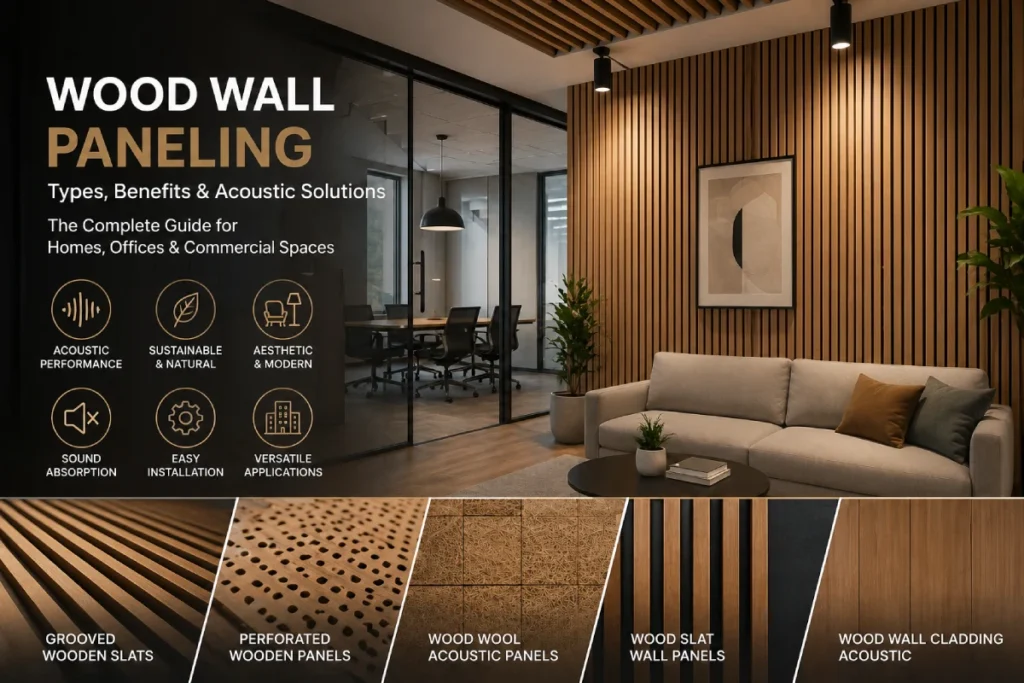
Wood wall paneling refers to any wall covering system that uses timber or timber-based composite panels as the primary surface material. In a purely decorative context, panels may be solid timber, engineered veneer boards, WPC (Wood Plastic Composite) sheets, or MDF with a wood-grain laminate — all installed primarily for their visual impact.
In an acoustic context, wood wall paneling goes significantly further. Acoustic wooden panels are engineered systems in which the timber face works in combination with a sound-absorbing core and a deliberately designed air gap to absorb, diffuse, and control sound energy. The timber surface may be grooved, perforated, slotted, or made from natural wood fibre composites — each configuration delivering a distinct acoustic performance profile.
The best acoustic wood wall panels achieve both objectives simultaneously: they look like premium architectural timber while performing to measurable, test-certified acoustic standards. This dual function — beauty and performance — is what makes them the preferred specification for architects, interior designers, and acoustic consultants working on demanding commercial and institutional projects across India.
Walk into any premium office, five-star hotel lobby, modern auditorium, or architect-designed residence in India today and you are almost certain to see wood wall paneling on at least one surface. The material has become the dominant choice in high-performance interior design for a simple reason: it is the only wall treatment that simultaneously delivers world-class acoustic performance, a premium aesthetic, and long-term durability — all from a single installation.
But not all wood wall panels are created equal. Purely decorative timber cladding and acoustically engineered wooden panels look nearly identical to the untrained eye yet perform in completely different ways. The difference — in sound absorption, NRC rating, fire safety, and long-term value — is enormous.
This guide explains everything you need to know about wood wall paneling: the different types available, how each works acoustically, which spaces each suits, how to specify correctly, and why the panels you choose matter as much as the surfaces you install them on.
[Web team note — image placement]: Insert a hero gallery here showing 4–6 room-scene photographs of installed Ecotone/Packsound wood wall panels across different spaces (office, auditorium, hotel lobby, home theatre). Source from completed project portfolio. Each image should carry an alt tag in the format:
"[Product name] installed in [space type] — Ecotone Systems". This directly addresses the single most important gap vs. Armstrong Ceilings, whose product page leads with high-quality room scene photography.
Understanding which type of wood wall panel suits your project requires knowing how each system works, what it absorbs, and where it excels.
Grooved wooden slat panels — also referred to as acoustic slat wall panels, wood slat panels, or sound slats — are among the most popular acoustic wall treatments in India’s premium commercial interiors market. Their clean, linear aesthetic suits everything from contemporary co-working spaces to executive boardrooms and hotel feature walls.
How they work: Precision-cut grooves are machined into the face of a high-density MDF or HDF board. These grooves act as acoustic apertures: sound enters through the slots, passes into the cavity behind the panel, and is absorbed by an acoustic backing material — typically black acoustic fleece, polyester fibre mat, or rockwool. A GI ‘Z’ clamp system or aluminium keel creates the necessary air gap between the panel and the structural wall, which is critical to low-frequency absorption performance.
Ecotone’s product — Grooved Wooden Slats (Packsound / EchoStop™ range):
Ecotone’s Grooved Wooden Slats are manufactured from high-density pre-laminated MDF boards conforming to IS-14587:1998. All panel joints use dowel connections to eliminate sagging and ensure a perfectly flat, consistent surface across large wall areas. The back of each panel is lined with black acoustic fleece, and the installation system creates a 25–50 mm air gap that can be infilled with polyester fibre or rockwool to increase the NRC value as per the acoustic consultant’s specification.
Technical specifications:
📄 Download the EchoStop™ Technical Data Sheet — available on the Grooved Wooden Slats product page or request via our acoustic consultation team.
Best for: Corporate offices, hotel lobbies, restaurants, conference rooms, home theatres, auditoriums, and feature walls in premium residential spaces. Proven in landmark installations including hospitality projects such as Hyatt Regency Bhikaji Cama Place, New Delhi, where aesthetic integration was as critical as acoustic performance.
Perforated wooden acoustic panels combine a timber or MDF face with a precision-drilled perforation pattern. Sound enters through the perforations and is absorbed by the backing material. Unlike grooved panels, perforations can be engineered to target specific frequency ranges by varying hole diameter, spacing, and panel depth — a principle derived from Helmholtz resonator acoustics.
How they work: The perforation geometry acts as a tunable resonant system. Larger perforation ratios and deeper air cavities absorb lower frequencies; smaller perforations with shallower cavities target mid and upper-mid frequencies. This makes perforated panels the preferred choice for acoustic consultants who need to address a specific frequency problem — for example, controlling the low-to-mid frequency buildup common in auditoriums, multiplex cinemas, and conference halls.
Ecotone’s product — Perforated Wooden Slats:
Ecotone’s perforated wooden panel system uses high-density pre-laminated MDF boards conforming to IS-14587:1998. All panel joints use dowel connections to prevent sagging. The reverse face of each panel is lined with black acoustic fleece, and panels are installed on a GI ‘Z’ clamp grid that creates a 25–50 mm cavity, infillable with polyester fibre or glass wool depending on the required absorption profile.
Ecotone’s ‘M’ and ‘T’ perforation patterns effectively absorb sound across low, medium, and high frequency ranges — making them among the most broadband-capable wooden wall panel systems available. The perforation pattern can be selected or customised based on the acoustic consultant’s frequency-band targets for each project.
Download the Perforated Wooden Slats Technical Data Sheet — available on the Perforated Wooden Slats product page or request via our project team.
Best for: Auditoriums, multiplex cinemas, performing arts centres, broadcast studios, recording studios, conference halls, airport lounges, and any space where frequency-specific acoustic tuning is required.
Wood wool panels — also called wood fibre acoustic panels — are manufactured by bonding natural wood fibres under high pressure with a cementitious or mineral binder. The result is a dense, dimensionally stable panel with a distinctly natural, textured aesthetic and exceptional broadband sound absorption across the full frequency spectrum.
Wood wool is unique among timber-based acoustic materials because it absorbs low, mid, and high frequencies effectively — not just the mid-high range that most grooved and perforated panels target. This makes wood wool the specification of choice for spaces with complex, broadband acoustic problems: gymnasiums, large atria, airport terminals, industrial canteens, and multipurpose halls.
Ecotone’s product — Wood Wool / Wooden Fibre Acoustic Panels:
Ecotone’s WFF (Wood Fibre Felt) wall tiles are 20 mm thick, covered with acoustically transparent fabric on the face in a choice of colours, and fixed on the wall with a 50 mm rockwool backing (48 kg/m³ density). Available in sizes of 1200×600 mm or 595×595 mm.
Certified performance:
Best for: Auditoriums, multiplex cinemas, classrooms, corporate boardrooms, hotel lobbies, gymnasiums, recording studios, restaurants, airport terminals, and industrial facilities where broadband absorption is required.
Ecotone’s Composite Acoustic Panels — branded Groovphonic™ by the Packsound range — combine a grooved perforated timber face with a polyester fibre acoustic pad core bonded using rubber-based adhesive, creating a single integrated panel with superior acoustic performance and impact resistance.
Construction:
Composite panels are particularly valued in auditoriums and multipurpose halls where the wall surface will be exposed to physical contact and requires a more robust construction than standard grooved slat panels.
Best for: Auditoriums, convention centres, multipurpose halls, school assembly halls, lecture theatres, and commercial spaces requiring both acoustic performance and impact resistance.
Fabric-wrapped acoustic panels use a rigid wood-based substrate (typically MDF or a wood fibre board) covered with acoustically transparent fabric over a high-performance absorption core — usually glass wool or rockwool. The fabric face allows sound to pass through freely to the absorptive core, while the timber backing frame provides structural rigidity and dimensional stability.
These panels deliver among the highest NRC values available from any wall-mounted acoustic treatment — up to 1.0 with a 75 mm rockwool core — while offering extraordinary design flexibility through choice of fabric colour, pattern, and texture.
Ecotone offers Fabric Wrapped Acoustic Panels in over 100 colours, with full-colour graphic image printing available for custom brand wall designs and feature installations.
Best for: Corporate boardrooms, executive offices, private meeting rooms, home cinemas, broadcast studios, hotel conference suites, and premium residential spaces.
| Product | Brand Name | NRC Range | Fire Rating | Best Application | Design Life | Data Sheet |
|---|---|---|---|---|---|---|
| Grooved Wooden Slats | EchoStop™ | 0.75–1.0 | IS/ASTM rated | Offices, hotels, home theatres, feature walls | 10 years | Download |
| Perforated Wooden Slats | EchoStop™ Micro Perforated | 0.70–0.95 | IS/ASTM rated | Auditoriums, cinemas, studios, concert halls | 10 years | Download |
| Wood Wool / Wood Fibre | WFF Panel | 0.85–0.90 | ASTM D-876 Class A | Gyms, classrooms, airports, multipurpose halls | 25–40 years | Download |
| Composite Acoustic | Groovphonic™ | Up to 0.86 | Chemically treated FR | Auditoriums, school halls, high-traffic walls | 15+ years | Download |
| Fabric Wrapped | PackSound Fabric Panel | Up to 1.0 | Fabric-dependent | Boardrooms, studios, home cinemas | 10–15 years | Download |
Not sure which panel suits your space? Request a free acoustic consultation →
Understanding why different wooden panel systems perform differently helps you specify with confidence and avoid the most common and costly specification mistakes.
Absorption vs. Diffusion: Wood wall panels primarily work through two acoustic mechanisms — absorption and diffusion. Absorption occurs when sound energy penetrates the panel surface and is converted into heat by the backing material. Diffusion occurs when the surface geometry (grooves, perforations, ridges) scatters sound waves in multiple directions, reducing the intensity of reflections. Most high-quality acoustic wood panels deliver a combination of both, making them more effective than pure absorbers (like foam) which deliver no diffusion benefit.
The critical role of the air gap: In every grooved and perforated wood panel installation, the air gap between the back of the panel and the structural wall is an active acoustic component — not a construction afterthought. Increasing the depth of this cavity shifts the peak absorption frequency toward lower registers. A 25 mm air gap primarily addresses mid and high frequencies; a 50 mm gap with rockwool infill adds meaningful low-frequency absorption. For spaces with significant bass problems, an air gap of 100 mm or more may be specified. This principle is why professional acoustic design cannot be replaced by simply mounting panels flush against the wall.
NRC and frequency response: The NRC (Noise Reduction Coefficient) is an average of a material’s sound absorption coefficients at four standard test frequencies (250 Hz, 500 Hz, 1000 Hz, and 2000 Hz). An NRC of 0.95 does not mean the material absorbs 95% of all sound at all frequencies — it means it absorbs an average of 95% across those four test points. Wood wool panels tend to have flatter, more consistent frequency responses than grooved slat panels, which often show stronger absorption in the mid frequencies and less at the low end. Understanding this distinction is essential when specifying for spaces with bass problems.
The air gap as a low-frequency tool: For architects who want to meet both low and high frequency targets without sacrificing the sleek visual of grooved wooden slat panels, the solution is to increase cavity depth and specify a denser infill material — not to switch to a different panel type. Ecotone’s acoustic consultants calculate the optimal combination of panel type, groove pattern, air gap depth, and infill density for every project.
Open-plan offices are acoustically one of the most demanding commercial environments. Hard floors, glass partitions, exposed ceilings, and densely populated floor plates create significant reverberation and speech privacy challenges. Acoustic wood wall panels on perimeter walls, partition spines, and feature walls reduce reverberation time, improve speech intelligibility, and create a sense of acoustic comfort without compromising the visual openness of the design.
Grooved wooden slat panels in natural teak or oak finishes are the dominant specification for contemporary Indian corporate offices — they deliver genuine acoustic performance while creating the premium aesthetic that modern workplaces demand. For boardrooms and conference rooms, fabric-wrapped panels or composite panels on the rear and side walls deliver higher NRC values for critical listening environments.
Auditorium acoustics are among the most complex acoustic design problems in architecture. The walls must absorb enough energy to prevent excessive reverberation without over-damping the space and losing the warmth and fullness that make live performance compelling. Perforated wooden panels and composite acoustic panels are the standard specification for auditorium sidewalls and rear walls — they combine tunable frequency absorption with a visual character that suits the formal architecture of performance venues.
Ecotone has delivered acoustic wall treatments for auditoriums, convention centres, multiplex cinemas, and performing arts facilities across India, providing full acoustic design support from room modelling through to material specification and installation.
Hospitality spaces use acoustic wood wall paneling primarily to improve the guest experience. In hotel lobbies, excessive noise from hard floors and glass surfaces creates an unwelcoming atmosphere. Grooved wooden slat panels on feature walls and behind reception counters provide warmth and quiet. In restaurants, wood wool or composite panels on perimeter walls reduce the ambient din that forces diners to raise their voices, which in turn raises the overall noise level further — a self-reinforcing cycle that acoustic treatment breaks.
The premium aesthetic of wood wall paneling also aligns naturally with the design intent of upscale hospitality projects, making it the most architecturally coherent acoustic treatment available.
Research consistently demonstrates that classroom acoustics have a direct, measurable impact on learning outcomes. Children — particularly those with hearing difficulties, English as a second language, or attention challenges — are disproportionately affected by excessive reverberation. Wood wool acoustic panels are a preferred specification for Indian classrooms and lecture halls: they deliver broadband absorption including low frequencies, carry Class A fire ratings, are VOC-free (critical for school environments), and are robust enough to withstand the demands of a high-traffic educational facility.
Ecotone has delivered acoustic solutions for educational institutions across India from primary schools to university lecture theatres, with full acoustic design support to meet NBC 2016 and international classroom acoustic standards.
Home theatre acoustics require controlled sound absorption on side walls and the rear wall to eliminate flutter echo and tame mid-frequency buildup, allowing the audio system to perform as the engineer intended. Grooved wooden slat panels in premium wood grain finishes are an increasingly popular choice in luxury Indian home theatre installations — they deliver genuine acoustic performance while creating the premium interior aesthetic that clients expect at this price point.
For maximum acoustic performance, perforated panels or fabric-wrapped panels should be specified on the rear wall where absorption demand is highest, with grooved slat panels used on side walls and as a feature element behind the screen.
Recording studios require the lowest possible noise floor, careful control of mid-frequency absorption and diffusion, and zero flutter echo. Perforated wooden panels on side walls and the rear of the recording room address mid-frequency buildup; wood wool panels in the live room control broadband reverberation. Fabric-wrapped panels with deep rockwool cores manage high-frequency absorption. Ecotone’s acoustic consultants design complete acoustic environments for recording, broadcasting, and podcasting facilities, integrating wall panels, ceiling systems, and bass treatment into a unified design.
Large sports halls are among the most acoustically challenging built environments: hard floors, bare block walls, metal roofing, and large volumes produce reverberation times of 3–5 seconds. Wood wool panels on the upper walls and composite acoustic panels in the lower zones (where impact resistance is required) are the standard specification for gymnasium acoustic treatment, typically reducing reverberation time to the 1.0–1.5 second range that makes verbal coaching, announcements, and ambient sound manageable.
With multiple panel types offering different acoustic profiles, visual options, and price points, selecting the right system for a specific project requires a structured approach.
Step 1 — Identify the acoustic problem: Is the primary issue excessive reverberation (long decay time), speech intelligibility problems, low-frequency buildup, or room-to-room sound transmission? Different panel types address different problems, and specifying the wrong system — however beautiful it looks — may not solve the acoustic issue.
Step 2 — Assess the space: Room volume, ceiling height, existing surface materials, and occupancy pattern all influence how much acoustic treatment is needed and which type will perform best. Large-volume spaces with long reverberation times typically need broadband absorbers like wood wool; smaller rooms with mid-frequency problems are well served by grooved slat panels.
Step 3 — Set the NRC target: Work with an acoustic consultant to establish the target NRC and RT60 for the space. This determines both the panel type and the coverage area required. Guessing at coverage — one of the most common and expensive specification errors — leads to spaces that still sound problematic after a costly installation.
Step 4 — Consider the installation environment: Humid spaces (pools, kitchens, industrial canteens) require moisture-resistant panel specifications. High-traffic or high-impact areas (school corridors, gymnasiums, industrial facilities) need the structural robustness of composite panels or wood wool rather than standard grooved slat systems.
Step 5 — Specify the backing system correctly: Never specify grooved or perforated wooden panels without defining the backing material and air gap depth. A grooved slat panel installed without acoustic backing against a solid wall delivers a fraction of its rated NRC performance. Insist on a full backing specification and verify during installation.
Step 6 — Engage Ecotone’s acoustic consultants early: The best acoustic outcomes are achieved when acoustic engineering is integrated into the design process from the beginning — not treated as a finishing detail. Ecotone Systems provides acoustic consultation, room modelling, material specification, supply, and turnkey installation for projects of all scales across India.
Ecotone Systems and the Packsound product range represent over 40 years of combined acoustic engineering expertise and a manufacturing and installation capability that covers the full spectrum of wood wall paneling solutions available in India.
Certified recycled content and sustainability: Ecotone’s acoustic panel boards carry certified average recycled content of at least 35% recycled glass (9% post-consumer + 26% pre-consumer materials) — a verified, third-party certified figure backed by test documentation, directly applicable to LEED India and GRIHA Materials credits. Wood fibre panels are FSC-sourced and biodegradable. EchoStop™ PET Felt panels are manufactured from post-consumer recycled PET fibres.
Comprehensive product range, all under branded product lines: Ecotone offers every major category of acoustic wood wall paneling — EchoStop™ Grooved Wooden Slats, EchoStop™ Micro Perforated Panels, WFF Wood Wool Fibre Panels, Groovphonic™ Composite Acoustic Panels, and Fabric Wrapped Acoustic Panels — all from a single manufacturing partner in Greater Noida. This eliminates the coordination risk of managing multiple suppliers and ensures a consistent, integrated acoustic outcome with a single technical point of contact.
Certified performance: All Ecotone acoustic wood wall panels are manufactured to IS-14587:1998 and tested to ISO 354:1985 and ASTM C423-90a. NRC values, fire ratings, and weather resistance data are supported by third-party test certificates — not manufacturer claims.
1,900+ completed projects: Ecotone and Packsound have delivered acoustic wall treatments across auditoriums, corporate offices, schools, hotels, multiplexes, and industrial facilities across India and internationally — including landmark hospitality installations such as Hyatt Regency Bhikaji Cama Place, New Delhi, the BAPS Shri Swaminarayan Mandir auditorium in Ahmedabad, and 350+ commercial office fit-outs. This track record means Ecotone’s specifications are field-validated across climates, space types, and acoustic challenges — not theoretical.
Design flexibility: With 50+ colour and wood grain options for grooved slat panels, 40 acoustic shades for wood wool tiles, 100+ fabric options for wrapped panels, and full-colour graphic printing capabilities, Ecotone’s wood wall paneling systems integrate seamlessly with any architectural design intent.
Turnkey delivery: Ecotone manages the complete process — acoustic assessment, design, material supply, installation, and post-installation acoustic verification — for projects from a single meeting room to a full auditorium complex.
ISO certification: As an ISO 9001, 14001, and 45001 certified organisation, Ecotone applies rigorous quality, environmental, and safety standards across every stage of every project.
Acoustic wood wall panel installation follows a well-defined sequence that, when executed correctly, delivers a flawless finish and full acoustic performance.
Surface preparation: The substrate wall must be clean, dry, plumb, and free from loose material. Any existing wall coverings should be removed. Electrical outlets, switchboards, and service penetrations are marked and accommodated in the panel layout plan.
Grid installation: GI ‘U’ channel frames (50 × 32 mm) are fixed to the wall at the specified grid spacing (typically 600 × 900 mm) using stainless steel screws. This grid creates the critical air gap between the structural wall and the acoustic panel.
Cavity infill (where specified): Rockwool, glass wool, or polyester fibre is placed in the cavity between grid members. The density and thickness of this infill is specified by the acoustic consultant and is not optional — it is a functional component of the acoustic system.
Acoustic fleece: Black acoustic fleece is fixed to the back of each panel or applied across the grid framework before panel installation. This prevents dust migration and maintains the acoustic cavity’s performance over time.
Panel installation: Panels are fixed to the GI ‘Z’ clamps using headless nails or screws. Dowel connections between adjacent panels ensure a flat, gap-free surface with no sagging. Panel layout is verified against the approved design drawing before final fixing.
Finishing: Edge panels are cut to size. Tapered V-joint edge cuts can be applied where specified for a refined joint detail. Electrical faceplate and service penetrations are completed after panel installation is confirmed as structurally sound and acoustically verified.
Acoustic wood wall panels are low-maintenance but benefit from a regular care routine to maintain both appearance and acoustic performance.
For standard grooved and perforated MDF panels with pre-laminated finishes, routine maintenance consists of dusting with a soft dry cloth or very low-suction vacuum brush. Avoid abrasive pads, solvent-based cleaners, or high-pressure water — all of which can damage the laminate face or the acoustic fleece backing.
For wood wool panels covered with fabric, vacuum gently with a soft brush attachment. Spot stains should be addressed immediately with a barely damp cloth and mild soap solution; do not saturate the panel.
Pre-laminated grooved panels with matt or melamine gloss finishes can be wiped with a lightly damp cloth for routine cleaning. In high-traffic areas, periodic professional cleaning once a year is recommended to restore the surface and inspect the suspension system.
With correct specification and routine maintenance, Ecotone acoustic wood wall panels maintain their full performance and visual appearance for a decade or more.
What is the difference between decorative wood wall panels and acoustic wood wall panels?
Decorative panels are installed purely for visual effect — they have no engineered acoustic core or air gap system. Acoustic wood wall panels are engineered systems with a specific backing material, air gap, and perforation or groove geometry designed to achieve a measured NRC rating. They look similar but perform fundamentally differently.
Can grooved wooden slat panels be used on ceilings as well as walls?
Yes. Ecotone’s grooved wooden slat and perforated panel systems can be installed on both walls and ceilings. Ceiling applications use the same GI grid system with appropriate structural fixings rated for overhead loads.
What is the best wood wall paneling option for a recording studio?
For recording studios, a combination of perforated wooden panels (for tunable mid-frequency absorption) on side walls, wood wool panels (for broadband low-to-high absorption) on the live room walls, and fabric-wrapped panels (for highest NRC) on the control room rear wall typically delivers the best results. Ecotone’s acoustic consultants design complete studio acoustic environments based on your specific recording requirements.
Are acoustic wood wall panels suitable for humid Indian coastal environments?
Wood wool panels are rated to perform without deterioration at 90% relative humidity and 60°C — conditions that exceed normal Indian coastal building environments. For grooved MDF panels in very humid spaces (swimming pools, industrial wash-down areas), moisture-resistant MDF substrates and sealed laminate faces should be specified. Contact Ecotone for the correct product specification for your specific environmental conditions.
Do acoustic wood wall panels contribute to LEED or GRIHA certification?
Yes. Acoustic wood wall panels made from FSC-certified timber, recycled content, or low-VOC materials can contribute credits under LEED India (Acoustic Performance credit, Materials credits) and GRIHA (Occupant Wellbeing, Materials criteria). Ecotone’s team can provide the documentation required for green building certification.
What coverage area of wood wall paneling is needed to solve an acoustic problem?
This depends entirely on the space volume, existing surface materials, current reverberation time, and target RT60. As a rough guide, treating 20–30% of total wall area with NRC 0.7+ panels will meaningfully reduce reverberation in most commercial spaces. A professional acoustic assessment provides the precise calculation. Ecotone offers acoustic consultation services to determine the optimal coverage for your project.
The right wood wall paneling does more than transform a space visually. It reduces reverberation, improves speech clarity, creates acoustic comfort, supports employee wellbeing, and in many cases contributes to green building certification — all from a single wall treatment that most building occupants simply experience as a premium, natural interior.
Whether you are specifying for a corporate headquarters, an auditorium, a luxury hotel, a school, or a home theatre, Ecotone’s range of acoustic wooden wall panels — grooved slats, perforated panels, wood wool boards, composite panels, and fabric-wrapped systems — provides the performance, the aesthetics, and the manufacturing and installation quality your project demands.
Contact Ecotone Systems today for a free acoustic consultation and a project-specific quotation. Our team will assess your space, recommend the right panel system, and manage the complete supply and installation process — from first drawings to final acoustic verification.
Explore related resources: Acoustic Wall Panels — full product range | Grooved Wooden Slats product page | Perforated Wooden Slats product page | Wood Wool Acoustic Panels | Composite Acoustic Panels | Sound Absorbing Materials for Walls — Complete Guide 2026
 Download the Perforated Wooden Slats Technical Data Sheet — available on the