Call ✆ +91 9809802016 | 9891320678

Research reveals that 60% of office workers struggle to concentrate due to acoustic distractions. Office acoustic solutions have become vital for modern workplaces. Background noise can lead to as much as a 66% drop in productivity and directly affect your bottom line. We’ve found that the right acoustic strategies can change your workspace. These range from office acoustic pods to the best acoustic solutions for office cubicles and open office acoustic solutions. This piece will walk you through proven acoustic solutions that improve privacy and boost productivity while reducing distractions.
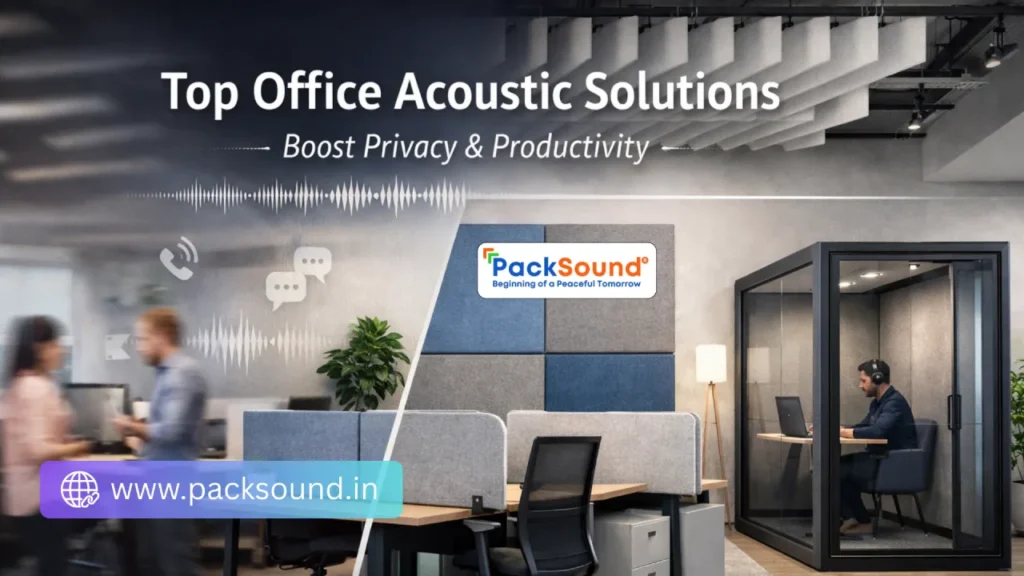
Open-plan offices were designed to promote collaboration, but they’ve created a noise crisis instead. Phone calls and in-person conversations rank as the top two sources of office noise. Mechanical equipment like printers and HVAC systems add to the cacophony, along with ringtones and text alerts. Among the 30 million American workers exposed to high noise levels, office employees face a unique challenge. The constant hum isn’t just annoying. It’s sabotaging their work.
The numbers paint a stark picture. More than half of all offices, 55% to be exact, are described as “noisy”. What’s more concerning is that 69% of workers in these disruptive environments report noise affects their concentration levels and productivity. Speech privacy emerges as the single greatest source of workplace dissatisfaction in a study of 50,000 workers across 351 buildings. Even those in private offices aren’t immune. About 30% identify acoustics as an element that interferes with their job performance.
The problem extends beyond occasional disruptions. Workers exposed to just one nearby conversation can experience up to a 66% reduction in productivity. This happens because of speech propagation. Conversations happening 30 feet away can be as disruptive as those at the adjacent desk. Only 8% of office workers feel they work in a quiet office, and just a quarter work in spaces with well-designed acoustics.
Selecting the right office acoustic solutions requires matching specific products to your workspace challenges. Here’s what works in a variety of office environments.
Ceiling treatments deliver full-coverage sound absorption from overhead surfaces. Acoustic ceiling tiles fit into standard 15/16″ T-grid systems and come in various materials including mineral fiber, fiberglass, and metal. These tiles achieve NRC ratings between 0.55 and 0.95, meaning they absorb 55% to 95% of sound striking them. We recommend tiles with an NRC of at least 0.70 for offices.
Acoustic ceiling clouds offer an alternative to full tile coverage. These suspended panels absorb sound from both top and bottom surfaces. They work well in spaces where you can’t install a complete drop ceiling. Baffles hang vertically and provide sound absorption while requiring fewer mounting points than other solutions.
Wall panels tackle sound reflections at their source. Materials include fabric-wrapped fiberglass, compressed mineral wool, foam, perforated wood, and recycled PET panels. These panels eliminate echo and reduce ambient noise when positioned at reflection points.
Fabric-wrapped panels blend acoustic performance with design flexibility, available in over 100 colors. Composite panels combine materials for optimal absorption in spaces with specific needs. Grooved wooden slats deliver both acoustic control and visual appeal for modern offices.
Acoustic work pods represent a dedicated solution for noise-free concentration. These prefabricated micro-rooms achieve Class A acoustic performance, blocking external noise while suppressing internal sound. The pods use special construction with sound-absorbing materials and three-dimensional panels that diffuse sound waves.
Sizes range from compact 4×4 ft single-person units to 8×12 ft spaces accommodating 4-8 people. Features include sealed doors, integrated lighting, power outlets, USB ports, and ventilation systems. Pods achieve verified metrics through tight door seals, robust wall builds using PET felt or acoustic foam, and laminated glazing.
Office acoustic pods reduce speech levels by up to 30 dB for private discussions and confidential meetings. Purpose-built pods combine high acoustic performance with smart features like occupancy indicators and automated adjustments. The soundproofing uses acoustic foam, double-paned glass, and airtight seals to minimize both incoming and outgoing noise.
Modern pods drop about 30 dB of noise across speech frequencies. Conversations stay private while the surrounding office continues functioning. Installation requires no permits or drywall, and mobility allows easy reconfiguration as needs change.
Desk dividers concentrate acoustic support at individual workstations without consuming floor space. These partitions use acoustic foam on both sides, with thicknesses ranging from 42mm to 66mm depending on foam layers. They offer maximum sound absorption when positioned at head height and aligned with voice projection[213].
Installation takes minutes using desktop clamps. The versatility makes desk screens suitable for all environments, from open-plan offices to home workspaces.
Carpet eliminates floor impact sounds from footfalls, moved chairs, and dropped objects. A typical broadloom carpet achieves an NRC of 0.35, absorbing 35% of striking sound. The NRC nearly doubles to 0.65 with underlay. Carpeted floors can reduce noise by over 20 decibels.
Carpet tiles with open-cell cushion backing transmit around 20 times less noise between floors than hardback carpet and 50 times less than hard flooring. Luxury vinyl tile with acoustic backing reduces impact sound up to 19dB if you prioritize hard surfaces.
Sound masking technology emits ambient sounds matching human speech frequencies. Background conversations become unintelligible without adding noticeable noise. Sound masking blends into the background, unlike white noise machines that can overwhelm at higher volumes. Systems with a 5-meter radius can cover large areas when distributed throughout the office. This approach reduces distractions, improves productivity, and improves speech privacy while keeping office noise levels comfortable.
Acoustic distractions create a cascading effect on cognitive function. When noise interrupts workflow, it takes an average of 23 minutes to regain concentration. Employees never reach the deep focus states necessary for complex cognitive work in open-plan offices where acoustic disruptions occur every few minutes. This presents a serious issue. Analytical work and creative thinking suffer from acoustic distractions, along with detailed writing and precision tasks.
The cognitive load increases by a lot in noisy conditions. The brain works harder to filter and process information. This leads to fatigue and slower reaction times. Workers complete tasks less efficiently, and errors creep in more often. Research shows that as noise intensity increases, the rate of errors also increases. The differences observed between error rates at 110 dB compared to 70 and 90 dB sound levels are substantial.
Beyond task performance, noise triggers physical stress responses. High noise levels elevate stress hormones and spike heart rate and blood pressure. They also contribute to poor sleep quality. A study of 1,000 office workers found that 44% reported noise had a negative effect on their overall wellbeing. Over 40% said workplace noise caused them to feel stressed. About 65% of surveyed workers reported that noise affected their ability to complete work in an accurate and timely manner.
Noise also affects collaboration and communication. Workers in noisy environments struggle to hear instructions or colleagues. This miscommunication causes delays and mistakes that affect efficiency. When employees cannot hear during meetings or must repeat themselves, the inefficiency multiplies across every interaction.
The price tag attached to poor acoustics is staggering. Workplace distractions, with noise being a main cause, result in an estimated INR 50,628.27 billion in lost productivity annually. U.S. businesses alone lose about INR 54,847.29 billion each year due to decreased productivity from distractions. This covers lost focus time and increased error rates. Extended project timelines and the mental fatigue that compounds throughout the workday add to these losses.
Organizations also pay indirect costs through employee satisfaction and retention. Half of all employees reveal that noise levels would affect their decision to accept a job. About 62% have considered leaving their company due to noise. With 69% of workers stating they would enjoy their job more if there was less noise, the connection between acoustics and workplace happiness becomes clear.
The good news? Investing in office acoustic solutions delivers measurable returns. Improved acoustics can eliminate conversational distractions by 51% and reduce employee stress by 27%. Work errors drop by 10%, and worker concentration improves by 48%. These benefits apply whether you’re implementing office acoustic pods for privacy or exploring the best acoustic solutions for office cubicles. They also apply when rolling out detailed open office acoustic solutions across your workspace.
Sound doesn’t just disappear when someone stops talking. How it moves through your workspace explains why certain office acoustic solutions work better than others.
When someone speaks at their desk, sound emanates from that point source in a spherical pattern and spreads outward in all directions. Close to the speaker, sound waves move through the space uniformly. This creates a fundamental challenge: without barriers or absorption, those waves continue traveling until they encounter a surface.
The process doesn’t end there. Sound waves maintain energy as they propagate across open floor plans. This explains why conversations 30 feet away can disrupt your focus just as much as discussions at adjacent desks. The physical properties of materials in the sound’s path determine what happens next and vary across different frequencies. Lower frequency sounds penetrate and travel farther, while higher frequencies get absorbed or deflected more.
Materials respond to sound waves in two distinct ways. Sound-absorbing materials dampen intensity by catching sound waves through their porous nature. When sound meets acoustic cotton or fiberglass panels, it doesn’t bounce back. The porous structure allows waves to enter but traps them inside, where the sound energy converts into heat through friction. Some noise may pass through, but it emerges muffled or muted.
These absorptive materials receive a Noise Reduction Coefficient (NRC) rating that describes absorption capacity. An NRC of 0 means the material reflects all sound, like bare concrete walls. An NRC of 1.0 means complete absorption, like thick acoustic felt. An NRC of 0.7 or higher is recommended for open office acoustic solutions.
Sound-reflecting materials send waves back due to their harder, less porous surfaces. Think of hitting a tennis ball against a wall: the ball returns to you. Hard surfaces like concrete, steel, glass, or untreated wood create the same effect with sound waves. These materials prevent sound from entering or leaving spaces but can create problematic echoes if positioned wrong.
Most effective office acoustic solutions lean heavily on absorptive materials because they force sound waves to break up and dissipate. But reflection serves purposes too. Reflective barriers angled the right way can deflect sound energy away from quiet zones, though incorrect angles might reflect noise upward and around barriers by accident.
Reverberation refers to the collection of reflected sounds that bounce off floors, walls, ceilings, and other surfaces and lose energy over time. Reverberation time measures how long after a sound source stops that it takes for sound to fade away. RT60 measures the time required for sound pressure level to reduce by 60 dB.
Excessive reverberation creates an overwhelming auditory experience and makes effective communication difficult during meetings, video calls, or even casual conversations. Research shows reverberation impairs speech recognition, especially at moderate signal-to-noise ratios. The problem compounds because reverberation exacerbates background noise effects on speech recognition, with combined impacts greater than their individual effects.
Listeners hear both direct sound from sources and delayed reflected energy in reverberant spaces. Early reflections that arrive within 0.05 seconds get integrated by our auditory system and may enhance speech recognition. Late reflections overlap with direct sound and cause masking and temporal smearing that reduces speech clarity.
Reverberation time should range between 0.4 to 0.7 seconds for offices. Private offices perform best under 0.6 seconds, while conference rooms need 0.6 to 0.8 seconds, and open plan spaces should stay under 0.8 seconds. Extended reverberation makes speech sound muffled and difficult to understand. Very short reverberation creates acoustically dead spaces that feel quiet in an unnatural way.
Absorptive surfaces are needed to control RT60. Smooth, hard surfaces cause sound waves to bounce over and over and extend reverberation. Soft, absorptive materials like carpet, acoustic panels, upholstered furniture, and ceiling treatments reduce excessive reverberation. Room size matters too: smaller rooms produce shorter reverberation times. This scientific foundation explains why the best acoustic solutions for office cubicles and office acoustic pods work: they combine absorption with strategic placement to manage how sound behaves in your workspace.
Cubicles and individual workstations need targeted approaches beyond office-wide treatments. These workspace-specific solutions put acoustic control directly in employees’ hands.
Desk dividers serve dual purposes: reducing noise from phone conversations while providing visual privacy. Modern screens use materials like ARCHISONIC Felt with sound-absorbing properties on both sides. They create effective barriers at the source of workplace chatter. The beauty lies in their simplicity. Most systems require just two components that attach to desktops without additional connectors or tools.
These partitions adapt to flexible working arrangements and allow teams to improve acoustic and visual privacy instantly. Designs covering the area below tabletops prevent visibility and sound transmission under sit-stand desks, which makes them especially useful. Polyester fiber panels offer pinnable surfaces, fire-retardant properties, and moisture-proof construction. Installation takes minutes using desk clamps. Sizes range from 740mm to 1790mm width to match various desk configurations.
Desks account for about 40% of flat surfaces in offices and create untapped acoustic potential. You can line the underside of desks with acoustic foam to absorb sound reflections from hard flooring without affecting office esthetics. Most employees won’t notice the foam installed beneath their workspace. The cumulative effect makes the entire office feel quieter.
Ridged or pyramid foam works best here. The material cuts easily to fit awkward spaces and delivers excellent noise reduction ratings. This approach reduces reflections bouncing between floor and desktop surfaces. It tackles a sound path often overlooked in acoustic planning.
Thoughtful team arrangement reduces acoustic conflicts before they start. Different departments operate differently: marketing teams thrive on regular collaboration and communication, while accounting teams need focused, quiet environments. Desk clusters compartmentalize noise and keep conversations in close proximity rather than spreading them around the floor.
You should separate noisy areas from quiet zones to cut distractions. Place high-traffic spots like kitchens or copy machines away from concentration-intensive workstations. This zoning acknowledges that noise tolerance varies among employees.
Noise-canceling headphones let individuals create their own quiet space whatever the surrounding activity. Active noise-canceling technology blocks distractions and allows employees to sit in silence while remaining visible to colleagues. Models like Bose Quiet Comfort 35 have built followings for lightweight design and superior noise blocking. Over-ear designs work best and cover ears to maximize sound isolation.
These solutions give employees control over their acoustic environment without structural changes. While not addressing why it happens, they provide immediate relief and personal choice in managing workplace noise.
Collaboration zones present unique acoustic challenges because they need to support energetic teamwork without creating chaos for surrounding workstations. The right open office acoustic solutions balance sound management with maintaining the collaborative spirit.
Suspended acoustic elements provide flexible alternatives when full ceiling coverage isn’t practical. Baffles hang vertically from ceilings and intercept sound as it travels upward. This makes them especially effective when you have spaces with high ceilings. These vertical panels work as sound-absorbing barriers suspended by small-gage steel cables anchored to the ceiling. Sound waves penetrate the panel and cause tiny fibers inside to vibrate. The friction converts sound energy into thermal energy.
Effectiveness depends on spacing. Baffles positioned less than two feet apart deliver optimal acoustic control. Depths of 12 inches or more provide adequate surface area to absorb sound. Spacing them too far apart on tight budgets renders them ineffective, however.
Acoustic clouds hang horizontally and cover larger surface areas. They resemble floating islands. Clouds absorb excess sound at rates surpassing vertical baffles because more surface area faces downward. You can position clouds directly above conference tables, work desks and gathering areas to target noise at its source. The Budapest office of Mastercard features an open ceiling treated with acoustic spray and suspended baffles. This supports collaboration in open zones without disturbing adjacent workstations.
Greenery delivers dual benefits in collaboration spaces. Green walls achieve a weighted sound reduction index of 15dB and a sound absorption coefficient of 0.40. Plants absorb sound through their flexible structures. Their irregular shapes scatter noise and reduce intensity. Research shows offices with abundant plants see a 15% jump in productivity. Job satisfaction rises and stress drops.
Dense foliage performs best. Large potted plants in deep containers offer greater surface area to absorb sound. You can group plants together to create sound-absorbing clusters rather than scatter them. Shrubs and tall plants work as natural partitions in open spaces and break up sound pathways. Position greenery at reflection points like corners or near hard surfaces where sound bounces and echoes.
Effective collaboration zones require thoughtful positioning. Group quiet work areas away from high-traffic or collaborative zones. Add buffer elements like lounges, phone booths or storage between contrasting uses to reduce sound transfer. This sequencing from quiet to active zones prevents acoustic conflicts before they start.
Mix soft and hard surfaces with care. Enough absorption reduces noise, but too much makes spaces feel flat or awkward. Ceiling baffles and wall treatments manage noise in collaboration zones without stifling communication. The goal centers on tuning energy levels rather than eliminating them. This lets spaces breathe with enough buzz to feel alive while maintaining comfort.
You need baseline data on your current environment before implementing office acoustic solutions. Walk through your space and survey it to identify potential noise problems. Indicators include difficulty hearing conversations at one meter distance, needing to raise voices, or employees reporting ringing in ears after shifts. This preliminary assessment pinpoints areas that require detailed measurement.
Sound level meters measure noise at specific workplace points. Dosimeters worn by employees track exposure over full shifts. Measurements should be taken during typical operations across all shifts to capture accurate conditions. Areas with loud equipment need focus, along with locations where employees spend considerable time and spots where workers report discomfort.
Measured levels should be compared against exposure standards. An 8-hour time-weighted average of 85 dB triggers hearing conservation programs. Determine which employees face excessive exposure and which machines generate harmful noise levels. This data reveals where office acoustic pods, the best acoustic solutions for office cubicles, or open office acoustic solutions deliver maximum effect.
Temporary acoustic curtains provide immediate noise control for compliance-sensitive situations. But retrofits cost more than construction-phase installations due to constrained ceiling heights, existing finishes and occupied-space complications. Early acoustic planning offers better product options and integration.
Acoustic consultants measure sound environments, design control solutions and ensure regulatory compliance. They provide formal assessments, detailed reports and expert testimony when conflicts arise. Consultants determine functional requirements and design room acoustics from project start. This delivers better outcomes than post-construction fixes.
Poor acoustics cost your business more than just employees’ complaints. Workplace noise can slash productivity by 66% and costs organizations billions annually, as we’ve shown. The good news? You don’t need to overhaul everything at once. Start by assessing your specific noise challenges and then choose targeted solutions that fit your budget. You might implement office acoustic pods for private conversations, add acoustic panels to collaboration zones, or install desk dividers at individual workstations. Each improvement delivers measurable returns. Employees concentrate better and make fewer errors. The investment in acoustic solutions pays for itself through productivity gains alone.
Background noise can lead to as much as a 66% drop in productivity. Workers exposed to just one nearby conversation can experience up to a 66% reduction in their work output. Additionally, when noise interrupts workflow, it takes an average of 23 minutes to fully regain concentration, meaning employees in noisy environments rarely achieve the deep focus needed for complex tasks.
The most effective solutions include acoustic ceiling panels and tiles with NRC ratings of 0.70 or higher, sound-absorbing wall panels, acoustic baffles and ceiling clouds suspended overhead, and office acoustic pods for private conversations. Combining multiple solutions works best—for example, using ceiling treatments to manage overhead sound while adding desk dividers for individual workstations and acoustic pods for confidential discussions.
Acoustic work pods are prefabricated micro-rooms that achieve Class A acoustic performance, effectively blocking external noise while suppressing internal sound. They reduce speech levels by up to 30 dB across speech frequencies, keeping conversations private. These pods use special construction with sound-absorbing materials, sealed doors, double-paned glass, and airtight seals, and they require no permits or construction work to install.
Sound-absorbing materials like acoustic panels and carpet dampen noise by trapping sound waves in their porous structure, where the energy converts to heat. Sound-reflecting materials like concrete, glass, and untreated wood bounce sound waves back into the space, potentially creating echoes. For offices, absorption is generally preferred because it forces sound waves to break up and dissipate rather than bouncing around the workspace.
Yes, several cost-effective solutions can provide immediate improvement. Desk-mounted acoustic screens install in minutes using simple clamps and reduce noise from phone conversations. Adding carpet or soft flooring can reduce noise by over 20 decibels. Under-desk sound absorption using acoustic foam is inexpensive and invisible. Incorporating plants creates natural sound barriers while improving air quality. For individual employees, noise-canceling headphones offer immediate personal relief without structural changes.


