Call ✆ +91 9809802016 | 9891320678

Quick Answer: Ecotone Packsound is a noise barrier manufacturer based in Greater Noida, India, building metallic, polycarbonate, and mobile noise barrier panels for highways, railways, DG sets, and factories. Panels deliver STC 30 to 40 and NRC up to 0.95, cut traffic and machine noise by 10 to 20 dB at the receiver, and are engineered for engineers, contractors, NHAI project consultants, and facility managers who need CPCB-compliant, IRC-referenced noise control on live sites.
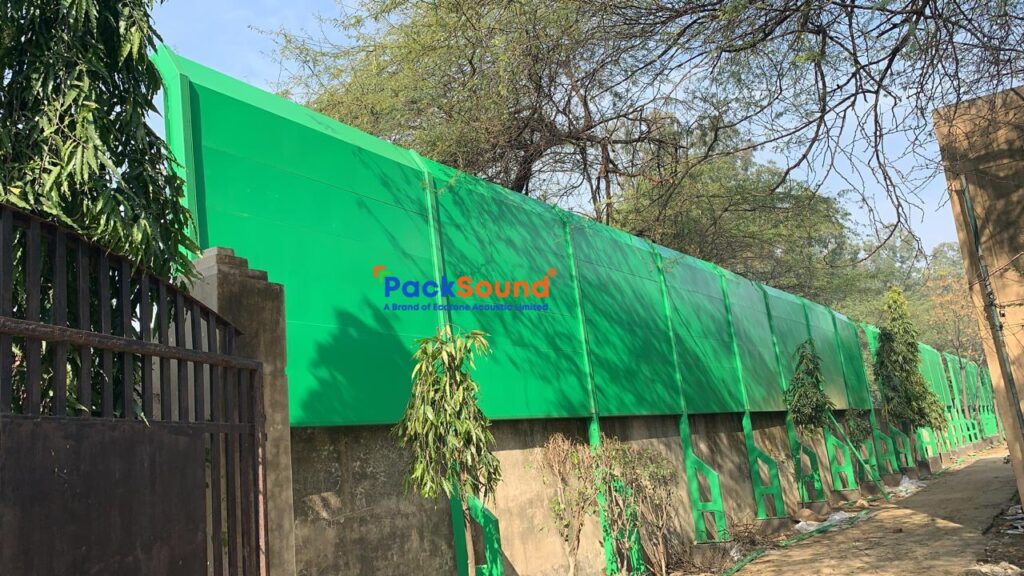
A noise barrier is a solid, sound-blocking wall or panel system placed between a noise source, such as a highway, railway line, or DG set, and the people it affects, so that sound energy is reflected or absorbed instead of reaching homes, hospitals, and schools. It works on a simple physics principle: sound cannot pass through a dense, continuous mass without losing most of its energy, and a barrier tall and long enough to break the direct line of sight between source and receiver can cut perceived noise by roughly half. In India, noise barriers are most visible along elevated highway stretches, metro corridors, and around DG rooms in commercial buildings, where the Central Pollution Control Board enforces ambient noise limits under the Noise Pollution (Regulation and Control) Rules, 2000. Also check: Polycarbonate Noise Barrier.
Ecotone Packsound is a noise barrier manufacturer in India serving highway EPC contractors, NHAI-empanelled consultants, metro rail agencies, factory owners, and residential societies located near arterial roads. If you are specifying a noise barrier on highway medians, boundary walls near a genset yard, or a temporary noise barrier for a construction site, this page is built for that decision: it covers material selection, real acoustic performance data, installation sequencing, and the gap between marketing claims and site reality, based on projects we have executed, not just catalogue promises.
A well-designed noise barrier panel typically reduces perceived noise by 10 to 15 dB at the nearest receiver, which the human ear experiences as roughly a 50 percent drop in loudness. Reduction depends on three site factors more than on the panel brand: barrier height relative to the sightline, barrier length beyond the protected zone, and the gap between panel base and ground. A barrier with even a 50 mm ground gap can lose 3 to 5 dB of its rated performance, which is the single most common installation error we see on Indian highway sites.
| Parameter | Value |
|---|---|
| Panel Material | Galvanized steel or aluminium with acoustic core |
| Sound Transmission Class (STC) | 30 to 40, application dependent |
| Noise Reduction Coefficient (NRC) | Up to 0.95 |
| Panel Thickness | 50 mm to 150 mm |
| Standard Height Range | 2 m to 6 m, custom above on request |
| Operating Temperature | -40°C to +80°C |
| Finish Options | Powder-coated, galvanized, perforated |
| Fixing Type | Modular, free-standing or wall-mounted |
| Feature | Detail |
|---|---|
| Core | Mineral wool or fiberglass acoustic infill |
| Facing | Perforated metal, solid metal, or polycarbonate |
| Panel Width | 500 mm to 1200 mm modular |
| Weight Class | Light (polycarbonate) to heavy (metallic) |
| Colour | RAL shades, custom on request |
| Certification | Tested for STC and NRC per project specification |
| Warranty | Structural and acoustic performance backed |
| Benefit | Why It Matters |
|---|---|
| 10-15 dB Real-World Reduction | Brings sites within CPCB residential/silence zone limits. |
| Weather and UV Resistant | No warping in Indian summer or monsoon cycles. |
| Modular Panel System | Faster replacement without shutting the full stretch. |
| Custom Acoustic Modeling | Right height and density instead of guesswork. |
| Multiple Facing Options | Matches highway, factory, or residential aesthetics. |
| Low Maintenance Design | Fewer site visits over the barrier’s service life. |
| Pan-India Delivery | Consistent supply for multi-location EPC contracts. |
| Application | Typical Use Case |
|---|---|
| Highway and Expressway Medians | Reducing traffic noise for adjacent colonies |
| Railway and Metro Corridors | Protecting buildings near elevated tracks |
| DG Set Enclosures | Meeting CPCB genset noise limits |
| Factory and Industrial Boundary | Containing machine and compressor noise |
| Construction Sites | Temporary mobile noise barrier around active zones |
| Residential Society Perimeter | Blocking arterial road noise from homes |
| Airports and Helipads | Ground-level operational noise containment |
| Step | Action |
|---|---|
| 1 | Site noise survey and source-receiver distance mapping |
| 2 | Acoustic modeling to fix barrier height and density |
| 3 | Foundation or post layout marked per structural design |
| 4 | Posts anchored and checked for vertical alignment |
| 5 | Modular panels fixed with zero ground gap |
| 6 | Joint sealing to remove flanking sound leaks |
| 7 | Post-installation dB check against baseline survey |
Most noise barrier manufacturer pages list features. What actually decides whether a barrier performs on site is the sequence most vendors skip: a baseline dB reading before fabrication, panel selection matched to whether the dominant noise is low-frequency traffic rumble or high-frequency machine whine, and a joint-sealing detail at every panel-to-panel and panel-to-ground junction. We have corrected barriers on live highway stretches where the panel spec was correct on paper but the ground gap alone was erasing 4 dB of rated performance. That is the gap between a noise barrier panel that looks right in a brochure and one that measurably works after handover.
No. They reduce it by 10-15 dB, not to complete silence.
Metallic panels with acoustic core suit highways; polycarbonate suits visibility-critical stretches.
Height depends on sightline between traffic source and nearest receiver.
Reduction is highest on the shielded side, lower on the source side.
STC 30 to 40 is typical for highway and industrial applications.
Quality galvanized or coated panels typically last 15-20 years outdoors.
Yes, even a small gap can leak significant sound underneath.
They give lower but useful reduction for temporary construction sites.
CPCB sets 55 dB day and 45 dB night for residential zones.
Facility managers, EPC contractors, and factory owners near DG sets.
[wpforms id=”7352″]