How Industrial Building Sound Consultants Solve Noise Problems Efficiently
Published by PackSound / Ecotone Acoustic Limited | Industrial Acoustics | March 2026
Walk into almost any large factory in India and the noise hits you before anything else. Heavy presses stamping metal, compressors cycling on and off, ventilation fans screaming overhead, and forklifts beeping through narrow aisles. For the people working in that environment every day, the noise is not just uncomfortable. It chips away at concentration, raises stress hormones, and over years of exposure can permanently damage hearing. For businesses, the consequences go further still: regulatory penalties, higher insurance costs, lower productivity, and a recruitment problem when skilled workers choose quieter workplaces.
This is exactly where industrial building sound consultants come in. These specialists are trained to assess, diagnose, and solve noise problems in industrial buildings using a combination of engineering knowledge, acoustic science, and practical experience. What makes their work interesting is that there is rarely a single correct answer to a noise problem. The solution depends on the source of the noise, how it travels through the building, what standards apply, what the budget allows, and how the building is used. Good consultants navigate all of those variables and arrive at interventions that genuinely work.
This article explains in plain language what industrial sound consultants do, what problems they commonly encounter, which solutions they reach for, and how Indian manufacturers can work with them to create quieter, safer, and more productive workplaces.
What Does an Industrial Building Sound Consultant Actually Do?
The title covers a broad range of work. At one end, a consultant might carry out a one-day noise survey at a plant to establish baseline decibel levels before a regulatory inspection. At the other end, they might be embedded in a project team from the very beginning of a greenfield factory design, shaping everything from the orientation of the building on the plot to the specification of machinery mounts and wall constructions.
Most consultants structure their work in three phases: assessment, design, and verification.
Assessment: Understanding the Noise Environment
Before recommending anything, a competent acoustic consultant needs data. This means visiting the site, walking the floor, and measuring sound pressure levels at multiple locations and times. They use calibrated sound level meters, octave band analysers, and sometimes noise mapping software to build a picture of where noise originates, how loud it is at different frequencies, and how it propagates through the space.
Frequency analysis is particularly important in industrial settings. A machine might produce a level of noise that does not seem extreme on a simple dB(A) reading but contain strong low-frequency components that travel long distances, penetrate walls easily, and cause structural vibration in other parts of the building. Without frequency data, a consultant risks designing a solution that misses the actual problem.
During assessment, consultants also look at how noise reaches workers. Direct airborne paths, reflections from hard surfaces like concrete floors and metal ceilings, and structure-borne vibration transmitted through the building frame are all common mechanisms. Identifying the dominant pathway is essential because the treatment approach differs for each one.
Design: Matching Solutions to Problems
Once the acoustic picture is clear, consultants move into design. This is where the art and the science converge. The goal is to achieve a measurable reduction in noise exposure at the places where people work, in a way that is practical to build, does not disrupt production, and fits within the project budget.
Design work can involve specifying acoustic enclosures around individual machines, recommending changes to building construction such as adding mass to walls or decoupling floor and ceiling layers, laying out quiet rest zones well away from noisy processes, and detailing the acoustic performance required from ventilation systems. Ecotone’s dedicated Acoustic Design and Consultancy service covers exactly this kind of end-to-end design support for industrial clients.
Verification: Confirming the Outcome
A good consultant does not disappear once the design is handed over. Post-construction or post-installation measurement confirms whether the predicted reductions have been achieved and whether workers are now within acceptable exposure limits. Where performance falls short, the consultant investigates why and recommends further measures. This verification stage is also important for demonstrating compliance to regulators and insurers.
The Most Common Noise Problems in Indian Industrial Buildings
Indian manufacturing covers an enormous range of industries, and the noise problems vary accordingly. However, certain patterns come up repeatedly.
High Overall Noise Levels from Heavy Machinery
Metal pressing, forging, stone cutting, textile weaving, and similar operations routinely produce noise levels above 90 dB(A) and in some cases well above 100 dB(A). At these levels, even with hearing protection, the residual risk to workers is significant if exposure is continuous across an eight-hour shift. The Central Pollution Control Board in India sets a daytime limit of 75 dB(A) for industrial zones, a standard that many busy factory floors exceed considerably.
Industrial sound consultants approach this by first identifying whether the noise can be reduced at source through machine enclosures or substitution of quieter equipment, and then by designing barriers and absorptive treatments to reduce reverberant buildup in the room.
Reverberation and Echo in Large Industrial Sheds
Large industrial sheds built with metal cladding, concrete floors, and no acoustic treatment are highly reflective spaces. Sound bounces between hard surfaces many times before it decays, which means that even moderate machinery noise builds up to uncomfortable levels throughout the space. Workers at the far end of a shed may experience similar noise levels to those standing next to the machine because of reflected energy.
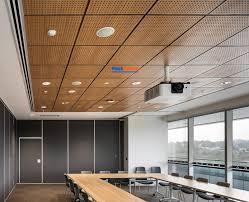
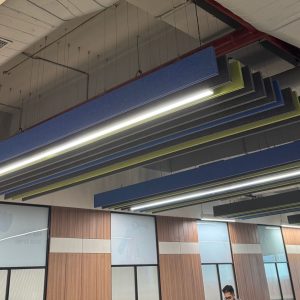
The solution here is almost always some form of sound absorption installed on the ceiling and upper walls. Acoustic baffles and hanging acoustic clouds are particularly well suited to industrial sheds because they do not require a suspended ceiling frame and can be fitted without interrupting production. PackSound’s range of acoustic baffles and acoustic ceiling clouds is designed specifically for high-ceiling industrial and commercial spaces and can make a dramatic difference to reverberant conditions.
Noise Transmitted Between Areas
Many factories have a mix of uses under one roof or in adjacent buildings. A quality control laboratory next to a pressing shop, an office block attached to a foundry, or a canteen separated from a compressor room by a lightweight partition are all situations where noise transmission between spaces is a serious problem. Workers in the quieter area are disturbed and may find concentration impossible.
This is a sound isolation challenge rather than a sound absorption one, and it requires different solutions. Mass, decoupling, and airtight construction are the key principles. Heavy walls with resilient connections to the structure, floating floors, and acoustic doors with proper seals can together achieve substantial reductions in transmitted noise. Ecotone manufactures acoustic wooden doors and a full range of soundproof partitions specifically designed for situations like this, where a high degree of isolation is needed between adjacent areas. PackSound also offers wooden acoustic doors through its Sonicguard range.
Noise from Building Services
Ventilation systems, air compressors, hydraulic power packs, cooling towers, and generators are often treated as an afterthought in industrial building design, but they are frequent sources of complaint. Noise travels through duct systems and emerges at supply or extract grilles in areas far from the plant room. Vibration from fans and compressors travels through pipework and structural connections into walls and floors.
Acoustic consultants specify silencers in ductwork, vibration isolation mounts under plant, flexible connections in pipework, and acoustic enclosures or louvred screens around external plant. These interventions are far cheaper and more effective when built in during initial construction than when retrofitted after complaints arise.
Environmental Noise and Community Impact
Industries located near residential areas face a different set of concerns. Environmental noise that escapes the building and affects neighbours can trigger complaints, enforcement action from State Pollution Control Boards, and reputational damage. Consultants carry out environmental noise assessments to establish what levels are reaching sensitive receptors, model the effect of proposed changes, and design barriers or building envelope upgrades to bring emissions within acceptable limits.
Noise barriers are a recognised and effective tool for managing environmental noise from industrial sites. These can be permanent metallic or composite structures erected along site boundaries, or mobile barriers positioned around specific outdoor operations. Ecotone’s range includes metallic noise barriers, polycarbonate noise barriers, and mobile noise barriers, giving consultants the flexibility to design solutions that match site constraints and operational requirements.
Core Techniques That Industrial Sound Consultants Use
Sound consultants draw on a toolkit that has been refined over decades of acoustic engineering practice. Understanding these techniques helps factory managers engage more productively with their consultants and set realistic expectations.
Source Control: Quieting the Machine Itself
The most effective place to address industrial noise is at the point where it is generated. Consultants look for opportunities to enclose noisy machines in acoustic enclosures lined with absorptive material and sometimes with a mass-loaded inner skin for added isolation. Where enclosure is not practical due to operator access requirements, partial barriers positioned close to the machine can still provide useful attenuation along specific propagation paths.
Vibration damping of panels and machine guards is another source-control technique. Metal panels attached to vibrating machinery radiate noise themselves even if the primary mechanism is quiet. Applying constrained layer damping treatments to these panels reduces their vibration amplitude and therefore the sound they radiate. This is a relatively low-cost modification with surprisingly large benefits in some applications.
Sound Absorption: Reducing Room Buildup
Absorptive treatment changes the acoustics of the space by converting sound energy into heat as it interacts with porous or fibrous materials. The result is a lower reverberant sound level throughout the room, which directly reduces worker exposure even when the noise source itself has not changed.
In industrial buildings the preferred forms of absorption are ceiling-mounted baffles, clouds suspended horizontally, or panels fixed to upper wall areas. These positions intercept reflected energy effectively. The materials used must be durable in industrial environments, resistant to moisture, dust, and in some cases chemicals. Mineral fibre, polyester fibre, and fibreglass products with protective facings are all used depending on the environment.
PackSound manufactures acoustic baffles and ceiling clouds in a range of materials suited to different industrial conditions, from clean manufacturing environments to harsher process industries. Ecotone complements this with mineral fibre clouds and polyester fibre clouds for specific performance requirements.
Sound Isolation: Blocking Transmission Paths
Sound isolation is about preventing sound from travelling from one space to another. The two main mechanisms of transmission are airborne sound passing through walls, floors, and ceilings, and structure-borne sound carried by the building fabric.
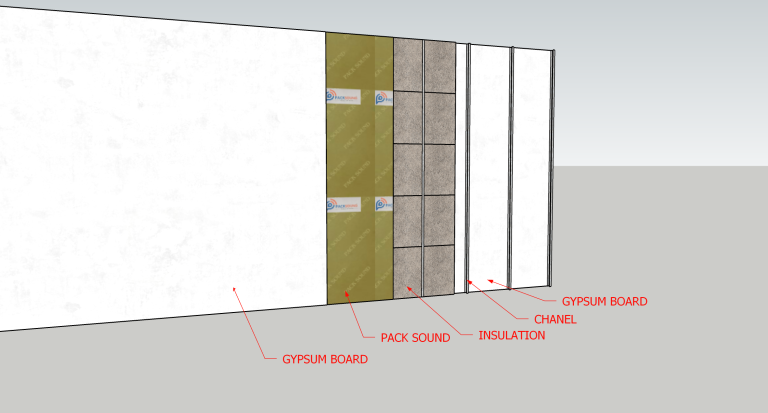
For airborne sound, mass is the primary tool. Heavy constructions such as dense blockwork or double-leaf drywall with a cavity perform better than lightweight alternatives. Airtightness is equally important because sound transmission through gaps and cracks can undermine even a very heavy wall construction. Ecotone’s acoustic sliding folding partitions and movable wall partitions are engineered to deliver meaningful isolation while remaining flexible for changing floor layouts.
Structure-borne sound requires decoupling. A machine bolted directly to a concrete floor transmits vibration into the structure, which then re-radiates as noise in remote parts of the building. Anti-vibration mounts placed under machines break this path. Similarly, floating floor constructions, resiliently mounted ceiling systems, and flexible pipe connections prevent vibration from spreading through the fabric.
Noise Barriers and Screens
Where it is not practical to enclose a source or treat the entire space, screens and acoustic barriers positioned between source and receiver can provide targeted attenuation. The effectiveness of a barrier depends on its height relative to the line of sight between source and receiver, its length, and the acoustic absorbency of its surfaces. A barrier with a reflective surface on both sides can actually increase noise levels for some receivers by scattering sound into areas that would otherwise be in acoustic shadow.
Industrial acoustic barriers are available in a range of forms to suit different needs. Fixed metallic noise barriers with absorptive infill panels are used where a permanent installation is required. Polycarbonate noise barriers allow natural light to pass through, which matters in spaces where daylighting is important. Mobile noise barriers on castors can be repositioned as operations change.
The Regulatory Framework in India That Makes This Work Urgent
Noise control in Indian industry is governed by a combination of occupational health law and environmental legislation. The Factories Act 1948 and its associated rules place a duty on factory occupiers to protect workers from hazardous conditions, including noise. More specifically, the Central Pollution Control Board has established ambient noise standards that set limits for industrial zones, with a daytime limit of 75 dB(A) and a night-time limit of 70 dB(A).
The Noise Pollution (Regulation and Control) Rules 2000 provide the framework for enforcement, and State Pollution Control Boards have the authority to inspect premises and issue directions to comply. Failure to comply can result in fines, directions to shut down noisy operations, or in serious cases, criminal liability for management.
Beyond regulatory compliance, the Bureau of Indian Standards has published guidelines on occupational noise exposure and hearing conservation programmes that responsible employers follow even in the absence of formal regulatory enforcement. Growing awareness among workers of their rights and the long-term health effects of noise exposure means that proactive noise control has become a factor in attracting and retaining skilled employees.
For industries that export to European or North American markets, customer audits sometimes include noise assessments as part of broader health and safety reviews. Meeting international standards is increasingly a commercial requirement as well as a moral one.
How the Consultation Process Works in Practice
Many factory managers are uncertain about how to start working with an acoustic consultant. The process is more straightforward than it might appear.
The first step is usually a brief conversation to describe the problem and the site. From this, the consultant can advise whether a simple noise survey is the right starting point or whether the nature of the problem already points toward a particular type of investigation. Ecotone’s Acoustic Consultant service is structured to make this initial engagement easy, with specialists who understand Indian industrial environments and the regulatory framework they operate within.
A site visit typically takes half a day to a full day depending on the size and complexity of the facility. The consultant will take noise measurements, observe how the building is used, identify problem areas, and discuss the history of the noise issue with site management. This conversation often reveals useful information such as when noise levels changed, which machinery is noisiest, and what workers have noticed.
Following the visit, the consultant prepares a report setting out findings, the applicable noise limits, and recommended measures in order of priority. Good reports include predicted noise reductions for each measure and an indication of cost, so that management can make informed decisions about which interventions to pursue and in what sequence.
Implementation typically involves contractors sourcing and fitting the specified products and constructions. Acoustic consultants may provide detailed specifications and tender documents to ensure that contractors install what was actually designed. Post-installation measurement then closes the loop by confirming performance.
Choosing the Right Products for Industrial Acoustic Solutions
The quality of acoustic products used in an industrial building can make a substantial difference to outcomes. Products that are well engineered and tested to recognised standards will deliver the attenuation values promised by the design, whereas cheaper or poorly specified alternatives may underperform significantly.
For sound absorption in large spaces, products need to balance acoustic performance with physical durability. Mineral fibre baffles and polyester fibre clouds perform well acoustically but have different resistance to moisture and mechanical damage. In food processing or pharmaceutical environments, hygiene ratings matter. In automotive or heavy engineering, robustness and resistance to oil contamination are important.
For partitions and enclosures, the critical specification is Sound Reduction Index (SRI), typically expressed as Rw in weighted form. A partition with Rw 35 will provide around 35 dB of insertion loss under ideal conditions. For meaningful isolation between a noisy manufacturing area and an adjacent office, an Rw of at least 40 to 45 is generally necessary. Acoustic doors need to be specified to match the wall construction; a high-performance wall with a standard hollow-core door will achieve very little overall.
Ecotone Acoustic Limited and PackSound between them offer a comprehensive range of products covering all of these categories, from absorptive ceiling baffles and clouds to acoustic partitions, acoustic doors, and noise barriers. Working with a manufacturer that understands the acoustic requirements of industrial buildings and can provide tested performance data is an important part of ensuring that a consultant’s design translates into a real-world result.
Practical Tips for Factory Managers Dealing with Noise
Not every noise problem requires a full consultancy engagement. Some issues can be addressed quickly with targeted measures. Here are practical starting points.
Identify the noisiest machines and schedule maintenance. Worn bearings, loose guards, and poorly lubricated gears all produce noise in excess of a well-maintained machine. A maintenance programme specifically focused on noise-generating faults can reduce levels without any capital expenditure.
Reorganise the floor layout where possible. Placing the noisiest machines as far as possible from workstations where people spend long periods reduces noise exposure even without treating the source. Creating physical distance between noisy processes and welfare areas is a simple administrative control.
Add absorptive material to bare ceilings. In a reflective industrial shed, adding acoustic baffles or ceiling clouds can reduce reverberation significantly and lower the overall noise level by several decibels. This is often one of the most cost-effective industrial noise control interventions available.
Check door and partition seals. Sound travels easily through gaps. Replacing worn seals on acoustic doors or filling gaps around partitions costs little and can produce meaningful reductions in transmitted noise between areas.
Commission a noise survey before problems escalate. A baseline noise survey establishes current conditions and identifies areas of concern before they become regulatory or legal issues. It also provides a baseline against which the effectiveness of future measures can be measured. Ecotone’s acoustic design and consultancy team can assist with this from day one.
Why Investing in Industrial Acoustic Consultancy Pays Off
The return on investment from industrial noise control is real and measurable. Reduced worker absenteeism and turnover in quieter workplaces have been documented across many industries. Improved communication between workers and between workers and supervisors reduces errors and improves safety. Lower noise levels in quality-sensitive operations such as electronics assembly or precision engineering improve product quality because workers can concentrate more effectively.
There is also a liability dimension. A factory that has a documented history of noise surveys, has taken action on the findings, and has implemented a hearing conservation programme is in a much stronger position if a worker later makes a noise-induced hearing loss claim than one that has ignored the issue. Legal costs and compensation awards for occupational deafness claims can be very significant.
Environmental noise control protects community relationships and the social licence to operate. A factory that generates noise complaints, even if technically within regulatory limits, creates friction with neighbours and local authorities that can complicate future planning applications and expansions.
Finally, the cost of acoustic consultancy is modest relative to the overall capital cost of an industrial facility or a significant machinery investment. Getting the acoustic design right at the start costs far less than retrofitting solutions after a building is occupied and problems have become apparent. As with structural engineering, thermal insulation, or fire safety, acoustic engineering is simply one of the disciplines that a well-designed industrial building needs.
Final Thoughts
Noise is one of the most pervasive and underestimated problems in Indian industrial buildings. It affects health, productivity, regulatory compliance, community relations, and ultimately the long-term viability of operations. Industrial building sound consultants bring the knowledge and methodology to address these problems systematically, from careful assessment of the acoustic environment through to verified, effective solutions.
The range of solutions available today is wider and more affordable than many factory managers realise. Absorptive ceiling treatments, acoustic partitions, noise barriers, vibration isolation, and machine enclosures can all be combined in a coherent programme that moves a noisy facility toward a genuinely comfortable and compliant acoustic environment.
Whether you are planning a new facility and want to get the acoustics right from the start, operating an existing plant where industrial noise is already a concern, or facing regulatory pressure to reduce noise emissions, working with experienced acoustic consultants and sourcing high-quality acoustic products from trusted manufacturers is the most reliable path to a quieter, safer, and more productive workplace.
PackSound and Ecotone Acoustic Limited offer both the specialist acoustic products and the consultancy expertise to support industrial clients at every stage of this journey, from initial assessment through design, product supply, and post-installation verification. Reach out to discuss how these capabilities can be applied to your specific noise challenges.