Call ✆ +91 9809802016 | 9891320678

By PackSound® Acoustic Experts | Updated: March 2026 | 11 min read
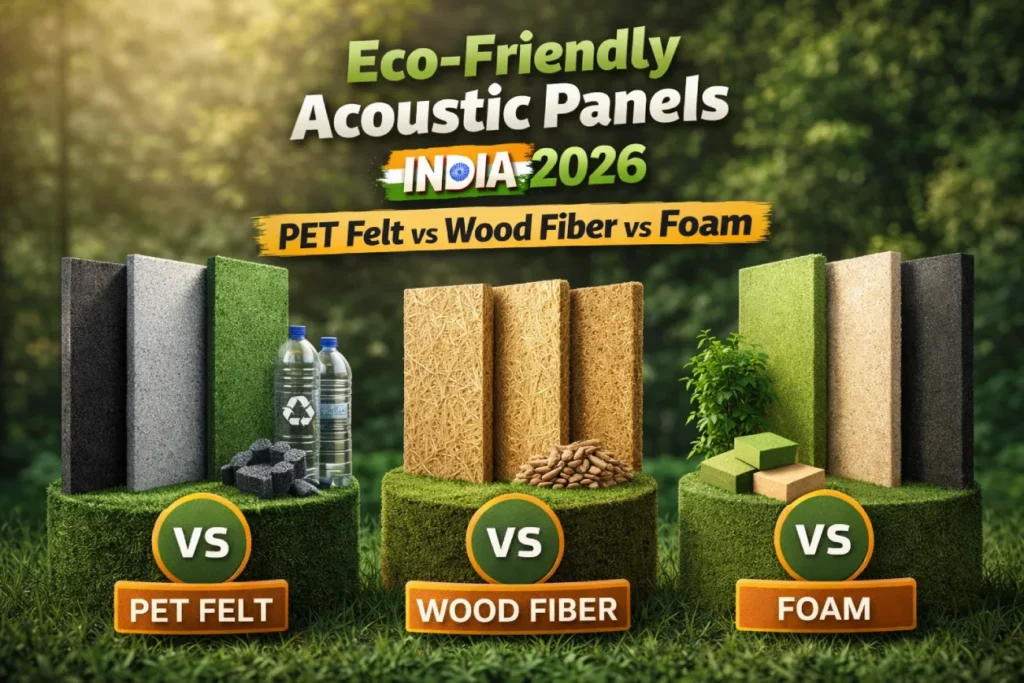
Sustainability is no longer a buzzword in Indian interiors — it is a procurement requirement. Architects, green building consultants, and interior designers across the country are being asked to specify eco-friendly materials that deliver both acoustic performance and environmental responsibility. This guide breaks down the three most popular eco-friendly acoustic panel options — PET Felt, Wood Fiber, and Acoustic Foam — with honest performance data, India-specific durability insights, and a clear recommendation for every use case.
India added over 1,200 GRIHA-rated and LEED-certified buildings in 2024 alone. Government projects under the Smart Cities Mission increasingly mandate sustainable materials. Corporate campuses in Bangalore, Hyderabad, and Pune are under pressure from ESG commitments to reduce their material carbon footprint. Schools and hospitals are seeking healthier indoor environments. And individual homeowners — particularly in metro cities — are making purchasing decisions based on environmental impact in ways that were rare even five years ago.
Acoustic treatment, once specified purely on performance metrics, is now evaluated through a sustainability lens too. The good news: you don’t have to sacrifice performance for eco-credentials. The best eco-friendly acoustic panels in India today match or exceed the performance of conventional alternatives — provided you know which material to choose for which application.
Quick Verdict: For most Indian offices, schools, and green buildings — Wood Fiber panels deliver the best combination of acoustic performance, sustainability, and design versatility. For home studios, content creators, and design-forward spaces — PET Felt panels win on customisation and safety. Foam is best avoided except for very tight budgets with low performance expectations.
Before comparing them, it helps to understand what each material actually is and how it is made — because the manufacturing process is central to the eco-credentials of each option.
PET (Polyethylene Terephthalate) felt acoustic panels are made from recycled plastic bottles. The manufacturing process collects post-consumer PET bottles, shreds them into fibres, and needle-punches those fibres into dense, felt-like sheets. A standard 9mm PET acoustic panel uses approximately 60–90 recycled 500ml plastic bottles per square metre.
The result is a panel that is genuinely eco-friendly in origin, completely safe to handle (no fibreglass irritation, no VOC emissions), lightweight, and available in an exceptional range of colours. PET felt can also be precision laser-cut or CNC-shaped into decorative patterns — making it a favourite among interior designers who want acoustic treatment that functions as wall art.
PackSound’s acoustic wall panels range includes PET felt options available in over 30 colours with custom CNC design capabilities.
Wood fiber acoustic panels are manufactured by bonding natural wood fibres — typically sourced from sustainable forestry or wood manufacturing waste — under high pressure with mineral binders. The resulting panels are dense, breathable, dimensionally stable, and carry a distinctly natural aesthetic that suits both contemporary and traditional Indian interiors.
Unlike foam or synthetic options, wood fiber panels are completely biodegradable at end of life. They are also inherently humidity-resistant — a critical advantage in Indian coastal cities and during monsoon season. Many wood fiber panels carry Forest Stewardship Council (FSC) certification confirming the timber source is responsibly managed.
PackSound’s EchoStop® Grooved Wooden Slat panels represent the premium end of the wood-based acoustic category — combining precision groove design with an absorptive backing for NRC ratings up to 0.95.
Acoustic foam is the oldest and most widely available option in India. It is manufactured from polyurethane or melamine foam through a chemical blowing process — creating open-cell structures that trap and dissipate sound energy. The wedge, pyramid, and egg-crate foam panels widely sold on Indian e-commerce platforms all fall into this category.
From an eco-standpoint, conventional polyurethane foam is petroleum-derived, non-biodegradable, and has a notably higher carbon footprint than both PET and wood fiber alternatives. Some foam variants use recycled content or bio-based inputs, but these remain a minority in the Indian market. The best ecological argument for foam is its low weight (reducing transport emissions) and its low cost enabling acoustic treatment where budgets are severely limited.
This is where material choice matters most — and where foam’s eco-story meets its sharpest limitations.
PET Felt (9–12mm thickness): Achieves NRC ratings of 0.65–0.85 at standard thicknesses. Performs well across mid and high frequencies (500 Hz–4,000 Hz). Thicker PET configurations (25mm+) begin to address lower-mid frequencies. For offices, home studios, podcast setups, and educational spaces, PET felt delivers genuinely professional results. It is not the highest-performing material at equivalent thickness, but the performance-to-aesthetics ratio is hard to beat.
Wood Fiber (15–25mm thickness): Achieves NRC ratings of 0.70–0.95 depending on thickness, density, and whether a grooved or perforated surface pattern is used. Wood fiber panels are particularly effective in the mid-frequency range (250 Hz–2,000 Hz) — which is the most critical band for speech clarity in offices, classrooms, and conference rooms. When paired with an appropriate backing system, as in PackSound’s composite panel systems described on the acoustic wall panels page, wood fiber panels can deliver broad-band absorption across a wide frequency spectrum.
Acoustic Foam (25–50mm thickness): Achieves NRC ratings of 0.40–0.75 depending on profile, thickness, and density. Foam performs best at high frequencies and falls short at low and low-mid frequencies. The cheap foam panels widely available in India (typically 25–32 kg/m³ density) perform significantly below their claimed ratings due to inconsistent manufacturing. At equivalent NRC performance, you need substantially more foam coverage than PET or wood fiber — eliminating the apparent cost advantage.
Winner: Wood Fiber for professional and commercial applications. PET Felt for design-led and home use. Foam is last in this category.
PET Felt: Made from 60–90% post-consumer recycled content (plastic bottles). No VOC emissions. Fully safe for indoor air quality. Can be recycled again at end of life in PET streams. Manufacturing uses significantly less energy than foam production. Carbon footprint per unit of acoustic performance is very low. This is arguably the most genuinely eco-friendly option in terms of material lifecycle.
Wood Fiber: Made from natural, biodegradable fibres, often from FSC-certified sustainable sources or industrial wood waste. Fully biodegradable at end of life. Mineral binders used in quality products are inert and non-toxic. The main environmental caveat is the energy required for high-pressure bonding during manufacture — though this is offset by the long service life (15–20 years) and zero end-of-life impact.
Acoustic Foam: Conventional polyurethane foam is petroleum-derived and non-biodegradable. It releases VOCs during off-gassing in the first weeks after installation — a legitimate indoor air quality concern in schools and healthcare settings. Foam also degrades physically much faster than PET or wood fiber, meaning more frequent replacement and higher lifetime material consumption. Bio-based or recycled foam variants exist but are not yet widely available from Indian suppliers at scale.
Winner: PET Felt on pure environmental metrics. Wood Fiber is a close second. Foam finishes last.
India’s climate — humid summers, monsoon season, coastal salt air, and significant temperature variation — places unusual demands on acoustic materials. This is one area where local knowledge matters enormously.
PET Felt: Performs well in humid conditions. PET fibers do not absorb water, and quality PET panels do not warp, swell, or support mould growth even in coastal environments. Colour fastness is good — panels maintain appearance for 10–12 years in most Indian conditions. Susceptible to physical damage (surface scratching, deformation under point pressure) if not handled carefully.
Wood Fiber: Performs excellently in Indian conditions. The high-pressure manufacturing process and mineral binders create a dimensionally stable panel that resists humidity-driven expansion and contraction. Unlike solid wood products, quality wood fiber panels do not warp during monsoon season. Fire-retardant treatments are available and well-established. Expected service life of 15–20 years in Indian conditions.
Acoustic Foam: Performs poorly in high-humidity Indian environments. Polyurethane foam absorbs moisture, which both reduces acoustic performance and accelerates physical degradation. In coastal cities like Mumbai, Chennai, and Kochi, cheap foam panels often show visible discolouration, surface crumbling, and structural breakdown within 3–5 years. This dramatically increases lifetime cost and material consumption.
Winner: Wood Fiber for long-term durability, with PET Felt a strong second. Foam has the shortest effective lifespan in India.
PET Felt: The clear winner for design flexibility. Available in 30–50 colours depending on supplier, can be CNC-cut into any shape, and is thin enough to be used as wall art panels. Custom printed designs are possible. Increasingly popular in co-working spaces, creative agencies, podcasting studios, and premium residences where the acoustic treatment is meant to be seen and appreciated.
Wood Fiber: Offers a warm, natural aesthetic that works beautifully in contemporary Indian interiors — particularly in the organic, biophilic design trends gaining popularity in premium offices and hospitality. PackSound’s EchoStop® Grooved Wooden Slat panels are available in a variety of wood grains, solid colours, and textured patterns — offering flexibility for both rustic and modern interior schemes. The natural material also carries a perceived premium that fabric and foam cannot replicate.
Acoustic Foam: Strictly functional aesthetics. The wedge and pyramid profiles have become associated with low-budget setups, and increasingly sophisticated clients — even in home studio contexts — are moving away from foam precisely because of its appearance. Limited colour options, and the grey-turning-yellow degradation common after a few years in Indian conditions creates ongoing aesthetic maintenance issues.
Winner: PET Felt for versatility and customisation. Wood Fiber for premium and natural aesthetics. Foam is strictly a utility option.
All three materials can be specified in fire-retardant (FR) grades — but the baseline fire behaviour differs significantly.
PET Felt (FR grade): Quality FR-rated PET panels pass IS 1641 and equivalent standards. The FR treatment is integral to the manufacturing process in premium products, not a surface coating. Behaves as self-extinguishing under standard test conditions.
Wood Fiber: Inherently better fire resistance than foam due to the density and mineral content of the panels. FR-treated wood fiber panels achieve excellent ratings and are widely specified in CPWD, PWD, and NBC-compliant projects in India.
Acoustic Foam: Standard polyurethane foam is highly flammable and produces toxic smoke when burned — a serious safety concern in occupied spaces. FR-treated foam grades exist but the FR coating is typically a surface treatment that degrades over time. For any commercial, institutional, or rented space in India, non-FR foam is genuinely dangerous and should not be specified.
Always request and verify IS-compliant fire certification before installation in any commercial or public space. PackSound’s full range of acoustic sound panels covers fire-rated options across all material types.
Winner: Wood Fiber on baseline safety. PET Felt (FR grade) is excellent. Standard foam should never be used in commercial spaces.
Panel Type | Thickness | NRC Range | Price per Sq Ft (INR) | Lifespan (India) |
|---|---|---|---|---|
Acoustic Foam (standard) | 25–50mm | 0.40–0.65 | ₹150–₹400 | 3–5 years |
Acoustic Foam (premium/FR) | 50mm | 0.60–0.75 | ₹350–₹700 | 5–7 years |
PET Felt (9mm) | 9mm | 0.65–0.75 | ₹400–₹700 | 10–12 years |
PET Felt (thick/custom) | 20–25mm | 0.75–0.85 | ₹700–₹1,200 | 10–12 years |
Wood Fiber (standard) | 15–20mm | 0.70–0.85 | ₹900–₹1,800 | 15–20 years |
Wood Fiber (grooved/premium) | 20–25mm | 0.85–0.95 | ₹1,800–₹4,500 | 15–20 years |
Lifetime cost reality check: At ₹300/sq ft, cheap foam replaced every 4 years costs ₹750/sq ft over 10 years. Quality PET felt at ₹600/sq ft lasting 10 years costs exactly ₹600/sq ft. Wood fiber at ₹1,200/sq ft lasting 20 years costs ₹600/sq ft over the same period. The “cheaper” option is often the most expensive choice.
Choose: PET Felt (thick grade) or Wood Fiber
PET felt in 20–25mm thickness delivers sufficient NRC for home studio walls and is available in colours that look professional on camera. For larger professional studios, wood fiber panels — particularly in grooved configurations — deliver the high NRC ratings and broadband performance that critical listening requires. Read our complete guide to best acoustic panels for recording studios in India 2026 for detailed studio-specific advice.
Choose: PET Felt or Wood Fiber
Both work extremely well. PET felt panels in custom brand colours are increasingly popular in creative agency and tech company offices — they solve acoustics while reinforcing brand identity. Wood fiber panels suit law firms, financial institutions, and premium offices where a more formal, natural aesthetic is preferred. For comprehensive office acoustic guidance, the acoustic sound panels guide covers open-plan, meeting room, and phone booth applications.
Choose: Wood Fiber (FR-rated)
Speech clarity is the primary acoustic goal in classrooms, and wood fiber panels in the 15–20mm range deliver NRC 0.75–0.85 — ideal for reducing reverberation to the 0.4–0.6 second RT60 range recommended for learning environments. FR certification is mandatory for school procurement in most Indian states, and wood fiber panels carry strong credentials here.
Choose: Wood Fiber (grooved/premium) or Composite
The hospitality sector demands materials that look as good as they perform. PackSound’s EchoStop® Grooved Wooden Slat panels are designed precisely for this application — as demonstrated in projects like the Hyatt Regency Bhikaji Cama Place installation in Delhi, where aesthetic integration was as critical as acoustic performance.
Choose: PET Felt (decorative) or Wood Fiber
Home theater acoustic treatment benefits from the NRC performance of wood fiber for critical listening, with PET felt accent panels for visual interest and colour. For spaces where the acoustic treatment is part of the interior design story, EchoStop® Micro Perforated Panels offer an almost invisible acoustic solution that preserves the visual integrity of premium interiors.
Choose: PET Felt (highest recycled content) or FSC-certified Wood Fiber
Both materials contribute to Indoor Environmental Quality credits under LEED and GRIHA rating systems. PET felt with documented post-consumer recycled content contributes to Materials & Resources credits. FSC-certified wood fiber panels contribute to Sustainable Sourcing credits. Request Environmental Product Declarations (EPDs) and certification documentation from your supplier — PackSound provides these for specified products on request.
Getting the right eco credentials requires asking the right questions before you purchase. Here is what to verify:
PackSound manufactures and supplies all three eco-friendly panel categories from our facility in Greater Noida, serving projects across pan-India. Our eco-friendly range includes:
EchoStop® PET Felt Panels — Made from post-consumer recycled PET fibres. Available in 30+ colours, standard and CNC-cut shapes, FR-rated options. NRC 0.65–0.85. Ideal for offices, studios, homes, and educational spaces.
EchoStop® Wood Fiber Panels — Natural wood fiber bonded under high pressure. FSC-sourced options available. FR-rated. NRC 0.70–0.95 depending on thickness and configuration. Suitable for all commercial, institutional, and hospitality applications.
EchoStop® Grooved Wooden Slat Panels — Premium wood-based architectural panels combining acoustic performance with high design. NRC up to 0.95 with backing. Available in a wide range of wood grain, solid colour, and textured finishes. View the full grooved wooden slat range →
Composite Panels — Combining PET + wood + fabric layers for wide-band absorption, diffusion, and insulation in a single panel. Ideal for premium offices, multipurpose halls, and industrial sites. Explore all acoustic wall panels →
Every PackSound eco-friendly panel comes with: – Third-party NRC test reports (ARAI-certified) – Fire-retardant certification as per Indian standards – Humidity-resistant construction for Indian climate conditions – Free acoustic consultation and layout planning – Professional turnkey installation across India
Q: Are PET felt panels actually eco-friendly or is it just marketing?
Genuinely eco-friendly when sourced from verified suppliers with documented recycled content. A standard 9mm PET felt panel from PackSound uses 60–80 post-consumer PET bottles per square metre, with no VOC emissions and no fibre health hazards. Always ask for the recycled content certification — some budget suppliers blend fresh PET to reduce cost.
Q: Can wood fiber panels be used outdoors or in semi-outdoor spaces in India?
Standard wood fiber panels are not rated for exterior use. However, PackSound’s composite panel systems can be configured for sheltered semi-outdoor applications such as covered verandas, parking structures, and open-sided buildings. Contact our team for site-specific advice.
Q: Do eco-friendly panels cost more than conventional options?
PET felt is price-competitive with conventional fabric-wrapped panels. Wood fiber carries a modest premium over synthetic alternatives but delivers significantly longer service life — resulting in lower total cost of ownership. Foam is cheapest to buy and most expensive to own.
Q: Are these panels suitable for LEED-certified projects in India?
Yes. PackSound can provide Environmental Product Declarations (EPDs), recycled content documentation, and FSC chain-of-custody certificates for LEED, GRIHA, and IGBC project submissions. Specify this requirement when requesting a consultation.
Q: What is the minimum order quantity for custom PET felt colours or shapes?
PackSound accepts custom colour and shape orders from a minimum of 50 square feet for PET felt. Custom printed panels have a higher minimum. Contact our team for a quote.
There is no single “best” eco-friendly acoustic panel — the right choice depends on your application, budget, climate zone, and aesthetic requirements. But here is a straightforward decision rule that works for most Indian projects:
Choose PET Felt when: design flexibility, colour customisation, safety in occupied spaces, or a LEED recycled-content contribution is the priority. Best for offices, home studios, podcast setups, schools, and healthcare.
Choose Wood Fiber when: maximum NRC performance, premium aesthetics, long-term durability in a humid climate, or biodegradability at end-of-life is the priority. Best for auditoriums, hospitality, recording studios, conference rooms, and green buildings.
Avoid standard foam when: the space is commercial, rented, or used by people who are not you. The fire safety risk, short lifespan, and poor performance in Indian humidity conditions make it a false economy in almost every real-world application.
If you are unsure which material is right for your specific project, PackSound’s acoustic consultants will assess your space, climate zone, budget, and certification requirements — and recommend a solution that performs, lasts, and meets your sustainability goals.
Ready to specify eco-friendly acoustic panels for your next project? PackSound provides free acoustic consultations for architects, interior designers, and project owners across India. Get your material samples, NRC data sheets, and EPD documentation today.
 Call/WhatsApp: +91 980 980 2016
 Email: Sales@packsound.in
 Explore our full range: packsound.in/acoustic-wall-panels/
PackSound® (a brand of Ecotone Acoustic Limited) is a Made-in-India acoustic solutions manufacturer based in Greater Noida, Uttar Pradesh. We have delivered acoustic solutions across 500+ projects in India including corporate offices, recording studios, schools, hospitals, luxury hotels, and government buildings. All panels are NRC-certified, fire-retardant tested, and backed by professional installation services pan-India.


