Call ✆ +91 9809802016 | 9891320678

If you’ve spent any time researching acoustic panels for your office, school, auditorium, or home — you’ve almost certainly run into three names: PET Felt, Wood Fiber, and Acoustic Foam. All three are marketed as “eco-friendly.” All three claim excellent sound absorption. And all three are available in India at wildly varying price points.
So which one should you actually specify?
This guide breaks it down completely — material science, acoustic performance data, India-specific durability considerations, green building compliance, cost analysis, and real use-case recommendations. By the end, you’ll know exactly which material works for your project and why.
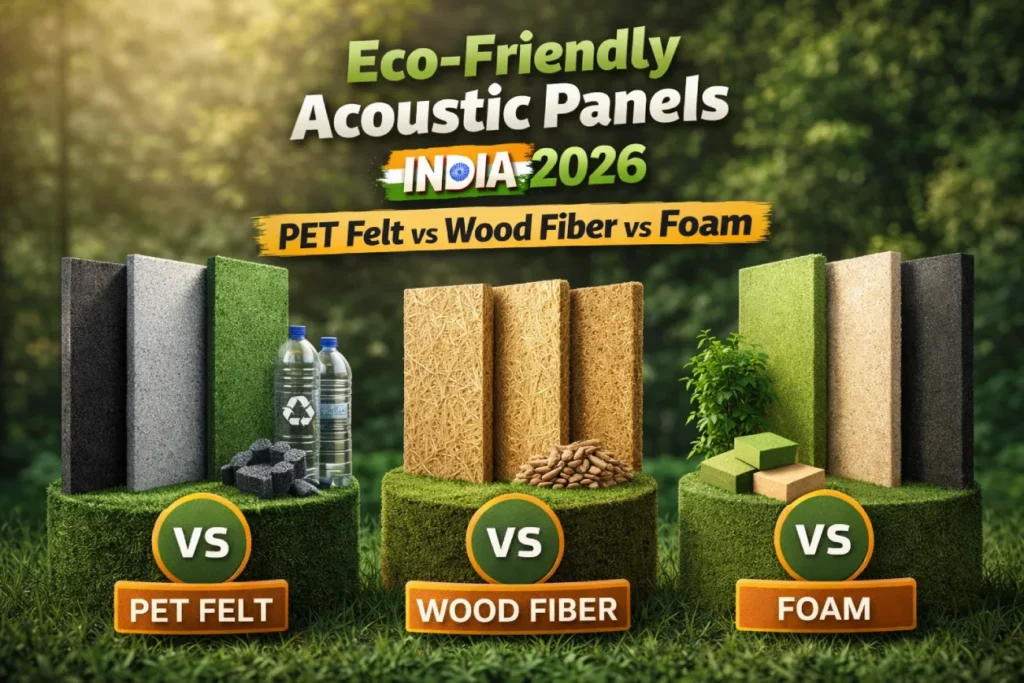
Quick verdict: For most Indian offices, auditoriums, schools, and green buildings — Wood Fiber panels deliver the best combination of acoustic performance, structural durability, and environmental credentials. For creative studios, podcast rooms, and design-forward interiors — PET Felt wins on customisation, safety, and circular economy credentials. Foam is a budget stopgap, not a long-term acoustic strategy.
India added over 1,200 GRIHA-rated and LEED-certified buildings in 2024 alone. Government projects under the Smart Cities Mission increasingly mandate sustainable materials. Corporate campuses in Bengaluru, Hyderabad, Pune, and the NCR are under direct ESG pressure to reduce material carbon footprints. Schools and hospitals across tier-2 cities are now specifying healthier indoor environments as a baseline.
This isn’t a passing trend. It’s a fundamental shift in how Indian architects, interior designers, and facility managers are thinking about material selection — and acoustic panels sit right at the intersection of indoor air quality, occupant wellbeing, and sustainable design.
The problem is that the market is flooded with products claiming eco-credentials that don’t hold up under scrutiny. Foam panels sold as “green” often contain polyurethane — a petroleum-derived, non-biodegradable material that off-gasses VOCs over time. PET felt panels vary enormously in recycled content, from genuine 80%+ post-consumer material to panels with barely 30% recycled input. Wood fiber panels range from FSC-certified, responsibly sourced products to composite boards with questionable binder chemistry.
At PackSound®, we manufacture and install acoustic solutions across India — from the Assam Rifles Auditorium in Shillong to Nalanda University in Bihar and Hyatt Regency in Delhi. We’ve seen how these materials perform in real Indian conditions — the monsoon humidity of coastal cities, the dry desert air of Rajasthan, the temperature swings of North India. That experience is what this guide is built on.
Before comparing performance, it helps to understand exactly what each material is — because the manufacturing process is central to the ecological story.
PET acoustic panels are made from recycled plastic bottles. The manufacturing process collects post-consumer PET bottles, shreds them into fibres, and needle-punches those fibres into dense, felt-like sheets under controlled heat. No adhesives. No chemical binders. The entire process is physical, not chemical.
A standard 9mm PET acoustic panel uses approximately 60 to 90 recycled 500ml plastic bottles per square metre. Premium-grade panels push this to 150+ bottles per square metre for greater density and performance.
What you get is a material that feels soft and textile-like, comes in virtually any colour, can be CNC-cut into intricate geometric shapes, and is genuinely safe to handle without gloves or protective equipment. PET felt is non-toxic, non-allergenic, and carries no VOC emissions — an important consideration for schools, childcare centres, and hospitals.
PackSound’s EchoStop® CNC PET Panel takes this material to its design peak — precision laser and CNC-cut geometries that double as decorative wall art while delivering professional acoustic performance.
Wood fiber acoustic panels are manufactured by bonding natural wood fibres — typically sourced from sustainable forestry waste or wood manufacturing offcuts — under high pressure with mineral binders, most commonly Portland cement or magnesium oxide. The result is a dense, rigid panel with a visually warm, distinctly natural texture.
Unlike synthetic alternatives, wood fiber panels are fully biodegradable at end of life. They are inherently resistant to humidity — a critical advantage in Indian coastal cities like Mumbai, Chennai, Kochi, and Visakhapatnam during monsoon season. Many premium wood fiber panels carry Forest Stewardship Council (FSC) certification, confirming the timber source is responsibly managed.
Wood fiber panels have an outstanding fire profile — the cement or mineral binder makes them Class A non-combustible, meeting the strictest fire safety specifications for auditoriums, hospitals, and public buildings.
PackSound’s Grooved Wooden Slat panels and Wooden Fiber Acoustic Panels via Ecotone represent the full range of wood-based acoustic options — from budget-conscious educational installations to premium auditorium finishes.
Conventional acoustic foam is manufactured from polyurethane — a petroleum-derived synthetic polymer. It is lightweight, inexpensive, and widely available. It also has the weakest ecological profile of the three, being non-biodegradable and often containing chemical flame retardants that off-gas over time.
Melamine foam is a step up — it is non-combustible and has a lighter environmental footprint than polyurethane — but it remains a synthetic, petroleum-based material that ends up in landfill at end of life.
The best ecological argument for foam is its very low weight, which reduces transport emissions, and its low cost, which enables acoustic treatment where budgets are severely constrained. But it is not, by any honest measure, a sustainable long-term material choice.
PackSound’s perspective: we stock and supply acoustic foam solutions for budget-constrained projects where performance expectations are modest. But we always recommend clients consider the total lifecycle cost before defaulting to foam.
Let’s cut through marketing language and look at real performance data.
NRC (Noise Reduction Coefficient) measures a material’s ability to absorb sound on a scale from 0 (total reflection) to 1.0 (total absorption). In practice, anything above 0.70 is considered high-performance for commercial use.
PET Felt (9–12mm standard thickness): NRC 0.65–0.85 depending on installation method. At 25mm+ thickness, PET felt begins to address lower-mid frequencies and can achieve NRC 0.80–0.95 with an air gap behind the panel.
Wood Fiber Panels (25–50mm thickness): NRC 0.70–0.95. Wood fiber excels across a broader frequency range than PET felt at equivalent thicknesses, with particularly strong performance in the low-to-mid frequency bands where most HVAC noise, speech, and music energy concentrates.
Acoustic Foam (25–50mm standard): NRC 0.65–0.85 for quality open-cell polyurethane. Melamine foam achieves NRC 0.95+ at 50mm thickness — impressive numbers, but the material degrades over time in humidity, UV exposure, and high-traffic environments.
PET felt delivers exceptional mid and high frequency absorption — precisely the frequency range where human speech (250Hz–4,000Hz) concentrates. This makes it ideal for offices, podcast studios, conference rooms, and educational spaces where speech clarity is the primary concern.
Wood fiber panels provide broad-spectrum absorption, handling low, mid, and high frequencies effectively. This makes them the preferred choice for auditoriums, concert halls, cinema halls, and spaces where music or complex sound environments need full-spectrum control.
Foam performs adequately across mid frequencies but tends to be less consistent across the full spectrum and deteriorates more quickly than either PET or wood fiber alternatives.
One thing that most comparison guides overlook: how you install a panel dramatically changes its performance. An air gap of just 50–100mm behind any acoustic panel can boost its low-frequency absorption significantly. PackSound’s acoustic engineers always account for installation depth when designing room treatments — it’s why our acoustic consultation service is essential for any serious acoustic project.
PET felt has a notable advantage here: it converts post-consumer waste (plastic bottles) into a useful material, avoiding both landfill disposal costs and virgin material extraction. The manufacturing process is entirely physical — no chemical waste streams, no hazardous emissions.
Wood fiber panels source material from wood manufacturing waste or sustainably certified forests. When cement-bonded, the carbon embedded in the wood fibres is effectively sequestered within the panel for its entire lifespan (typically 30–50 years in commercial use). At end of life, certified wood fiber panels are biodegradable.
Foam carries the heaviest carbon footprint of the three: polyurethane production is energy-intensive, petroleum-derived, and generates chemical waste streams. Even “eco-foam” variants using recycled or bio-based inputs remain a minority in the Indian market.
This is increasingly relevant as more Indian projects target LEED, IGBC, or GRIHA ratings.
PET Felt: Contributes LEED credits under Materials & Resources (recycled content), Indoor Environmental Quality (low VOC), and Innovation categories. EU REACH-compliant. GREENGUARD eligible.
Wood Fiber: Contributes LEED credits under Materials & Resources (FSC-certified wood), Indoor Environmental Quality, and Regional Materials categories when sourced from Indian or South Asian timber operations. Carries EPD (Environmental Product Declaration) certification in premium variants.
Foam: Limited LEED contribution. Polyurethane foam can actually negatively impact Indoor Environmental Quality scores due to VOC emissions. Melamine foam performs better but still lacks the circular economy credentials of PET or wood fiber.
PET felt is recyclable — it can be reprocessed into new PET products at end of life. Wood fiber panels are biodegradable. Foam, in most commercial configurations, goes to landfill.
For projects with serious sustainability commitments — corporate ESG requirements, LEED Platinum targets, government green building mandates — PET felt and wood fiber are the only defensible long-term choices.
This is where most internationally-sourced acoustic guides fall short. India’s climate is not uniform — and the material you specify for a Mumbai office building will need to perform very differently from one in Delhi or Ahmedabad.
PET felt: Excellent moisture resistance. The polymer fibres do not absorb water, which means no mold growth, no swelling, no delamination. PET felt panels installed in coastal offices in Chennai and Kochi have performed without degradation for 8+ years in PackSound projects.
Wood fiber: Inherently humidity-resistant due to the mineral binder matrix. Premium cement-bonded wood fiber panels are used extensively in humid tropical climates worldwide. However, untreated or poorly bonded wood fiber panels can show surface mottling over time in very high humidity environments. Always specify mineral-bonded (not resin-bonded) wood fiber for coastal Indian applications.
Foam: Polyurethane foam is the most vulnerable to humidity. In Indian conditions — particularly in the monsoon season and in poorly ventilated spaces — foam panels can develop mold on their surfaces and within their cell structure. This is not just an aesthetic problem; mold-contaminated foam can degrade indoor air quality. This alone should give facility managers serious pause before specifying foam in tropical Indian climates.
All three materials perform adequately across Indian temperature ranges. PET felt has the best dimensional stability — it doesn’t expand or contract meaningfully with temperature changes, making it reliable in spaces with aggressive air conditioning cycles.
PET felt is robust enough for public spaces — it resists surface abrasion, doesn’t crumble or shed fibres, and maintains its appearance over years of use. Wood fiber panels, being rigid and cement-bonded, are the most physically durable of the three — they can be painted, cleaned with damp cloths, and resist impact far better than either PET felt or foam.
Foam is the most fragile. It is not appropriate for corridors, reception areas, or any space where physical contact with the panels is likely.
Architecture in India has undergone a design revolution. The days of purely functional acoustic treatment — grey foam tiles stuck to a wall — are finished. Today’s architects and interior designers expect acoustic materials to be part of the spatial composition, not an afterthought.
PET felt is available in virtually unlimited colours — from subtle naturals to bold, saturated hues. It can be CNC-cut into any shape: geometric patterns, biophilic leaf motifs, brand logos, custom artwork. It is lightweight enough to be suspended as ceiling baffles or acoustic clouds. It can be layered and combined to create textured wall compositions.
PackSound’s Auraluxe® 3D Wall Panels take this concept further — combining PET felt with three-dimensional structural forms for installations that read as sculpture before they read as acoustic treatment.
For home theatres, podcast studios, premium corporate boardrooms, and hospitality interiors where the acoustic treatment needs to be invisible or beautiful, PET felt is the right choice. Explore PackSound’s home theatre soundproofing guide to understand how PET felt integrates into complete room treatment systems.
Wood fiber panels carry a visual warmth that no synthetic material can fully replicate. The natural texture — varying from smooth to rustic depending on fibre size and treatment — reads as premium in auditoriums, educational institutions, and corporate environments where design credibility matters.
Grooved Wooden Slat panels — a subcategory of wood-based acoustic treatment — combine linear wood aesthetics with outstanding acoustic absorption, delivering the biophilic design quality that is increasingly specified in wellness-forward Indian workplaces and hospitality projects.
The Composite Acoustic Panels and Perforated Panels in PackSound’s wall panel range bridge wood and engineered surfaces for applications where both performance and visual refinement are non-negotiable.
There’s no diplomatic way to say this. Foam is acoustically functional in controlled environments but aesthetically limited. The characteristic wedge or pyramid surface texture, the neutral colours, the soft edges — none of this is appropriate for client-facing commercial spaces or premium residential projects. Foam belongs in recording booths, broadcast rooms, and technical spaces where aesthetics are secondary to performance.
Sustainable doesn’t have to mean expensive. But it does mean understanding the full lifecycle cost, not just the purchase price.
Acoustic Foam (25–50mm): ₹150–400 per sq ft installed. Lowest upfront cost but highest replacement frequency.
PET Felt Panels (9–12mm standard): ₹250–600 per sq ft installed, depending on colour, custom cutting, and design complexity. CNC-cut premium designs can reach ₹800–1,200 per sq ft.
Wood Fiber Panels (25–50mm): ₹300–800 per sq ft installed. Cement-bonded premium panels with FSC certification and painted finishes sit at the higher end. Grooved wooden slat systems can reach ₹1,000–1,800 per sq ft for architect-specified installations.
Foam panels typically need replacement every 5–8 years in Indian conditions, particularly in humid regions. Factor in replacement costs and the lifecycle economics shift dramatically — foam becomes the most expensive option over a 15-year building lifecycle.
PET felt panels, when properly installed, maintain performance and appearance for 15–20 years. Wood fiber panels, being mineral-bonded rigid boards, have design lives of 25–40 years — comparable to the building itself.
For any commercial project with a 15+ year occupancy expectation, the total cost of ownership strongly favours PET felt or wood fiber over foam.
After 25+ years of acoustic manufacturing and 1,900+ completed projects across India and internationally, here is PackSound’s honest recommendation by space type.
Winner: PET Felt. Speech clarity in open-plan offices is primarily a mid and high-frequency challenge — exactly where PET felt excels. The colour flexibility allows acoustic treatment to integrate with brand identities. The lightweight panels are easy to reconfigure as office layouts evolve. For open-plan offices with glass partitions and hard concrete floors, target 25–35% surface coverage with PET felt panels on walls and overhead baffles on ceilings.
PackSound’s AcoFascia® Acoustic Partitions paired with EchoStop® PET panels delivers a complete office acoustic solution. Our ThinkPod® Acoustic Office Pods — as installed at Pfizer’s Visakhapatnam facility — add private work zones within open-plan environments without permanent construction.
Winner: Wood Fiber (with composite PET applications). Auditorium acoustics demand full-spectrum performance — from the low-frequency rumble of orchestral bass to the high-frequency sparkle of vocal harmonics. Wood fiber panels, combined with fabric-wrapped bass absorbers and diffusers, deliver the most complete acoustic environment for performance use. Fire safety requirements for public assembly buildings make mineral-bonded wood fiber’s Class A non-combustible rating essential.
PackSound has treated auditoriums at Nalanda University, the Assam Rifles complex in Shillong, and BAPS Swaminarayan Mandir in Ahmedabad — each requiring precise full-spectrum acoustic design.
Winner: Wood Fiber for classrooms, PET Felt for activity spaces. Classrooms need durable, washable, non-toxic acoustic panels that reduce reverberation for speech intelligibility. Wood fiber panels are wipeable, non-allergenic, and dimensionally stable — perfect for Kerala or Mumbai schools where monsoon humidity is a real concern. For art rooms, music practice rooms, and common areas where colour and creativity matter, PET felt’s design flexibility is unmatched.
Winner: PET Felt (supplemented with foam bass traps in budget applications). Mid and high-frequency absorption is the primary need. PET felt’s NRC performance in the speech frequency range is exceptional. For professional broadcast and recording environments, PackSound’s fabric-wrapped acoustic panels with specialist absorptive fill deliver the precise absorption coefficients required. See our dedicated guide on acoustic panels for recording studios in India.
Winner: Wood Fiber and Composite Panels. Hospitality spaces demand acoustic panels that look premium, are easy to maintain, and can withstand years of cleaning and physical use. Wood fiber panels with painted or veneer finishes meet hotel brand standards while delivering real acoustic performance. Sliding and folding acoustic partitions are the go-to solution for banquet halls that need to divide large spaces — as PackSound installed at Hyatt Regency Bhikaji Cama Place and Crowne Plaza Gurgaon.
Winner: PET Felt for walls, with consideration for composite wood systems in dedicated theatres. Home theatres in India are increasingly sophisticated. PET felt’s safety profile (non-toxic, no VOCs, safe for family environments), combined with its design flexibility, makes it the ideal choice for residential acoustic treatment. For truly dedicated cinema rooms, a combination of PET felt wall panels, fabric-wrapped bass absorbers, and ceiling acoustic clouds — as detailed in PackSound’s home theatre soundproofing guide for India — delivers the immersive experience audiophiles demand.
| Criterion | PET Felt | Wood Fiber | Acoustic Foam |
|---|---|---|---|
| Eco-Credentials | ★★★★★ (recycled bottles, zero VOC) | ★★★★☆ (FSC wood, biodegradable) | ★★☆☆☆ (petroleum-based) |
| NRC Performance | 0.65–0.95 | 0.70–0.95 | 0.65–0.95 |
| Frequency Range | Mid–High | Full Spectrum | Mid–High |
| Humidity Resistance | Excellent | Very Good | Poor |
| Fire Safety | Good (inherent) | Excellent (Class A) | Variable |
| Design Flexibility | Exceptional | Good | Limited |
| Durability (India) | 15–20 years | 25–40 years | 5–8 years |
| LEED / IGBC Compatibility | ★★★★★ | ★★★★☆ | ★★☆☆☆ |
| Best For | Offices, Studios, Homes | Auditoriums, Schools, Hospitality | Budget/Technical spaces |
At PackSound, sustainability isn’t a product category — it’s a design philosophy that runs through every project we touch.
Our acoustic wall panels range spans the full spectrum from PET felt to grooved wooden slats to composite and perforated systems — because we believe the right material for any project is the one that performs best in that specific environment, with those specific users, under those specific conditions.
Our ceiling acoustic range — from FeatherLite tiles to acoustic clouds and baffles — includes certified eco-friendly options across every category.
Every significant project begins with an acoustic consultation — we measure the space, model the acoustic environment digitally using RT60 analysis and 3D simulation, and specify materials based on actual performance requirements. This means you never pay for overspecified materials, and you never end up with underperforming ones.
Our parent brand Ecotone Acoustic Limited also supplies wooden fiber acoustic panels and fabric-wrapped acoustic panels with full sustainability certification for projects requiring documented environmental credentials.
Can I mix PET felt and wood fiber panels in the same space? Absolutely — and it’s often the best approach. Many of PackSound’s premium auditorium and corporate projects combine wood fiber panels for structural wall surfaces with PET felt clouds and baffles for ceiling treatment. The materials complement each other acoustically and aesthetically.
Are these panels safe for use around children? PET felt is the safest option for children’s environments — it is non-toxic, contains no formaldehyde, carries no sharp edges, and can be safely handled without protective equipment. Wood fiber panels (mineral-bonded) are also safe for educational environments. Avoid foam in children’s spaces where physical contact with panels is likely.
Do PackSound panels meet green building certification requirements? Yes. PackSound’s PET felt and wood fiber panels can contribute to LEED, IGBC, and GRIHA certification submissions under Materials & Resources and Indoor Environmental Quality categories. Speak to our acoustic consultants for specific certification support.
What is the minimum order for custom panels? PackSound offers custom sizing, colour, and CNC cutting from relatively modest quantities for most panel types. Contact our sales team at Sales@packsound.in or call +91 980 980 2016 for a detailed quotation.
How do I know how much acoustic treatment my space needs? Coverage requirements depend on room volume, ceiling height, surface materials, and intended use. Our acoustic engineers use RT60 (reverberation time) targets to calculate precise coverage requirements. A free consultation covers the basics — and for larger projects, our 3D acoustic modelling service ensures every specification is backed by simulation data.
The eco-friendly acoustic panel market in India is maturing rapidly. Buyers are smarter, specifications are tighter, and greenwashing is increasingly easy to spot. The three materials covered in this guide — PET Felt, Wood Fiber, and Acoustic Foam — are genuinely different in their ecological profiles, acoustic performance, durability, and design potential.
PET felt is the most versatile, most design-flexible, and most credibly eco-friendly option for most interior applications. Wood fiber is the strongest all-round performer for large public spaces, auditoriums, and high-humidity environments. Foam is a legitimate cost-driven option for technical and budget applications — but should not be specified where longevity, aesthetics, or serious green building credentials are required.
Whatever your project — a corporate campus in Gurugram, a university auditorium in Bihar, a hotel banquet hall in Hyderabad, or a home theatre in Bengaluru — PackSound has the right acoustic solution, the manufacturing capability, and the installation expertise to deliver results that genuinely perform.
Ready to find the right acoustic panel for your space?
Get a free acoustic consultation from India’s most trusted acoustic manufacturer.
 +91 980 980 2016 | +91 9990 858 797
  Sales@packsound.in
  packsound.in | ecotone.co.in
 A-719, Tower 3, NX One, Techzone IV, Greater Noida West, UP 201306
PackSound® is a brand of Ecotone Acoustic Limited — India’s leading acoustic products manufacturer with 1,900+ completed projects, 25+ years of acoustic excellence, and 1.5 crore sq ft of acoustic treatment installed across India and internationally.
Related Reading:


