Call ✆ +91 9809802016 | 9891320678

When you have been looking into ceiling acoustic treatment, you have almost certainly come across these two options sitting side by side on every product page and specification guide. Acoustic clouds and acoustic baffles are both suspended from the ceiling, both made from sound-absorbing materials, and both designed to do the same fundamental job: reduce reverberation and make a space easier to communicate in. So why are they two different products? And more importantly, which one is right for your project?
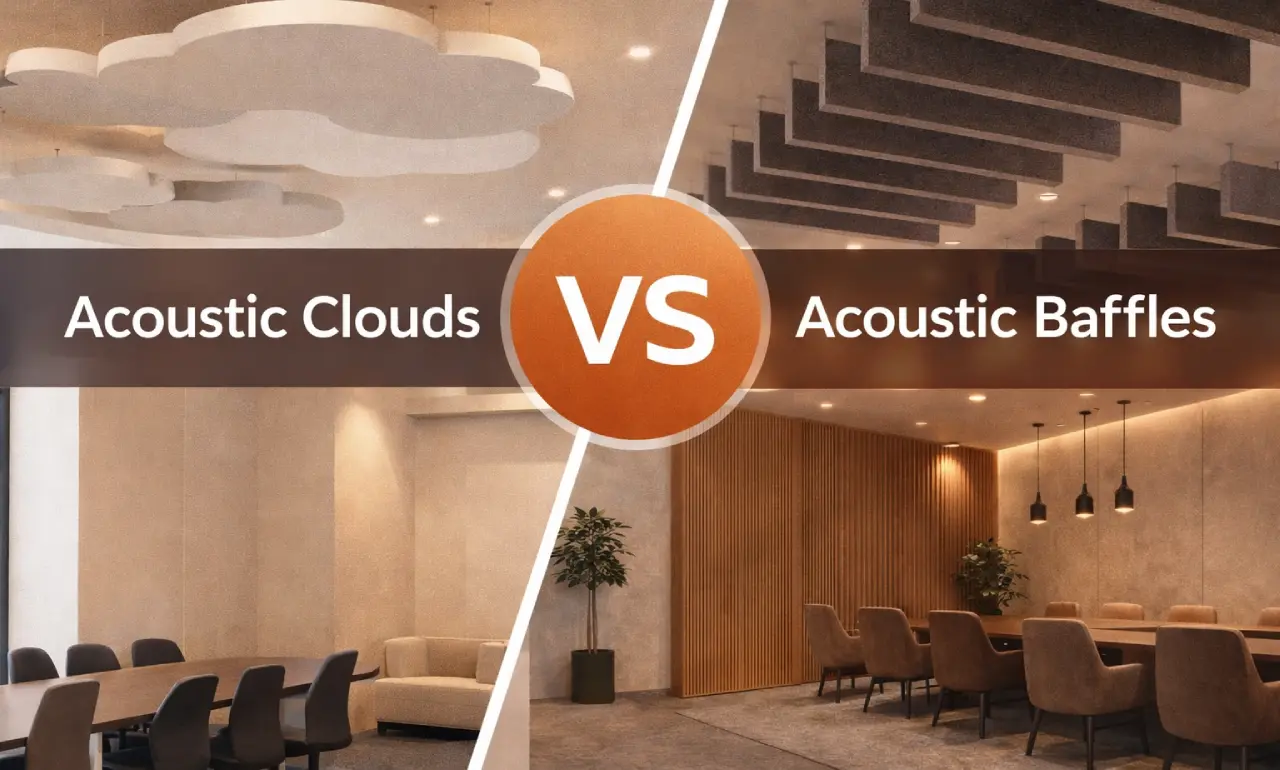
The answer comes down to something that seems simple on the surface but has significant practical consequences: orientation. Clouds hang horizontally, parallel to the ceiling. Baffles hang vertically, perpendicular to it. That single difference changes everything about how they absorb sound, which spaces they suit, how they look, how they are installed, and what they cost. Choosing the wrong one — or choosing correctly but specifying the wrong quantity or spacing — can mean spending money on acoustic treatment that underperforms.
This guide walks through both products in detail. By the end, you will have a clear understanding of how each one works, where each one excels, and how to decide which is the better fit for your specific space — or whether a combination of both is actually the smarter solution.
Before comparing the two products directly, it helps to understand what both are trying to achieve and why the ceiling is such an important surface to treat acoustically.
In any large or open room, sound energy travels outward from its source in all directions. It strikes walls, floors, and ceilings and bounces back. In a room with hard, untreated surfaces, this reflected energy accumulates faster than it decays, creating reverberation that sits on top of every conversation, every presentation, and every piece of audio being recorded. The longer the reverberation time, the muddier and louder the room feels.
The ceiling is often the single largest uninterrupted reflective surface in a room. Treating it absorptively has a disproportionately large effect on the overall acoustics because it intercepts a high proportion of the total reflected energy. This is why ceiling-mounted solutions like acoustic baffles and acoustic ceiling clouds are so widely specified as standalone treatments — in many spaces, treating only the ceiling produces 70 to 80 percent of the acoustic improvement that treating every surface would achieve, at a fraction of the cost and complexity.
Both baffles and clouds achieve this by presenting absorptive surfaces to the room. Where they differ is in how those surfaces are oriented and therefore which sound paths they intercept most effectively.
Acoustic ceiling clouds are panels suspended horizontally from the ceiling structure, floating parallel to the floor at a specified height below the structural soffit. They present two large flat faces to the room: a bottom face that absorbs sound traveling upward from the room below, and a top face that absorbs sound reflected downward from the ceiling above. This dual-face absorption makes them more effective per unit of panel area than a single-face surface treatment like a wall panel.
Because they are horizontal, clouds work most naturally with the way most rooms generate and reflect sound. People speak horizontally, sound travels upward and reflects downward, and clouds intercept that vertical sound path with a large surface area positioned exactly where the reflection occurs. This makes them particularly effective at controlling the ceiling reflection that is often the dominant path in rooms with moderate ceiling heights.
Clouds are also inherently design-friendly. Their horizontal orientation means they can be sized and shaped to follow the plan geometry of a room, positioned over specific activity zones, or configured as architectural features in their own right. A cloud suspended directly above a conference table, a reception desk, or a restaurant dining area treats the acoustics of that zone specifically while leaving the rest of the ceiling open. When multiple clouds are arranged in a considered layout, the result is often visually striking as well as acoustically effective.
PackSound manufactures acoustic ceiling clouds in mineral fibre and polyester fibre formats with a range of dimensions and finishes. Ecotone Acoustic Limited complements this with acoustical hanging clouds, mineral fibre clouds, and polyester fibre clouds to suit different performance requirements and aesthetic preferences.
Acoustic ceiling baffles are panels suspended vertically from the ceiling structure, hanging down into the room like a series of parallel fins or blades. Each baffle panel exposes both of its faces — front and back — to the room simultaneously. This means that sound waves traveling in any horizontal direction through the space will strike a baffle surface. In a row of baffles spaced across a ceiling, sound has to pass between the panels, and each time it does, energy is absorbed by the surfaces on both sides.
This geometry is what makes baffles particularly powerful in tall spaces. When ceiling heights reach five metres, eight metres, twelve metres, or more, a cloud panel suspended close to the ceiling can feel remote from the activity below, with the sound path between source and ceiling long enough that the cloud contributes less than it would in a lower-ceilinged space. Baffles, by contrast, hang down into the room from the ceiling and position their absorptive surfaces directly in the path of the horizontal and diagonal sound waves that fill a tall space. The exposed surface area per unit of ceiling footprint is much higher with baffles than with clouds, which is why baffles are the standard specification for factories, warehouses, sports halls, atria, and any other space with a large volume.
Baffles also have a practical advantage in environments where services run across the ceiling. Lighting rigs, HVAC ductwork, structural beams, and fire suppression pipework can make it difficult to find clear ceiling areas for cloud installation. Baffles, being narrow and vertical, can be hung between services without conflict, using the ceiling height that would otherwise be dead space acoustically.
PackSound manufactures acoustic hanging baffles for commercial, industrial, and institutional applications. Ecotone Acoustic Limited offers a complementary range of acoustic hanging baffles and wooden acoustic hanging baffles for projects where a natural wood finish or a more refined aesthetic is required alongside industrial-grade performance.
The fundamental difference is orientation. Acoustic clouds are horizontal and primarily intercept sound traveling vertically between the room and the ceiling. Acoustic baffles are vertical and primarily intercept sound traveling horizontally and diagonally through the room volume. In spaces where the dominant reflection path is ceiling-to-floor, clouds are the more efficient choice. In spaces where sound fills a large volume and travels in all directions, baffles intercept more of the total energy per square metre of ceiling footprint.
Acoustic clouds perform best in spaces with ceiling heights up to around four to five metres. In these rooms, the horizontal panel is positioned close enough to both the floor and the ceiling to intercept reflections effectively. Above this height, the acoustic path from the room below to the cloud surface becomes long enough that the cloud’s influence diminishes.
Acoustic baffles become increasingly effective as ceiling height increases. In rooms above five metres — and particularly in the eight to fifteen metre range common in Indian industrial buildings, warehouses, sports halls, and large commercial lobbies — baffles are almost always the more appropriate specification. They can be hung at whatever depth is most effective acoustically, regardless of the ceiling height above.
Both products use the same absorptive materials and achieve similar NRC ratings per unit of panel face area. The difference in overall efficiency comes from how much surface area each configuration presents to the room for a given ceiling footprint. A row of baffles running across a ten-metre span presents both faces of each panel to the room continuously. A cloud of equivalent plan area presents two faces, but only along the top and bottom planes. In a very tall room, baffles present significantly more total absorptive surface per unit of ceiling coverage.
In rooms of moderate height, clouds can match or exceed baffles in overall absorption because the horizontal orientation means their full face area intercepts the dominant vertical reflection path efficiently.
This is an area where the two products diverge meaningfully. Acoustic clouds offer more design flexibility in terms of shape, composition, and visual effect. They can be sized individually, arranged in groups, configured as geometric forms, or designed as architectural features. In premium commercial interiors, restaurants, hotel lobbies, and reception areas, a well-designed cloud installation adds visual interest and a sense of considered design. PackSound’s Auraluxe acoustic ceiling clouds and AeroLoom clouds take this further, combining absorptive performance with sculptural forms that turn acoustic treatment into a design centrepiece.
Acoustic baffles have a more linear, rhythmic visual character. In rows running across a ceiling, they create a structured, modern look that suits open-plan offices, creative studios, and industrial spaces well. They can be specified in a range of colours and materials, including natural wood finishes through Ecotone’s wooden acoustic hanging baffles, to suit different aesthetic contexts. In industrial settings, the visual character of baffles is often an asset: they feel intentional and modern rather than institutional.
Acoustic baffles are generally simpler and faster to install than clouds of equivalent coverage. Each baffle typically requires just two suspension points — one at each end — connected to the structural ceiling by wire rope or threaded rod. A large area of ceiling can be treated relatively quickly with a systematic grid of baffles. Installation cost per square metre of acoustic coverage is typically lower for baffles than for clouds.
Acoustic clouds require more careful planning of suspension points and heights to achieve the flat, level appearance that makes them look deliberate and professional. Larger clouds need more suspension points to prevent sagging, and getting the alignment right across a cluster of clouds requires more precision during installation. That said, the installation is still well within the capability of any competent acoustic fit-out contractor, and the visual result when done well justifies the additional effort.
In buildings with significant services above the ceiling — which describes virtually every commercial and industrial building in India — the interaction between acoustic treatment and HVAC ductwork, electrical conduit, fire suppression systems, and structural elements is a practical consideration.
Acoustic baffles are generally easier to coordinate with busy service zones because their narrow vertical profile fits between duct runs and pipes without displacing them. They also do not obstruct sprinkler coverage in the way that large horizontal panels can.
Acoustic clouds need clear ceiling zones for installation, and large clouds can interfere with sprinkler dispersion patterns, requiring careful coordination with fire safety specifications. For spaces where sprinkler coverage is a design constraint, baffles or smaller-format clouds are the more practical solution.
A cloud suspended directly above the conference table treats the most acoustically active zone in the room precisely where it matters most. The cloud absorbs ceiling reflections above the table, reduces reverberation during presentations and video calls, and improves speech intelligibility for all participants. The horizontal format integrates naturally with the rectilinear geometry of a boardroom and can accommodate integrated lighting for a clean, resolved finish.
Clusters of clouds positioned above workstation groups and collaboration zones reduce the reverberant noise floor in open-plan areas without requiring a full suspended ceiling. This approach suits the exposed ceiling aesthetic that is common in modern Indian office fit-outs, treating acoustics without sacrificing the industrial loft character that many design briefs specify.
For offices where acoustic privacy at individual desks is also a priority, acoustic screens and acoustic divider partitions from PackSound’s AcoFascia range complement ceiling treatment effectively. And for teams needing a fully private space for calls or focused work, PackSound’s ThinkPod office pods provide self-contained acoustic environments within the open plan.
The hospitality sector has embraced acoustic ceiling clouds as both a functional and decorative element. In a busy restaurant, clouds positioned above dining areas absorb the reflected sound energy that would otherwise accumulate into the loud, echoey environment that discourages repeat visits. Because clouds can be specified in custom shapes and fabric finishes, they contribute to the interior design language rather than compromising it.
In rooms with controlled ceiling heights, clouds provide precise first-reflection control above the listening or recording position. A cloud above the mix position in a studio intercepts the ceiling reflection that would otherwise blur stereo imaging and reduce monitoring accuracy. PackSound’s Auraluxe 3D ceiling clouds and EchoGlow acoustic ceiling lights add a premium visual dimension that suits the high-specification environments these projects demand.
Clouds positioned above student seating areas in classrooms and lecture halls reduce the ceiling reflections that blur speech intelligibility, helping students follow instruction more easily. This is particularly effective in lecture theatres with tiered seating, where a series of clouds at different heights can be tailored to treat each seating tier specifically.
This is the natural home of acoustic baffles. Factory floors, warehouses, and processing plants in India are typically built with metal-clad roofs, concrete floors, and no acoustic treatment. The resulting reverberation is severe, and the large volumes mean that a horizontal cloud would need to be enormous to cover a meaningful proportion of the ceiling area effectively. Baffles hung at regular intervals across the full ceiling area treat the space comprehensively, reducing the reverberant noise level throughout the room and lowering average worker noise exposure. For industrial spaces also dealing with external noise, noise barriers from Ecotone can address the building envelope simultaneously.
Sports halls present some of the most challenging acoustic conditions of any building type. Large volumes, highly reflective hard surfaces on every face, and activities that generate both impulsive and continuous noise create extremely long reverberation times. Baffles are almost universally specified for these spaces in India, both because of their efficiency in tall volumes and because their vertical orientation is less obstructive to play than large horizontal panels.
Large auditorium acoustic treatment projects typically combine baffles for volume control with clouds or wall panels for zone-specific treatment. Baffles in the fly tower, stage house, and upper audience areas control the large-volume reverberation that makes amplified and unamplified sound bloom and lose clarity.
Airport terminals, railway station concourses, shopping mall atria, and large public lobbies are among the noisiest interior spaces in India. Their combination of hard finishes, large volumes, and continuous crowd noise creates acoustic conditions that cause fatigue, increase perceived stress, and make public address announcements difficult to understand. Baffles are the standard specification for these environments because they can be installed in large quantities across ceiling and soffit areas without conflicting with the complex service and structural installations that characterise major public buildings.
Industrial and institutional canteens with metal deck ceilings and hard flooring are consistently among the noisiest spaces in any facility. The combination of cutlery, conversation, and highly reflective surfaces produces noise levels that make breaks genuinely uncomfortable. Baffles installed across the canteen ceiling can reduce reverberation time and overall noise levels substantially, improving the welfare experience for workers throughout the day.
The question of clouds versus baffles is not always a binary one. Many well-designed acoustic schemes use both, with each product addressing a different acoustic need within the same space.
A common hybrid approach in large open-plan offices uses baffles across the general ceiling area for broad reverberation control, and clouds positioned above specific zones — meeting tables, reception desks, collaboration areas — for targeted first-reflection treatment. This combination addresses both the room-wide acoustic problem and the localised speech intelligibility requirements of active zones, producing better results than either product alone could achieve.
In auditoriums and performance venues, the combination of clouds above the audience for speech clarity and baffles in the large upper volumes for reverberation control is a standard acoustic design strategy. Ecotone’s acoustic design and consultancy service regularly develops hybrid specifications for complex projects where a single product type would not fully address all acoustic objectives.
Both clouds and baffles are available in the same range of core materials, with the choice depending on the acoustic, environmental, and aesthetic requirements of the project.
Mineral fibre is the most widely specified core material for both products in commercial and institutional applications. It achieves high NRC ratings at moderate thicknesses, carries excellent fire ratings, and is dimensionally stable across the temperature and humidity cycles common in Indian buildings. Ecotone’s mineral fibre clouds and acoustic hanging baffles are specified extensively for offices, educational buildings, and healthcare facilities.
Polyester fibre offers comparable acoustic performance to mineral fibre with better moisture resistance and slightly lighter weight. It is the preferred material for humid environments, coastal locations, food processing facilities, and anywhere that moisture resistance is a priority. Ecotone’s polyester fibre clouds are specifically designed for these conditions.
Engineered wood facing over an absorptive core gives both baffles and clouds a natural warmth that suits premium commercial, hospitality, and residential applications. Ecotone’s wooden acoustic hanging baffles bring the character of natural timber to industrial and commercial settings where the standard mineral fibre panel would feel out of place.
Decorative and 3D formats are available through PackSound’s Auraluxe range, which includes 3D ceiling clouds and AeroLoom clouds designed for premium interiors where the acoustic treatment is expected to be a visual feature in its own right. The EchoGlow acoustic ceiling light integrates LED lighting directly into the cloud panel, combining acoustic treatment and general illumination in a single suspended element.
Position clouds directly above the primary activity zone — the conference table, the dining area, the workstation group, the performance stage. The cloud’s horizontal face should be at a height that feels proportionate to the room. In rooms of three to four metre height, clouds at two to two and a half metres above floor level work well. Allow for at least four suspension points on clouds larger than one metre in either dimension to prevent sagging.
Where multiple clouds are used in a cluster, consistent hanging heights give a clean, resolved appearance. A variation in height across a group of clouds can be used deliberately to create a dynamic, layered effect if the design brief calls for it, but inconsistent heights from poor installation look unfinished and should be avoided.
Spacing is the single most important variable in baffle installation. Baffles spaced too far apart — more than 600 mm centre to centre — leave large gaps through which sound passes without interception, reducing effectiveness significantly. For most applications, 300 to 600 mm spacing delivers good acoustic performance. Baffles should be at least 300 mm deep to provide meaningful absorption; shallower panels reduce in effectiveness at mid and low frequencies.
Installing baffles in two directions — running both north-south and east-west across the ceiling in a grid pattern — intercepts horizontal sound waves from all directions rather than only those travelling perpendicular to the baffle faces. This is particularly important in square or near-square rooms where a single direction of baffles would leave a dominant reflection path untreated.
Acoustic baffles in mineral fibre or polyester fibre formats are priced from approximately ₹600 to ₹1,800 per square metre of panel face area, depending on core material, thickness, dimensions, and surface finish. Installation cost adds roughly ₹150 to ₹400 per square metre depending on ceiling height and structural fixing conditions.
Acoustic clouds in standard mineral fibre or polyester fibre formats are priced from approximately ₹800 to ₹2,500 per square metre of panel face area. Premium decorative clouds from PackSound’s Auraluxe range, with 3D forms, integrated lighting, or custom fabric finishes, sit at the upper end of this range. Installation costs are comparable to baffles, though larger or more complex cloud configurations require additional planning and fixing labour.
For large industrial or commercial projects, the most cost-effective approach is almost always to get a proper acoustic specification produced before purchasing. Specifying the wrong product, the wrong quantity, or the wrong spacing wastes budget and produces a result that fails to achieve the target reverberation time. Ecotone’s acoustic design and consultancy service can produce a full specification with predicted acoustic outcomes for a fraction of the cost of over-specifying or having to retrofit additional treatment.
Can acoustic clouds and baffles be used in the same room?
Yes, and this hybrid approach is often the best solution for complex spaces. Clouds above specific activity zones and baffles across the general ceiling area address both localised and room-wide acoustic needs simultaneously. An acoustic consultant can advise on the optimal combination for your specific space and budget.
Do acoustic clouds or baffles also provide thermal insulation?
Both mineral fibre and polyester fibre panels provide some thermal benefit as a secondary function of their porous structure. The contribution is modest compared to a dedicated thermal insulation layer, but in air-conditioned commercial spaces it can reduce heat gain through the roof zone meaningfully. For buildings where thermal performance is a primary concern alongside acoustics, this dual function is worth factoring into the specification.
How do I clean and maintain acoustic clouds and baffles?
Both can be gently vacuumed using a soft brush attachment to remove accumulated dust, which is particularly important in industrial environments where airborne particles can reduce acoustic performance over time. Panels with fabric facings can be spot-cleaned with a damp cloth and mild detergent for surface soiling. Avoid saturating any panel with water. Regular light maintenance extends service life significantly and maintains acoustic performance close to the tested NRC value throughout the panel’s life.
What fire rating do these products carry?
Mineral fibre panels are non-combustible and typically carry an Euroclass A1 or A2 fire classification, the highest available levels. Polyester fibre panels carry good but slightly lower fire ratings. For buildings subject to specific fire safety requirements, always confirm the fire rating of the specified product before purchase and ensure it meets the applicable standard for the building type and occupancy. PackSound and Ecotone can provide tested fire certification documentation on request.
How long do acoustic clouds and baffles last?
Well-specified and properly maintained mineral fibre or polyester fibre panels in commercial environments typically last 20 to 25 years. In industrial environments with higher dust loads or chemical exposure, panels may need more frequent cleaning and eventual replacement, but a ten to fifteen year service life is realistic for panels specified correctly for the environment.
Still deciding between acoustic clouds and acoustic baffles for your project? Our specialists work across studios, offices, factories, schools, and hospitality venues throughout India. Share the details of your space with us and we will recommend the right products, quantities, spacing, and installation approach to achieve the acoustic result you need.