Call ✆ +91 9809802016 | 9891320678

Architect quoted a false ceiling? Acoustic consultant says panels? Learn the real difference, when each is right, and how both can work together in one installation.
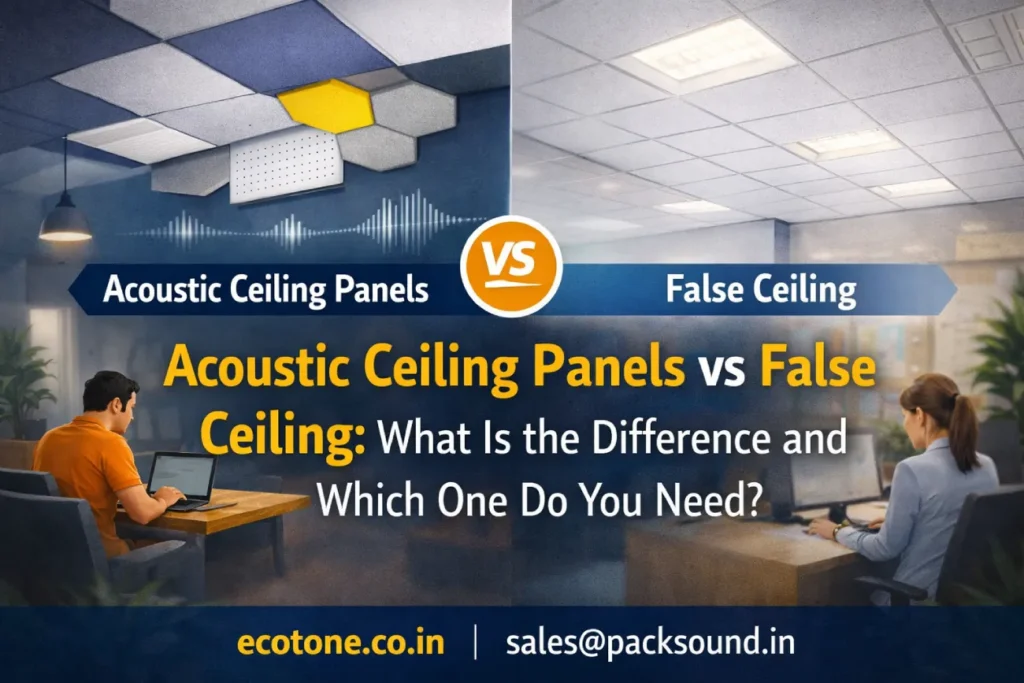
Your architect has quoted a gypsum false ceiling. Your acoustic consultant says you need acoustic panels. Your contractor says both are the same thing. None of them are explaining why. So you’re stuck, and the project is waiting.
This is one of the most common points of confusion we hear from clients across India — office owners, school administrators, hospitality managers, and homeowners alike. The terms get used interchangeably, and the result is spending a significant budget on a ceiling that looks right but does not perform acoustically.
This guide cuts through the confusion. By the end, you will understand exactly what a standard false ceiling does, what acoustic ceiling panels do differently, when each is the right answer, and how the two can work together in a single installation.
A false ceiling — also called a drop ceiling, suspended ceiling, or secondary ceiling — is a secondary surface installed below the main structural ceiling of a room. It is hung from the RCC slab above using a metal framework, creating a gap between the two surfaces that typically conceals MEP services: electrical wiring, HVAC ducts, plumbing runs, and data cables.
False ceilings serve several purposes that have nothing to do with acoustics:
Concealment of services. The plenum space created between the slab and the false ceiling hides the mechanical, electrical, and plumbing infrastructure that modern buildings require. Without a false ceiling, all of that is visible.
Visual finish. A false ceiling creates a clean, level, painted surface that improves the perceived quality of any interior.
Height control. In buildings with high floor-to-floor heights, a false ceiling brings the perceived ceiling height to a more human scale, improving thermal comfort and reducing HVAC load.
Some thermal benefit. The air gap between the slab and the false ceiling provides modest thermal insulation, reducing heat transfer from the roof slab in top-floor spaces.
The materials most commonly used for false ceilings in India are gypsum board, PVC panels, calcium silicate board, and aluminium or GI grid systems with various infill materials.
Here is the honest answer, and it’s one that the construction industry in India rarely states clearly.
A standard gypsum or PVC false ceiling provides very little meaningful sound absorption. It is primarily a visual and services-concealment solution.
Gypsum board, which is the most popular false ceiling material in Indian commercial construction, has an NRC of approximately 0.05 to 0.10 in a standard installation. PVC panels sit in a similar range. This means these materials absorb somewhere between 5 and 10 per cent of the sound energy that reaches them and reflect the remaining 90 to 95 per cent back into the room.
To put that in perspective: bare concrete has an NRC of roughly 0.02. A standard gypsum false ceiling is only marginally better from an acoustic standpoint. It will not meaningfully reduce reverberation, reduce echo, or improve speech clarity in any measurable way.
This surprises many clients, because the construction industry often describes false ceilings as providing “acoustic improvement.” What that typically means is that the ceiling looks finished, which makes a room feel quieter even when the physics of the room have not changed. The psychological effect is real, but the acoustic performance is not.
Acoustic ceiling panels are purpose-engineered to absorb sound energy, not simply to provide a finished ceiling surface. The materials, core construction, and surface design of an acoustic panel are all chosen specifically to convert sound waves into heat through the principle of porous absorption.
When sound enters a porous acoustic material, the air particles within the structure vibrate as the sound wave passes through. This vibration creates friction at a microscopic level, and that friction converts kinetic sound energy into a small amount of heat. The result is that the sound energy does not reflect back into the room. It is absorbed.
The effectiveness of this absorption is measured by the Noise Reduction Coefficient, or NRC. Quality acoustic ceiling tiles achieve NRC values between 0.70 and 0.95. The practical difference between NRC 0.10 (gypsum) and NRC 0.90 (acoustic panel) is the difference between a reverberant space and a comfortable one.
The core materials used in acoustic ceiling panels are fundamentally different from gypsum:
Fiberglass and mineral wool are inherently porous and deliver high NRC across a broad frequency range. They are among the most acoustically efficient materials available for ceiling treatment.
UHAVC core — used in PackSound’s FeatherLite and AirLite tiles — is a specially engineered ultra-high acoustic value core material. It delivers NRC 0.85 without requiring a separate acoustic backing layer, making it particularly suitable for lightweight applications.
Perforated MDF or HDHMR with acoustic fleece backing, used in the PackSound Soft Fiber Ceiling Tile, achieves NRC 0.90 by combining surface perforation with a high-density fleece layer that captures sound energy as it passes through.
Perforated metal with acoustic backing, used in the PackSound Metal Ceiling Tile, delivers NRC 0.70 to 0.85 while offering the durability and washability of metal construction.
| Feature | Standard False Ceiling | Acoustic Ceiling Panels |
|---|---|---|
| Primary purpose | Concealment and aesthetics | Sound absorption |
| NRC rating | 0.05 to 0.15 | 0.70 to 0.95 |
| Echo reduction | Minimal | Significant |
| Speech clarity improvement | Negligible | Substantial |
| Fire rating | Class A (gypsum) | Class A (all PackSound panels) |
| Moisture resistance | Poor (gypsum) to Good (PVC) | Good to Excellent |
| T-grid compatibility | Yes | Yes |
| Direct mount option | Yes | Yes |
| Cost per sq ft (approx.) | ₹55 to ₹150 | ₹120 to ₹400 |
| Typical lifespan | 10 to 15 years | 15 to 25 years |
| Suitable for humid environments | PVC only | AirLite and FeatherLite |
The table tells a clear story. A standard false ceiling and an acoustic ceiling panel are compatible with the same installation systems — both work with T-grid frameworks — but they are solving fundamentally different problems. One hides what is above it. The other changes how the room sounds.
The false ceiling industry in India has successfully positioned its products as providing acoustic benefit because the word “ceiling” is associated with quiet in the consumer’s mind. A finished ceiling does feel like a quieter room compared to a bare slab with exposed services. But this is a sensory illusion driven by aesthetics and reduced visual chaos, not a measurable acoustic improvement.
When a client installs a gypsum false ceiling in a conference room and then complains that meetings are still noisy and echo-filled, the contractor often responds by suggesting a thicker board, additional layers, or more insulation above. None of these solve the problem because the problem is not the weight of the ceiling — it is the complete absence of porous acoustic material on any surface the sound touches.
This is why acoustic consultants and architects who have worked on performance-critical spaces specify acoustic ceiling tiles rather than standard false ceiling boards. They are addressing the actual acoustic physics of the space, not just its appearance.
There are absolutely situations where a standard false ceiling is the correct specification, and over-specifying acoustic panels where they are not needed is not good practice either.
Residential living rooms and bedrooms without echo issues. If the space is naturally damped by furniture, soft furnishings, curtains, and carpets, the room may not have a significant acoustic problem. A gypsum or PVC false ceiling will provide a clean finish without adding cost.
Spaces where services concealment is the primary need. A corridor, a storage room, or a utility space may need a finished ceiling purely to hide ductwork and wiring. Acoustic performance is not relevant to its function.
Budget-constrained projects with no acoustic performance requirement. Not every space needs to be acoustically treated. If the room is used for storage, as a reception holding area, or for any use where speech intelligibility and noise levels are not priorities, a standard false ceiling is appropriate.
Zones within a larger space where acoustic panels are used elsewhere. In a project where acoustic panels are installed in the primary activity zones, a standard false ceiling may be used in secondary areas like corridors and service areas to complete the visual finish cost-effectively.
The decision to specify acoustic ceiling panels rather than a standard false ceiling should be driven by the function of the space. If any of the following apply, acoustic panels are the right choice.
The space is used for meetings, presentations, or collaborative work.
Offices, conference rooms, boardrooms, and collaborative work zones all depend on speech clarity. Reverberation in these spaces directly reduces the effectiveness of communication and increases cognitive fatigue. A standard false ceiling will not solve this.
The space is used for learning.
Schools, universities, coaching institutes, and training rooms are environments where students and teachers spend the majority of the day communicating verbally. Research in acoustic design consistently shows that reverberation above 0.7 seconds in a classroom measurably reduces comprehension and increases the amount of repetition required by teachers. Acoustic ceiling tiles are not a premium choice in these environments — they are a functional requirement.
The space is used for healthcare.
Hospitals, clinics, and diagnostic centres require acoustic control for patient dignity, staff communication, and occupant wellbeing. High-humidity healthcare environments need panels specifically rated for moisture exposure, such as the AirLite Ceiling Tile.
The space is a restaurant, hotel lobby, or hospitality venue.
Noisy restaurants are a common complaint in India. The cause is almost always a ceiling and floor combination of entirely hard, reflective surfaces. Introducing acoustic ceiling panels or suspended acoustic baffles significantly reduces ambient noise levels and improves the dining experience.
The space has received echo or noise complaints.
If occupants are already complaining about noise, echo, difficulty hearing on calls, or general acoustic discomfort, the space has an acoustic problem that only acoustic-grade materials can solve.
Yes, and this is actually the most common installation approach in well-designed commercial projects across India.
The hybrid approach uses acoustic ceiling tiles — such as the FeatherLite or AirLite — within the same T-grid framework that would normally hold standard false ceiling tiles. The grid itself is identical. The only difference is what is placed into it.
This approach gives you the services concealment and visual finish of a false ceiling system combined with the acoustic performance of purpose-built panels. From the outside, the ceiling looks like a finished commercial installation. What changes is how the room sounds.
The cost difference between installing standard gypsum or mineral fibre tiles and installing PackSound acoustic tiles in the same T-grid framework is typically ₹40 to ₹150 per square foot depending on the panel specified. For a 500 square foot conference room, the incremental acoustic upgrade cost is approximately ₹20,000 to ₹75,000. In the context of a full office fit-out, this is a small percentage of total project cost, and its impact on the usability of the conference room is significant.
In spaces with very high ceilings — atriums, open-plan offices with exposed slab heights above 3.5 metres — the hybrid approach may also incorporate suspended acoustic baffles or acoustic clouds at a lower height to bring acoustic absorption closer to the occupants.
One question we get regularly is whether the higher upfront cost of acoustic ceiling panels is justified compared to standard false ceiling materials. Here is how the economics look when you account for the full picture.
PackSound’s full acoustic ceiling range is designed to be installed within the same suspended grid systems used for standard false ceilings, making the upgrade from a decorative ceiling to an acoustic one straightforward.
Soft Fiber Acoustic Ceiling Tile — NRC 0.90. The highest-performing tile in our range, it uses a micro-perforated MDF/HDHMR core with acoustic fleece. Available in multiple sizes, edge profiles, and finishes including digital print. Best suited to conference rooms, offices, classrooms, and any space where maximum speech clarity is required.
FeatherLite Ceiling Tile — NRC 0.85. At under 4 kg per square metre, this is our premium lightweight option. The 25mm UHAVC core with mica laminate face delivers NRC 0.85 without any additional backing material. Well suited to premium boardrooms, auditoriums, home theatres, and commercial spaces where the aesthetic is as important as the performance.
AirLite Ceiling Tile — NRC 0.85. Our lightest tile at 2.74 kg per square metre, rated to 95 per cent relative humidity and carrying Class A fire resistance. The correct specification for schools, hospitals, and any project in a coastal or high-humidity environment. Its thermal conductivity of ≤0.040 W/m·K also provides meaningful thermal insulation alongside acoustic performance.
Metal Ceiling Tile — NRC 0.70 to 0.85. Galvanised steel or aluminium with precision perforation and acoustic backing. Washable, impact-resistant, and visually suited to modern commercial, retail, and hospitality interiors. A replacement for decorative metal false ceilings that adds genuine acoustic value.
Acoustic Baffles — NRC 0.70 to 0.95. Suspended vertically from the ceiling, these are used where standard tile coverage is insufficient or where exposed ceiling aesthetics are preferred. They perform double-sided absorption, making them particularly effective in high-ceiling commercial spaces.
Acoustic Clouds — NRC 0.70 to 0.95. Horizontally suspended at chosen heights, clouds provide targeted absorption above high-activity zones. They integrate well with exposed ceiling designs and are available in curved, custom-shaped, and feature-finish options.
Can acoustic ceiling panels replace a false ceiling entirely?
Yes. Acoustic ceiling tiles installed in a T-grid suspended framework serve both the concealment and acoustic functions simultaneously. You do not need a separate false ceiling layer underneath. The T-grid holds the acoustic tiles, hides the services above, and delivers the acoustic performance of the panels.
Is a gypsum false ceiling soundproof?
No. Gypsum board provides very limited sound absorption (NRC 0.05 to 0.10) and has a moderate STC rating when used in a wall partition — but as a ceiling tile in a drop ceiling system, it contributes almost no meaningful acoustic improvement. It is a decorative and services-concealment product, not an acoustic one.
Will acoustic ceiling panels look different from a standard false ceiling?
Not necessarily. The FeatherLite and AirLite tiles sit in standard T-grid systems and present a clean, finished surface visually identical to a high-quality commercial false ceiling. The Soft Fiber Ceiling Tile is available in multiple laminate finishes and edge profiles. In most installations, visitors to the space will not identify the ceiling as an acoustic product — they will simply notice that the room sounds right.
Can I install acoustic panels over an existing false ceiling?
In some cases, yes. Direct-mount acoustic panels can be fixed to an existing gypsum false ceiling surface using appropriate adhesive or mechanical fixing. This approach does not require demolishing the existing ceiling. However, the plenum depth above the existing ceiling and the structural capacity of the existing grid both need to be assessed before proceeding.
What is the minimum NRC I should specify for a conference room?
For a conference room used for video calls and presentations, we recommend a minimum NRC of 0.85. The Soft Fiber Ceiling Tile at NRC 0.90 is our recommendation for this application. Combined with 65 to 75 per cent ceiling coverage, this will bring the RT60 of a typical Indian conference room well within the 0.3 to 0.5 second target range for comfortable speech intelligibility.
Ceiling treatment is the most impactful starting point, but a complete acoustic solution for demanding spaces often incorporates wall treatment as well.
Not sure whether your project needs a standard false ceiling, acoustic ceiling panels, or a hybrid of both? Our acoustic team works through this question with clients every day. Share your space dimensions, intended use, and any existing complaints about the acoustic environment, and we will give you a clear recommendation and a budgetary breakdown at no cost.
Call us: +91 980 980 2016
Email: Sales@packsound.in
Contact page: packsound.in/contact-us/
A standard false ceiling and an acoustic ceiling panel are not the same product. They are not interchangeable. They solve different problems.
A false ceiling conceals services and provides a visual finish. It contributes almost nothing to the acoustic quality of a room. An acoustic ceiling panel is engineered from the core outward to absorb sound energy, reduce reverberation, and make a space genuinely more comfortable to work, learn, and communicate in.
The good news is that you do not have to choose between the two. The right T-grid installation with PackSound acoustic ceiling tiles gives you the services concealment and visual finish of a false ceiling and the acoustic performance of purpose-built panels — in the same installation, at the same time.
If your space has a function that depends on how well people can hear and be heard, specify acoustic panels. If it does not, a standard false ceiling is fine. If you are not sure which category your space falls into, get in touch and we will help you work it out.