Call ✆ +91 9809802016 | 9891320678

By PackSound® Acoustic Design Team | Updated: March 2026 | 14 min read
Whether you are designing a 1,000-seat university auditorium in Pune, a corporate conference centre in Gurugram, or a multipurpose community hall in Ahmedabad — the acoustic treatment decisions you make at the planning stage will define the quality of every event held in that space for the next 20 years. This guide covers everything architects, facility managers, and project owners in India need to know before specifying acoustic treatment for any large-venue project.
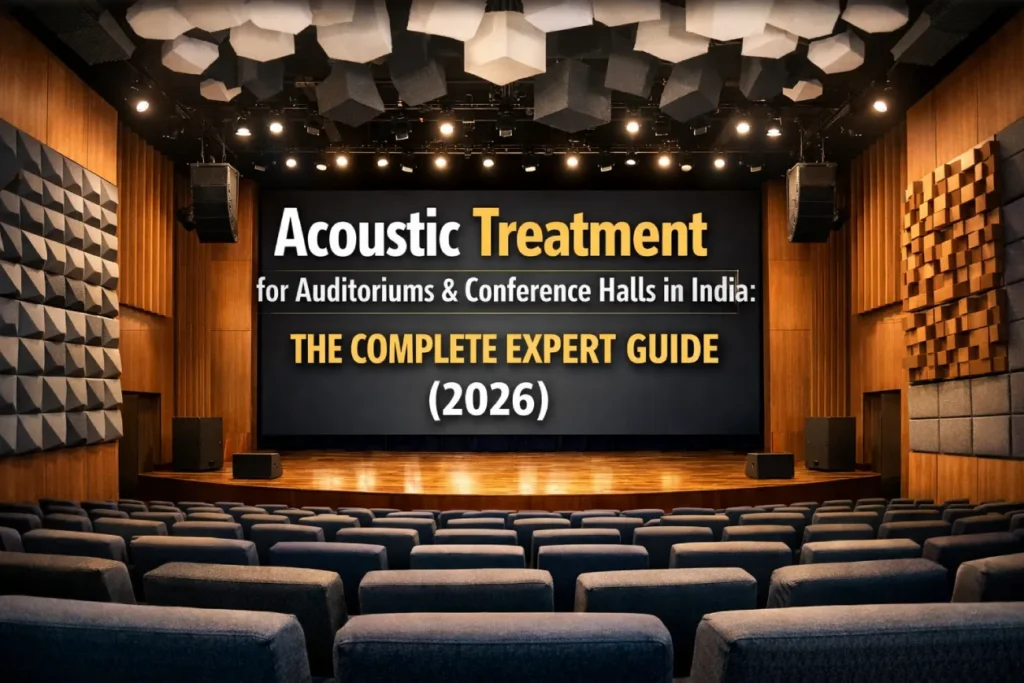
Walk into most Indian auditoriums built before 2015 and you will experience the same problem: spoken words echo, music sounds muddy, audiences at the back struggle to hear, and the PA system is cranked so loud it distorts. These are not PA system problems. They are acoustic design failures — and they are almost entirely preventable.
India is in the middle of a significant wave of institutional construction. Smart Cities Mission infrastructure, new university campuses, corporate headquarters, convention centres, school auditoriums, and government assembly halls are being commissioned at a pace unseen since the 1970s. The difference today is that clients — architects, principals, and facility heads — increasingly understand that an auditorium that sounds bad is an auditorium that fails its purpose, regardless of how well it looks.
Getting auditorium acoustics right requires understanding a handful of core principles, specifying the correct materials for each surface, and working with experienced acoustic consultants who understand both the science and the practical constraints of Indian construction. That is exactly what this guide covers.
Key Insight: Indian Standard IS 2526-1963 provides the national code of practice for acoustical design of auditoriums and conference halls. Any serious acoustic treatment project for these spaces should be designed in compliance with this standard. PackSound’s acoustic design team works to IS 2526 on all institutional and government projects as a baseline.
Every acoustic space has a reverberation time — abbreviated as RT60 — which measures how long it takes for sound energy to decay by 60 decibels after the source stops. In practical terms, it is the time between a speaker stopping a word and that word fully dying away in the room.
Get RT60 right and your auditorium sounds professional. Get it wrong and no amount of expensive PA equipment or skilled performers will compensate.
The ideal RT60 depends entirely on the primary use of the space:
Space Type | Ideal RT60 (seconds) | Primary Acoustic Goal |
|---|---|---|
Conference Room / Boardroom | 0.4 – 0.6 sec | Maximum speech intelligibility |
Classroom / Lecture Hall | 0.4 – 0.7 sec | Clear speech, no distractions |
Multipurpose Auditorium | 0.8 – 1.2 sec | Speech + light music balance |
Drama Theatre | 0.8 – 1.2 sec | Natural voice, dramatic clarity |
Concert Hall (mixed use) | 1.2 – 1.8 sec | Warmth + musical richness |
Large Symphonic Hall | 1.8 – 2.5 sec | Full orchestral resonance |
Most Indian auditoriums and conference halls — which are concrete-walled, tile-floored, and sparsely furnished — have untreated RT60 values between 2.5 and 5 seconds. A conference room with 4 seconds of reverberation makes every conversation sound like it is happening in a swimming pool. The treatment goal is to bring that number into the target range through strategic placement of absorptive, diffusive, and reflective surfaces.
Professional acoustic treatment is never just about putting panels everywhere. It involves a carefully calculated combination of three different acoustic functions:
Absorption reduces reverberation by converting sound energy into negligible heat as it passes through porous or fibrous materials. Acoustic panels, ceiling baffles, upholstered seating, and carpet all contribute absorptive function. Too much absorption makes a room sound unnaturally dead — like speaking into a blanket. The correct amount brings RT60 into the target range without killing the life of the space.
Diffusion scatters sound energy in multiple directions without absorbing it. Diffusive surfaces — shaped panels, angled walls, geometric ceiling elements — redistribute sound energy evenly across the room, preventing hot spots of excessive volume and dead zones of poor clarity. Well-designed auditoriums use diffusion on rear walls and upper side walls to create a sense of spaciousness and envelopment.
Reflection directs early arriving sound energy from the stage or speaker toward the audience. Properly angled ceiling panels and upper side walls act as natural reflectors, extending the reach of unamplified sound and improving clarity in the rear seating areas. The challenge is ensuring reflections arrive at the audience within approximately 25 milliseconds of the direct sound — later arrivals are perceived as echo.
Every surface in an auditorium or conference hall performs one of these three functions. Professional acoustic design is the process of ensuring the right function is assigned to the right surface.
While RT60 is the primary design metric, the Speech Transmission Index (STI) is the number that most directly describes what audiences actually experience: the clarity and intelligibility of spoken words. STI ranges from 0 to 1, with the following practical benchmarks:
A well-treated Indian auditorium should target STI above 0.65. Most untreated concrete auditoriums in India fall below 0.50.
Understanding what goes wrong helps you understand what treatment is required.
India’s dominant construction material — reinforced concrete — is acoustically one of the most reflective surfaces that exists. A concrete wall reflects approximately 97% of the sound that strikes it. A concrete auditorium without treatment is essentially a large echo chamber. This is the most widespread acoustic problem in Indian institutional buildings and the primary driver of demand for acoustic treatment.
When two parallel walls face each other without intervening absorption, sound bounces back and forth between them in a rapid repetitive pattern — a condition called flutter echo. It produces a distinctive metallic “ringing” sound after sharp transients like hand claps, consonants, or cymbal hits. Many Indian auditoriums and conference rooms exhibit severe flutter echo due to their rectangular geometry and bare concrete walls.
The solution is to break the parallel relationship through angled panels, to add absorption on at least one of the parallel surfaces, or both.
In any large room, a sound that travels from the stage, reflects off the rear wall, and arrives back at the audience more than 50 milliseconds after the direct sound is perceived as a distinct echo — not reverberation. This is particularly common in Indian auditoriums with deep floor plans and hard rear walls, and it is highly damaging to speech intelligibility.
Treatment: rear walls of auditoriums require either deep absorptive treatment (4-inch panels, NRC 0.90+) or angled diffusive surfaces to scatter the reflection rather than returning it directly to the audience.
Low-frequency sound — bass — builds up in corners and along wall-floor and wall-ceiling junctions due to pressure accumulation at room boundaries. In large concrete rooms, this buildup creates a consistent low-frequency “boom” that muddies music and makes bass-heavy voices (common in South Indian classical music, for instance) sound thick and unclear in the mix. Thick corner absorption and low-frequency tuned absorbers address this directly.
India’s tropical climate means air conditioning systems run at significant capacity for most of the year. Poorly designed or unmaintained HVAC systems introduce a constant broadband noise floor into auditoriums and conference halls — raising the ambient noise level and dramatically reducing the effective SNR (signal-to-noise ratio) for speech. Any serious acoustic project must address HVAC noise alongside room treatment. Acoustic duct lining, vibration isolation, and diffuser placement all contribute to solving this.
Many Indian auditoriums feature deep balconies that create enclosed under-balcony zones with poor sound coverage. Audience members seated beneath the balcony receive reduced direct sound from the stage and increased reflections from the low ceiling above them — creating a distinctly worse listening experience than the main floor. Acoustic treatment of under-balcony ceilings and supplementary distributed speaker systems are the standard solutions.
The stage area requires a mix of absorptive and reflective treatment. Side walls adjacent to the stage should be angled to project early reflections toward the audience — this is the most effective way to increase perceived loudness and clarity of unamplified performances without PA support. Above the stage, a hardwood or composite reflective canopy (often called a “shell” in concert hall design) projects sound downward and outward toward the stalls.
PackSound solution: EchoStop® Grooved Wooden Slat Panels on stage side walls combine a reflective outer surface with absorptive backing — providing controlled early reflections while preventing harsh specular reflection. Available in premium wood grain finishes that complement formal auditorium aesthetics.
Mid-room side walls are critical for lateral reflection — the sense of envelopment and spaciousness that makes large-hall listening feel immersive. Alternating absorptive and diffusive panels on side walls is the professional standard: absorption reduces RT60 and controls flutter echo, while diffusion distributes lateral energy evenly across the audience.
PackSound solution: Fabric-wrapped fiberglass panels (NRC 0.90–1.0) at acoustic first-reflection points, combined with EchoStop® Micro Perforated Panels at diffusive positions. Custom fabric colours allow seamless integration with interior design schemes.
The rear wall is the most acoustically critical surface in any auditorium. A flat, hard rear wall returns a focused reflection to the entire audience simultaneously — the definition of a damaging echo. Treatment options:
For speech-primary spaces (conference halls, lecture theatres): Deep absorptive treatment with 4-inch NRC 0.90+ panels covering 70–80% of the rear wall surface. The remaining area can incorporate a geometric diffusive element for visual interest.
For performance spaces (multipurpose auditoriums): A combination of cylindrical or faceted diffusive elements (scattering sound in multiple directions) combined with absorptive panels in a ratio determined by the target RT60 for the space.
PackSound solution: Custom rear-wall treatment systems combining thick fabric-wrapped absorption and geometric diffusive elements. Designed to project specifications with RT60 modelling included as part of consultation.
Auditorium ceilings are complex acoustic surfaces that must perform multiple functions simultaneously: directing early reflections toward the audience, preventing long-delayed ceiling echoes, and contributing the correct amount of absorption to achieve target RT60.
For most Indian auditoriums, the ceiling above the stage and front stalls should be angled or convex to direct sound outward. The ceiling above the mid and rear stalls benefits from acoustic clouds — suspended absorptive panels that reduce RT60 and prevent late-arriving ceiling reflections without entirely eliminating the reflective contribution of the structural ceiling.
PackSound solution: Acoustic Ceiling Baffles and Clouds in custom sizes and configurations. Suspended systems are available in aluminium frame construction rated for the load requirements of institutional ceilings in India.
The floor itself contributes absorption — carpeted aisles and upholstered seating are significant acoustic assets. A fully occupied auditorium with upholstered seats absorbs approximately three to four times more sound than the same room with empty hard seating. This is why acoustic treatment must be designed for the occupied condition: a room that sounds acceptable when empty may sound dead when full, and vice versa.
The practical recommendation for Indian auditoriums: specify upholstered seats with absorptive properties similar to a seated person. This keeps the acoustic behaviour consistent between occupied and unoccupied conditions — essential for venues that host events at varying attendance levels.
Conference halls differ from auditoriums in two important ways acoustically: they are smaller, and speech intelligibility is the absolute priority. A conference that cannot be heard clearly is a failed event.
Room Size | Target RT60 | Target STI | Panel Coverage Recommendation |
|---|---|---|---|
Small (up to 30 pax, <150 m²) | 0.35 – 0.50 sec | >0.75 | 25–35% wall surface treated |
Medium (30–80 pax, 150–350 m²) | 0.45 – 0.65 sec | >0.70 | 30–40% wall + full ceiling cloud |
Large (80–200 pax, 350–700 m²) | 0.55 – 0.75 sec | >0.65 | 35–50% wall + ceiling treatment |
Auditorium-scale (200+ pax) | 0.70 – 1.20 sec | >0.60 | Full acoustic design required |
Application | Recommended Panel | Thickness | NRC Target | PackSound Product |
|---|---|---|---|---|
Auditorium rear wall | Fabric-wrapped Rockwool | 50mm | 0.90–1.0 | EchoStop® FR Series |
Auditorium side walls | Grooved Wooden Slat | 20–25mm | 0.70–0.85 | EchoStop® Grooved Slat |
Conference room walls | PET Felt / Fabric-wrapped | 20–25mm | 0.80–0.95 | EchoStop® PET / FR Series |
Conference ceiling cloud | Fabric-wrapped Fiberglass | 50mm | 0.95–1.0 | Custom Ceiling Cloud |
Stage side walls | Perforated Wood Panel | 18mm | 0.65–0.80 | EchoStop® Perforated |
Under-balcony ceiling | Fabric-wrapped Fiberglass | 50mm | 0.90–1.0 | EchoStop® FR Series |
Corner bass treatment | Broadband corner absorber | 100mm+ | 0.85–1.0 | EchoStop® Corner Trap |
Before signing any acoustic panel supply contract for an auditorium or institutional project, verify the following documentation:
NRC Test Certificate (ARAI or equivalent third-party lab): Every panel specification must be backed by an independent NRC test report — not a manufacturer’s claimed value. Request the actual lab certificate with the tested NRC value for the specific product you are specifying.
Fire Retardancy Certification (IS 1641 / BIS compliance): Non-negotiable for any public assembly space, educational institution, or government building in India. Ask specifically whether the FR treatment is integral to the material (preferred) or a surface coating (degrades over time).
IS 2526 Design Compliance: For formal institutional projects, request confirmation that the acoustic design has been developed with reference to IS 2526-1963, India’s national standard for auditorium and conference hall acoustical design.
GRIHA / LEED Documentation: If the project is pursuing green building certification, request Environmental Product Declarations and material composition documentation for LEED MR and IEQ credit submissions.
PackSound provides all of the above documentation as standard for institutional and government projects. Our design team prepares complete specification packages for architects and project consultants.
The Indian acoustic market for institutional and large-venue projects involves several significant players. Understanding what each offers helps project owners and architects make informed decisions.
Ecotone Acoustics Pvt. Ltd. is a well-established name in the Indian market, particularly for sliding partitions and ceiling baffles. They have experience in auditorium projects and offer acoustic consultancy services. Their primary strength is in the industrial and partition segment; their architectural panel range for large venues is narrower than PackSound’s custom capabilities.
Armstrong World Industries and Gyproc (Saint-Gobain) offer internationally recognised ceiling tile and wall panel systems widely distributed through Indian building material channels. Their products are reliable and well-documented — but they are global catalogue products, not custom solutions. For a unique auditorium space requiring bespoke panel geometries, custom colour matching, or site-specific acoustic design, global catalogue products fall short. Their pricing is also notably higher than equivalent-performance domestic manufacturing.
MMT Acoustix serves primarily the residential and small studio market through online channels. Their foam-based product range is not appropriate for institutional auditorium or conference hall applications where fire safety, durability, and high NRC performance at low and mid frequencies are required.
Anutone offers a range of decorative acoustic boards popular in school and office applications. Their product design is strong; their institutional project capability and pan-India installation support is more limited than their product quality suggests.
What PackSound delivers differently: PackSound is a full-service, Made-in-India acoustic manufacturer with end-to-end institutional project capability — from RT60 modelling and IS 2526-compliant acoustic design through to panel fabrication, delivery, and professional installation anywhere in India. Every product carries ARAI-certified NRC documentation, IS 1641 fire rating, and can be specified in custom dimensions, colours, and finishes to match the architect’s design intent. For large-venue projects, this combination of technical credibility, custom manufacturing, and pan-India installation support is genuinely difficult to match.
Here is exactly how PackSound approaches an institutional acoustic project — from first enquiry to project completion:
Step 1 — Free Site Acoustic Assessment Our acoustic design team visits the site (or works from architectural drawings for new builds) to assess room dimensions, construction materials, HVAC configuration, and intended use patterns. We identify existing acoustic problems or, for new builds, predict performance from drawings.
Step 2 — RT60 Modelling and Treatment Design Using room acoustic simulation, we model the existing RT60, identify target RT60 for the intended use, and design a treatment solution — specifying panel types, dimensions, NRC requirements, coverage areas, and placement for each surface. For IS 2526-compliant projects, compliance documentation is prepared at this stage.
Step 3 — Material Specification and Cost Estimate We produce a complete material specification — panel product, dimensions, NRC, fire rating, finish, quantity — with an itemised cost estimate. This package is designed to be directly usable by architects for BOQ submission and procurement.
Step 4 — Fabrication at Greater Noida Facility Panels are manufactured at our Greater Noida production facility to project specifications. Custom dimensions, colours, fabric choices, and surface patterns are accommodated. Lead time is typically 3–5 weeks for institutional projects depending on order size.
Step 5 — Professional Installation PackSound’s trained installation teams handle delivery, site preparation, panel installation, and quality verification across India. For large projects, we coordinate with the main contractor on sequencing and site access.
Step 6 — Post-Installation RT60 Verification On projects where it is specified, we conduct post-installation RT60 measurement to verify design targets have been achieved. This is particularly valuable for institutional clients who need to demonstrate acoustic compliance as part of project handover.
Budget planning for auditorium acoustic treatment varies significantly based on room size, material specification, and whether the project is new construction or a retrofit. Here is a realistic guide for Indian project conditions in 2026:
Project Type | Approximate Area | Treatment Budget Range (INR) | Scope |
|---|---|---|---|
Conference room (medium) | 150–250 m² | ₹4,00,000 – ₹8,00,000 | Ceiling cloud + wall panels + corners |
School auditorium | 300–500 m² | ₹8,00,000 – ₹18,00,000 | Full wall, ceiling, rear wall treatment |
Corporate conference centre | 500–800 m² | ₹15,00,000 – ₹35,00,000 | Full treatment + custom finishes |
University auditorium | 800–1,500 m² | ₹30,00,000 – ₹75,00,000 | Complete acoustic design + treatment |
Large multipurpose hall | 1,500 m²+ | ₹60,00,000+ | Custom acoustic design project |
These ranges cover material supply and installation. Acoustic design consultancy (RT60 modelling, IS 2526 compliance documentation) is typically additional for very large projects, though PackSound includes basic design support in the project scope for most standard institutional commissions.
For reference and comparison, explore PackSound’s completed institutional projects including the Hyatt Regency Bhikaji Cama Place acoustic installation — a large-scale hospitality project that demonstrates the combination of acoustic performance and premium interior aesthetics that PackSound delivers.
Q: Is acoustic treatment required by law for auditoriums and conference halls in India? Indian Standard IS 2526-1963 is the national code of practice for acoustical design of auditoriums and conference halls. While not always enforced as a mandatory legal requirement in all states, it is referenced in CPWD specifications, many state PWD standards, and is increasingly required documentation for institutional building approvals in metro cities. Beyond compliance, the practical and reputational cost of an auditorium that functions poorly is significant.
Q: Can existing auditoriums be acoustically treated as a retrofit, or is it only viable for new builds? Acoustic treatment retrofits are both viable and common in India. The majority of PackSound’s institutional projects are retrofits of existing auditoriums, conference halls, and multipurpose spaces built without acoustic design. Retrofit treatment can typically bring a poorly performing room to a good acoustic standard — though structural constraints may limit some solutions available in new construction.
Q: How long does acoustic treatment installation take in a typical auditorium? For a school or university auditorium (300–600 m²), installation typically takes 5–10 working days with a trained crew. Larger projects are sequenced to minimise disruption to ongoing facility use. We regularly complete conference room installations over a weekend to avoid disruption to business operations.
Q: Should acoustic panels be specified before or after the PA/AV system? Both should be designed together — acoustic treatment and PA system design are interdependent. An underpowered PA in a well-treated room often outperforms an expensive PA system in a reverberant room. Ideally, acoustic treatment is completed or at least fully specified before the PA system is finalised, as RT60 directly affects speaker selection, placement, and signal processing requirements.
Q: What is the minimum coverage percentage needed to meaningfully improve a conference room in India? As a rule of thumb, treating 30% of the total surface area of a hard-walled Indian conference room with NRC 0.85+ panels will typically reduce RT60 by 40–60% — which usually brings a 3–4 second reverberant room into the 0.6–0.9 second range. However, placement matters as much as coverage: panels in the wrong positions are significantly less effective than the same coverage area at first-reflection points and the ceiling.
An auditorium that sounds excellent is an institution’s most powerful advertisement — for a university, a corporate headquarters, a government building, or a performing arts venue. The audiences who leave a space having heard every word clearly and experienced music the way it was intended to be heard carry that impression with them for years.
PackSound has delivered acoustic solutions for auditoriums, conference halls, multipurpose spaces, and institutional venues across India — from school halls in tier-2 cities to premium corporate conference centres in Mumbai, Delhi, Bangalore, and Hyderabad. Our team includes acoustic design engineers, ARAI-certified product specifications, and pan-India installation capability under a single project contract.
Request your free acoustic assessment and project quote today. Our consultants will review your drawings or visit your site, model the acoustic performance, and provide a complete specification and cost plan — at no charge.
📞 Call / WhatsApp: +91 980 980 2016 📧 Email: Sales@packsound.in
🌐 Explore our full institutional range: packsound.in/acoustic-wall-panels/
PackSound® (a brand of Ecotone Acoustic Limited) is a Made-in-India acoustic solutions manufacturer based in Greater Noida, Uttar Pradesh. We have delivered acoustic treatment for 500+ projects across India including corporate auditoriums, university halls, government conference facilities, luxury hotels, and performing arts venues. All panels are NRC-certified, IS 1641 fire-retardant rated, and backed by professional installation services across pan-India. Acoustic design services are provided by qualified engineers with experience on IS 2526-compliant institutional projects.