Call ✆ +91 9809802016 | 9891320678

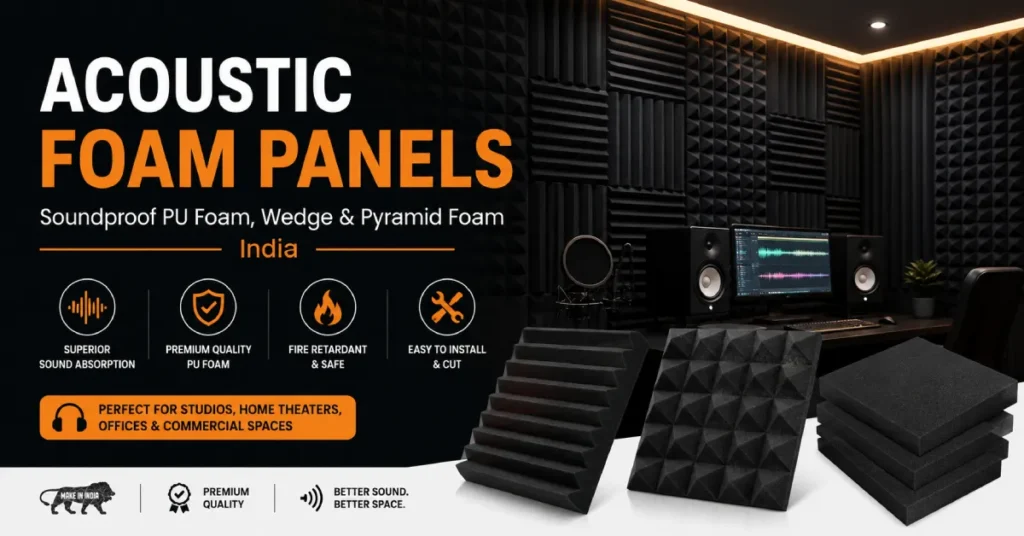
Acoustic Foam Panels by Ecotone Acoustic Limited are engineered for superior sound absorption and echo control. Available in PU foam, wedge, and pyramid designs, these high-performance acoustic panels are ideal for studios, home theatres, offices, cinemas, and industrial spaces across India.
You’ve invested in the best microphone, the finest speakers, or the most thoughtfully designed conference room. But if your space is working against you — bouncing sound off hard walls, creating muddy echoes, killing vocal clarity — none of that investment matters.
Acoustic foam is the single most accessible, most effective way to take control of how sound behaves in a room. And when it’s manufactured to professional-grade standards, the difference is immediate and unmistakable.
At PackSound by Ecotone Acoustic Limited, we manufacture high-performance acoustic PU foam panels — including wedge foam, pyramid foam, and anechoic foam — tested to deliver an NRC (Noise Reduction Coefficient) of 0.8 and certified to UL 94 fire retardancy standards. We supply directly from our manufacturing facility in Greater Noida to studios, offices, auditoriums, industrial facilities, and institutions across India.
Whether you’re treating a professional recording studio, a corporate boardroom, a home theater, a classroom, or an industrial acoustic enclosure — PackSound acoustic foam delivers certified performance, lasting durability, and manufacturer-direct pricing.
Before choosing any acoustic treatment product, it’s worth understanding exactly what acoustic foam does — and what it doesn’t do. This is one of the most commonly misunderstood areas in acoustic treatment, and getting it right saves you from expensive mistakes.
Acoustic foam is an open-cell polyurethane (PU) or melamine material engineered to absorb sound waves that strike it. When sound waves travel through a room and hit hard surfaces — walls, ceilings, glass, concrete floors — they reflect back into the space, creating echo, reverberation, flutter echo, and standing waves.
Acoustic foam panels interrupt this process. Sound waves enter the foam’s open-cell structure, lose energy through friction as they pass through the foam’s internal pathways, and are converted into a tiny amount of heat. The result: significantly less reflected sound energy bouncing around your room.
What acoustic foam does:
What acoustic foam does not do:
For complete sound isolation — blocking noise between rooms — acoustic foam should be combined with mass-based soundproofing materials. For acoustic treatment within a room, foam alone is highly effective.
Key insight: Most people need both. Acoustic foam handles what’s happening inside your room. Soundproofing materials handle what crosses between rooms. PackSound by Ecotone can provide both — see our full range of acoustic wall panels and soundproof fixed partition systems.
Sound is a pressure wave — a ripple of compression and rarefaction moving through air. When these waves hit a hard, flat surface, they bounce back (reflect) at an angle equal to the angle they arrived — just like light hitting a mirror.
In a bare room, this happens hundreds of times per second from every wall, the ceiling, and the floor simultaneously. The result is a complex wash of overlapping reflections that smear the clarity of any sound in the space — music sounds muddy, voices sound distant and unclear, recordings capture ambient noise instead of clean signal.
Acoustic foam works by:
The result is a room where sound behaves the way you want it to — controlled, clear, and free of the reflective chaos that degrades both listening experience and recording quality.
All PackSound acoustic foam products are manufactured from 32 FR (Fire Retardant) grade polyurethane, tested to international standards, and available in multiple profiles and dimensions.
Parameter | Specified Value | Test Method | Observed Value |
Density (kg/m³) | 30 ± 1 | IS-7888 | 31 |
Tensile Strength (kg/cm²) | ≥ 0.80 | IS-7888 | 1.07 |
Elongation (%) | ≥ 120 | IS-7888 | 130 |
Hardness (IFD) kg/323 cm² @ 50% compression | 30–40 | IS-7888 | 37.03 |
Resilience (%) | ≥ 30 | IS-7888 | 34 |
Fire Retardancy | UL 94 compliant | UL 94 | Compliant |
NRC Rating | 0.8 | — | 0.8 |
Plain Sheet
Wedge Acoustic Foam
Pyramid Acoustic Foam
Standard color: Grey
Custom colors: Available on request
Foam type: 32 FR (Fire Retardant) Polyurethane
Not all acoustic foam is designed for the same purpose. Understanding the differences helps you choose the right product for your specific space and acoustic goals.
Wedge foam is the most widely used acoustic treatment product in professional environments — and for good reason. Its parallel ridges present sound waves with a consistent, angled surface that efficiently absorbs energy, particularly in the mid-to-high frequency range (500 Hz–8,000 Hz).
The directional nature of the wedge profile means that positioning matters. For best performance, install wedge panels with the ridges perpendicular to the primary sound source — for example, if your studio monitors face horizontally, orient the wedges vertically.
Wedge foam is ideal for:
Key advantage: Higher absorption coefficient at mid frequencies compared to pyramid foam — particularly effective between 500 Hz and 4,000 Hz.
Pyramid foam shares the same base material as wedge foam but features a four-sided pyramid profile that provides multidirectional sound diffusion in addition to absorption. Where wedge foam absorbs sound primarily from one direction, pyramid foam scatters incoming sound waves in multiple directions simultaneously.
This makes pyramid foam particularly effective in rooms where sound arrives from multiple angles — multipurpose spaces, home listening rooms, and conference rooms where you want acoustic treatment without completely deadening the room.
Pyramid foam is ideal for:
Key advantage: Four-sided pyramid profile provides greater surface area and multidirectional diffusion — creates a more natural-sounding room that doesn’t feel “over-treated.”
Anechoic foam uses deep-profile wedge geometry to achieve near-total sound absorption across a very wide frequency range. Used in anechoic chambers, acoustic test facilities, defense applications, and specialized industrial measurement environments, anechoic foam is the highest-performance option in our range.
The deep wedge geometry — available in profiles up to 900 mm depth — provides absorption coefficients approaching 1.0 (perfect absorption) across frequencies from as low as 100 Hz.
Anechoic wedge foam is ideal for:
Plain foam sheets are flat-profile panels used as backing material in composite acoustic assemblies, for lining machinery enclosures, duct lining, HVAC acoustic treatment, and any application where a profiled surface is not required.
Plain sheets are ideal for:
One of the most common mistakes in acoustic treatment is addressing mid and high frequencies while ignoring low-frequency buildup. No matter how much wedge or pyramid foam you apply to walls, if your room has bass buildup in the corners, your acoustic environment will never be truly controlled.
Low-frequency sound waves (below 250 Hz) are much longer than mid and high-frequency waves. Standard 50 mm foam panels simply aren’t thick enough to absorb them effectively. Bass traps — thick, high-density foam panels (or mineral wool blocks) designed for corner placement — address this problem.
Corners are where low-frequency energy concentrates most heavily. Placing bass traps floor-to-ceiling in room corners dramatically reduces room modes, standing waves, and low-frequency buildup that makes bass sound boomy and indistinct.
PackSound recommends combining our 200–400 mm thick PU foam panels in corners with standard 50–100 mm wall panels for a complete broadband acoustic treatment that addresses the full frequency spectrum.
For even more comprehensive low-frequency control, pair acoustic foam with our fabric wrapped acoustic panels and composite acoustic panels, which offer broader frequency coverage.
The recording studio is where acoustic PU foam was born, and it remains the gold standard for studio wall treatment. In a properly treated recording space, acoustic foam eliminates the room’s acoustic signature — flutter echoes, early reflections, and high-frequency room tone — leaving only the sound of the instrument or voice being recorded.
For a complete recording studio acoustic treatment:
The result: recordings that translate accurately to any playback system — headphones, car speakers, professional monitors.
Open-plan offices have an acoustic problem that is well-documented and widely suffered: noise distraction and lack of speech privacy. When everyone can hear everyone else’s conversations, productivity drops and stress levels rise.
Acoustic foam panels applied to walls and ceilings in open office environments absorb mid and high-frequency noise — the frequencies of the human voice — reducing the reverberation time (RT60) of the space and making the acoustic environment significantly more comfortable.
In conference rooms and boardrooms, acoustic foam ensures that speech is clear and intelligible without echo or muddy reverberation — essential for video conferencing where audio clarity directly affects communication quality.
Pair acoustic foam with acoustic ceiling tiles and acoustic hanging baffles for a comprehensive office acoustic treatment strategy.
A home theater with poor acoustics is a wasted investment. The surround sound system, the 4K projector, the premium screen — all of it is undermined by reflections and echoes that smear the audio image and reduce immersion.
Pyramid acoustic foam is particularly well-suited to home theater applications because it provides controlled diffusion that prevents the room from feeling “dead” while significantly reducing the reflections that compromise surround imaging and dialogue clarity.
Strategic placement — primary reflection points on side walls, ceiling panels above the listening position, and corner bass traps — transforms a basic media room into a cinema-quality experience.
Reverberation in classrooms is a serious, well-documented problem. When a teacher’s voice bounces off hard walls and ceilings before reaching students, clarity suffers — particularly for students with hearing difficulties, language learning challenges, or attention disorders.
The WHO and international educational standards recommend reverberation times below 0.6 seconds for primary school classrooms. Most untreated classrooms have RT60 values of 1–2 seconds or more.
Acoustic foam panels applied to classroom walls reduce reverberation time, improve speech intelligibility, and create a learning environment where students can actually hear and understand what is being taught.
For large lecture halls and auditoriums, combine acoustic foam with our acoustic hanging baffles, acoustic hanging clouds, and auditorium acoustic treatment solutions for comprehensive room treatment.
Industrial machinery generates noise that can damage hearing and violate regulatory noise limits. Acoustic PU foam — particularly the plain sheet and anechoic profiles — is extensively used to line machine enclosures, generator housings, HVAC units, and industrial acoustic barriers.
PackSound plain foam sheets adhere to metal, MDF, and concrete surfaces and can be fabricated into custom shapes for complex industrial applications. Combined with our noise barrier systems, they provide comprehensive industrial noise control.
The explosion of content creation — podcasts, YouTube channels, streaming, gaming — has created millions of home and semi-professional studios. The single most impactful upgrade any content creator can make to their setup is acoustic treatment.
A microphone in an untreated room captures the room as much as the voice. Acoustic foam eliminates that room signature — giving content creators the clean, professional vocal sound that audiences associate with high-quality production.
A common question is: “How many panels do I need to treat my room effectively?”
The answer depends on your room dimensions, surfaces, and acoustic goals. As a general rule:
Room Type | Recommended Coverage |
Vocal booth / isolation booth | 60–80% of all wall surfaces |
Recording studio (live room) | 40–60% of wall + ceiling surfaces |
Control room / mix room | 30–50% of wall + ceiling surfaces |
Home theater / listening room | 25–40% of walls, ceiling above listening position |
Conference room / boardroom | 20–35% of walls + ceiling tiles |
Open-plan office | 15–25% of walls, supplemented with ceiling treatment |
Classroom | 20–30% of walls |
Always prioritize:
Our acoustic consultants can provide a room-specific treatment plan for complex projects.
One of the biggest advantages of acoustic PU foam is how straightforward it is to install. No specialist tools, no complex frameworks, no structural modifications. Here’s the process:
Before anything touches a wall, map out where your panels will go. Use the “mirror test” to find first reflection points: sit in your primary position (mix seat, listening chair, desk), hold a mirror flat against the side wall, and have a helper slide it along. Mark every position where you can see a speaker or sound source in the mirror — these are your primary treatment locations.
Mark panel positions on the wall lightly with a pencil. Decide whether you’ll install in a uniform grid pattern or an alternating pattern (wedge panels rotated 90° between adjacent panels for visual interest and improved diffusion).
Ensure wall surfaces are clean, dry, and free from dust or grease. Adhesive bonds poorly to dirty surfaces, which can cause panels to detach over time.
Use acoustic spray adhesive or foam-safe contact adhesive. Apply to the back of the foam panel (not the wall) in a perimeter pattern plus a few central points. Allow to become tacky (30–60 seconds for spray adhesive) before mounting.
Alternatively: Use heavy-duty double-sided mounting tape for a cleaner, more reversible installation — particularly useful in rented spaces.
Avoid: Solvent-based adhesives that can dissolve polyurethane foam. Always test a small area first.
Press each panel firmly and evenly onto the prepared surface. Hold for 30–60 seconds to ensure good contact across the entire panel face.
Place your thicker foam panels (200–400 mm) in room corners, floor to ceiling where possible. These address the low-frequency buildup that standard wall panels cannot reach.
After installation, clap your hands sharply in the center of the room. The flutter echo should be significantly reduced or eliminated. If you hear residual ringing, identify and treat the remaining reflection points.
Acoustic foam is one tool in a broader acoustic treatment toolkit. Understanding how it compares to alternatives helps you build the right solution for your space.
Material | Primary Function | Frequency Range | Best For |
Acoustic PU Foam (Wedge/Pyramid) | Sound absorption | Mid–High (500 Hz+) | Studios, offices, home theaters |
Melamine Foam | Sound absorption | Broadband (lower freq.) | Industrial, high-temp environments |
Mineral Wool / Rockwool Panels | Broadband absorption | Low–High (125 Hz+) | Professional studios, broadcast |
Fabric Wrapped Acoustic Panels | Absorption + aesthetics | Mid–High | Offices, hospitality, public spaces |
Mass Loaded Vinyl (MLV) | Sound blocking | Broadband | Between rooms, floors, walls |
Bass Traps (deep foam/mineral wool) | Low-frequency absorption | Low (below 250 Hz) | Room corners, studios |
Acoustic Diffusers | Sound scattering | Mid–High | Rear walls, large rooms |
For most spaces, the optimal solution combines acoustic foam for mid and high-frequency absorption with fabric wrapped panels or mineral wool panels for broader frequency coverage, and bass traps for low-frequency control.
Explore PackSound’s complete acoustic treatment range:
This is the most frequently misunderstood distinction in the world of acoustic products. Let’s put it to rest clearly:
Acoustic foam = treatment of sound within a room Soundproofing = blocking sound from passing between spaces
Acoustic Foam | Soundproofing | |
What it does | Absorbs internal reflections | Blocks transmission between rooms |
Primary benefit | Better sound quality inside the room | Reduced noise bleed between spaces |
Typical materials | PU foam, melamine foam, mineral wool | Dense drywall, MLV, mass-based composites |
Works by | Sound energy absorption/friction | Mass and decoupling |
Cost | Lower | Higher |
Complexity | Low — DIY friendly | Higher — often structural |
A professional recording studio needs both: acoustic foam inside the recording and control rooms for accurate sound, and mass-based soundproofing in the walls, floor, and ceiling to prevent sound from escaping or entering.
For comprehensive soundproofing solutions, explore our soundproof fixed partition / drywall systems and acoustic wooden doors.
We manufacture our acoustic foam at our Greater Noida facility. When you buy from PackSound, you’re buying directly from the manufacturer — which means better pricing, faster lead times, full quality accountability, and the ability to customize without limitations.
Every PackSound foam product is manufactured to documented specifications and tested for compliance. Our 32 FR grade PU foam meets IS-7888 material standards and complies with UL 94 fire retardancy requirements. Our NRC rating of 0.8 is verified — not a marketing claim.
All PackSound acoustic foam is 32 FR grade — the “FR” stands for Fire Retardant. This is critical in commercial installations where building codes, insurance requirements, or safety standards mandate fire-retardant materials. Our foam complies with UL 94 standards.
Need a non-standard size? A specific color? A custom profile? Because we manufacture in-house, we can accommodate custom requirements that off-the-shelf products cannot. Contact our team to discuss your specific needs.
PackSound is not just an acoustic foam supplier. We’re India’s comprehensive acoustic solutions partner — from individual foam panels to complete room acoustic design, from acoustic ceiling tiles to soundproof office pods. Whatever your acoustic challenge, we have a solution.
Not sure what you need? Our acoustic design and consultancy team can assess your space, model the acoustic problem, and specify the exact treatment required — eliminating guesswork and ensuring your investment delivers the results you need.
PackSound acoustic PU foam is designed for long-term performance with minimal maintenance. Key care guidelines:
Acoustic foam is an open-cell polyurethane (PU) or melamine material designed to absorb sound waves inside a room. Sound waves entering the foam’s open-cell structure lose energy through friction as they pass through the foam’s internal network of air pockets, converting acoustic energy into a negligible amount of heat. This reduces echo, reverberation, and flutter echo inside the treated space. PackSound acoustic foam achieves an NRC of 0.8, meaning it absorbs 80% of the sound energy that strikes it.
No — and this is the most important distinction to understand. Acoustic foam is designed to improve the acoustic quality inside a room by absorbing internal reflections. It does not block sound from transmitting between rooms. For soundproofing (preventing sound from leaving or entering a room), you need mass-based materials such as dense drywall, mass loaded vinyl, or our soundproof fixed partition systems. Most professional installations use both: acoustic foam for internal treatment and mass-based soundproofing for transmission control.
NRC (Noise Reduction Coefficient) is a standardized measure of how much sound a material absorbs, expressed as a value between 0 and 1. An NRC of 0 means the material reflects all sound (like a mirror). An NRC of 1 means the material absorbs all sound perfectly. PackSound acoustic foam achieves an NRC of 0.8 — meaning it absorbs 80% of the sound energy that strikes it across the rated frequency range. This is excellent performance for a PU foam product.
Both are profiled acoustic PU foam panels, but they differ in geometry and performance characteristics:
For most professional recording applications, wedge foam is preferred. For listening rooms, conference spaces, and multipurpose environments, pyramid foam is often the better choice.
Yes. All PackSound acoustic foam is manufactured from 32 FR (Fire Retardant) grade polyurethane and complies with UL 94 fire retardancy standards. This is essential for commercial and institutional installations where fire safety compliance is mandatory. Note that fire-retardant means the foam self-extinguishes when a flame source is removed — it is not fireproof and should not be exposed to direct flame.
PackSound acoustic PU foam is available in the following standard configurations:
Custom dimensions are available on request. Thicker panels provide better low-frequency absorption — 50 mm panels for standard wall treatment, 100–200 mm for enhanced bass control, 400–900 mm for anechoic applications.
Yes. Acoustic foam panels are one of the most DIY-friendly acoustic products available. Installation requires no specialist tools or structural modifications. Use spray adhesive, foam-safe contact glue, or heavy-duty double-sided mounting tape. Apply adhesive to the back of the panel, allow to become tacky, then press firmly to the prepared wall surface. For large-scale installations or complex commercial projects, our team offers professional installation services.
Coverage requirements depend on your room type and acoustic goals. As a general guideline: recording studios need 40–60% wall coverage; home theaters need 25–40%; conference rooms need 20–35%; classrooms need 20–30%. Always prioritize first reflection points on side walls, the ceiling above the primary listening position, and room corners (with thick panels for bass control). Contact our team for a room-specific coverage calculation.
High-quality PackSound acoustic foam maintains consistent acoustic performance for 5–10 years under normal indoor conditions with basic care. Factors that affect lifespan include UV exposure (direct sunlight accelerates degradation), humidity levels, and physical handling. Avoid exposure to solvents or harsh chemicals, keep panels dust-free with periodic gentle vacuuming, and protect from direct sunlight where possible.
Both are open-cell foam materials used for sound absorption, but they differ in composition and properties:
PackSound offers both. Explore our melamine foam acoustic panels for applications where Class A fire rating is required.
Bad acoustics are a problem you don’t have to live with. Whether you’re building a recording studio from scratch, improving an existing conference room, treating a home theater, or specifying acoustic lining for industrial equipment — PackSound by Ecotone has the product, the expertise, and the manufacturing capability to deliver exactly what your space needs.
Our team is ready to help you:
📞 Call us: +91 9809802016 | +91 9891320678
📧 Email us: Sales@PackSound.in | Abhinav@PackSound.in
📍 Visit us: NX One, A-717, Techzone-4, Industrial Area, Greater Noida (West), U.P. – 201306
Request a Free Quote →
Download Our Full Catalogue →
Explore Our Projects →
PackSound by Ecotone Acoustic Limited — Manufacturer of certified acoustic foam panels, PU wedge foam, pyramid foam, melamine foam, and complete acoustic treatment solutions. Serving recording studios, corporate offices, educational institutions, hotels, auditoriums, and industrial facilities across India.