Call ✆ +91 9809802016 | 9891320678

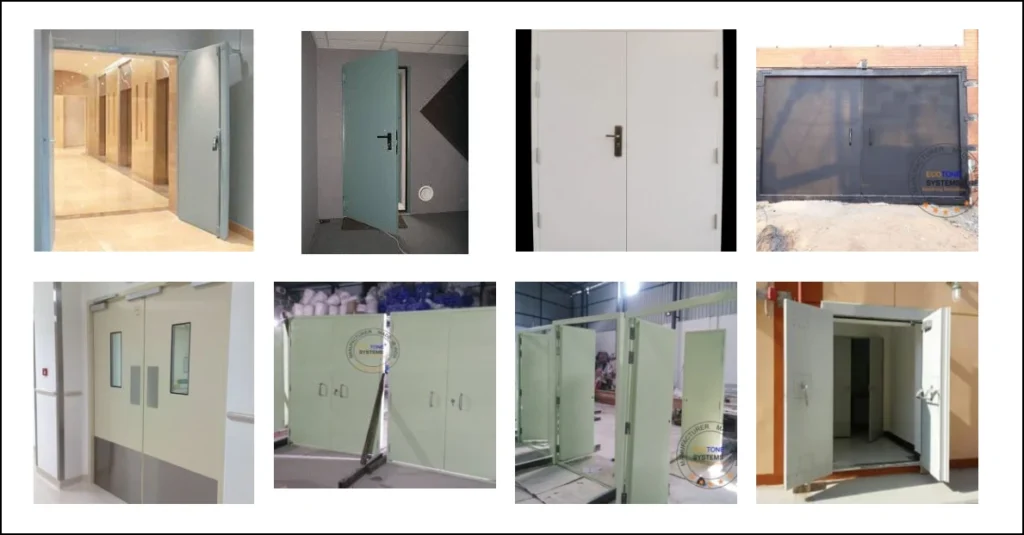
An acoustic steel door is a heavy steel shutter and frame assembly, usually 65mm to 100mm thick, filled with mineral wool or rockwool and sealed with a compressible rubber gasket, engineered to stop airborne sound from passing between two rooms. Acoustic steel doors are rated using a Sound Transmission Class, or STC, a single number derived from lab testing under ASTM E90 and classified under ASTM E413, where a higher number means less sound gets through, similar to how Wikipedia’s overview of Sound Transmission Class explains the rating scale used across the construction industry. In short, an STC 35 door will let you hear loud speech faintly through it, while an STC 45 door will reduce even loud machinery noise to a low hum.
Ecotone’s acoustic steel doors are lab tested for airborne sound transmission as per IS-9901 (Part III)-1981, DIN 52210 Part IV-1984 and ISO 140 (Part III)-1995, the same family of standards referenced internationally by ASTM E90 testing protocols used to certify STC ratings for doors, walls and partitions worldwide.
| Door Thickness | STC Rating | Typical Use Case |
|---|---|---|
| 65mm | STC 35–36 | Offices, meeting rooms, single-leaf studio doors |
| 80mm | STC 40 | Broadcast rooms, hospital OTs, control rooms |
| 100mm | STC 44–45 | DG rooms, AHU rooms, engine test beds, auditoriums |
A door’s STC number is only reliable if it comes from an accredited lab report, not a catalogue estimate. Always ask your acoustic door manufacturer for the test certificate before you finalise a PO.
| Point | Detail |
|---|---|
| 1 | Shutter thickness: 65mm to 100mm |
| 2 | STC rating: 35 to 45 (thickness dependent) |
| 3 | Sheet: 18/16 SWG CRCA or GI steel |
| 4 | Frame: MS pipe or ISMC, 3-sided |
| 5 | Seal: Neoprene/EPDM gasket, full perimeter |
| 6 | Finish: Powder coat, PU paint or spray paint |
| 7 | Variants: Fire and bullet resistant variants available on request. |
| Point | Benefit |
|---|---|
| 1 | Reduces noise transfer between rooms by up to STC 45 |
| 2 | Withstands heavy daily traffic without acoustic performance loss |
| 3 | Available fire rated for combined safety compliance |
| 4 | Custom sizes, finishes and single or double leaf options |
| 5 | Replaceable gasket design lowers long-term maintenance cost |
| 6 | Meets IS, DIN and ISO airborne sound test standards |
| 7 | Suitable for retrofit and new-build project timelines |
| Point | Application |
|---|---|
| 1 | DG rooms, AHU rooms, engine test beds |
| 2 | Recording studios and broadcast facilities |
| 3 | Auditoriums, cinemas and machine rooms |
| 4 | Hospitals, ICUs and diagnostic rooms |
| 5 | Pharma and cleanroom facilities |
| 6 | Data centres, vaults and control rooms |
| 7 | Industrial plants under factory noise norms |
| Step | Action |
|---|---|
| 1 | Site measurement and civil opening verification |
| 2 | Frame anchoring into wall with grouting |
| 3 | Alignment check with spirit level and plumb |
| 4 | Shutter hanging on heavy-duty hinges |
| 5 | Gasket and drop seal fitting |
| 6 | Hardware fitting: handle, lock, closer |
| 7 | Final acoustic seal and swing test |
| Myth | Reality |
|---|---|
| Myth Thicker door always means higher STC. | Reality Frame fit and gasket seal affect STC as much as thickness. |
| Myth Any steel door blocks industrial noise well. | Reality Only lab-tested, insulation-filled steel doors reach STC 35-45. |
| Myth Acoustic doors need no maintenance. | Reality Gaskets and drop seals need checks every 6-12 months. |
| Myth Fire rated and acoustic rated are the same thing. | Reality Both ratings are tested separately and must be specified together. |
| Myth Bullet proof doors are automatically soundproof. | Reality Ballistic and acoustic ratings are independent specifications. |
Ecotone manufactures acoustic steel doors, acoustical doors and acoustic wooden doors from its Greater Noida facility, lab tested to internationally referenced airborne sound standards, with fire rated and bullet resistant variants engineered on request. For architects and MEP consultants comparing acoustic door manufacturers, the deciding factors should always be the test certificate, the frame fabrication quality, and the gasket replacement design, not the catalogue photo.
Most DG rooms need STC 44-45 rated acoustic steel doors, since generator noise often exceeds 95 dB at source.
Steel doors handle higher traffic and reach higher STC, wooden doors suit lighter, low-noise office use.
Yes, Ecotone builds acoustic steel doors with fire ratings from 30 to 120 minutes, tested separately.
Not automatically, ballistic and acoustic performance are separate ratings and must both be specified.
Cost depends on STC rating, size, fire rating and finish, request a project-specific quote directly.
Usually no, acoustic performance depends on a matched frame, so replacement of both is recommended.
Typically 12-18 months under heavy use before compression set reduces sealing performance noticeably.
Both terms are used interchangeably, though “acoustic rated” implies a lab-tested STC number specifically.
Yes, check gaskets, drop seals and hinges every 6-12 months, especially in DG and AHU rooms.
Studios, hospitals, pharma plants, data centres, auditoriums and manufacturing facilities buy them regularly.